
Waterdrop's certifications are genuine but model-specific. NSF's own database lists its refrigerator filters under NSF/ANSI 42, 53 and 401 — lead included — and its pitchers under 42 only. The reverse osmosis systems are certified by IAPMO R&T instead, so they appear in a different database.
Quick picks
Tap any row to jump to the full write-up. The button goes straight to the retailer.
| # | Product | Best for | Price |
|---|---|---|---|
| 1 | 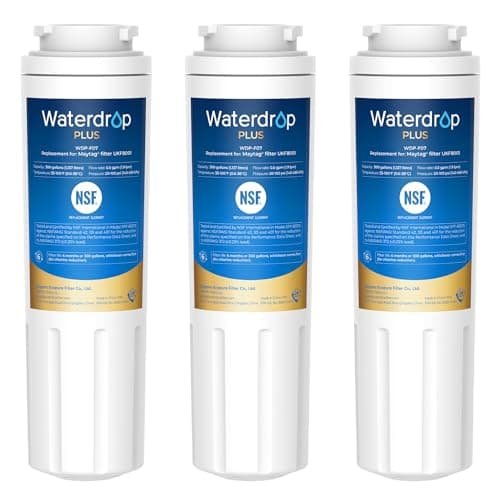 Waterdrop Plus UKF8001 Refrigerator Filter (WDP-F07)NSF/ANSI 42, 53 and 401 in NSF's own database: lead, cysts, mercury and six emerging compounds. Waterdrop Plus UKF8001 Refrigerator Filter (WDP-F07)NSF/ANSI 42, 53 and 401 in NSF's own database: lead, cysts, mercury and six emerging compounds. | The one NSF lists for lead | $27.99 - View on Amazon $36.99 — 24% off #ad Price as of October 6, 2026. We may earn a commission. Disclosure. |
| 2 | 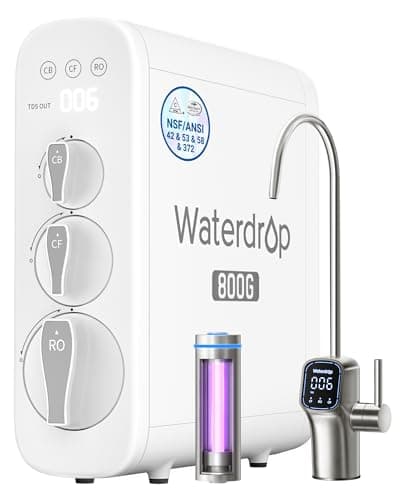 Waterdrop G3P800 Tankless Reverse Osmosis SystemCertified by IAPMO R&T to NSF/ANSI 42, 53 and 58, plus 372 for materials, with fluoride among the named claims. Waterdrop G3P800 Tankless Reverse Osmosis SystemCertified by IAPMO R&T to NSF/ANSI 42, 53 and 58, plus 372 for materials, with fluoride among the named claims. | The widest claim list | $699.00 - View on Amazon $999.00 — 30% off #ad Price as of October 6, 2026. We may earn a commission. Disclosure. |
| 3 | 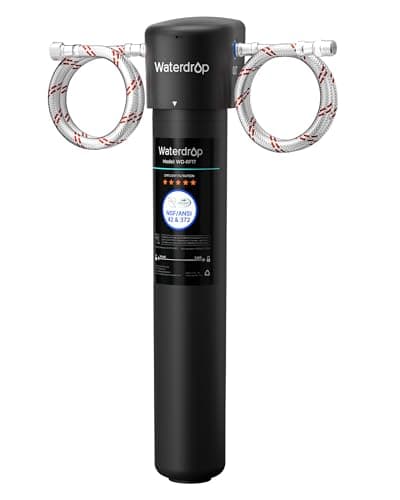 Waterdrop 17UA Direct-Connect Under-Sink Filter24,000 rated gallons into the faucet you already have — at an NSF/ANSI 42 claim level, which is taste and odor. Waterdrop 17UA Direct-Connect Under-Sink Filter24,000 rated gallons into the faucet you already have — at an NSF/ANSI 42 claim level, which is taste and odor. | If you cannot drill | Check price on Amazon #ad We do not show a price we cannot verify today. We may earn a commission. Disclosure. |
| 4 | 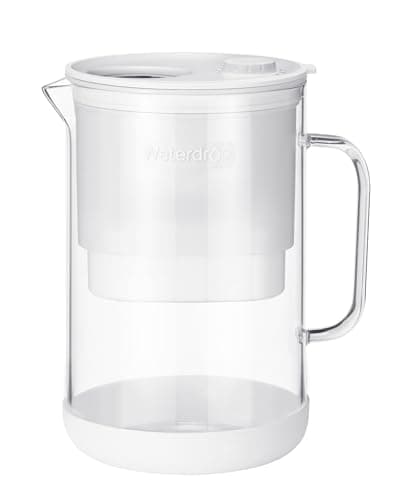 Waterdrop PT-09W 10-Cup Glass Filter PitcherCertified for chlorine, taste and odor and mercury. The PFOA/PFOS figure is third-party lab testing, not a certification. Waterdrop PT-09W 10-Cup Glass Filter PitcherCertified for chlorine, taste and odor and mercury. The PFOA/PFOS figure is third-party lab testing, not a certification. | The glass pitcher | $58.89 - View on Amazon $73.99 — 20% off #ad Price as of October 6, 2026. We may earn a commission. Disclosure. |
The certification is in the cartridge code
Waterdrop is the largest filter brand most people have never heard of: hundreds of models, most of them sold through Amazon rather than a plumbing counter, and a certification story that changes from one product line to the next. It is not a brand you can buy or dismiss as a whole. You have to read the model number.
The clearest example is a single family of refrigerator filters. Three cartridges fit the same fridge, are sold in the same listings, and differ by one letter — and NSF's own listing certifies them completely differently.
| Cartridge code | NSF/ANSI 42 | NSF/ANSI 53 | NSF/ANSI 401 |
|---|---|---|---|
| WD-F07 | Chlorine, taste and odor | Not listed | Not listed |
| WDS-F07 | Chlorine, taste and odor | Cyst, lead, benzene, carbofuran, endrin | Not listed |
| WDP-F07 (Plus) | Chlorine, taste and odor | The same five, plus mercury | Six emerging compounds |
WD- is the plain filter, WDS- the mid tier and WDP- the "Plus" line. That pattern holds across most of the refrigerator range, but not every family — in the 644845 family, for instance, both the S and the P cartridge are listed under 53 for cysts only, with no lead claim at all. So treat the prefix as a strong hint and the listing as the answer.
What NSF actually lists, by the numbers
We searched NSF's database for the trade name Waterdrop and counted what came back. The result is more interesting than either the marketing or the skeptics suggest.
| What is listed | Count | Which product line |
|---|---|---|
| Waterdrop system models listed in total | 148 | 62 refrigerator, 86 pitcher |
| Models with an NSF/ANSI 53 listing | 20 | Refrigerator filters only |
| Models with an NSF/ANSI 401 listing | 19 | Refrigerator filters only |
| Models listed under NSF/ANSI 42 alone | 128 | Pitchers and the plainer fridge filters |
| Reverse osmosis or under-sink systems | 0 | Certified by IAPMO R&T instead |
Two things follow. First, Waterdrop's refrigerator line is one of the most heavily NSF-listed ranges of compatible filters in the category — that is a real credential, and most of the cheap compatibles it sits beside on Amazon have nothing like it. Second, the health-effects claims are concentrated in exactly 20 models. If you bought a Waterdrop for lead and it is not one of those, you did not buy a lead filter.
Where the lead certification actually lives
It is in the fridge. The WDP-F07, sold as a replacement for the Maytag UKF8001 and the Whirlpool Filter 4, is listed under all three health-relevant standards, and Waterdrop publishes a reduction figure for each claim.
| Claim | Standard | Waterdrop's published reduction |
|---|---|---|
| Lead | NSF/ANSI 53 | 99.6% |
| Cysts | NSF/ANSI 53 | 99.99% |
| Benzene | NSF/ANSI 53 | 96.6% |
| Carbofuran | NSF/ANSI 53 | 98.4% |
| Endrin | NSF/ANSI 53 | 93.6% |
| Mercury | NSF/ANSI 53 | Listed by NSF, no figure published |
| Chlorine, taste and odor | NSF/ANSI 42 | 97.3% |
| Bisphenol A | NSF/ANSI 401 | 99.2% |
| Nonyl phenol | NSF/ANSI 401 | 97.2% |
| Naproxen / estrone / phenytoin / ibuprofen | NSF/ANSI 401 | 96.2% / 96.6% / 95.2% / 94.4% |
That is a broader certified list than most faucet mounts carry, on a filter that costs less than a tank of gas and sits inside an appliance you already own. The refrigerator filter roundup covers how this compares with the OEM filter, which is the other half of the decision.
The reverse osmosis systems are in a different database
Search NSF for Waterdrop and you will find no reverse osmosis system at all. That is not evidence of a missing certification — it is evidence of a second certifier. Waterdrop states that the G3P800 is certified by IAPMO R&T to NSF/ANSI 42, 53 and 58, and to NSF/ANSI 372 for lead-free materials, and IAPMO keeps its own listing directory. Both bodies are accredited; a product certified by one does not appear in the other's database.
This matters because it is the single most common way people talk themselves out of a good product, or into a bad one. "Not in the NSF database" means look in the other database, then look at the wording on the sheet. What you are checking for is a named body and a named standard — not the NSF logo, which is a trademark and not a claim. What each standard covers is the companion to this page.
The G3P800 is the widest claim set Waterdrop sells: an 800 GPD tankless system with a published 3:1 pure-to-drain ratio, cartridges rated at 550, 1,100 and 2,200 gallons, and a 58 certification that brings fluoride into range, which no carbon filter in the catalog touches. Against the iSpring RO800G it is the one with the checkable paperwork, and the full review covers the power outlet requirement that stops some installs.
NSF/ANSI 372 is not a filtration claim
Waterdrop's own certification page lists a large part of the catalog — countertop systems, several under-sink units, the K6 and the tankless RO range — with NSF/ANSI 372 against their names, sometimes as the only standard.
372 is a materials standard. It certifies that the wetted parts contain no more than a 0.25% weighted average of lead, which is the federal lead-free definition for plumbing products. It says the housing will not add lead to your water. It says nothing whatsoever about what the filter takes out. A product certified to 372 and nothing else has no certified contaminant claim at all, and that is the most misread badge in this category.
- 42 is aesthetic: chlorine, taste, odor, particulates.
- 53 is health effects: lead, cysts, VOCs, mercury, some PFAS.
- 58 is reverse osmosis, which is the route to a certified fluoride or dissolved-solids claim.
- 401 is emerging compounds: pharmaceutical residues, BPA, microplastics.
- 372 is the materials the product is made from. Nothing else.
The pitchers: 42, and only 42
Eighty-six Waterdrop pitcher models sit in NSF's database, and every one of them is listed under NSF/ANSI 42 for chlorine and taste and odor. None carries a 53 listing. The long-life cartridges — the WD-PF-01A family used by the 10-cup pitchers — are rated at 200 gallons, which is five times a Brita Standard and well clear of a Brita Elite. The compact cartridges are rated at 60.
The glass pitcher is the interesting case. Waterdrop's listing for the PT-09 says its cartridge is certified against NSF/ANSI 42 for chlorine, taste and odor, against NSF/ANSI 53 for mercury, and to 372 for materials, with copper, cadmium and PFOA/PFOS covered by third-party laboratory testing rather than by the certification. The PT-09 does not appear in NSF's database under any standard, so that 53 claim presumably sits with another body. We report both, because a mercury certification and a PFOA claim are not the same kind of evidence and the listing does not make that obvious.
If you want a pitcher, that is the whole decision. For glass, the glass pitcher roundup explains why the plastic liner matters more than the glass. For a certified lead claim, the pitcher roundup lists the three cartridges that hold one, and none of them is a Waterdrop.
How to check any of this yourself
This is the useful part, and it works for every brand on this site. NSF publishes its drinking water treatment unit listings publicly and lets you search by trade name. Search Waterdrop, or your own brand, and you get the system model, the replacement cartridge code, the rated capacity, the service flow and every certified claim. If your model is not there, check IAPMO R&T and WQA before concluding anything — three bodies certify to the same standards.
Two sentences that look identical on a box are not: certified by IAPMO R&T to NSF/ANSI 53 is a listing you can look up, and tested to NSF standards is a sentence anyone can write. The first names a body and a standard. The second names neither.
What Waterdrop does not do
Fluoride, except by reverse osmosis. No pitcher, fridge filter or direct-connect cartridge in the range claims it. That is physics rather than Waterdrop — it is the limit of the carbon tier.
Microbes. None of these systems is certified as a microbiological purifier, and a boil-water notice means boil.
Hardness. Nothing here softens water. Filters and softeners do different jobs.
The cost-per-gallon math
The three Waterdrop tiers price out very differently per gallon, and the gap is much wider than the shelf prices suggest.
A WDP-F07 fridge cartridge is rated at 300 gallons and runs about six months. The 17UA under-sink cartridge is rated at 24,000 gallons — eighty times as much water per cartridge, at a much weaker claim level. The G3P800 needs three cartridges on a 6, 12 and 24-month rotation. Work out what your household actually drinks, divide, and the answer is usually that the certified fridge filter is the cheapest certified lead claim in the range, and the RO system is the only route in the range to a certified fluoride claim.
We show the arithmetic rather than a verdict so you can redo it with the price you actually pay. Filter prices move; the rated capacities above do not.
The picks in full
The one NSF lists for lead
Waterdrop Plus UKF8001 Refrigerator Filter (WDP-F07)
Waterdrop
The compatible refrigerator filter that holds the certification people assume all of them have. NSF lists this cartridge under 42, 53 and 401 — lead, cysts, mercury and six emerging compounds — which is a broader certified list than any faucet mount on this site. The catch is that the near-identical cartridge codes beside it are not listed the same way.
Certification status
Listed by NSF under system model EFF-6007S with element WDP-F07 (also sold as WDP-UKF8001): NSF/ANSI 42 for chlorine, taste and odor; NSF/ANSI 53 for cyst, lead, benzene, carbofuran, endrin and mercury; NSF/ANSI 401 for phenytoin, ibuprofen, naproxen, estrone, bisphenol A and nonylphenol. Rated at 300 gallons and 0.5 gpm. The plain WD-F07 cartridge in the same family is listed under NSF/ANSI 42 only, and the WDS-F07 drops mercury and the 401 claims.
Published specifications
| Replaces | Maytag UKF8001, Whirlpool Filter 4, EDR4RXD1, 4396395, PUR Puriclean II, Kenmore 46-9005 / 46-9006 |
|---|---|
| Rated life | 300 gallons / about 6 months |
| Certified standards | NSF/ANSI 42, 53 and 401 (NSF listing) |
| Lead | 99.6% reduction |
| Cysts | 99.99% |
| Chlorine, taste and odor | 97.3% |
| Bisphenol A / nonyl phenol | 99.2% / 97.2% |
| Pharmaceutical residues | Naproxen 96.2%, estrone 96.6%, phenytoin 95.2%, ibuprofen 94.4% |
| Service flow | 0.5 gpm |
What we like
- A checkable NSF listing that names lead, cysts and mercury — most compatibles carry an NSF/ANSI 42 taste claim or nothing
- The NSF/ANSI 401 listing adds six emerging compounds, which even some OEM filters do not carry
- Sold in multipacks, so the cost per certified gallon is among the lowest on this site
What we do not
- Only the WDP (Plus) code carries this listing — the WD and WDS versions of the same filter are certified for less, and the listings look nearly identical
- 300 gallons is a shorter rated life than an under-sink cartridge by a wide margin
- A compatible, not an OEM part, so fit tolerances and appliance warranties are your call to make
- Refrigerator filters are the most counterfeited product in home water filtration — buy from a seller you can identify
Skip it if
Fluoride, arsenic or PFAS, none of which appears in the listing, and anyone whose fridge takes a different filter — these are model-specific parts and the compatibility list is the first thing to check.
$36.99 — 24% off
#ad Price as of October 6, 2026. We may earn a commission. Disclosure.
The widest claim list
Waterdrop G3P800 Tankless Reverse Osmosis System
Waterdrop
Tankless reverse osmosis that gives back the cupboard a pressure tank would eat, fills a glass without the pause, and sends markedly less water down the drain than a classic tank system.
Certification status
Certified to NSF/ANSI 42 for chlorine reduction, NSF/ANSI 53 and 58 for TDS, fluoride, cadmium, hexavalent chromium and selenium, and NSF/ANSI 372 for lead-free materials.
Published specifications
| Output | 800 GPD |
|---|---|
| Pure-to-drain ratio | 3:1 |
| Format | Tankless — no pressure tank |
| Certified standards | NSF/ANSI 42, 53, 58, 372 |
| Installation | Two holes: smart LED faucet and drain |
| Faucet | Included, with TDS display |
What we like
- No pressure tank, so it fits cabinets a tank system cannot
- 3:1 pure-to-drain is far better than the ratio typical of older reverse osmosis
- 800 GPD means no waiting for a tank to refill
What we do not
- Needs a power outlet under the sink — a real constraint in older kitchens
- Proprietary filter cartridges, so you are tied to Waterdrop's pricing
- Requires drilling for the included faucet unless you have a spare hole
Skip it if
Renters, and anyone with no outlet under the sink. It is a permanent, powered installation — a countertop unit is the answer if you cannot commit to that.
$999.00 — 30% off
#ad Price as of October 6, 2026. We may earn a commission. Disclosure.
Where these specifications came from
If you cannot drill
Waterdrop 17UA Direct-Connect Under-Sink Filter
Waterdrop
The answer to the most common under-sink objection: it plumbs into the cold line feeding the faucet you already have, so there is no extra tap, no drilled counter and nothing visible.
Certification status
The 17 series is certified against NSF/ANSI 42 for chlorine reduction and NSF/ANSI 372 for lead-free materials. Verify the listing for the specific variant before buying — the 17UB (dedicated faucet) and 17UA (direct connect) are listed separately.
Published specifications
| Rated capacity | 24,000 gallons / about 3 years |
|---|---|
| Format | Direct connect to the existing cold line — no separate faucet |
| Certified standards | NSF/ANSI 42, 372 |
| Connection | Quick-connect fittings, no threading |
What we like
- No counter drilling and no second tap — the single biggest objection to under-sink filtration, removed
- 24,000-gallon rated capacity means a filter change roughly every three years
- Quick-connect install is a genuinely realistic first-time DIY job
What we do not
- NSF/ANSI 42 is an aesthetic standard — chlorine, taste and odor, not a health claim
- Filters everything the tap delivers, including draws for cooking, which shortens life
- Not a lead or PFAS answer at this certification level
Skip it if
Anyone with a health-driven contaminant worry. NSF/ANSI 42 covers taste and odor. If lead or PFAS is the reason you are shopping, this is the wrong tier of certification.
#ad We do not show a price we cannot verify today. We may earn a commission. Disclosure.
Where these specifications came from
The glass pitcher
Waterdrop PT-09W 10-Cup Glass Filter Pitcher
Waterdrop
The one mainstream glass pitcher whose cartridge is listed against NSF standards. Read the body description carefully though: the pitcher is glass with a plastic inner liner, which is not the same as plastic-free.
Certification status
Waterdrop lists the PT-09 cartridge as certified against NSF/ANSI 42 for chlorine, taste and odor, against NSF/ANSI 53 for mercury, and to NSF/ANSI 372 for lead-free materials. Copper, cadmium and PFOA/PFOS are covered by third-party laboratory testing rather than by that certification, which is a different kind of evidence. The PT-09 does not appear in NSF's own listing database under any standard, so the certification presumably sits with another body. Waterdrop states the rated life is 100 gallons, and it publishes no per-contaminant reduction table the way Brita and PUR do.
Published specifications
| Capacity | 10 cups |
|---|---|
| Body | Glass, with a plastic inner liner |
| Rated filter life | 100 gallons / about 2 months |
| Flow | About 8.5 oz per minute |
| Standards claimed | NSF/ANSI 42 (chlorine, taste, odor), 53 (mercury), 372 (materials) |
| Certified claims | Chlorine, taste and odor, mercury |
| Lab-tested claims | Copper, cadmium, PFOA/PFOS |
| Filtration | 5-stage: carbon fiber, ion exchange resin, carbon block |
What we like
- A PFOA/PFOS reduction claim from third-party laboratory testing, which almost no glass pitcher carries at all
- Glass body does not hold odors or stain the way a scratched plastic reservoir does
- Dishwasher-friendly body, which is the practical reason people want glass
What we do not
- The plastic inner liner means water still contacts plastic — buy it for cleaning and odor, not for a plastic-free claim
- 100 rated gallons is short, and about two months for most households
- No published per-contaminant reduction table to check the claims against, and the 53 certification covers mercury rather than lead
- Glass is heavy when full, and it breaks
Skip it if
Anyone buying glass specifically to keep water away from every plastic surface. This pitcher does not do that, and no pitcher we could verify does it completely.
$73.99 — 20% off
#ad Price as of October 6, 2026. We may earn a commission. Disclosure.
Questions people actually ask
Is Waterdrop NSF certified?
Some models are. Searching NSF's public database for the trade name Waterdrop returns 148 system models: 62 refrigerator filters and 86 pitchers. Of those, 20 carry an NSF/ANSI 53 health-effects listing and 19 carry NSF/ANSI 401 — all of them refrigerator filters. The reverse osmosis systems are certified by IAPMO R&T instead, so they do not appear in NSF's database at all.
Which Waterdrop filter removes lead?
The refrigerator filters in the WDP and WDS lines, and the reverse osmosis systems. The WDP-F07, sold as a UKF8001 replacement, is listed by NSF under NSF/ANSI 53 for lead, cysts, benzene, carbofuran, endrin and mercury, with a published 99.6% lead reduction. No Waterdrop pitcher carries a lead certification.
Are Waterdrop filters good?
The certified ones are good value, and the range is more heavily certified than most Amazon filter brands. The problem is that Waterdrop sells hundreds of models at every certification level, from a full NSF/ANSI 42, 53 and 401 listing down to a 372 materials certification that covers no contaminant at all. The brand name tells you nothing; the cartridge code tells you everything.
What does NSF/ANSI 372 mean on a Waterdrop filter?
It means the materials the product is made from contain no more than a 0.25% weighted average of lead — the federal lead-free definition for plumbing. It is a statement about the housing, not about filtration. A product certified only to 372 has no certified contaminant reduction claim.
Is Waterdrop better than Brita?
For a pitcher, no. Every Waterdrop pitcher cartridge NSF lists is certified to NSF/ANSI 42 only, while the Brita Elite is certified to 42, 53 and 401 and covers lead. Waterdrop's advantage is cartridge life — 200 rated gallons against the Elite's 120 — and range: it sells certified fridge filters and reverse osmosis systems, which Brita does not.
Is Waterdrop or iSpring better for reverse osmosis?
Waterdrop for evidence, iSpring for price. The G3P800 is certified by IAPMO R&T to NSF/ANSI 42, 53 and 58 with a published 3:1 pure-to-drain ratio. The head-to-head comparison on this site runs both systems through the same criteria.