A filter removes contaminants by adsorption or exclusion; a softener removes hardness by ion exchange. They share no mechanism and neither substitutes for the other, which is why hard chlorinated supply usually calls for both.
Quick picks
Tap any row to jump to the full write-up. The button goes straight to the retailer.
| # | Product | Best for | Price |
|---|---|---|---|
| 1 | Wno photoWhirlpool WHES40E 40,000-Grain Water Softener40,000 grains, demand regeneration, NSF certified. This is what removes scale. | The softener | Check price on Amazon #ad We do not show a price we cannot verify today. We may earn a commission. Disclosure. |
| 2 | 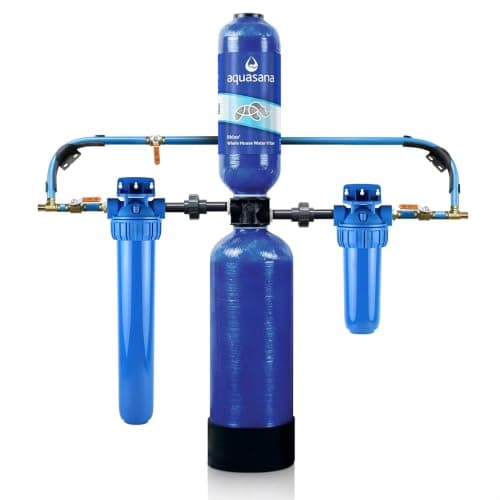 Aquasana Rhino EQ-1000 Whole-House FilterNSF/ANSI 42 certified chlorine reduction. This is what removes the pool taste. Aquasana Rhino EQ-1000 Whole-House FilterNSF/ANSI 42 certified chlorine reduction. This is what removes the pool taste. | The filter | $1,123.00 - View on Amazon #ad Price as of October 17, 2026. We may earn a commission. Disclosure. |
| 3 | 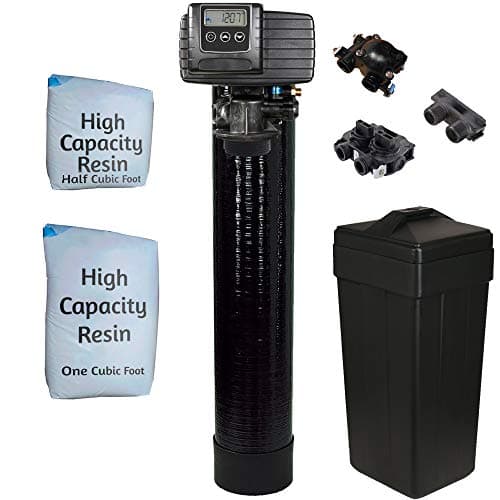 AFWFilters Fleck 5600SXT 48,000-Grain Metered Softener48,000 grains at 12 gpm on the industry-standard Fleck valve. AFWFilters Fleck 5600SXT 48,000-Grain Metered Softener48,000 grains at 12 gpm on the industry-standard Fleck valve. | The softener, larger homes | $793.00 - View on Amazon #ad Price as of October 17, 2026. We may earn a commission. Disclosure. |
The mechanisms, because everything follows from them
| Water filter | Water softener | |
|---|---|---|
| How it works | Adsorption onto carbon, or exclusion by a membrane | Ion exchange on a resin bed |
| Removes chlorine | Yes | No |
| Removes lead | Yes, if certified to NSF/ANSI 53 | No |
| Removes hardness | No | Yes |
| Stops limescale | No | Yes |
| Improves taste | Yes | Marginally |
| Consumables | Media or cartridges | Salt, continuously |
| Needs a drain | No | Yes |
| Needs power | No | Yes |
| Adds anything to the water | No | Sodium, in proportion to hardness removed |
Carbon does not adsorb calcium and magnesium ions — they are small, charged and inorganic, and carbon holds organic molecules. A sediment filter does not catch dissolved ions either. So there is no version of a filter that softens water, at any price.
Equally, ion exchange targets hardness ions specifically. A softener does not remove chlorine, taste, odor, lead or PFAS, and softened water still tastes exactly like the disinfectant your utility added.
Which symptom points where
| What you notice | Filter | Softener |
|---|---|---|
| Pool or bleach taste | Yes | No |
| White crust on the kettle | No | Yes |
| Spotted glassware | No | Yes |
| Soap will not lather | No | Yes |
| Lead concern | Yes, certified | No |
| Rotten-egg smell | Oxidation, a specific kind of filter | No |
| Orange staining | Oxidation and filtration | Limited, at low levels only |
| Dry skin after showering | Sometimes — chlorine removal helps | Often |
The salt-free confusion
"Salt-free water softener" is a category name that describes something which is not a softener. Template-assisted crystallization and similar systems change hardness into a crystal form less likely to stick to surfaces. They do not remove it.
So after installing one: your hardness test reads the same, your soap still will not lather, your glassware still spots — and your water heater and pipes are genuinely better protected from scale adhesion. That is a real benefit, honestly stated. It is just not softening, and buying one expecting soft water ends in disappointment.
When you need both
Hard, chlorinated municipal supply — which describes a large share of the country — has both problems and neither machine addresses the other. The standard arrangement is filter first, softener second, for two reasons: chlorine degrades softener resin, and sediment fouls it.
The combined-system guide covers sizing, order and the physical requirements.
The sodium question
Softening adds sodium in proportion to the hardness removed, which for typical supplies is a small amount — considerably less than most people expect and far less than a normal diet. If you are on a sodium-restricted diet, potassium chloride can be substituted at a higher running cost.
A common arrangement is to leave the kitchen cold tap unsoftened, so drinking and cooking water bypasses the softener entirely while everything else benefits.
The cost-per-gallon math
The two machines have completely different cost shapes.
A tank filter is a purchase plus a decade of essentially nothing. A softener is a purchase plus salt, forever, in proportion to your hardness and household size, plus the water used in regeneration.
The softener case is usually built on your water heater: scale insulates the element, so the heater consumes more energy each year and fails earlier. Set your local salt cost against the fraction of a heater replacement you are deferring. At 15 grains per gallon that maths generally favors softening; at 5 it does not.
We show the arithmetic rather than a verdict so you can redo it with the price you actually pay. Filter prices move; the rated capacities above do not.
The picks in full
The softener
Whirlpool WHES40E 40,000-Grain Water Softener
Whirlpool
A demand-regenerating softener sized for most houses, sold in a single carton with a manual anyone can follow. It is a softener, not a filter, and that is exactly the point — nothing else on this site touches hardness.
Certification status
NSF certified. Softening capacity and iron tolerance are published by the manufacturer.
Published specifications
| Capacity | 40,000 grains |
|---|---|
| Hardness handled | Up to 125 grains per gallon |
| Clear-water iron tolerance | Up to 10 ppm |
| Service flow | 8.5 gpm |
| Dimensions | 19" D x 18" W x 47 7/8" H |
| Regeneration | Demand — regenerates on usage, not a timer |
| Power | 110/120 V AC, transformer included |
| Warranty | 10 years on salt and resin tanks; 3 years on the control board |
What we like
- Demand regeneration uses noticeably less salt and water than a timer-based unit
- One carton, one manual, no dealer visit required
- Handles up to 10 ppm clear-water iron, which many softeners in this class do not
What we do not
- Softening only — it does nothing for chlorine, lead or PFAS
- Adds sodium to the softened water, which matters on a sodium-restricted diet
- Needs a drain and a power outlet at the install point
Skip it if
Anyone whose problem is taste, odor or a health contaminant. A softener swaps calcium and magnesium for sodium; it is not a purifier and it is not marketed as one.
#ad We do not show a price we cannot verify today. We may earn a commission. Disclosure.
Where these specifications came from
The filter
Aquasana Rhino EQ-1000 Whole-House Filter
Aquasana
A million-gallon point-of-entry filter for chlorinated municipal supply. It fixes the shower and the laundry as well as the kitchen tap, and it does not pretend to be a health-contaminant system.
Certification status
Certified by NSF International to NSF/ANSI 42, with the tank certified to NSF/ANSI 61 for material safety. NSF/ANSI 42 is an aesthetic-effects standard — taste, odor and chlorine — not a health-effects claim.
Published specifications
| Rated capacity | 1,000,000 gallons / up to 10 years |
|---|---|
| Rated flow | 7.0 gpm |
| Max operating pressure | 100 psi |
| Operating temperature | 40-90 degrees F |
| Dimensions | 46" L x 9" W x 44" H, 44.1 lb |
| Certified standards | NSF/ANSI 42; tank to NSF/ANSI 61 |
| Published chlorine reduction | Greater than 97% |
What we like
- Ten years or a million gallons before the main media is due — effectively no maintenance routine
- Treats every tap, so showers and laundry benefit, not just drinking water
- NSF/ANSI 61 material certification on the tank
What we do not
- NSF/ANSI 42 only — this is a chlorine and aesthetics system, not a lead or PFAS system
- Needs a main-line install, usually a plumber, and space where the water enters
- Does nothing for hardness
Skip it if
Anyone buying it to solve lead, PFAS or hard water. It is certified for aesthetic effects. Pair it with an under-sink system for drinking-water health contaminants, and a softener for hardness.
#ad Price as of October 17, 2026. We may earn a commission. Disclosure.
Where these specifications came from
The softener, larger homes
AFWFilters Fleck 5600SXT 48,000-Grain Metered Softener
AFWFilters
The Fleck 5600SXT is the valve independent water-treatment dealers have used for decades, which means parts, manuals and people who know it are everywhere. Assembled rather than boxed as an appliance.
Certification status
Manufacturer-published capacity and flow figures. The valve is an industry-standard component with widely available service parts.
Published specifications
| Capacity | 48,000 grains |
|---|---|
| Resin | 1.5 cubic feet, 8% cross-linked |
| Resin tank | 10" x 54" |
| Brine tank | 14" |
| Service flow | Up to 12 gpm |
| Control | Fleck 5600SXT digital metered valve |
| Connection | 1" male threaded yoke, bypass valve included |
| Warranty | 5 years on the valve, 10 years on the tank |
What we like
- Fleck valves are the industry standard, so service parts and expertise are genuinely available
- Higher capacity and flow than most consumer-boxed softeners
- Metered regeneration rather than a clock
What we do not
- Ships as components — you assemble and load the resin yourself
- Larger physical footprint than an appliance-style unit
- No help at all with anything other than hardness
Skip it if
Anyone who wants an appliance experience. If loading a resin tank and programming a valve sounds like a bad Saturday, buy a boxed softener or hire a dealer.
#ad Price as of October 17, 2026. We may earn a commission. Disclosure.
Where these specifications came from
Questions people actually ask
Do I need a water softener if I have a whole-house filter?
If your water is hard, yes. A filter does not remove hardness, so scale will keep forming in your water heater and appliances exactly as before. The two machines are commonly installed together for that reason.
Will a water softener make my water taste better?
Only marginally. Softening changes the mineral profile, which some people notice, but it does not remove chlorine, taste or odor compounds. If your water tastes like a pool, the softener is not the machine that fixes it.
Is softened water safe to drink?
Yes. It contains added sodium in proportion to the hardness removed, which for typical supplies is small compared with dietary intake. On a sodium-restricted diet, potassium chloride is an alternative, or leave the kitchen cold tap unsoftened.
Are salt-free softeners real?
They are real products that do something real — they reduce scale adhesion — but they are not softeners. Hardness is still present after treatment, so your hardness test reads the same and your soap still will not lather. Buy one for pipe protection, never for soft water.