
For pitchers, Brita wins on certification: the Elite is certified to NSF/ANSI 42, 53 and 401 and covers lead, while every Waterdrop pitcher cartridge in NSF's database is listed under 42 alone. Waterdrop wins on cartridge life, 200 rated gallons against 120, and on range — it sells certified reverse osmosis and fridge filters that Brita does not.
Quick picks
Tap any row to jump to the full write-up. The button goes straight to the retailer.
| # | Product | Best for | Price |
|---|---|---|---|
| 1 | 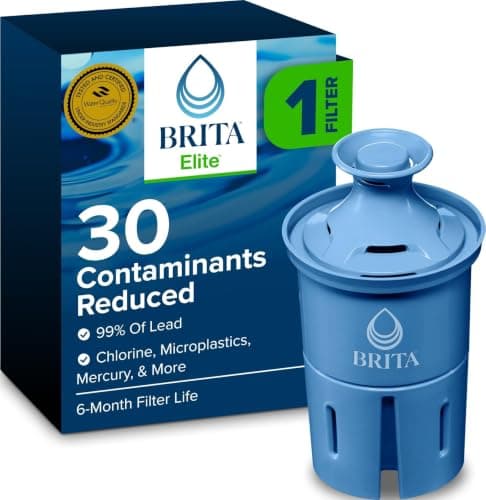 Brita Elite Filter (with any Brita pitcher)Certified to NSF/ANSI 42, 53 and 401 at 120 rated gallons. No Waterdrop pitcher matches the claim list. Brita Elite Filter (with any Brita pitcher)Certified to NSF/ANSI 42, 53 and 401 at 120 rated gallons. No Waterdrop pitcher matches the claim list. | If lead matters | $19.88 - View on Amazon #ad Price as of October 7, 2026. We may earn a commission. Disclosure. |
| 2 | 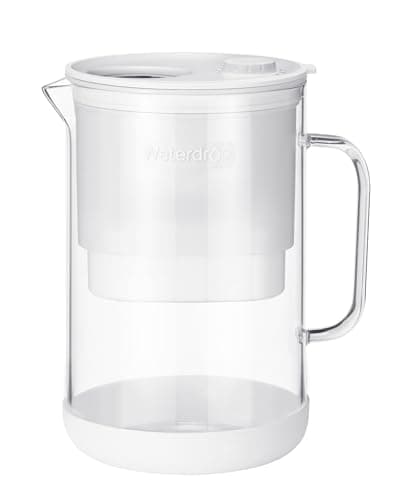 Waterdrop PT-09W 10-Cup Glass Filter PitcherGlass body, 5-stage cartridge, and a certification that covers chlorine, taste, odor and mercury. Waterdrop PT-09W 10-Cup Glass Filter PitcherGlass body, 5-stage cartridge, and a certification that covers chlorine, taste, odor and mercury. | If taste and glass matter | $58.89 - View on Amazon $73.99 — 20% off #ad Price as of October 7, 2026. We may earn a commission. Disclosure. |
| 3 | 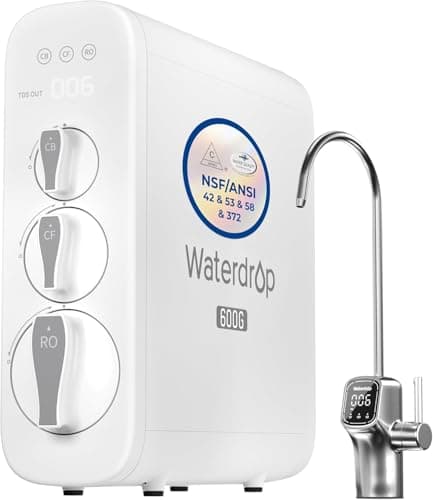 Waterdrop G3P600 Tankless Reverse Osmosis SystemBrita sells nothing like it: certified tankless reverse osmosis under the sink. Waterdrop G3P600 Tankless Reverse Osmosis SystemBrita sells nothing like it: certified tankless reverse osmosis under the sink. | Where Waterdrop wins outright | $399.00 - View on Amazon $539.00 — 26% off #ad Price as of October 7, 2026. We may earn a commission. Disclosure. |
The comparison in one table
Most people searching this are comparing pitchers, so start there. Both brands sell more than pitchers, and the rest of the range changes the answer — but the pitcher question has a clean answer and it is not the one the marketing suggests.
| Brita Elite | Waterdrop pitcher cartridges | |
|---|---|---|
| Certified standards | NSF/ANSI 42, 53, 401 | NSF/ANSI 42 (every pitcher model in NSF's listing) |
| Lead | Certified | No certified claim |
| Microplastics | Certified, 99.6% at 0.5-1 micron | No certified claim |
| Chlorine, taste and odor | Certified | Certified |
| Rated cartridge life | 120 gallons | 200 gallons on the long-life cartridge, 60 on the compact |
| Glass body option | No | Yes |
| Under-sink and RO range | None | Certified tankless RO, direct-connect filters |
| Certified fridge filters | No | Yes, NSF-listed under 42, 53 and 401 |
Where Brita wins: the certification
The Brita Elite is certified to three standards, and the one that matters is 53 — the health-effects standard that covers lead. If you are filtering because of old plumbing, a service line of unknown age, or a number on your water report, that certification is the entire reason to buy a pitcher at all.
Every Waterdrop pitcher model in NSF's public database — 86 of them — is listed under NSF/ANSI 42 for chlorine, taste and odor. Not one carries a 53 listing. The Waterdrop brand page has the counts and the search you can repeat yourself. Waterdrop's glass pitcher goes a little further: its listing claims a 53 certification for mercury, with copper, cadmium and PFOA/PFOS covered by third-party laboratory testing rather than by the certification.
That is a real difference in evidence, and it is the whole argument for Brita in the pitcher tier. Brita, filter by filter covers the trap on the other side — the white Standard cartridge fits the same pitcher and carries no lead claim.
Where Waterdrop wins: filter life and range
Waterdrop's long-life pitcher cartridge is rated at 200 gallonsagainst the Elite's 120. On the same consumption that is roughly four cartridges a year instead of six, and it is the strongest practical argument the brand has in this tier — a filter you change less often is a filter you are less likely to run past its rating.
Outside the pitcher aisle it stops being a contest. Brita sells pitchers, dispensers and a faucet mount. Waterdrop sells certified tankless reverse osmosis, direct-connect under-sink filters, whole-house cartridges and one of the most heavily NSF-listed ranges of refrigerator filters in the category. If your answer is a system rather than a jug, Brita does not make one.
The tier question underneath this
Comparing two pitchers assumes a pitcher is the right tier. It often is not.
- Chlorine taste only? Either brand, whichever is cheaper on the day. This is the easiest problem in home water filtration.
- Lead? Brita Elite, or a certified system. The lead roundup lists every certified option by tier.
- PFAS? Neither pitcher. The certified pitcher route is ZeroWater, and the stronger route is reverse osmosis — which the research backs.
- A household of four? A pitcher of either brand becomes a chore. A dispenser or an under-sink system is the honest upgrade, and the dispenser roundup runs the fills per filter.
Availability, price and the thing nobody admits
Brita is in every supermarket in America; Waterdrop is mostly online. That matters more than enthusiasts allow, because the cheapest filter is the one you actually replace on schedule. A cartridge you have to remember to order is a cartridge that runs two weeks past its rating at least twice a year.
Price moves constantly on both brands and we do not quote numbers in prose for that reason — the live figures beside each pick above are the ones to compare, along with the rated gallons, because cost per gallon is the only honest comparison in this category.
The cost-per-gallon math
A household drinking two gallons a day uses about 730 gallons a year.
At 120 rated gallons the Brita Elite needs about six cartridges a year. At 200, the Waterdrop long-life cartridge needs about four. Multiply each by the price on the day and Waterdrop usually wins on running cost — then ask whether you are buying for taste or for lead, because on lead the cheaper cartridge does not carry the claim at all.
We show the arithmetic rather than a verdict so you can redo it with the price you actually pay. Filter prices move; the rated capacities above do not.
The picks in full
If lead matters
Brita Elite Filter (with any Brita pitcher)
Brita
The cheapest route to an NSF/ANSI 53 lead certification. It drops into a pitcher most households already have, and it is emphatically not the same filter as the white Brita Standard.
Certification status
Certified to NSF/ANSI 42, 53 and 401. The lead certification belongs to the Elite (blue) filter only — the Standard (white) filter is certified to NSF/ANSI 42 for taste and odor and is not certified for lead. Per Brita's January 2026 performance data sheet the Elite is not certified for PFOA or PFOS, and no Brita pitcher filter is certified for fluoride.
Published specifications
| Rated filter life | 120 gallons / about 6 months |
|---|---|
| Standard filter life, for comparison | 40 gallons / about 2 months |
| Certified standards | NSF/ANSI 42, 53, 401 |
| Lead | Certified under NSF/ANSI 53 |
| PFOA / PFOS | Not certified (January 2026 performance data sheet) |
| Fluoride | Not certified, not claimed |
What we like
- Genuine NSF/ANSI 53 lead certification at the lowest entry price of anything on this site
- Fits Brita pitchers and dispensers already in millions of kitchens — no new hardware
- Three times the rated life of the Standard filter, which changes the cost-per-gallon math
What we do not
- Not certified for PFOA or PFOS, so it is the wrong answer to a PFAS worry
- No fluoride claim at all
- Slow gravity flow, like every pitcher
Skip it if
Anyone whose actual worry is PFAS or fluoride. The Elite is not certified for either, and buying it for those is buying the wrong thing.
#ad Price as of October 7, 2026. We may earn a commission. Disclosure.
Where these specifications came from
If taste and glass matter
Waterdrop PT-09W 10-Cup Glass Filter Pitcher
Waterdrop
The one mainstream glass pitcher whose cartridge is listed against NSF standards. Read the body description carefully though: the pitcher is glass with a plastic inner liner, which is not the same as plastic-free.
Certification status
Waterdrop lists the PT-09 cartridge as certified against NSF/ANSI 42 for chlorine, taste and odor, against NSF/ANSI 53 for mercury, and to NSF/ANSI 372 for lead-free materials. Copper, cadmium and PFOA/PFOS are covered by third-party laboratory testing rather than by that certification, which is a different kind of evidence. The PT-09 does not appear in NSF's own listing database under any standard, so the certification presumably sits with another body. Waterdrop states the rated life is 100 gallons, and it publishes no per-contaminant reduction table the way Brita and PUR do.
Published specifications
| Capacity | 10 cups |
|---|---|
| Body | Glass, with a plastic inner liner |
| Rated filter life | 100 gallons / about 2 months |
| Flow | About 8.5 oz per minute |
| Standards claimed | NSF/ANSI 42 (chlorine, taste, odor), 53 (mercury), 372 (materials) |
| Certified claims | Chlorine, taste and odor, mercury |
| Lab-tested claims | Copper, cadmium, PFOA/PFOS |
| Filtration | 5-stage: carbon fiber, ion exchange resin, carbon block |
What we like
- A PFOA/PFOS reduction claim from third-party laboratory testing, which almost no glass pitcher carries at all
- Glass body does not hold odors or stain the way a scratched plastic reservoir does
- Dishwasher-friendly body, which is the practical reason people want glass
What we do not
- The plastic inner liner means water still contacts plastic — buy it for cleaning and odor, not for a plastic-free claim
- 100 rated gallons is short, and about two months for most households
- No published per-contaminant reduction table to check the claims against, and the 53 certification covers mercury rather than lead
- Glass is heavy when full, and it breaks
Skip it if
Anyone buying glass specifically to keep water away from every plastic surface. This pitcher does not do that, and no pitcher we could verify does it completely.
$73.99 — 20% off
#ad Price as of October 7, 2026. We may earn a commission. Disclosure.
Where Waterdrop wins outright
Waterdrop G3P600 Tankless Reverse Osmosis System
Waterdrop
The G3P800's smaller sibling: same slim tankless body, same cartridge rotation, 600 gallons a day instead of 800. The specification that actually changes is the one people skim — it sends two gallons to the drain for every three it makes, where the 800 sends one.
Certification status
Waterdrop's certification page lists the G3P600 under NSF/ANSI 58 for reverse osmosis performance and NSF/ANSI 372 for lead-free materials, and lists 42 and 53 for the G3 series; the retail listing claims 42, 53, 58 and 372. Note that fluoride, arsenic and hexavalent chromium claims are optional within NSF/ANSI 58, so a 58 certification alone does not mean a system was tested for any of them.
Published specifications
| Rated production | 600 GPD, 0.42 gpm |
|---|---|
| Pure-to-drain ratio | 2:1 |
| Format | Tankless — no pressure tank |
| Stages | 8, with a 0.0001 micron membrane |
| Sediment and carbon filter | 550 gallons / about 6 months |
| Carbon block filter | 1,100 gallons / about 12 months |
| RO membrane | 2,200 gallons / about 24 months |
| Dimensions | 18.11" x 5.67" x 17.73", 15.44 lb |
| Installation | Power outlet, a 1-inch faucet hole and a drain connection |
What we like
- Tankless, so it gives back the cupboard space a pressure tank occupies
- Long cartridge intervals: 6, 12 and 24 months across the three filters
- Fast enough that it feels like a tap rather than a tank refilling
What we do not
- 2:1 pure-to-drain against the G3P800's 3:1 — it wastes half again as much water
- Needs a power outlet under the sink, which is the most common reason this install stalls
- Proprietary cartridges, so Waterdrop sets the replacement price for the life of the system
- Waterdrop states it is not recommended for well water
- No remineralizing stage, so the water arrives with almost no mineral content
Skip it if
Wells, cabinets with no outlet, and anyone who cares more about wastewater than about the purchase price — the G3P800 is the same machine with a better drain ratio.
$539.00 — 26% off
#ad Price as of October 7, 2026. We may earn a commission. Disclosure.
Questions people actually ask
Is Waterdrop better than Brita?
It depends on what you are filtering for. Brita's Elite cartridge is certified to NSF/ANSI 42, 53 and 401 and covers lead; every Waterdrop pitcher cartridge in NSF's database is listed under 42 alone, for chlorine, taste and odor. Waterdrop's cartridges last longer — 200 rated gallons against 120 — and its range extends to certified reverse osmosis, which Brita does not sell.
Do Waterdrop pitchers remove lead?
No Waterdrop pitcher cartridge in NSF's certified listings carries a lead claim. The brand's lead certifications are in its refrigerator filters and its reverse osmosis systems. If lead is your reason for buying a pitcher, the Brita Elite is the certified option in that tier.
Which lasts longer, a Waterdrop or Brita filter?
Waterdrop, by a wide margin in the pitcher tier: its long-life cartridge is rated at 200 gallons against the Brita Elite's 120. On the compact Waterdrop pitchers the cartridge is rated at 60 gallons, so check which cartridge the pitcher you are looking at actually takes.
Is Waterdrop a good brand?
Its certified products are good value, and its refrigerator range is more heavily NSF-listed than most. The difficulty is that it sells hundreds of models at every certification level, from full 42, 53 and 401 listings down to a materials-only certification. The model number tells you what you are buying; the brand name does not.
Which is cheaper to run?
Usually Waterdrop in the pitcher tier, because the long-life cartridge is rated for two thirds more water than the Brita Elite. Compare on cost per rated gallon rather than on the price of the box, and remember that a cheaper cartridge with a narrower certification is not the same product.