Four questions decide which tier of water treatment you need: what is actually wrong, where in the house you notice it, whether you can modify the plumbing, and how much water you treat. Answer those in order and the shortlist is usually one product.
Quick picks
Tap any row to jump to the full write-up. The button goes straight to the retailer.
| # | Product | Best for | Price |
|---|---|---|---|
| 1 | 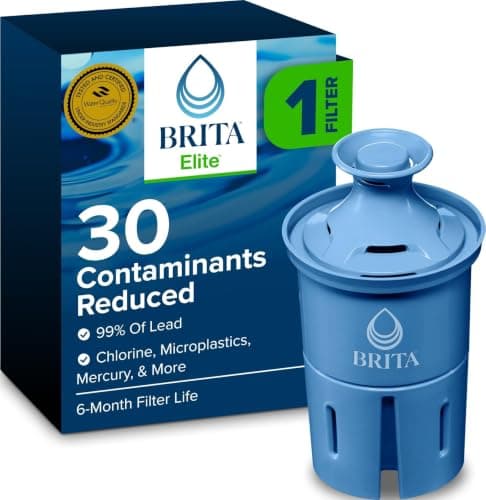 Brita Elite Filter (with any Brita pitcher)Certified for lead, 120 rated gallons, works in a pitcher you may already own. Brita Elite Filter (with any Brita pitcher)Certified for lead, 120 rated gallons, works in a pitcher you may already own. | Tier 1 — no plumbing | $19.88 - View on Amazon #ad Price as of October 17, 2026. We may earn a commission. Disclosure. |
| 2 | 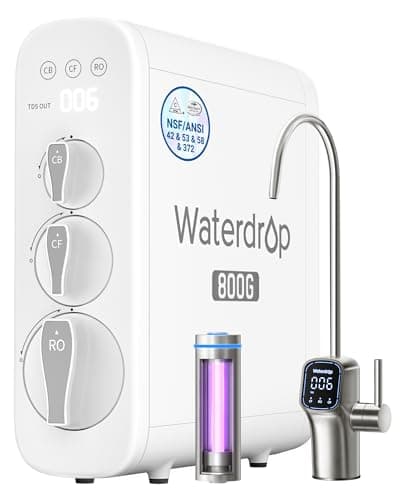 Waterdrop G3P800 Tankless Reverse Osmosis SystemTankless reverse osmosis certified to NSF/ANSI 42, 53, 58 and 372. Waterdrop G3P800 Tankless Reverse Osmosis SystemTankless reverse osmosis certified to NSF/ANSI 42, 53, 58 and 372. | Tier 2 — one tap | $759.00 - View on Amazon $999.00 — 24% off #ad Price as of October 17, 2026. We may earn a commission. Disclosure. |
| 3 | 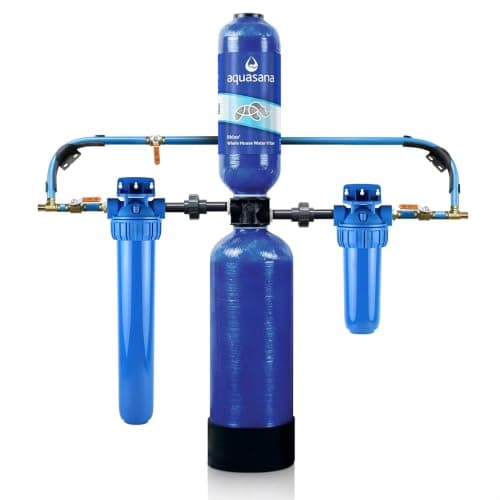 Aquasana Rhino EQ-1000 Whole-House FilterNSF/ANSI 42 certified point of entry, a million gallons of chlorine reduction. Aquasana Rhino EQ-1000 Whole-House FilterNSF/ANSI 42 certified point of entry, a million gallons of chlorine reduction. | Tier 3 — every tap | $1,123.00 - View on Amazon #ad Price as of October 17, 2026. We may earn a commission. Disclosure. |
| 4 | Wno photoWhirlpool WHES40E 40,000-Grain Water SoftenerFor scale. No filter on this site removes hardness; this machine does. | Not a filter at all | Check price on Amazon #ad We do not show a price we cannot verify today. We may earn a commission. Disclosure. |
Question 1: what is actually wrong?
Not "my water is bad." A specific contaminant or a specific symptom. If you do not have one, get one first — either from the symptom hub if you noticed something, or from a test if you read something.
| The problem | The mechanism it needs | Which tier |
|---|---|---|
| Chlorine taste | Carbon adsorption | Any — a pitcher is enough |
| Lead | Certified carbon or RO | Point of use only. Not whole-house. |
| PFAS | Certified carbon or RO | Point of use |
| Fluoride, nitrate, arsenic | Reverse osmosis | Point of use, RO specifically |
| Hardness and scale | Ion exchange | A softener. Not a filter. |
| Rotten-egg smell | Oxidation | Point of entry |
| Iron staining | Oxidation and filtration | Point of entry |
| Bacteria | UV or certified purification | Point of entry, last in the train |
Question 2: where do you notice it?
This is the question that separates a $40 purchase from a $1,500 one, and people skip it.
- Only in what you drink? Point of use. A pitcher or an under-sink system. Nothing else is required.
- In the shower, the laundry, the appliances? Point of entry. Nothing at the kitchen tap reaches those, by definition.
- At one fixture only? Neither. That is a fixture problem — check the aerator and the supply line before buying any treatment system.
Question 3: can you modify the plumbing?
| Your situation | Available to you |
|---|---|
| Renting, cannot install anything | Pitchers, countertop RO, faucet mounts |
| Renting, reversible installs allowed | The above, plus direct-connect under-sink |
| Own the home | Everything, including point of entry and softeners |
Renting narrows the options less than people assume. Certified countertop reverse osmosis reaches NSF/ANSI 53, 58, 401 and P473 with no plumbing at all — see the renter guide.
Question 4: how much water are you treating?
Volume decides cost per gallon, and cost per gallon decides which tier is actually cheaper over time rather than on the day.
- One or two people, modest drinking: a pitcher stays the cheapest option, and there is nothing second-rate about a certified pitcher filter.
- A family, or heavy cooking: an under-sink system is cheaper per gallon inside about a year and stops the refilling ritual.
- The whole household's water: point of entry, priced per household rather than per drink.
Putting it together
| Problem | Where noticed | Can install? | Buy |
|---|---|---|---|
| Chlorine taste | Drinking | Either | Certified pitcher |
| Chlorine | Shower too | Yes | Whole-house carbon |
| Lead | Drinking | No | Certified pitcher or countertop RO |
| Lead | Drinking | Yes | Certified under-sink |
| PFAS | Drinking | No | ZeroWater, or countertop RO |
| PFAS | Drinking | Yes | Under-sink RO |
| Fluoride or nitrate | Drinking | Either | Reverse osmosis — nothing else |
| Scale | Everywhere | Yes | A softener, not a filter |
| Rotten eggs | Shower | Yes | Point-of-entry oxidation |
| Iron staining | Everywhere | Yes | Point-of-entry oxidation |
The two mistakes this page exists to prevent
Buying whole-house for a drinking-water problem. Most whole-house systems are certified to NSF/ANSI 42, which is aesthetic. An under-sink system costs a fraction and carries health certifications this tier usually does not.
Buying a filter for hardness. No filter on this site removes calcium and magnesium. Not the expensive ones either. It is a different mechanism and a different machine — see filter versus softener.
The cost-per-gallon math
Every tier is cheap or expensive depending on how much of your water you are treating.
Divide a pitcher filter's price by its rated gallons and you get a figure that only applies to what you pour into it. Divide a whole-house tank's cost by a million gallons and you get a very small number that applies to everything, including the water you flush.
Neither figure is wrong. They answer different questions, which is why question two — where do you notice it — has to be answered before any price comparison means anything.
We show the arithmetic rather than a verdict so you can redo it with the price you actually pay. Filter prices move; the rated capacities above do not.
The picks in full
Tier 1 — no plumbing
Brita Elite Filter (with any Brita pitcher)
Brita
The cheapest route to an NSF/ANSI 53 lead certification. It drops into a pitcher most households already have, and it is emphatically not the same filter as the white Brita Standard.
Certification status
Certified to NSF/ANSI 42, 53 and 401. The lead certification belongs to the Elite (blue) filter only — the Standard (white) filter is certified to NSF/ANSI 42 for taste and odor and is not certified for lead. Per Brita's January 2026 performance data sheet the Elite is not certified for PFOA or PFOS, and no Brita pitcher filter is certified for fluoride.
Published specifications
| Rated filter life | 120 gallons / about 6 months |
|---|---|
| Standard filter life, for comparison | 40 gallons / about 2 months |
| Certified standards | NSF/ANSI 42, 53, 401 |
| Lead | Certified under NSF/ANSI 53 |
| PFOA / PFOS | Not certified (January 2026 performance data sheet) |
| Fluoride | Not certified, not claimed |
What we like
- Genuine NSF/ANSI 53 lead certification at the lowest entry price of anything on this site
- Fits Brita pitchers and dispensers already in millions of kitchens — no new hardware
- Three times the rated life of the Standard filter, which changes the cost-per-gallon math
What we do not
- Not certified for PFOA or PFOS, so it is the wrong answer to a PFAS worry
- No fluoride claim at all
- Slow gravity flow, like every pitcher
Skip it if
Anyone whose actual worry is PFAS or fluoride. The Elite is not certified for either, and buying it for those is buying the wrong thing.
#ad Price as of October 17, 2026. We may earn a commission. Disclosure.
Where these specifications came from
Tier 2 — one tap
Waterdrop G3P800 Tankless Reverse Osmosis System
Waterdrop
Tankless reverse osmosis that gives back the cupboard a pressure tank would eat, fills a glass without the pause, and sends markedly less water down the drain than a classic tank system.
Certification status
Certified to NSF/ANSI 42 for chlorine reduction, NSF/ANSI 53 and 58 for TDS, fluoride, cadmium, hexavalent chromium and selenium, and NSF/ANSI 372 for lead-free materials.
Published specifications
| Output | 800 GPD |
|---|---|
| Pure-to-drain ratio | 3:1 |
| Format | Tankless — no pressure tank |
| Certified standards | NSF/ANSI 42, 53, 58, 372 |
| Installation | Two holes: smart LED faucet and drain |
| Faucet | Included, with TDS display |
What we like
- No pressure tank, so it fits cabinets a tank system cannot
- 3:1 pure-to-drain is far better than the ratio typical of older reverse osmosis
- 800 GPD means no waiting for a tank to refill
What we do not
- Needs a power outlet under the sink — a real constraint in older kitchens
- Proprietary filter cartridges, so you are tied to Waterdrop's pricing
- Requires drilling for the included faucet unless you have a spare hole
Skip it if
Renters, and anyone with no outlet under the sink. It is a permanent, powered installation — a countertop unit is the answer if you cannot commit to that.
$999.00 — 24% off
#ad Price as of October 17, 2026. We may earn a commission. Disclosure.
Where these specifications came from
Tier 3 — every tap
Aquasana Rhino EQ-1000 Whole-House Filter
Aquasana
A million-gallon point-of-entry filter for chlorinated municipal supply. It fixes the shower and the laundry as well as the kitchen tap, and it does not pretend to be a health-contaminant system.
Certification status
Certified by NSF International to NSF/ANSI 42, with the tank certified to NSF/ANSI 61 for material safety. NSF/ANSI 42 is an aesthetic-effects standard — taste, odor and chlorine — not a health-effects claim.
Published specifications
| Rated capacity | 1,000,000 gallons / up to 10 years |
|---|---|
| Rated flow | 7.0 gpm |
| Max operating pressure | 100 psi |
| Operating temperature | 40-90 degrees F |
| Dimensions | 46" L x 9" W x 44" H, 44.1 lb |
| Certified standards | NSF/ANSI 42; tank to NSF/ANSI 61 |
| Published chlorine reduction | Greater than 97% |
What we like
- Ten years or a million gallons before the main media is due — effectively no maintenance routine
- Treats every tap, so showers and laundry benefit, not just drinking water
- NSF/ANSI 61 material certification on the tank
What we do not
- NSF/ANSI 42 only — this is a chlorine and aesthetics system, not a lead or PFAS system
- Needs a main-line install, usually a plumber, and space where the water enters
- Does nothing for hardness
Skip it if
Anyone buying it to solve lead, PFAS or hard water. It is certified for aesthetic effects. Pair it with an under-sink system for drinking-water health contaminants, and a softener for hardness.
#ad Price as of October 17, 2026. We may earn a commission. Disclosure.
Where these specifications came from
Not a filter at all
Whirlpool WHES40E 40,000-Grain Water Softener
Whirlpool
A demand-regenerating softener sized for most houses, sold in a single carton with a manual anyone can follow. It is a softener, not a filter, and that is exactly the point — nothing else on this site touches hardness.
Certification status
NSF certified. Softening capacity and iron tolerance are published by the manufacturer.
Published specifications
| Capacity | 40,000 grains |
|---|---|
| Hardness handled | Up to 125 grains per gallon |
| Clear-water iron tolerance | Up to 10 ppm |
| Service flow | 8.5 gpm |
| Dimensions | 19" D x 18" W x 47 7/8" H |
| Regeneration | Demand — regenerates on usage, not a timer |
| Power | 110/120 V AC, transformer included |
| Warranty | 10 years on salt and resin tanks; 3 years on the control board |
What we like
- Demand regeneration uses noticeably less salt and water than a timer-based unit
- One carton, one manual, no dealer visit required
- Handles up to 10 ppm clear-water iron, which many softeners in this class do not
What we do not
- Softening only — it does nothing for chlorine, lead or PFAS
- Adds sodium to the softened water, which matters on a sodium-restricted diet
- Needs a drain and a power outlet at the install point
Skip it if
Anyone whose problem is taste, odor or a health contaminant. A softener swaps calcium and magnesium for sodium; it is not a purifier and it is not marketed as one.
#ad We do not show a price we cannot verify today. We may earn a commission. Disclosure.
Where these specifications came from
Questions people actually ask
Do I need a whole-house filter or just an under-sink one?
Under-sink, unless the shower, the laundry or the appliances are part of your complaint. Most whole-house systems are certified to NSF/ANSI 42 for aesthetics, so for a health contaminant at the drinking tap an under-sink system is both cheaper and better certified.
Can one system handle everything?
No, and any product claiming to should be read carefully. Hardness needs ion exchange, iron needs oxidation, lead needs certified point-of-use filtration, and bacteria needs UV. Households with several problems install several stages in a specific order.
What is the cheapest thing that actually works?
A certified pitcher filter, for the problems it covers — chlorine taste and, with the right filter, lead. It is genuinely certified and genuinely effective. The mistake is buying one for a problem in the shower or a scale problem it cannot touch.
I have several problems. Where do I start?
With a test, then with the sequence. Sediment first, pH correction if needed, then oxidation for iron and sulfide, then softening, then UV, then point-of-use for drinking-water contaminants. The order is not optional and getting it wrong shortens the life of the expensive components.