
Pitchers cannot remove hardness, hydrogen sulfide, iron, or bacteria, and most cannot remove fluoride or PFAS. Those limits are mechanical rather than a matter of quality, so a more expensive pitcher does not change them.
Quick picks
Tap any row to jump to the full write-up. The button goes straight to the retailer.
| # | Product | Best for | Price |
|---|---|---|---|
| 1 | Wno photoWhirlpool WHES40E 40,000-Grain Water SoftenerIon exchange, which is the only mechanism that removes calcium and magnesium. | For hardness | Check price on Amazon #ad We do not show a price we cannot verify today. We may earn a commission. Disclosure. |
| 2 | Sno photoSpringWell WS1 Well Water Iron Filter (Air Injection)Air-injection oxidation at the point of entry. We earn nothing on this one. | For sulfur and iron | Sold direct by SpringWell Water. No affiliate link, so nothing to click and nothing for us to earn. The maker's page is in the sources below. Disclosure. |
| 3 | 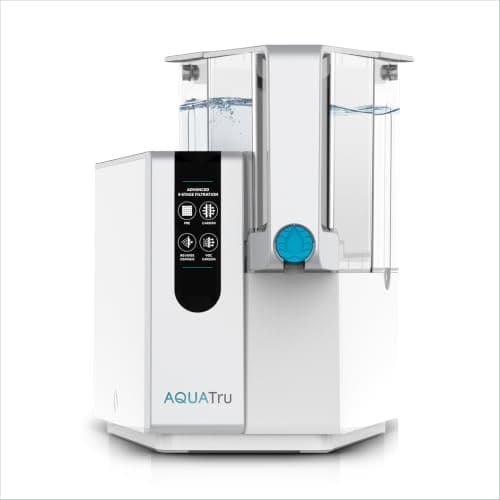 AquaTru Classic Countertop Reverse Osmosis PurifierCertified countertop reverse osmosis, which reaches what carbon cannot. AquaTru Classic Countertop Reverse Osmosis PurifierCertified countertop reverse osmosis, which reaches what carbon cannot. | For fluoride and PFAS, without plumbing | $451.25 - View on Amazon $475.00 — 5% off #ad Price as of October 17, 2026. We may earn a commission. Disclosure. |
Why the limits are mechanical
A pitcher filter is a small volume of media that water passes through slowly under gravity. Two mechanisms are available to it: adsorption, where organic molecules stick to carbon's enormous internal surface area, and ion exchange, where a resin swaps one ion for another.
Anything outside those two mechanisms is out of reach regardless of price. That is why a premium pitcher does not soften water and a cheap one does not either — it is not a quality difference.
1. Hardness
Why not: calcium and magnesium ions are small, charged and inorganic. Carbon does not adsorb them. A pitcher with an ion-exchange stage does swap some, but the bed is tiny and exhausts in gallons.
What does: a softener with a regenerating resin bed. See hard water systems.
2. Hydrogen sulfide (the rotten-egg smell)
Why not: it is a dissolved gas. Carbon adsorbs a trace and saturates almost immediately. And the smell is worst in the shower, which a pitcher cannot reach by definition.
What does: oxidation at the point of entry. See iron and sulfur systems. And check the hot tap first — a hot-only smell is your water heater's anode rod.
3. Iron
Why not: dissolved ferrous iron passes straight through carbon, then oxidizes downstream and stains. Oxidized ferric iron blinds a small filter almost immediately. And the staining problem is in your tubs and laundry, not your drinking glass.
What does: point-of-entry oxidation and filtration.
4. Bacteria and viruses
Why not: standard carbon filters are not certified as microbiological purifiers, and a wet filter that sits unused for weeks is a hospitable place for growth rather than a barrier to it.
What does: UV disinfection, or a system specifically certified for microbiological purification. During a boil-water notice, boiling — no pitcher on this site changes that instruction. See UV treatment.
5. Fluoride and PFAS, on most models
This one is a certification limit rather than an absolute one, which makes it the most confusing.
| Contaminant | Certified pitchers | Tested pitchers | Reliable answer |
|---|---|---|---|
| Fluoride | None on this site | Epic Pure, Clearly Filtered | Reverse osmosis (NSF/ANSI 58) |
| PFOA / PFOS | ZeroWater | Epic Pure, Clearly Filtered | Reverse osmosis, or the certified pitcher |
So it is not that pitchers cannot address these — one certified pitcher does PFAS. It is that most do not, and the ones that address fluoride do so on test data rather than a certification listing.
That split is the entire decision between the two premium pitchers people usually end up choosing between. ZeroWater against Clearly Filtered works through it: the cheaper pitcher holds the certified PFAS claim, the pricier one has the fluoride figure and nearly seven times the filter life.
And one thing that is not a limitation
Pitchers do not remove "good minerals" in any meaningful way, and the marketing claim that they do is mostly aimed at selling you something else. Carbon does not remove dissolved minerals; that is reverse osmosis, and even there the dietary significance is small for most people on a normal diet.
The cost of buying the wrong tier
The arithmetic here is not per gallon, it is the wasted purchase. A pitcher bought to fix a sulfur smell delivers zero value, and its running cost continues while the problem does.
Worse, it delays the correct fix. A household that spends a year on pitcher filters before installing an iron system has paid twice and lived with the problem the whole time. Match the tier to the mechanism first, then compare prices within that tier.
We show the arithmetic rather than a verdict so you can redo it with the price you actually pay. Filter prices move; the rated capacities above do not.
The picks in full
For hardness
Whirlpool WHES40E 40,000-Grain Water Softener
Whirlpool
A demand-regenerating softener sized for most houses, sold in a single carton with a manual anyone can follow. It is a softener, not a filter, and that is exactly the point — nothing else on this site touches hardness.
Certification status
NSF certified. Softening capacity and iron tolerance are published by the manufacturer.
Published specifications
| Capacity | 40,000 grains |
|---|---|
| Hardness handled | Up to 125 grains per gallon |
| Clear-water iron tolerance | Up to 10 ppm |
| Service flow | 8.5 gpm |
| Dimensions | 19" D x 18" W x 47 7/8" H |
| Regeneration | Demand — regenerates on usage, not a timer |
| Power | 110/120 V AC, transformer included |
| Warranty | 10 years on salt and resin tanks; 3 years on the control board |
What we like
- Demand regeneration uses noticeably less salt and water than a timer-based unit
- One carton, one manual, no dealer visit required
- Handles up to 10 ppm clear-water iron, which many softeners in this class do not
What we do not
- Softening only — it does nothing for chlorine, lead or PFAS
- Adds sodium to the softened water, which matters on a sodium-restricted diet
- Needs a drain and a power outlet at the install point
Skip it if
Anyone whose problem is taste, odor or a health contaminant. A softener swaps calcium and magnesium for sodium; it is not a purifier and it is not marketed as one.
#ad We do not show a price we cannot verify today. We may earn a commission. Disclosure.
Where these specifications came from
For sulfur and iron
SpringWell WS1 Well Water Iron Filter (Air Injection)
SpringWell
Air injection oxidation rather than chemical dosing: it draws in air, oxidizes iron and sulfide into particles, and backwashes them out. The published limits are unusually specific, which makes them easy to check against your own water test.
Certification status
SpringWell publishes performance limits by contaminant rather than a system NSF certification listing. Match those limits against your own lab test before buying — this is a system you size from data, not from a category.
Published specifications
| Iron | Up to 7 ppm |
|---|---|
| Hydrogen sulfide | Up to 8 ppm |
| Manganese | Up to 1 ppm |
| Service flow | 12 gpm |
| Process | Air injection oxidation, chemical-free |
| Regeneration | Automatic backwash |
| Warranty | Lifetime |
What we like
- Handles iron, sulfur and manganese in one system, which is the actual well-water problem set
- No chemical dosing and no chlorine tank to refill
- Published ppm limits you can check against a lab report before you buy
What we do not
- Needs a drain for backwash, which constrains where it can go
- Not sold through Amazon, so we earn nothing on this recommendation
- Does nothing for bacteria — that is a UV job
Skip it if
Anyone who has not tested their well. Buying an iron filter without a lab result is how people end up with a system rated for 7 ppm sitting on 12 ppm water, and it fails within months.
Sold direct by SpringWell Water. No affiliate link, so nothing to click and nothing for us to earn. The maker's page is in the sources below. Disclosure.
Where these specifications came from
For fluoride and PFAS, without plumbing
AquaTru Classic Countertop Reverse Osmosis Purifier
AquaTru
Reverse osmosis performance with no plumbing, no drilling and no landlord conversation. You pay for that with counter space, a wait, and two tanks you fill and empty by hand.
Certification status
Certified by IAPMO to NSF/ANSI 53, 58, 401 and P473, covering lead, reverse-osmosis performance, emerging compounds and the PFOA/PFOS protocol.
Published specifications
| Filtration | 4-stage countertop reverse osmosis |
|---|---|
| Clean water tank | 0.75 gallons |
| Tap water tank | 1 gallon |
| Installation | None — no plumbing connection |
| Certified standards | NSF/ANSI 53, 58, 401, P473 (IAPMO) |
What we like
- Real reverse osmosis with a P473 PFOA/PFOS certification and zero installation
- The strongest answer available to a renter with a lead or PFAS problem
- No drilling, no drain saddle, no landlord permission needed
What we do not
- Takes up substantial counter space
- You refill and empty tanks by hand — it is not on-demand
- Highest purchase price in the no-plumbing tier by a wide margin
Skip it if
Anyone who can plumb in an under-sink system. A permanent under-sink RO is cheaper per gallon, on-demand, and out of sight. Buy this when you genuinely cannot install.
$475.00 — 5% off
#ad Price as of October 17, 2026. We may earn a commission. Disclosure.
Where these specifications came from
Questions people actually ask
Do water filter pitchers remove bacteria?
No. Standard carbon pitchers are not certified as microbiological purifiers, and during a boil-water notice they change nothing about the instruction to boil. Only systems specifically certified for microbiological purification make that claim.
Will a pitcher help with hard water?
No. Hardness is dissolved calcium and magnesium, and carbon adsorption does not act on them. Your kettle will scale exactly as before. Removing hardness requires an ion-exchange softener with a regeneration cycle.
Can a pitcher remove fluoride?
None of the certified pitchers on this site claim it. Epic Pure and Clearly Filtered both address fluoride within independent test results rather than a certification listing. For a certified fluoride claim, reverse osmosis under NSF/ANSI 58 is the route.
Is a more expensive pitcher better at these things?
No, and that is the point of this page. The limits are mechanical, not quality-related. A premium pitcher buys a broader contaminant list within what adsorption and ion exchange can do; it does not buy a new mechanism.