
NSF/ANSI 42 covers aesthetic effects — taste, odor and chlorine — and is not a health claim. 53 covers health contaminants including lead. 58 covers reverse osmosis. 401 covers emerging compounds. P473 is a protocol specific to PFOA and PFOS.
Quick picks
Tap any row to jump to the full write-up. The button goes straight to the retailer.
| # | Product | Best for | Price |
|---|---|---|---|
| 1 | 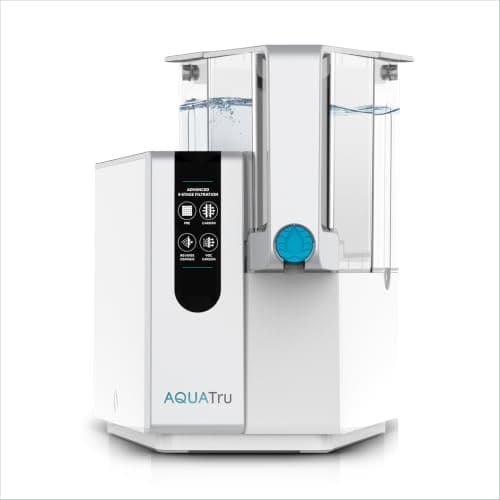 AquaTru Classic Countertop Reverse Osmosis PurifierIAPMO to NSF/ANSI 53, 58, 401 and P473 — health, RO, emerging compounds and PFAS. AquaTru Classic Countertop Reverse Osmosis PurifierIAPMO to NSF/ANSI 53, 58, 401 and P473 — health, RO, emerging compounds and PFAS. | Most complete certification list | $451.25 - View on Amazon $475.00 — 5% off #ad Price as of October 17, 2026. We may earn a commission. Disclosure. |
| 2 | 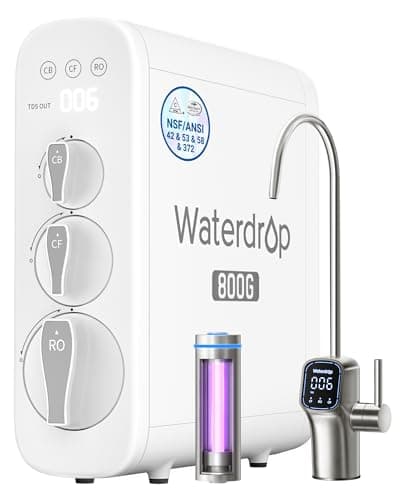 Waterdrop G3P800 Tankless Reverse Osmosis SystemNSF/ANSI 42, 53, 58 and 372, covering aesthetics, health, RO and lead-free materials. Waterdrop G3P800 Tankless Reverse Osmosis SystemNSF/ANSI 42, 53, 58 and 372, covering aesthetics, health, RO and lead-free materials. | Best certified under-sink | $759.00 - View on Amazon $999.00 — 24% off #ad Price as of October 17, 2026. We may earn a commission. Disclosure. |
| 3 | 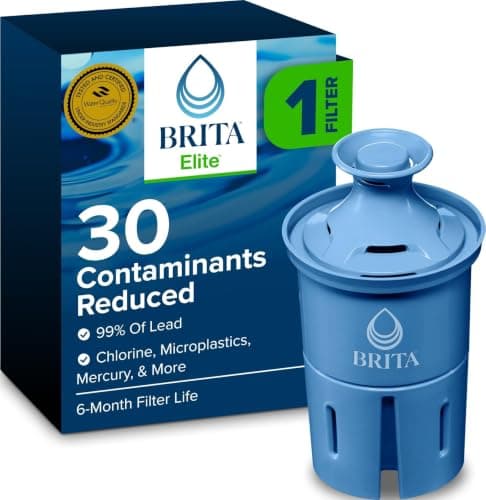 Brita Elite Filter (with any Brita pitcher)NSF/ANSI 42, 53 and 401 in a pitcher filter. The 53 is what covers lead. Brita Elite Filter (with any Brita pitcher)NSF/ANSI 42, 53 and 401 in a pitcher filter. The 53 is what covers lead. | Cheapest health certification | $19.88 - View on Amazon #ad Price as of October 17, 2026. We may earn a commission. Disclosure. |
The five you will actually encounter
| Standard | Covers | Health claim? | Where you see it |
|---|---|---|---|
| NSF/ANSI 42 | Aesthetic effects: taste, odor, chlorine | No | Almost every carbon filter, and most whole-house systems |
| NSF/ANSI 53 | Health effects: lead, cysts, VOCs, chromium, certain PFAS and others | Yes | Better pitchers, certified under-sink filters |
| NSF/ANSI 58 | Reverse osmosis: arsenic, barium, fluoride, lead, nitrate, radium, selenium, TDS | Yes | Reverse osmosis systems |
| NSF/ANSI 401 | Emerging and incidental compounds at trace level, e.g. pharmaceuticals | Yes | Premium carbon and RO systems |
| NSF P473 | A protocol specific to PFOA and PFOS, at concentrations relevant to the EPA limit | Yes | PFAS-targeted products |
You will also see NSF/ANSI 372, which certifies lead-free materials — the product does not add lead to the water — and NSF/ANSI 61 for the safety of materials in contact with drinking water, common on whole-house tanks.
The 42-versus-53 gap is where money gets wasted
NSF/ANSI 42 is the most widely held certification in home water treatment and the least expensive to satisfy. It covers taste, odor and chlorine, and it makes no health claim whatsoever.
A product with a big "NSF Certified" badge may be certified to 42 alone. If you bought it for lead, you bought a taste filter. Read the number, always.
Certification is per contaminant, not per standard
A product certified to NSF/ANSI 53 is certified for the specific contaminants it was tested against — not for the whole list of things 53 covers.
The cleanest real example: per Brita's January 2026 performance data sheet, the Brita Elite is certified to NSF/ANSI 53 for lead and is not certified for PFOA or PFOS. Same standard, different contaminants. Meanwhile ZeroWater's 5-stage filter is IAPMO-certified against NSF/ANSI 53 for PFOA and PFOS.
So "is it NSF 53 certified" is the wrong question. "Is it certified for my contaminant" is the right one.
Certified to, versus tested to
| Certified | Tested | |
|---|---|---|
| Who verified it | A certification body | An independent laboratory, once |
| Ongoing surveillance | Yes | No |
| Publicly listed | Yes, in a directory | Only in the manufacturer's published results |
| Legally meaningful | Stronger | Weaker |
| Evidence quality | Highest available to a consumer | Real, and less |
Some genuinely good products are tested rather than certified — Clearly Filtered and Epic both publish broad independent test results against NSF methods. That is real evidence and it is not the same as a maintained listing.
The practical rule: if you need to point somebody else at a listing — a landlord, a lender, a health directive — buy certified. If you are satisfied by published test data, tested products give you access to contaminants the certified ones do not cover, such as fluoride in a pitcher.
Who does the certifying
NSF International writes the standards and also certifies to them. So do other accredited bodies — IAPMO and the Water Quality Association among them, and WQA's Gold Seal is a certification in its own right.
A product certified by IAPMO against NSF/ANSI 53 is certified to that standard. The certifying body is not the same thing as the standard, and seeing a body you do not recognize is not a red flag by itself — accreditation is.
How to check a claim
- Find the standard number, not just the word "certified".
- Find the specific contaminant within that standard.
- Find the rated capacity — certification applies up to it and not beyond.
- Look the product up in the certifying body's public listing directory.
That last step is the one nobody does and the one that settles arguments. Certification listings are public.
What certification costs, and why it matters
Certification is expensive for manufacturers — laboratory testing, listing fees and ongoing surveillance — which is precisely why a certified product costs more than an uncertified one making similar claims.
That premium is buying third-party verification by an organization with something to lose. Set against a filter that fails to remove the contaminant you bought it for, it is the cheapest part of the purchase.
The honest converse: do not pay a premium for certifications covering contaminants you do not have. A product certified to five standards is not better for you than one certified to the one standard your water actually needs.
We show the arithmetic rather than a verdict so you can redo it with the price you actually pay. Filter prices move; the rated capacities above do not.
The picks in full
Most complete certification list
AquaTru Classic Countertop Reverse Osmosis Purifier
AquaTru
Reverse osmosis performance with no plumbing, no drilling and no landlord conversation. You pay for that with counter space, a wait, and two tanks you fill and empty by hand.
Certification status
Certified by IAPMO to NSF/ANSI 53, 58, 401 and P473, covering lead, reverse-osmosis performance, emerging compounds and the PFOA/PFOS protocol.
Published specifications
| Filtration | 4-stage countertop reverse osmosis |
|---|---|
| Clean water tank | 0.75 gallons |
| Tap water tank | 1 gallon |
| Installation | None — no plumbing connection |
| Certified standards | NSF/ANSI 53, 58, 401, P473 (IAPMO) |
What we like
- Real reverse osmosis with a P473 PFOA/PFOS certification and zero installation
- The strongest answer available to a renter with a lead or PFAS problem
- No drilling, no drain saddle, no landlord permission needed
What we do not
- Takes up substantial counter space
- You refill and empty tanks by hand — it is not on-demand
- Highest purchase price in the no-plumbing tier by a wide margin
Skip it if
Anyone who can plumb in an under-sink system. A permanent under-sink RO is cheaper per gallon, on-demand, and out of sight. Buy this when you genuinely cannot install.
$475.00 — 5% off
#ad Price as of October 17, 2026. We may earn a commission. Disclosure.
Where these specifications came from
Best certified under-sink
Waterdrop G3P800 Tankless Reverse Osmosis System
Waterdrop
Tankless reverse osmosis that gives back the cupboard a pressure tank would eat, fills a glass without the pause, and sends markedly less water down the drain than a classic tank system.
Certification status
Certified to NSF/ANSI 42 for chlorine reduction, NSF/ANSI 53 and 58 for TDS, fluoride, cadmium, hexavalent chromium and selenium, and NSF/ANSI 372 for lead-free materials.
Published specifications
| Output | 800 GPD |
|---|---|
| Pure-to-drain ratio | 3:1 |
| Format | Tankless — no pressure tank |
| Certified standards | NSF/ANSI 42, 53, 58, 372 |
| Installation | Two holes: smart LED faucet and drain |
| Faucet | Included, with TDS display |
What we like
- No pressure tank, so it fits cabinets a tank system cannot
- 3:1 pure-to-drain is far better than the ratio typical of older reverse osmosis
- 800 GPD means no waiting for a tank to refill
What we do not
- Needs a power outlet under the sink — a real constraint in older kitchens
- Proprietary filter cartridges, so you are tied to Waterdrop's pricing
- Requires drilling for the included faucet unless you have a spare hole
Skip it if
Renters, and anyone with no outlet under the sink. It is a permanent, powered installation — a countertop unit is the answer if you cannot commit to that.
$999.00 — 24% off
#ad Price as of October 17, 2026. We may earn a commission. Disclosure.
Where these specifications came from
Cheapest health certification
Brita Elite Filter (with any Brita pitcher)
Brita
The cheapest route to an NSF/ANSI 53 lead certification. It drops into a pitcher most households already have, and it is emphatically not the same filter as the white Brita Standard.
Certification status
Certified to NSF/ANSI 42, 53 and 401. The lead certification belongs to the Elite (blue) filter only — the Standard (white) filter is certified to NSF/ANSI 42 for taste and odor and is not certified for lead. Per Brita's January 2026 performance data sheet the Elite is not certified for PFOA or PFOS, and no Brita pitcher filter is certified for fluoride.
Published specifications
| Rated filter life | 120 gallons / about 6 months |
|---|---|
| Standard filter life, for comparison | 40 gallons / about 2 months |
| Certified standards | NSF/ANSI 42, 53, 401 |
| Lead | Certified under NSF/ANSI 53 |
| PFOA / PFOS | Not certified (January 2026 performance data sheet) |
| Fluoride | Not certified, not claimed |
What we like
- Genuine NSF/ANSI 53 lead certification at the lowest entry price of anything on this site
- Fits Brita pitchers and dispensers already in millions of kitchens — no new hardware
- Three times the rated life of the Standard filter, which changes the cost-per-gallon math
What we do not
- Not certified for PFOA or PFOS, so it is the wrong answer to a PFAS worry
- No fluoride claim at all
- Slow gravity flow, like every pitcher
Skip it if
Anyone whose actual worry is PFAS or fluoride. The Elite is not certified for either, and buying it for those is buying the wrong thing.
#ad Price as of October 17, 2026. We may earn a commission. Disclosure.
Where these specifications came from
Questions people actually ask
What is the difference between NSF 42 and NSF 53?
NSF/ANSI 42 covers aesthetic effects — taste, odor and chlorine — and is not a health claim. NSF/ANSI 53 covers health effects including lead, cysts, VOCs and certain PFAS. A filter certified only to 42 makes no lead claim regardless of how the box reads.
Is 'tested to NSF standards' the same as NSF certified?
No. Tested means an independent laboratory ran the standard's method and the result was published. Certified means a certification body verified it, lists it publicly, and maintains ongoing surveillance. Both are real evidence; certification is stronger.
Does an NSF certification cover every contaminant in the standard?
No. A product is certified for the specific contaminants it was tested against. The Brita Elite is certified to NSF/ANSI 53 for lead and not for PFOA or PFOS — same standard, different contaminants. Always check the specific contaminant.
Can I look up a product's certification?
Yes. Certification listings are public and searchable through the certifying body — NSF, IAPMO or WQA. That is the definitive check, and it settles any question about what a product's marketing implies.