Iron and sulfur systems are chosen by matching your lab numbers to published ppm ceilings. Air injection reaches the highest limits and needs a drain; cartridge systems are far cheaper and cap around 3 ppm, sometimes combined across all three contaminants.
Quick picks
Tap any row to jump to the full write-up. The button goes straight to the retailer.
| # | Product | Best for | Price |
|---|---|---|---|
| 1 | Sno photoSpringWell WS1 Well Water Iron Filter (Air Injection)7 ppm iron, 8 ppm sulfide, 1 ppm manganese by air injection. We earn nothing on it. | Best overall | Sold direct by SpringWell Water. No affiliate link, so nothing to click and nothing for us to earn. The maker's page is in the sources below. Disclosure. |
| 2 | 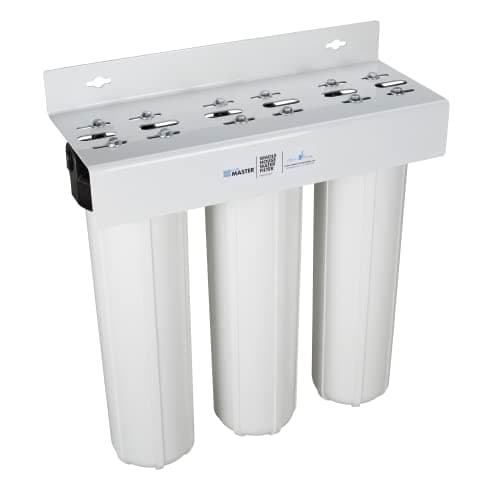 Home Master HMF3SdgFeC 3-Stage Well Water Filter3 ppm combined, radial flow, under 1 psi drop and no drain connection needed. Home Master HMF3SdgFeC 3-Stage Well Water Filter3 ppm combined, radial flow, under 1 psi drop and no drain connection needed. | Best low-pressure-drop cartridge | $503.85 - View on Amazon #ad Price as of October 17, 2026. We may earn a commission. Disclosure. |
| 3 | 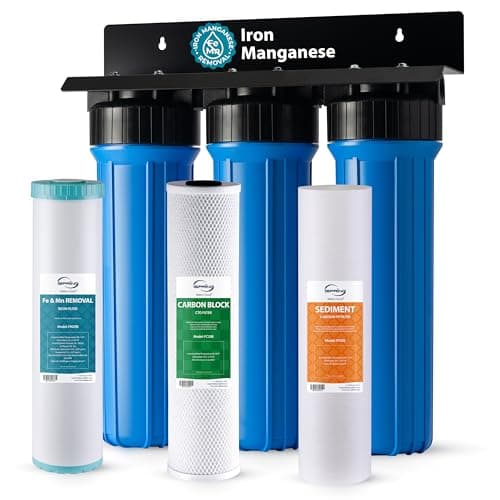 iSpring WGB32BM 3-Stage Iron & Manganese Whole-House Filter3 ppm iron and 1 ppm manganese with separate published ceilings for each. iSpring WGB32BM 3-Stage Iron & Manganese Whole-House Filter3 ppm iron and 1 ppm manganese with separate published ceilings for each. | Best budget cartridge | $459.00 - View on Amazon $535.99 — 14% off #ad Price as of October 17, 2026. We may earn a commission. Disclosure. |
Two approaches, and the honest trade
| Air injection oxidation | Cartridge filtration | |
|---|---|---|
| Iron ceiling | Up to 7 ppm | Around 3 ppm |
| Hydrogen sulfide | Up to 8 ppm | Limited |
| Drain connection | Required, for backwash | None |
| Ongoing work | Automatic backwash | Heavy cartridge changes, roughly annually |
| Consumables | None — it uses air | Cartridges, several per change |
| Up-front cost | Several times higher | The reason people choose it |
| Chemicals | None | None |
Air injection is the mainstream well-water answer and it is genuinely low-maintenance: the system pulls in air, oxidizes iron and sulfide as water passes through the pocket, traps the particles in the media bed, and backwashes them to drain on a schedule. No consumables at all.
Cartridge systems trade that for a much lower entry price and no drain requirement, which matters in a finished basement where plumbing a backwash drain is genuinely awkward. The price is real work: two or three heavy, wet cartridges roughly once a year, and a hard ceiling that unforgiving water will exceed.
The combined-limit trap
Read the ceiling wording carefully, because two of the systems here express it differently:
- iSpring WGB32BM publishes separate ceilings: 3.0 ppm iron and 1.0 ppm manganese.
- Home Master HMF3SdgFeC publishes a combined ceiling: 3 ppm across iron, manganese and sulfur together.
A well testing 2 ppm iron and 2 ppm manganese sits inside the iSpring's iron limit but over the Home Master's combined limit. That is not a small distinction, and it is the kind of thing that only shows up in the specification rather than the product title. Add your numbers before you decide which way to read them.
Capacity falls as concentration rises
The iSpring WGB32BM is rated at 100,000 gallons generally and 50,000 gallons at 3.0 ppm iron. That is the manufacturer telling you plainly that the rated life halves at the top of the range. Any cartridge system behaves this way — the media loads faster on harder work — and it is worth factoring into the running-cost comparison rather than assuming the headline capacity.
Sequence, if you need more than one thing
A typical well train, in order:
- Sediment — protects everything downstream from grit
- Neutralizer — only if pH is below about 6.8, and it must come before oxidation
- Iron and sulfur removal — the systems on this page
- Softener — after iron removal, because iron fouls softener resin
- UV — last, because it needs clear water to work at all
Getting this order wrong is the most expensive well-water mistake there is, and it is usually invisible until a component fails early. The well hub covers the full picture.
The cost-per-gallon math
The comparison people skip is the ten-year one, and it flips the obvious answer.
A cartridge system costs a fraction up front and then consumes a set of cartridges roughly annually, forever. An air-injection system costs several times more up front and consumes nothing but electricity for the valve and the water it backwashes.
Multiply your local cartridge set price by ten years and set it against the difference in purchase price. On a well with real iron, the air-injection system frequently wins on total cost as well as on capability — and it certainly wins on the number of Saturdays spent wrestling wet cartridges.
We show the arithmetic rather than a verdict so you can redo it with the price you actually pay. Filter prices move; the rated capacities above do not.
The picks in full
Best overall
SpringWell WS1 Well Water Iron Filter (Air Injection)
SpringWell
Air injection oxidation rather than chemical dosing: it draws in air, oxidizes iron and sulfide into particles, and backwashes them out. The published limits are unusually specific, which makes them easy to check against your own water test.
Certification status
SpringWell publishes performance limits by contaminant rather than a system NSF certification listing. Match those limits against your own lab test before buying — this is a system you size from data, not from a category.
Published specifications
| Iron | Up to 7 ppm |
|---|---|
| Hydrogen sulfide | Up to 8 ppm |
| Manganese | Up to 1 ppm |
| Service flow | 12 gpm |
| Process | Air injection oxidation, chemical-free |
| Regeneration | Automatic backwash |
| Warranty | Lifetime |
What we like
- Handles iron, sulfur and manganese in one system, which is the actual well-water problem set
- No chemical dosing and no chlorine tank to refill
- Published ppm limits you can check against a lab report before you buy
What we do not
- Needs a drain for backwash, which constrains where it can go
- Not sold through Amazon, so we earn nothing on this recommendation
- Does nothing for bacteria — that is a UV job
Skip it if
Anyone who has not tested their well. Buying an iron filter without a lab result is how people end up with a system rated for 7 ppm sitting on 12 ppm water, and it fails within months.
Sold direct by SpringWell Water. No affiliate link, so nothing to click and nothing for us to earn. The maker's page is in the sources below. Disclosure.
Where these specifications came from
Best low-pressure-drop cartridge
Home Master HMF3SdgFeC 3-Stage Well Water Filter
Home Master
Radial-flow media in oversized housings, built specifically to avoid the pressure loss that makes most cartridge systems miserable on a well. The published limit is combined, not per contaminant, which is the detail people miss.
Certification status
Published performance figures rather than a system certification listing. The 3 ppm ceiling is combined across iron, manganese and sulfur.
Published specifications
| Iron + manganese + sulfur | Up to 3 ppm COMBINED |
|---|---|
| Max filtered flow | 15 gpm |
| Feed pressure | 20-90 psi |
| Feed temperature | 40-100 degrees F |
| Rated capacity | 100,000 gallons |
| Stage 1 | 4-layer sediment, 25 / 10 / 5 / 1 micron |
| Stage 2 | Radial-flow iron reduction, under 1 psi pressure drop |
| Stage 3 | Radial-flow coconut-shell granular carbon |
What we like
- Radial flow keeps pressure drop under 1 psi — the usual complaint about cartridge systems, addressed
- Graded 4-layer sediment stage handles the grit a well actually delivers
- Works down to 20 psi feed pressure, lower than most competitors
What we do not
- 3 ppm is a COMBINED ceiling, so 2 ppm iron plus 2 ppm manganese is already over it
- No bacteria treatment
- Cartridge changes on a well are messier than on city water
Skip it if
Wells whose combined iron, manganese and sulfur exceeds 3 ppm. Add your lab numbers together before you decide, not separately.
#ad Price as of October 17, 2026. We may earn a commission. Disclosure.
Where these specifications came from
Best budget cartridge
iSpring WGB32BM 3-Stage Iron & Manganese Whole-House Filter
iSpring
A cartridge answer to a problem usually solved with a tank. It works inside its published limits and fails outside them, so the lab result decides whether this is the right purchase or wasted money.
Certification status
Published performance figures rather than a system certification listing. The stated limits are the buying criteria.
Published specifications
| Iron | Max 3.0 ppm, reduced to 0.01 ppm |
|---|---|
| Manganese | Max 1.0 ppm, reduced to 0.01 ppm |
| Rated capacity | 100,000 gallons; 50,000 gallons at 3.0 ppm iron |
| Peak flow | 15 gpm |
| Working pressure | 25-80 psi |
| pH range | 6-11 |
| Cartridge size | 20" x 4.5", 3 stages |
What we like
- Far cheaper than a backwashing iron tank
- No drain connection required — a real advantage in a finished basement
- Explicit iron and manganese ceilings you can test against
What we do not
- Hard 3.0 ppm iron ceiling; above it the cartridges blind off quickly
- Capacity halves at the top of the iron range
- Cartridge changes are heavy, wet work
Skip it if
Wells above 3 ppm iron, and any well whose main complaint is a rotten-egg smell. Hydrogen sulfide needs oxidation, not a cartridge.
$535.99 — 14% off
#ad Price as of October 17, 2026. We may earn a commission. Disclosure.
Where these specifications came from
Questions people actually ask
Will a water softener remove iron?
It removes a limited amount of dissolved ferrous iron as a side effect of ion exchange, and softener manufacturers publish that limit. Oxidized ferric iron fouls the resin instead. Above the published limit, iron gets removed before the softener rather than by it.
Do I need a drain for an iron filter?
Backwashing systems, including air injection, need a drain to flush the trapped particles. Cartridge systems do not, which is their main practical advantage in a finished basement. That single requirement often decides which route is realistic in a given house.
How often do cartridge iron filters need changing?
Typically about once a year for a family of four, and sooner as iron concentration rises — one system publishes a rated life that halves at the top of its iron range. Pressure drop is the practical signal: when flow noticeably weakens, the cartridges are loaded.
Can I use one of these on city water?
You can, but you almost certainly should not need to. Municipal supplies rarely deliver meaningful iron or sulfide, and if yours does, that is worth reporting to the utility rather than treating privately. These systems are built for untreated groundwater.