Both are wide-claim pitchers whose headline numbers come from lab testing, not certification, and both are rated at 100 gallons — so filter life is a tie. Epic tested to the microbiological protocol, Clearly Filtered to the PFAS one. Pick by which of those you actually need.
Quick picks
Tap any row to jump to the full write-up. The button goes straight to the retailer.
| # | Product | Best for | Price |
|---|---|---|---|
| 1 | 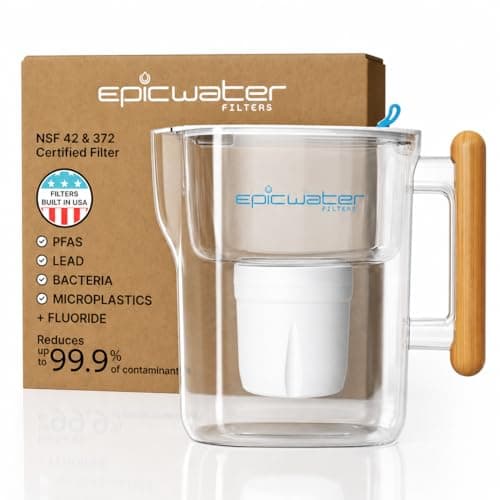 Epic Pure XP Water Filter PitcherEpic states the XP filter is NSF certified to NSF/ANSI 42 and NSF/ANSI/CAN 372, and separately tested to the P231 microbiological protocol. | Best certified paperwork | $82.00 - View on Amazon $89.00 — 8% off #ad Price as of November 2, 2026. We may earn a commission. Disclosure. |
| 2 | 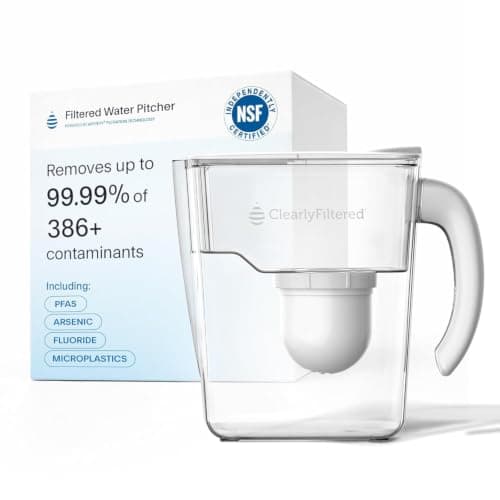 Clearly Filtered Water Pitcher (Affinity)386+ contaminants claimed and published PFOA/PFOS figures under the P473 protocol. All of it test data beyond chlorine and materials. | Widest claim list | $109.99 - View on Amazon #ad Price as of November 2, 2026. We may earn a commission. Disclosure. |
| 3 | 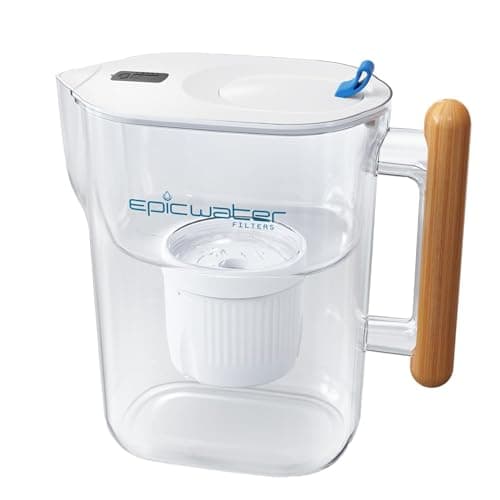 Epic Pure Water Filter PitcherThe original Pure cartridge: a broader own-claim list than the XP, no certification listing, same 100 gallons. | Cheaper fluoride option | $82.00 - View on Amazon #ad Price as of November 2, 2026. We may earn a commission. Disclosure. |
| 4 | 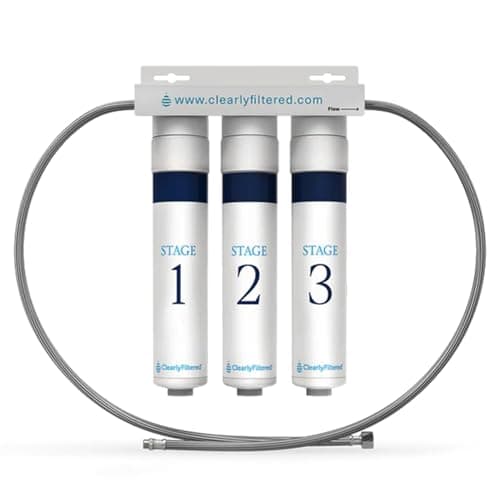 Clearly Filtered 3-Stage Under-Sink System (CF-UTSF)2,000 rated gallons against the pitcher's 100 — twenty times the water per cartridge, and the company calls it third-party tested rather than certified. | If you want the claim list at a sane interval | $550.00 - View on Amazon #ad Price as of November 2, 2026. We may earn a commission. Disclosure. |
Why these two get compared at all
Almost every pitcher comparison on this site is a contest between a certified product and a cheap one. This one is different, which is why it needs its own page: Epic and Clearly Filtered are the same kind of product, sold on the same promise, and the usual deciding factors do not separate them.
Both publish contaminant lists far wider than anything the certified mainstream claims. Both reach fluoride and PFAS, which a Brita or a PUR does not. Both are the expensive end of the pitcher tier. And in both cases the headline list rests on laboratory testing commissioned by the company rather than on a certification listing held by a listing body.
So the reader arriving at this comparison has usually already accepted the trade — they are not asking "certified or tested", they are asking which of these two to buy. That question has a real answer, and it is not the one most comparisons give.
What each one actually holds, as evidence
This is the section worth reading slowly, because the two brands are more alike here than their marketing suggests.
Epic. Epic's own page for the Pure XP states the filter is NSF Certified to NSF/ANSI Standard 42 and NSF/ANSI/CAN 372, and separately that it was Independently tested to NSF/ANSI Standards 42, 53, 401 and P231. The claim count on that page is 70+ contaminants. NSF's own listing database records Epic's PureXP and NanoXP filters under NSF/ANSI 42.
Clearly Filtered. NSF's listing database records the Filtered Water Pitcher under NSF/ANSI 42 at 100 gallons for chlorine reduction and taste and odor reduction. The company states it holds NSF/ANSI 42 and 372. Everything beyond that — the 386-plus contaminant list, the fluoride and PFAS figures — comes from testing at an ISO 17025 accredited laboratory working to NSF/ANSI protocols, including P473.
| Epic (Pure XP) | Clearly Filtered (pitcher) | |
|---|---|---|
| Certified to | NSF/ANSI 42 and NSF/ANSI/CAN 372 | NSF/ANSI 42 (NSF listing); 42 and 372 per the company |
| In NSF's own database | Yes — PureXP and NanoXP under 42 | Yes — pitcher under 42 |
| Headline claim count | 70+ contaminants | 386+ contaminants |
| Rated filter life | 100 gallons | 100 gallons |
| Tested to, not certified under | NSF/ANSI 42, 53, 401 and P231 | NSF/ANSI 53, 401 and P473 methods |
| The protocol that differs | P231 — microbiological purifier | P473 — PFOA and PFOS |
Read the last two rows together and the comparison resolves. These are not two brands making the same claim at different prices. They are two brands that paid for different tests.
P231 and P473, which is the whole decision
Protocol numbers look like trivia and they are not. They describe what a laboratory was asked to challenge the filter with, and the two brands chose differently.
NSF P231 is the microbiological purifier protocol. It is about bacteria, viruses and cysts — biological contamination rather than chemistry. A filter tested to P231 is making a claim about pathogens, which is why Epic's retail listing mentions bacteria and viruses at all. Almost no pitcher goes near this.
NSF P473 is the PFOA and PFOS protocol. It is the specific test behind credible PFAS claims, and it is the one Clearly Filtered's published PFAS figures rest on. The certification guide covers what each standard number means in full.
So the buyer question is not "which is better". It is which contamination you are actually worried about:
| What is worrying you | Which of these two | Why |
|---|---|---|
| PFAS from a utility notice or a test result | Clearly Filtered | The published figures rest on the P473 protocol |
| Bacteria, viruses or cysts | Epic | Tested to P231, the microbiological protocol |
| Fluoride | Either — both publish figures | Neither is certified for it; compare the published numbers |
| Lead | Either, but consider a certified pitcher instead | Brita Elite holds an actual NSF/ANSI 53 lead listing |
| Chlorine taste only | Neither | This is a lot of money for a claim a cheap certified filter holds |
| A result you must act on formally | Neither | Test data is not a certification listing — see the skip box |
One honest caveat on the Epic side: a P231 test is not a reason to treat a pitcher as a substitute for disinfection on water of unknown quality. If biological contamination is a live risk — a private well, a boil-water notice — the cyst page covers what the certifications actually permit, and well bacteria is its own problem with its own equipment.
Filter life used to separate them. It no longer does.
This page previously would have been a short one, because Epic's cartridge was the longest-lived in the tier. That has changed, and it is worth stating plainly because the old figure is still all over the internet.
Epic's own page now rates the Pure cartridge at 100-gallon filter capacity, lasting approximately 3-4 months with typical use. Retailer listings still quote 150 gallons in places; the 100-gallon figure is the one on the manufacturer's own site and the one on the current retail listings, and it is what this site now uses.
Clearly Filtered's pitcher is rated at 100 gallons, per NSF's own listing. So the two are level, and the cost-per-gallon comparison collapses into a straight cartridge-price comparison with no capacity advantage to either side.
For context on the tier: a Brita Elite is rated at 120 gallons and a ZeroWater at 15 to 20. Both of these sit in the middle of that range — the filter-life page works through how to turn a rated capacity into your real interval, which is a different number from the one on the box.
Price, and what the gap buys
There is a real and consistent price gap between these two, and it is the clearest practical argument on the page.
Clearly Filtered sits at the top of the pitcher tier; Epic sits meaningfully below it, with the Pure and the Pure XP at the same price as each other. Since the rated capacities are now identical, that gap is not buying gallons. It is buying claim breadth — 386-plus against 70-plus — and the P473 protocol instead of P231.
Whether that is worth it depends entirely on whether the extra claims cover something in your water. For a household with a PFAS notice, it plainly can be. For a household buying on a general sense that more is better, it is a lot of money for numbers that are not certifications either way.
We do not print prices in this text. The buy buttons carry the live figure and the date it was checked.
The under-sink escape hatch
If you have read this far and concluded you want the Clearly Filtered claim list, there is a version of that purchase which makes far more sense per gallon, and the pitcher comparison obscures it.
The company's under-sink system is rated at 2,000 gallons against the pitcher's 100 — twenty times the water per cartridge. Note how the company itself labels the two differently: the pitcher listing says NSF Certified, and the under-sink listing says third-party tested. That is a fair description, and it is the under-sink system's honest weakness: it has no certification listing at all, where the pitcher at least holds one for chlorine and materials.
Epic's equivalent move is the Smart Shield, which is a genuinely different proposition because it is IAPMO certified to NSF/ANSI 42, 53 and 401 at 651 gallons — a real certification across a health-effects standard, which neither pitcher here has. If the certification is what has been bothering you through this whole page, that is where to look rather than at either pitcher.
What we would actually buy
A comparison that refuses to land is useless, so here is the ranking with its reasoning exposed.
If you have a PFAS result: Clearly Filtered, for the P473 figures, and accept that they are test data. The PFAS roundup lists the certified alternatives, and they are mostly reverse osmosis.
If you want the best paperwork of the two: Epic Pure XP. A stated NSF certification to 42 and 372 plus a P231 test is a stronger evidence package than a wider list with the same certification scope, and it is cheaper.
If fluoride is the single reason you are shopping: either, and then read the fluoride roundup, because reverse osmosis is certified for fluoride under NSF/ANSI 58 and no pitcher is.
If you only have a chlorine taste problem: neither. Buy a certified mainstream pitcher from the pitcher roundup and spend the difference on something else.
The cost-per-gallon math
With rated capacities level at 100 gallons, this arithmetic is unusually simple — which is itself the finding.
A household drinking two gallons a day uses about 730 gallons a year, so either pitcher needs roughly seven cartridges annually. Divide each brand's cartridge price by 100 to get cost per gallon, then multiply by 730. There is no capacity term to argue about any more, so whichever cartridge is cheaper on the day is cheaper per gallon, full stop.
Then run the same sum on the alternatives before committing. The Clearly Filtered under-sink system at 2,000 rated gallons and the Epic Smart Shield at 651 both beat either pitcher per gallon by a wide margin, and the Smart Shield does it while holding a health-effects certification. The under-sink roundup has the tier.
We do not print product prices in this text. The buy buttons carry the live figure and the date it was checked, which is the only price worth quoting.
We show the arithmetic rather than a verdict so you can redo it with the price you actually pay. Filter prices move; the rated capacities above do not.
The picks in full
Best certified paperwork
Epic Pure XP Water Filter Pitcher
Epic Water Filters
The newer Epic pitcher, and the more honest one: NSF certified for chlorine and materials, lab-tested for the rest, with a shorter cartridge life than the original Pure and a shorter headline claim count. Better paperwork, fewer gallons.
Certification status
Epic states the Pure XP is NSF certified to NSF/ANSI 42 and NSF/ANSI/CAN 372, and lab-tested to NSF/ANSI 53, 401 and P231 methods. NSF's own listing records Epic's PureXP and NanoXP filters under NSF/ANSI 42. Published laboratory figures include 99.2% fluoride, 99.9% lead and 99.9% PFAS — test data rather than certified claims.
Published specifications
| Rated filter life | 100 gallons / about 3-4 months |
|---|---|
| Certified | NSF/ANSI 42 and 372 (NSF) |
| Lab-tested | NSF/ANSI 53, 401 and P231 methods |
| Contaminants claimed | 70+ |
| Fluoride | 99.2% (laboratory data) |
| Lead | 99.9% (laboratory data) |
| PFAS | 99.9% (laboratory data) |
What we like
- A genuine NSF certification, which most wide-claim pitchers do not hold at all
- Published fluoride and PFAS figures, which certified mainstream pitchers do not claim
- Clear separation on Epic's own pages between what is certified and what is tested
What we do not
- 100 rated gallons against the original Pure's 150 — fewer gallons for better paperwork
- The certification covers chlorine, taste, odor and materials, not the headline claim list
- Premium cartridge price, so cost per gallon is high next to a certified mainstream pitcher
- Gravity flow through dense media is slow
Skip it if
Anyone who needs a certification listing naming fluoride or PFAS. No pitcher holds one; reverse osmosis is the certified route for both.
$89.00 — 8% off
#ad Price as of November 2, 2026. We may earn a commission. Disclosure.
Widest claim list
Clearly Filtered Water Pitcher (Affinity)
Clearly Filtered
The broadest claim list of any pitcher we list, and the one that needs the most careful reading: it is independently tested to NSF standards, not certified by a listing body. That distinction is the whole decision.
Certification status
Two different kinds of evidence sit on this pitcher. NSF's own listing records the Filtered Water Pitcher under NSF/ANSI 42 at 100 gallons for chlorine reduction and taste and odor reduction, and Clearly Filtered states it holds NSF/ANSI 42 and 372 certifications and is pursuing 53 and 401. Everything beyond that — the 386+ contaminant list, including fluoride, PFAS, arsenic and chromium-6 — comes from testing at QFT, now IAPMO New Jersey, an ISO 17025 laboratory working to NSF/ANSI protocols. Test data, not a certification listing.
Published specifications
| Capacity | 80 oz / 10 cups |
|---|---|
| Rated filter life | 100 gallons / about 4 months |
| Filtration | 3-stage: stainless mesh, coconut carbon, Affinity composite shell |
| Certified | NSF/ANSI 42 and 372 (chlorine, taste and odor; lead-free materials) |
| Tested, not certified | NSF/ANSI 53, 401 and P473 methods |
| Manufacturer claim | Up to 99.99% of 386+ contaminants |
| Fluoride / lead | >99.54% / 99.34% (laboratory data) |
| PFOA / PFOS | 99.64% / >99.80% (laboratory data) |
| Housing | Tritan, BPA-free |
What we like
- Addresses PFAS and fluoride, which most certified pitchers do not touch
- 100-gallon rated life is far longer than ZeroWater's
- Published test data covers an unusually wide contaminant list
What we do not
- Outside chlorine and materials, every claim is test data rather than a certification listing
- Highest sticker price in the pitcher tier
- Flow is slow even by pitcher standards
Skip it if
Anyone who needs a certification listing for a specific contaminant — for a landlord, a lender, a health directive, or their own peace of mind. If the listing is what you need, buy a certified product instead.
#ad Price as of November 2, 2026. We may earn a commission. Disclosure.
Where these specifications came from
Cheaper fluoride option
Epic Pure Water Filter Pitcher
Epic Water Filters
One of very few pitchers that addresses fluoride at all, and the cheaper of the two wide-claim pitchers. Like Clearly Filtered, it is tested against the standards rather than certified under them.
Certification status
Tested against NSF/ANSI 42, 53, 401 and P473. Tested to the standards, not certified under them — read the claim precisely.
Published specifications
| Rated filter life | 100 gallons / about 3-4 months |
|---|---|
| Standards tested against | NSF/ANSI 42, 53, 401, P473 |
| Manufacturer claim | Over 200 contaminants, including lead, PFAS, chromium-6 and fluoride |
What we like
- Addresses fluoride, which certified pitchers essentially never do
- Addresses PFAS, chromium-6 and fluoride in one cartridge, which the certified mainstream does not
- Published test data spans an unusually broad contaminant list
What we do not
- Tested to, not certified under, the NSF standards
- Expensive per filter, though the long life narrows the gap per gallon
- Slow flow — the trade-off for a dense media block
Skip it if
Anyone who needs a certification listing rather than a test report, or anyone whose only problem is chlorine taste — this is a lot of filter for that job.
#ad Price as of November 2, 2026. We may earn a commission. Disclosure.
Where these specifications came from
If you want the claim list at a sane interval
Clearly Filtered 3-Stage Under-Sink System (CF-UTSF)
Clearly Filtered
The same Affinity media as the pitcher, plumbed in and rated for twenty times as much water. It publishes fluoride, arsenic and PFAS figures that no certified carbon system on this site claims — and, like everything else this brand sells beyond chlorine, those figures are laboratory test data rather than a certification listing.
Certification status
Clearly Filtered publishes performance data for the CF-UTSF measured by QFT, now operating as IAPMO New Jersey, an ISO 17025 accredited laboratory testing to NSF/ANSI protocols. It is not a certified system: only the company's pitcher appears in NSF's certified product listing, and that listing covers NSF/ANSI 42 for chlorine, taste and odor. Read the claim list as test data.
Published specifications
| Rated capacity | 2,000 gallons / about 12 months |
|---|---|
| Contaminants claimed | Up to 99.99% of 232+ |
| Evidence | Laboratory testing to NSF/ANSI protocols (IAPMO New Jersey) |
| Fluoride | >90.65% |
| Lead | >99.34% |
| PFOA / PFOS | >99.62% / >99.81% |
| Chromium-6 | >99.67% |
| Arsenic | 94.27% |
| Faucet | Connects to the existing kitchen faucet; no second tap required |
What we like
- 2,000 rated gallons — twenty times the pitcher cartridge, which transforms the cost per gallon
- Fluoride and arsenic figures that no certified carbon system publishes
- No dedicated faucet and no drain line, so the install is far simpler than reverse osmosis
What we do not
- Not certified: the published claim list is test data, and only the company's pitcher holds an NSF listing
- Highest purchase price of any carbon under-sink system on this site by a wide margin
- Proprietary cartridges on an annual cadence, priced accordingly
- Flow rate is not published, and dense composite media is slow by design
Skip it if
Anyone who needs a certification listing for the contaminant they are worried about. If the claim has to be checkable in a public directory, buy a certified carbon system or reverse osmosis instead.
#ad Price as of November 2, 2026. We may earn a commission. Disclosure.
Where these specifications came from
Questions people actually ask
Is Epic or Clearly Filtered better?
They are better at different things, and filter life no longer separates them — both are rated at 100 gallons. Clearly Filtered claims a far wider list (386+ against Epic's 70+) and its PFAS figures rest on the NSF P473 protocol. Epic states an NSF certification to NSF/ANSI 42 and NSF/ANSI/CAN 372 and tested to P231, the microbiological protocol covering bacteria, viruses and cysts, and it costs less. Buy Clearly Filtered for a PFAS result, Epic for better paperwork at a lower price.
Are Epic and Clearly Filtered NSF certified?
Both hold a narrow certification and claim much more than it covers. NSF's listing database records Clearly Filtered's pitcher under NSF/ANSI 42 for chlorine, taste and odor, and Epic's PureXP and NanoXP filters under NSF/ANSI 42; Epic also states NSF/ANSI/CAN 372 for lead-free materials. Every claim beyond chlorine, taste, odor and materials — fluoride, PFAS, heavy metals — is laboratory test data commissioned by the company, not a certification listing.
What is the difference between NSF P231 and P473?
They test for completely different things. P231 is the microbiological purifier protocol, covering bacteria, viruses and cysts. P473 is the protocol for PFOA and PFOS, the two best-known PFAS compounds. Epic publishes P231 testing and Clearly Filtered publishes P473 testing, so the protocol each brand paid for tells you which contamination it is making a serious claim about.
How long do Epic and Clearly Filtered filters last?
Both are rated at 100 gallons. Epic's own page gives the Pure cartridge a 100-gallon capacity lasting approximately 3-4 months with typical use, and NSF's listing records the Clearly Filtered pitcher at 100 gallons. Older retailer listings still quote 150 gallons for Epic; the 100-gallon figure is on the manufacturer's own site. For comparison, a Brita Elite is rated at 120 gallons.
Do either remove fluoride?
Both publish fluoride reduction figures, and neither is certified for it. That distinction matters because no pitcher of any brand holds a fluoride certification — carbon does not remove fluoride, and the wide-claim pitchers reach it with composite media whose performance is reported from testing rather than from a listing. If a certified fluoride claim is what you need, reverse osmosis holds one under NSF/ANSI 58.
Is Clearly Filtered worth the extra money over Epic?
Only if the extra claims cover something actually in your water. The price gap no longer buys filter life, since both are rated at 100 gallons. It buys claim breadth and the P473 PFAS protocol. With a PFAS notice from your utility that can be worth it; bought on a general sense that more is better, it is a lot of money for numbers that are test data on both sides.
Is there a cheaper way to get these claim lists?
Yes, and it is the thing the pitcher comparison hides. Clearly Filtered's under-sink system is rated at 2,000 gallons against the pitcher's 100, and Epic's Smart Shield at 651 gallons is IAPMO certified to NSF/ANSI 42, 53 and 401 — an actual health-effects certification neither pitcher holds. Both beat either pitcher badly on cost per gallon.