Pitcher filters are rated in gallons, not months, and rated capacities across common models range from about 15 to 150 gallons. The months figure on the box assumes a household size that may not be yours, and most change indicators are timers rather than sensors.
Quick picks
Tap any row to jump to the full write-up. The button goes straight to the retailer.
| # | Product | Best for | Price |
|---|---|---|---|
| 1 | 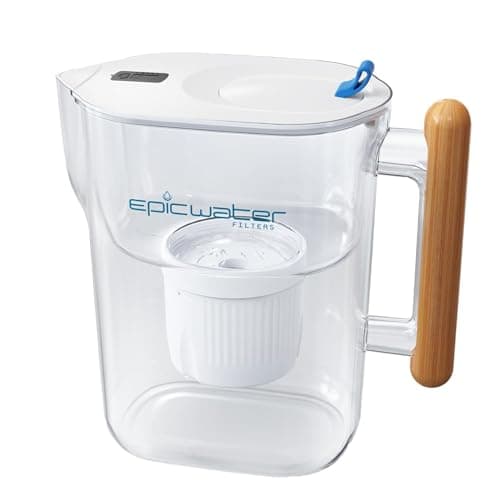 Epic Pure Water Filter Pitcher150 gallons — the longest in the pitcher tier by a clear margin. Epic Pure Water Filter Pitcher150 gallons — the longest in the pitcher tier by a clear margin. | Longest rated life | $82.00 - View on Amazon #ad Price as of October 17, 2026. We may earn a commission. Disclosure. |
| 2 | 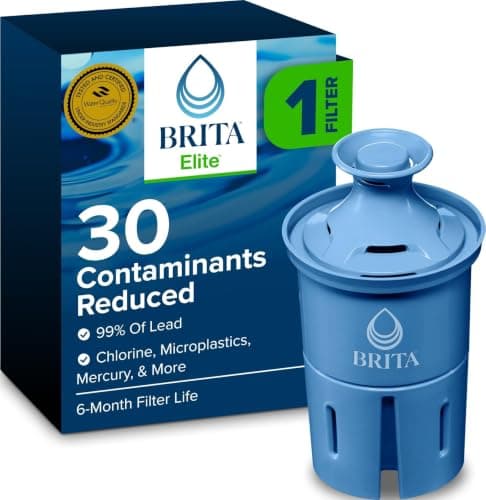 Brita Elite Filter (with any Brita pitcher)120 rated gallons with a lead certification, which is the best of both. Brita Elite Filter (with any Brita pitcher)120 rated gallons with a lead certification, which is the best of both. | Best certified life | $19.88 - View on Amazon #ad Price as of October 17, 2026. We may earn a commission. Disclosure. |
| 3 | 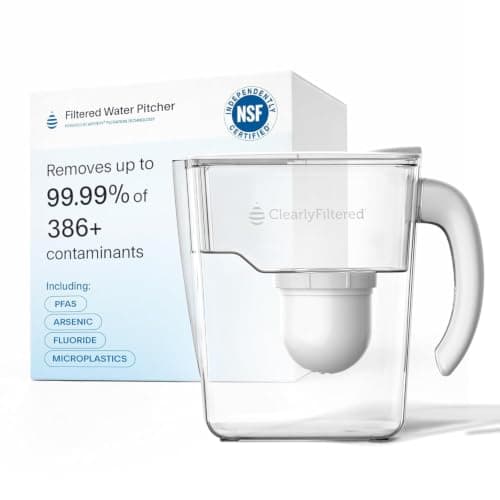 Clearly Filtered Water Pitcher (Affinity)100 gallons across the widest tested claim list here. Clearly Filtered Water Pitcher (Affinity)100 gallons across the widest tested claim list here. | Longest broad-spectrum life | $109.99 - View on Amazon #ad Price as of October 17, 2026. We may earn a commission. Disclosure. |
Rated capacity is the specification. Months is marketing.
Certification is granted at a rated capacity in gallons, because that is what a laboratory can actually test. The "about six months" on the box is that gallon figure divided by an assumed household consumption — and if your household drinks more than the assumption, you exhaust the filter earlier and the certified performance claim no longer applies.
| Filter | Rated gallons | Marketed as | At 2 gal/day |
|---|---|---|---|
| ZeroWater 5-stage | ~15-20 | Varies with TDS | About 8-10 days |
| Brita Standard | 40 | ~2 months | 20 days |
| PUR PLUS lead-reducing | 40 | ~2 months | 20 days |
| Clearly Filtered | 100 | ~4 months | 50 days |
| Brita Elite | 120 | ~6 months | 60 days |
| Epic Pure | 150 | — | 75 days |
Look at the Brita Elite row. Marketed as six months, and at two gallons a day it is exhausted in two. Neither figure is dishonest — they assume different households — but only one of them is about yours.
How to work out your real interval
- Estimate your daily volume. A pitcher holding 10 cups is about 0.6 gallons. Count refills for a week and divide by seven.
- Divide the rated capacity by that number. That is your interval in days.
- Write the change date on the filter in marker, or set a phone reminder. This is unglamorous and it is the only thing that works.
Why indicator lights mislead
Most pitcher change indicators are timers. Some count lid openings, which is closer but still an estimate. Very few measure water volume, and none of the pitchers here measure contaminant loading — which is what actually determines whether the filter is still performing.
The exception is ZeroWater's TDS meter, which is a genuine measurement of whether the resin still works. It is the only pitcher on this site where the manufacturer's replacement guidance is a reading rather than a schedule, and that is a point in its favor even though its life is the shortest.
What happens past the rated capacity
- The certification no longer applies. Certified performance was verified up to the rated capacity, not beyond it. Past it you have an uncertified filter.
- Carbon can release what it captured. A saturated bed does not simply stop working; under some conditions it can shed adsorbed compounds back into the water.
- Flow slows. The most visible symptom, and usually the one that finally prompts a change.
- Bacteria can grow in a long-idle wet filter. A pitcher that sat unused for a month wants a new filter rather than a rinse.
Things that shorten filter life
- High TDS. Devastating for ion-exchange filters specifically — the resin is consumed by everything dissolved, not just your target contaminant.
- Sediment. Visible particles blind the media surface early.
- High chlorine. Consumes carbon capacity that would otherwise go to whatever else you are targeting.
- Warm water. Reduces adsorption efficiency. Filter cold water.
The cost-per-gallon math
Cost per gallon is filter price divided by rated gallons, and it is the only fair way to compare pitchers.
Across the table above, rated capacities span roughly a factor of ten — 15 gallons to 150. Filter prices do not span anything like that range, which means the cheapest filter per unit is frequently the most expensive per gallon.
The Brita Standard is the clearest example. It is the cheapest filter Brita sells, it is rated for 40 gallons against the Elite's 120, and it carries no lead certification. On cost per gallon it loses to the filter that is also more capable. Run the division before assuming the cheap one is cheap.
Nothing about that swap is a hardware decision, either — the two cartridges are the same size, so the Elite fits any Brita pitcher you already own. The exception is the Stream format, whose filter is fixed at 40 gallons with no longer-life option.
We show the arithmetic rather than a verdict so you can redo it with the price you actually pay. Filter prices move; the rated capacities above do not.
The picks in full
Longest rated life
Epic Pure Water Filter Pitcher
Epic Water Filters
One of very few pitchers that addresses fluoride at all, with a 150-gallon rated life that partly offsets a high filter price. Like Clearly Filtered, it is tested against the standards rather than certified under them.
Certification status
Tested against NSF/ANSI 42, 53, 401 and P473. Tested to the standards, not certified under them — read the claim precisely.
Published specifications
| Rated filter life | Up to 150 gallons |
|---|---|
| Standards tested against | NSF/ANSI 42, 53, 401, P473 |
| Manufacturer claim | Over 200 contaminants, including lead, PFAS, chromium-6 and fluoride |
What we like
- Addresses fluoride, which certified pitchers essentially never do
- 150-gallon rated life is the longest in the pitcher tier
- Published test data spans an unusually broad contaminant list
What we do not
- Tested to, not certified under, the NSF standards
- Expensive per filter, though the long life narrows the gap per gallon
- Slow flow — the trade-off for a dense media block
Skip it if
Anyone who needs a certification listing rather than a test report, or anyone whose only problem is chlorine taste — this is a lot of filter for that job.
#ad Price as of October 17, 2026. We may earn a commission. Disclosure.
Where these specifications came from
Best certified life
Brita Elite Filter (with any Brita pitcher)
Brita
The cheapest route to an NSF/ANSI 53 lead certification. It drops into a pitcher most households already have, and it is emphatically not the same filter as the white Brita Standard.
Certification status
Certified to NSF/ANSI 42, 53 and 401. The lead certification belongs to the Elite (blue) filter only — the Standard (white) filter is certified to NSF/ANSI 42 for taste and odor and is not certified for lead. Per Brita's January 2026 performance data sheet the Elite is not certified for PFOA or PFOS, and no Brita pitcher filter is certified for fluoride.
Published specifications
| Rated filter life | 120 gallons / about 6 months |
|---|---|
| Standard filter life, for comparison | 40 gallons / about 2 months |
| Certified standards | NSF/ANSI 42, 53, 401 |
| Lead | Certified under NSF/ANSI 53 |
| PFOA / PFOS | Not certified (January 2026 performance data sheet) |
| Fluoride | Not certified, not claimed |
What we like
- Genuine NSF/ANSI 53 lead certification at the lowest entry price of anything on this site
- Fits Brita pitchers and dispensers already in millions of kitchens — no new hardware
- Three times the rated life of the Standard filter, which changes the cost-per-gallon math
What we do not
- Not certified for PFOA or PFOS, so it is the wrong answer to a PFAS worry
- No fluoride claim at all
- Slow gravity flow, like every pitcher
Skip it if
Anyone whose actual worry is PFAS or fluoride. The Elite is not certified for either, and buying it for those is buying the wrong thing.
#ad Price as of October 17, 2026. We may earn a commission. Disclosure.
Where these specifications came from
Longest broad-spectrum life
Clearly Filtered Water Pitcher (Affinity)
Clearly Filtered
The broadest claim list of any pitcher we list, and the one that needs the most careful reading: it is independently tested to NSF standards, not certified by a listing body. That distinction is the whole decision.
Certification status
Two different kinds of evidence sit on this pitcher. NSF's own listing records the Filtered Water Pitcher under NSF/ANSI 42 at 100 gallons for chlorine reduction and taste and odor reduction, and Clearly Filtered states it holds NSF/ANSI 42 and 372 certifications and is pursuing 53 and 401. Everything beyond that — the 386+ contaminant list, including fluoride, PFAS, arsenic and chromium-6 — comes from testing at QFT, now IAPMO New Jersey, an ISO 17025 laboratory working to NSF/ANSI protocols. Test data, not a certification listing.
Published specifications
| Capacity | 80 oz / 10 cups |
|---|---|
| Rated filter life | 100 gallons / about 4 months |
| Filtration | 3-stage: stainless mesh, coconut carbon, Affinity composite shell |
| Certified | NSF/ANSI 42 and 372 (chlorine, taste and odor; lead-free materials) |
| Tested, not certified | NSF/ANSI 53, 401 and P473 methods |
| Manufacturer claim | Up to 99.99% of 386+ contaminants |
| Fluoride / lead | >99.54% / 99.34% (laboratory data) |
| PFOA / PFOS | 99.64% / >99.80% (laboratory data) |
| Housing | Tritan, BPA-free |
What we like
- Addresses PFAS and fluoride, which most certified pitchers do not touch
- 100-gallon rated life is far longer than ZeroWater's
- Published test data covers an unusually wide contaminant list
What we do not
- Outside chlorine and materials, every claim is test data rather than a certification listing
- Highest sticker price in the pitcher tier
- Flow is slow even by pitcher standards
Skip it if
Anyone who needs a certification listing for a specific contaminant — for a landlord, a lender, a health directive, or their own peace of mind. If the listing is what you need, buy a certified product instead.
#ad Price as of October 17, 2026. We may earn a commission. Disclosure.
Where these specifications came from
Questions people actually ask
Can I use a pitcher filter past its rated life?
The water will not suddenly become dangerous, but the certified performance claim no longer applies, flow will have slowed, and a saturated carbon bed can shed adsorbed compounds back into the water. Past the rated capacity you are drinking through an uncertified filter.
How do I know if my filter is exhausted?
Slowed flow and returning taste are the practical signals, and both are late indicators. A TDS meter gives you a real measurement on ion-exchange filters. For carbon filters the honest answer is to track gallons, because there is no cheap way to measure adsorption capacity at home.
Does refrigerating the pitcher extend filter life?
Not the rated capacity, which is about gallons and contaminant loading. Cold storage does discourage bacterial growth in the wet media, which matters for a pitcher used intermittently.
Why do I need to soak a new filter?
To wet the media fully and displace trapped air. A dry filter lets water channel around the media instead of through it, which is the most common cause of a brand-new filter that runs fast and tastes wrong. It also flushes loose carbon fines.