
The Brita Elite is the cheapest route to an NSF/ANSI 53 lead certification, with a 120-gallon rated life — three times the Standard filter. Per Brita's January 2026 performance data sheet it is not certified for PFOA or PFOS, and no Brita filter is certified for fluoride.
Quick picks
Tap any row to jump to the full write-up. The button goes straight to the retailer.
| # | Product | Best for | Price |
|---|---|---|---|
| 1 | 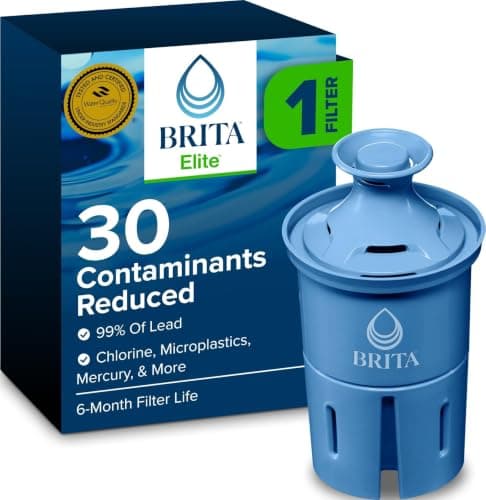 Brita Elite Filter (with any Brita pitcher)NSF/ANSI 42, 53 and 401. Lead certified. 120 rated gallons. Brita Elite Filter (with any Brita pitcher)NSF/ANSI 42, 53 and 401. Lead certified. 120 rated gallons. | The filter reviewed here | $19.88 - View on Amazon #ad Price as of October 17, 2026. We may earn a commission. Disclosure. |
| 2 | 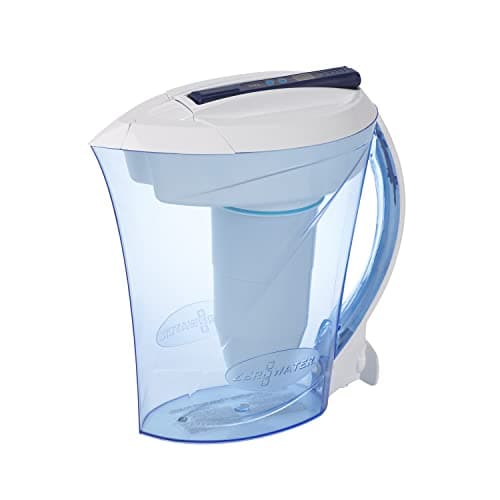 ZeroWater 10-Cup Ready-Pour PitcherCertified for PFOA and PFOS, which the Elite is not. ZeroWater 10-Cup Ready-Pour PitcherCertified for PFOA and PFOS, which the Elite is not. | If PFAS is the worry instead | $28.99 - View on Amazon $59.98 — 52% off #ad Price as of October 17, 2026. We may earn a commission. Disclosure. |
Why this filter gets its own page
Because two filters fit the same Brita pitcher and only one of them is a lead filter, and the difference costs a few dollars. That is the most consequential and least visible decision in the entire pitcher tier.
| Brita Standard (white) | Brita Elite (blue) | |
|---|---|---|
| Certified standards | NSF/ANSI 42 | NSF/ANSI 42, 53, 401 |
| Lead | Not certified | Certified |
| Rated life | 40 gallons / ~2 months | 120 gallons / ~6 months |
| PFOA / PFOS | Not certified | Not certified |
| Fluoride | Not claimed | Not claimed |
| Fits | Standard Brita pitchers | The same pitchers |
What it genuinely does well
The lead certification is real and it is cheap. NSF/ANSI 53 is the health-effects standard, lead is explicitly within it, and this is the lowest-cost consumer product on this site carrying that claim. For a renter in an older building who has tested positive for lead, this is the answer that costs the least and works.
The 120-gallon rated life changes the running cost. Three times the Standard filter's 40 gallons, at a small price premium. Even ignoring the certification, the Elite is the cheaper filter per gallon — which means the Standard is hard to justify on any grounds.
It fits pitchers people already own. No new hardware, no counter space, no decision beyond which filter to put in.
What it does not do
PFAS. This is the important one, because Brita is the default brand and PFAS is the current worry. Per the January 2026 performance data sheet, the Elite is not certified for PFOA or PFOS. It is not a defect — the filter was never marketed as a PFAS product — but it is a mismatch people make constantly. The full answer.
Fluoride. No Brita pitcher filter is certified for fluoride and none claims it. If fluoride is your reason, you are looking at reverse osmosis or a tested-not-certified pitcher.
Anything outside the pitcher. No hardness, no sulfur, nothing in the shower. Standard limits of the whole tier.
Living with it
Flow is slow, as it is on any dense-media pitcher filter, and slower still if you skip the pre-soak. The change indicator is a timer rather than a sensor, so it counts days and not gallons — a household drinking heavily will exhaust 120 gallons well before the light changes. Track gallons instead if you can.
The cost-per-gallon math
At 120 rated gallons, a household drinking two gallons a day gets about two months per filter, or roughly six filters a year.
Against the Standard filter's 40 gallons, that same household needs about eighteen filters a year. Even at a lower price per filter, the Standard costs meaningfully more annually — and does not carry the lead certification.
Against the PUR PLUS, also 40 rated gallons and also lead-certified, the Elite is the better running cost by the same arithmetic. Run it with the filter prices you see on the day; the rated capacities do not change.
We show the arithmetic rather than a verdict so you can redo it with the price you actually pay. Filter prices move; the rated capacities above do not.
The picks in full
The filter reviewed here
Brita Elite Filter (with any Brita pitcher)
Brita
The cheapest route to an NSF/ANSI 53 lead certification. It drops into a pitcher most households already have, and it is emphatically not the same filter as the white Brita Standard.
Certification status
Certified to NSF/ANSI 42, 53 and 401. The lead certification belongs to the Elite (blue) filter only — the Standard (white) filter is certified to NSF/ANSI 42 for taste and odor and is not certified for lead. Per Brita's January 2026 performance data sheet the Elite is not certified for PFOA or PFOS, and no Brita pitcher filter is certified for fluoride.
Published specifications
| Rated filter life | 120 gallons / about 6 months |
|---|---|
| Standard filter life, for comparison | 40 gallons / about 2 months |
| Certified standards | NSF/ANSI 42, 53, 401 |
| Lead | Certified under NSF/ANSI 53 |
| PFOA / PFOS | Not certified (January 2026 performance data sheet) |
| Fluoride | Not certified, not claimed |
What we like
- Genuine NSF/ANSI 53 lead certification at the lowest entry price of anything on this site
- Fits Brita pitchers and dispensers already in millions of kitchens — no new hardware
- Three times the rated life of the Standard filter, which changes the cost-per-gallon math
What we do not
- Not certified for PFOA or PFOS, so it is the wrong answer to a PFAS worry
- No fluoride claim at all
- Slow gravity flow, like every pitcher
Skip it if
Anyone whose actual worry is PFAS or fluoride. The Elite is not certified for either, and buying it for those is buying the wrong thing.
#ad Price as of October 17, 2026. We may earn a commission. Disclosure.
Where these specifications came from
If PFAS is the worry instead
ZeroWater 10-Cup Ready-Pour Pitcher
ZeroWater
The only mainstream pitcher that hands you a TDS meter and invites you to check its work. It buys you a PFOA/PFOS certification the Brita Elite does not have, and it costs you filter life.
Certification status
The 5-stage filter is system-certified by IAPMO against NSF/ANSI 42 for chlorine taste and odor and NSF/ANSI 53 for lead, hexavalent chromium, mercury and PFOA/PFOS.
Published specifications
| Filtration | 5-stage, including ion-exchange resin |
|---|---|
| Rated filter life | About 15-20 gallons, varying with source TDS |
| Certified standards | NSF/ANSI 42 and 53 (IAPMO) |
| PFOA / PFOS | Certified under NSF/ANSI 53 |
| Published reduction — PFOA/PFOS | 99% |
| Published reduction — lead | 95% |
| Published reduction — chromium 6 | 99% |
| Included | Handheld TDS meter |
What we like
- Carries a PFOA/PFOS certification, which the Brita Elite does not
- The bundled TDS meter turns 'is it still working' from a guess into a reading
- Ion exchange drives total dissolved solids far lower than carbon alone
What we do not
- Filter life is the shortest of any pitcher here, and it collapses further on hard or high-TDS water
- Cost per gallon is the highest in the pitcher tier as a result
- Some owners find the taste flat or faintly sour at very low TDS — a real preference issue, not a defect
Skip it if
Anyone on hard, high-TDS water who will not tolerate changing a filter every few weeks. On 400+ ppm supply the running cost is genuinely painful and an under-sink system is cheaper inside a year.
$59.98 — 52% off
#ad Price as of October 17, 2026. We may earn a commission. Disclosure.
Where these specifications came from
Questions people actually ask
Is the Brita Elite worth the extra over the Standard?
Yes, on two independent grounds. It carries a lead certification the Standard does not, and at 120 rated gallons against 40 it is cheaper per gallon despite the higher filter price. There is little reason to buy the Standard.
Does the Brita Elite remove PFAS?
No. Per Brita's January 2026 performance data sheet it is not certified for PFOA or PFOS. If PFAS is your concern, ZeroWater's 5-stage filter carries that certification and the Elite does not.
How long does a Brita Elite filter actually last?
It is rated at 120 gallons, marketed as about six months. Six months assumes a specific household consumption; if you drink more than that assumes, you reach 120 gallons sooner and the certification no longer applies past the rated capacity.
Why is my Brita Elite so slow?
Usually because it was not soaked before first use, which leaves air trapped in the media. Occasionally it is sediment loading the filter faster than expected. If it slowed gradually over weeks, it is loading normally and approaching the end of its life.