
ZeroWater's 5-stage filter is IAPMO certified against NSF/ANSI 53 for PFOA and PFOS, lead, chromium 6 and mercury, with published reductions of 99%, 95% and 99% respectively. Rated life is roughly 15 to 20 gallons and falls further on high-TDS water.
Quick picks
Tap any row to jump to the full write-up. The button goes straight to the retailer.
| # | Product | Best for | Price |
|---|---|---|---|
| 1 | 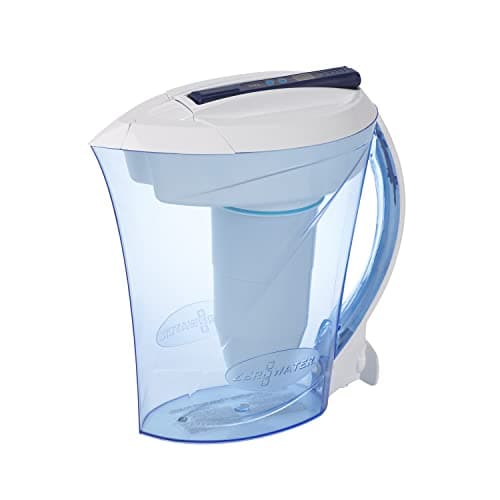 ZeroWater 10-Cup Ready-Pour PitcherIAPMO certified for PFOA/PFOS, lead, chromium 6 and mercury. TDS meter included. ZeroWater 10-Cup Ready-Pour PitcherIAPMO certified for PFOA/PFOS, lead, chromium 6 and mercury. TDS meter included. | The pitcher reviewed here | $27.94 - View on Amazon #ad Price as of October 17, 2026. We may earn a commission. Disclosure. |
| 2 | 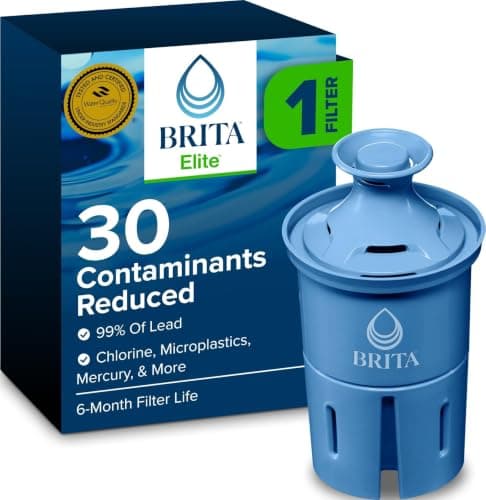 Brita Elite Filter (with any Brita pitcher)Six times the rated life, lead certified, no PFAS claim. Brita Elite Filter (with any Brita pitcher)Six times the rated life, lead certified, no PFAS claim. | If cost per gallon matters more | $19.88 - View on Amazon #ad Price as of October 17, 2026. We may earn a commission. Disclosure. |
| 3 | 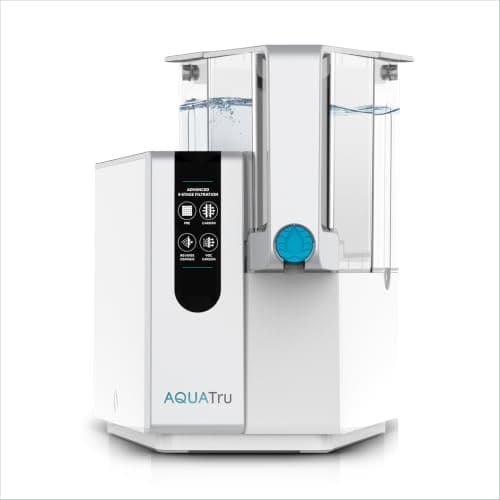 AquaTru Classic Countertop Reverse Osmosis PurifierCertified countertop reverse osmosis, far lower running cost at volume. AquaTru Classic Countertop Reverse Osmosis PurifierCertified countertop reverse osmosis, far lower running cost at volume. | If you want RO without plumbing | $451.25 - View on Amazon $475.00 — 5% off #ad Price as of October 17, 2026. We may earn a commission. Disclosure. |
What makes it different
Most pitchers are carbon. ZeroWater is a five-stage assembly that includes an ion-exchange resin bed, and ion exchange removes dissolved solids that carbon simply does not adsorb. That is why it can drive a TDS reading toward zero when a carbon pitcher barely moves it.
The certification follows from that capability. The filter is system-certified by IAPMO against NSF/ANSI 42 for chlorine taste and odor, and against NSF/ANSI 53 for lead, hexavalent chromium, mercury and PFOA/PFOS.
| Contaminant | Published reduction |
|---|---|
| PFOA / PFOS | 99% |
| Chromium 6 | 99% |
| Chlorine | 97% |
| Mercury | 96% |
| Lead | 95% |
The TDS meter is the best thing in the box
Every other pitcher on this site asks you to trust that it is still working. ZeroWater hands you a meter and invites you to check. Measure your tap, measure the filtered output, and watch the filtered number climb as the resin exhausts.
That is a genuine trust feature, and it is rare. It is also the mechanism by which ZeroWater tells you to change the filter — the manufacturer's guidance is a reading rather than a calendar, which is the correct way round.
Worth being precise about what TDS is and is not: it is the sum of everything dissolved, so a high reading is not a danger signal and a low one is not a safety guarantee. It measures the filter, not the risk.
The filter life problem
Rated capacity is around 15 to 20 gallons, and it varies with source TDS. That is the shortest of any pitcher we list, by a factor of six against the Brita Elite's 120 gallons, and there is a mechanism behind it: the resin is consumed by all dissolved solids, so hard water eats it fast.
The unfortunate irony is that the people most drawn to ZeroWater — those with visibly poor, high-TDS water — are exactly the ones who will burn through filters fastest. On water above 400 ppm, a fortnightly change is realistic.
The taste question
Some owners find very low TDS water flat or faintly sour. That is a real and repeatable effect, not imagination: the dissolved minerals people are used to are exactly what has been removed, and low-mineral water sits differently on the palate. It is a preference, not a defect, and if you dislike RO water you will probably dislike this too.
The cost-per-gallon math
This is the pitcher where the arithmetic most obviously changes the recommendation.
A household drinking two gallons a day uses about 730 gallons a year. At a 20-gallon rated life, that is roughly 36 filters annually — and on high-TDS water where the life drops toward 10 gallons, more like 70.
Set that annual filter spend against a certified under-sink or countertop reverse osmosis system, whose consumables run on a multi-month to multi-year cycle. For a household of three or more on hard water, the RO system frequently pays for itself inside two years. For one person drinking modestly on soft water, ZeroWater stays the cheaper option and the certification is genuinely good value.
We show the arithmetic rather than a verdict so you can redo it with the price you actually pay. Filter prices move; the rated capacities above do not.
The picks in full
The pitcher reviewed here
ZeroWater 10-Cup Ready-Pour Pitcher
ZeroWater
The only mainstream pitcher that hands you a TDS meter and invites you to check its work. It buys you a PFOA/PFOS certification the Brita Elite does not have, and it costs you filter life.
Certification status
The 5-stage filter is system-certified by IAPMO against NSF/ANSI 42 for chlorine taste and odor and NSF/ANSI 53 for lead, hexavalent chromium, mercury and PFOA/PFOS.
Published specifications
| Filtration | 5-stage, including ion-exchange resin |
|---|---|
| Rated filter life | About 15-20 gallons, varying with source TDS |
| Certified standards | NSF/ANSI 42 and 53 (IAPMO) |
| PFOA / PFOS | Certified under NSF/ANSI 53 |
| Published reduction — PFOA/PFOS | 99% |
| Published reduction — lead | 95% |
| Published reduction — chromium 6 | 99% |
| Included | Handheld TDS meter |
What we like
- Carries a PFOA/PFOS certification, which the Brita Elite does not
- The bundled TDS meter turns 'is it still working' from a guess into a reading
- Ion exchange drives total dissolved solids far lower than carbon alone
What we do not
- Filter life is the shortest of any pitcher here, and it collapses further on hard or high-TDS water
- Cost per gallon is the highest in the pitcher tier as a result
- Some owners find the taste flat or faintly sour at very low TDS — a real preference issue, not a defect
Skip it if
Anyone on hard, high-TDS water who will not tolerate changing a filter every few weeks. On 400+ ppm supply the running cost is genuinely painful and an under-sink system is cheaper inside a year.
#ad Price as of October 17, 2026. We may earn a commission. Disclosure.
Where these specifications came from
If cost per gallon matters more
Brita Elite Filter (with any Brita pitcher)
Brita
The cheapest route to an NSF/ANSI 53 lead certification. It drops into a pitcher most households already have, and it is emphatically not the same filter as the white Brita Standard.
Certification status
Certified to NSF/ANSI 42, 53 and 401. The lead certification belongs to the Elite (blue) filter only — the Standard (white) filter is certified to NSF/ANSI 42 for taste and odor and is not certified for lead. Per Brita's January 2026 performance data sheet the Elite is not certified for PFOA or PFOS, and no Brita pitcher filter is certified for fluoride.
Published specifications
| Rated filter life | 120 gallons / about 6 months |
|---|---|
| Standard filter life, for comparison | 40 gallons / about 2 months |
| Certified standards | NSF/ANSI 42, 53, 401 |
| Lead | Certified under NSF/ANSI 53 |
| PFOA / PFOS | Not certified (January 2026 performance data sheet) |
| Fluoride | Not certified, not claimed |
What we like
- Genuine NSF/ANSI 53 lead certification at the lowest entry price of anything on this site
- Fits Brita pitchers and dispensers already in millions of kitchens — no new hardware
- Three times the rated life of the Standard filter, which changes the cost-per-gallon math
What we do not
- Not certified for PFOA or PFOS, so it is the wrong answer to a PFAS worry
- No fluoride claim at all
- Slow gravity flow, like every pitcher
Skip it if
Anyone whose actual worry is PFAS or fluoride. The Elite is not certified for either, and buying it for those is buying the wrong thing.
#ad Price as of October 17, 2026. We may earn a commission. Disclosure.
Where these specifications came from
If you want RO without plumbing
AquaTru Classic Countertop Reverse Osmosis Purifier
AquaTru
Reverse osmosis performance with no plumbing, no drilling and no landlord conversation. You pay for that with counter space, a wait, and two tanks you fill and empty by hand.
Certification status
Certified by IAPMO to NSF/ANSI 53, 58, 401 and P473, covering lead, reverse-osmosis performance, emerging compounds and the PFOA/PFOS protocol.
Published specifications
| Filtration | 4-stage countertop reverse osmosis |
|---|---|
| Clean water tank | 0.75 gallons |
| Tap water tank | 1 gallon |
| Installation | None — no plumbing connection |
| Certified standards | NSF/ANSI 53, 58, 401, P473 (IAPMO) |
What we like
- Real reverse osmosis with a P473 PFOA/PFOS certification and zero installation
- The strongest answer available to a renter with a lead or PFAS problem
- No drilling, no drain saddle, no landlord permission needed
What we do not
- Takes up substantial counter space
- You refill and empty tanks by hand — it is not on-demand
- Highest purchase price in the no-plumbing tier by a wide margin
Skip it if
Anyone who can plumb in an under-sink system. A permanent under-sink RO is cheaper per gallon, on-demand, and out of sight. Buy this when you genuinely cannot install.
$475.00 — 5% off
#ad Price as of October 17, 2026. We may earn a commission. Disclosure.
Where these specifications came from
Questions people actually ask
Does ZeroWater remove PFAS?
Yes. The 5-stage filter is IAPMO certified against NSF/ANSI 53 for PFOA and PFOS, with a published 99% reduction. This is one of the few pitcher filters carrying that certification rather than test data alone.
Why does my ZeroWater filter die so fast?
Because the ion-exchange resin is consumed by every dissolved solid in the water, not just the contaminants you care about. High source TDS exhausts it proportionally faster. Measure your tap water with the included meter — that number predicts your filter life directly.
Why does my ZeroWater taste sour?
Two causes. Very low TDS water tastes flat or slightly sour to many people, which is a preference rather than a fault. Distinctly unpleasant taste usually means the resin is exhausted and should have been changed — check the TDS reading, which should be at or near zero on a working filter.
Is zero TDS water safe to drink?
Yes. TDS measures dissolved solids in aggregate and is not a safety metric — distilled water is zero TDS. The mineral contribution of drinking water is small relative to food for most people on a normal diet.