
Distilled water is safe to drink. Health Canada warns that regular consumption of demineralized water over weeks or months can cause calcium, magnesium or sodium deficiencies, so it is a poor everyday default. For drinking water, a certified reverse osmosis system is the better purchase.
Quick picks
Tap any row to jump to the full write-up. The button goes straight to the retailer.
| # | Product | Best for | Price |
|---|---|---|---|
| 1 | 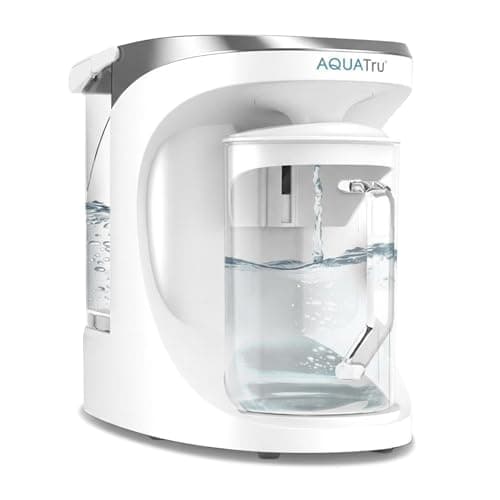 AquaTru Carafe Countertop Reverse Osmosis PurifierCertified under NSF/ANSI 58 with a 94.5% minimum TDS reduction — low-mineral water on demand, without a heating element. AquaTru Carafe Countertop Reverse Osmosis PurifierCertified under NSF/ANSI 58 with a 94.5% minimum TDS reduction — low-mineral water on demand, without a heating element. | Best for drinking water | $356.25 - View on Amazon $375.00 — 5% off #ad Price as of October 17, 2026. We may earn a commission. Disclosure. |
| 2 | 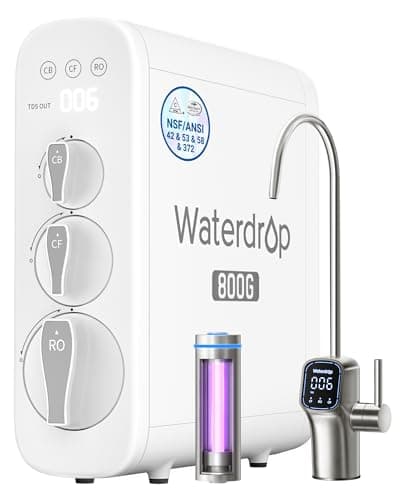 Waterdrop G3P800 Tankless Reverse Osmosis SystemUnder-sink reverse osmosis at a published 3:1 pure-to-drain ratio, with four certifications. Waterdrop G3P800 Tankless Reverse Osmosis SystemUnder-sink reverse osmosis at a published 3:1 pure-to-drain ratio, with four certifications. | Best plumbed low-TDS system | $759.00 - View on Amazon $999.00 — 24% off #ad Price as of October 17, 2026. We may earn a commission. Disclosure. |
| 3 | 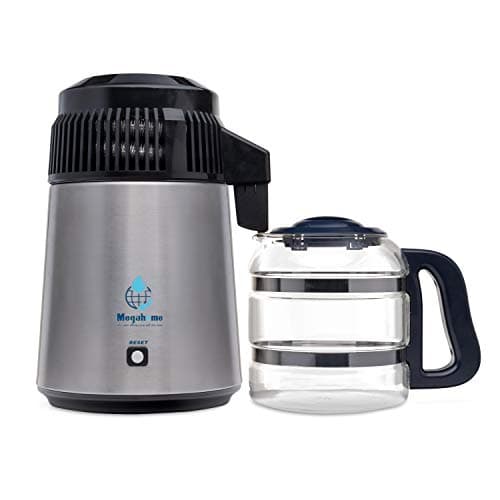 Megahome Countertop Water DistillerActual distillation, a gallon at a time, for a CPAP or a steam appliance. Not a drinking-water upgrade. Megahome Countertop Water DistillerActual distillation, a gallon at a time, for a CPAP or a steam appliance. Not a drinking-water upgrade. | If a device manual says distilled | $299.00 - View on Amazon #ad Price as of October 17, 2026. We may earn a commission. Disclosure. |
| 4 | 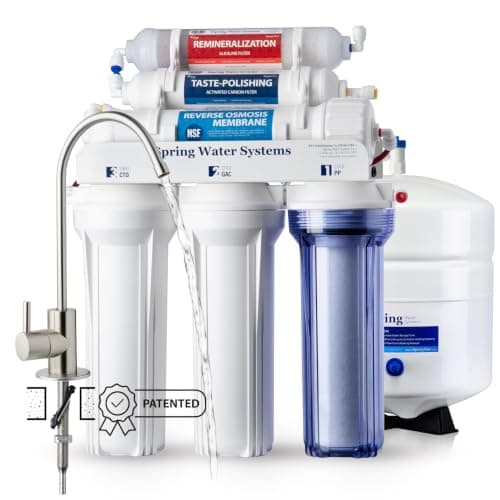 iSpring RCC7AK 6-Stage Reverse Osmosis SystemReverse osmosis with an alkaline remineralization stage, which is the opposite of what a distiller does. iSpring RCC7AK 6-Stage Reverse Osmosis SystemReverse osmosis with an alkaline remineralization stage, which is the opposite of what a distiller does. | If you want the minerals back | $211.49 - View on Amazon $234.99 — 10% off #ad Price as of October 17, 2026. We may earn a commission. Disclosure. |
The short answer, and then the useful one
Yes. Distilled water is safe to drink, it will not harm you, and the alarming claims circulating about it leaching minerals out of your body are not supported by the regulators who actually look at this.
The useful question is a different one, and it is the reason this page is not three sentences long: almost nobody asking it needs a distiller. They need either reassurance about a bottle they already bought, or they need low-mineral water for a specific device, or they want cleaner drinking water and have landed on the wrong technology. Those three need different answers.
What the regulators actually say about low-mineral water
Here is where the genuine nuance sits, and it is worth getting right rather than picking whichever side suits the conclusion.
Total dissolved solids — the bulk measure of minerals in water — has no health-based limit anywhere, in either direction. Health Canada is explicit that it is not possible to derive a meaningful health-based value for TDS because it is a mixture of many different salts, and sets only an aesthetic objective of 500 mg/L or less, aimed at taste and scaling complaints. WHO has likewise never proposed a health-based guideline value for TDS.
And yet the same Health Canada document does not dismiss the mineral concern. It states that regular drinking of distilled or demineralized water over weeks or months can lead to deficiencies in calcium, magnesium or sodium, listing possible effects including extreme fatigue, muscle cramps and cardiovascular disorders.
Both of those are from the same official source and they are not contradictory. The honest reading is: there is no safe-minimum mineral level in water, drinking distilled water is not dangerous, and a national health agency nonetheless advises against making demineralized water your sole source for months on end. Context matters a great deal — a normal diet supplies far more calcium and magnesium than water does, so the risk is concentrated in people with marginal intake to begin with.
Which is why this page's position is not "distilled water is bad". It is that distillation is a poor choice of technology for everyday drinking water, for reasons that have little to do with minerals.
Distilled, reverse osmosis and filtered are three different things
People use these words interchangeably and they describe genuinely different mechanisms with different failure modes.
| Distillation | Reverse osmosis | Carbon filtration | |
|---|---|---|---|
| Mechanism | Boil, then condense the steam | Pressure across a semi-permeable membrane | Adsorption onto activated carbon |
| Dissolved solids | Essentially all removed | 94.5% minimum in one certified listing | Not removed |
| Fluoride, nitrate, arsenic | Removed | Certified under NSF/ANSI 58 | Not removed |
| Lead | Removed | Certified under 58 | Certified under 53 on many filters |
| Volatile organics | Can carry over with the steam | Certified under 53 | Carbon's strongest suit |
| On demand? | No — a batch, hours at a time | Yes | Yes |
| Running cost | Electricity per gallon | Cartridges and some wastewater | Cartridges |
| Certification to check | NSF/ANSI 62, rarely held | NSF/ANSI 58, widely held | NSF/ANSI 42, 53, 401 |
The volatile-organics row is the one that surprises people and it is the honest weakness of distillation. Compounds that boil at or below water's boiling point travel with the steam and condense alongside it, which is why a carbon stage is part of the process on any serious distiller rather than an upsell.
The certification row is the practical one. CDC's own list of home-treatment standards names Standard 62 (distillation) alongside 42, 53 and 58 — so the standard exists. It is simply that very few consumer distillers are listed under it, while reverse osmosis systems are listed under 58 in quantity. If you want to verify performance rather than trust physics, that difference decides it.
What reverse osmosis actually gets you, in numbers
The case for reverse osmosis over a distiller for drinking water is not hand-waving; there are published certified figures, and they are close enough to distillation for the purpose.
Take the AquaTru Carafe's IAPMO performance data sheet as a worked example, because the whole table is public. Against a 750 mg/L TDS challenge the system is certified to reduce dissolved solids to a permissible 22 mg/L, with a minimum reduction of 94.5%. Fluoride goes from an 8 mg/L challenge to the 1.5 mg/L limit at 96.4% average. Nitrate averages 98.3%, lead 99.2%, pentavalent arsenic 98.8%.
A distiller would get the TDS figure closer to zero. The question is whether the difference between 22 mg/L and near-zero is worth five and a half hours of waiting and a heating element per gallon — and for drinking water, it is not. For a humidifier or a CPAP reservoir, where mineral scale is the entire problem, it might be.
The mineral question on reverse osmosis is covered properly on its own page, and remineralizing systems exist precisely for people who want the dissolved solids put back after the membrane has done its work. That option has no equivalent on a distiller.
When a distiller is genuinely the right purchase
There is a real list here, and it is worth stating clearly because the answer to the page's title question is often "yes, and you need it for something that is not drinking".
A CPAP machine, where the manual specifies distilled water. This is the most common legitimate reason, and the specification is about scale in the humidifier chamber rather than about health. Reverse osmosis water at 22 mg/L is very low but it is not distilled, and the manual is the authority on what voids the warranty.
Nasal rinsing — with an important correction. Distilled or sterile water is one of the accepted options, but a distiller does not make sterile water: the collection bottle, the air and your hands are all recontamination routes. The cyst page covers what CDC and FDA actually accept for sinus rinsing, and store-bought sterile water or a one-minute boil is the simpler answer.
Steam irons, humidifiers and aquarium top-off. Anywhere water evaporates and leaves its minerals behind, dissolved solids are the problem and removing all of them is the point.
Laboratory or hobby work with a stated purity requirement. If a procedure specifies distilled water, use distilled water.
Notice that drinking is not on that list, and that most of the list is about scale rather than about safety.
Why distilled water tastes the way it does
This is the practical objection people raise after they buy one, and it has a clean explanation worth knowing in advance.
Dissolved minerals are most of what water tastes like. Remove them all and what is left reads as flat — the common descriptions are "empty" or "like nothing", which is accurate rather than imaginative. Health Canada's 500 mg/L aesthetic objective is a ceiling for the same reason that very low figures taste odd: the agency is managing complaints about taste at both ends of a range.
If you have been drinking distilled water and dislike it, that is the mechanism, and the fix is either a remineralizing stage or a different technology. It is also, incidentally, why coffee made with distilled water extracts badly — the coffee page covers the published mineral targets for brewing, and zero is well below all of them.
The cost-per-gallon math
The running-cost comparison between these two technologies is unusual because the consumables are different in kind: a distiller spends electricity, a membrane spends cartridges.
For a distiller, work it from the element rating and the cycle time: a batch that takes about five and a half hours to make a gallon is paying for most of that in a heating element per gallon, every gallon, forever. Multiply by your local rate per kWh and by your consumption. There is no cartridge, which is the compensation.
For reverse osmosis, work it from the cartridge ratings as usual — and include the wastewater, which is a real cost on a metered supply. The reverse osmosis cost page does that arithmetic over ten years, including the drain ratio most comparisons leave out.
For a household drinking two gallons a day, the comparison is not close: the membrane wins on cost per gallon and wins again on the five and a half hours you did not spend waiting. The distiller only wins when distilled is the actual specification.
We do not print product prices in this text. The buy buttons carry the live figure and the date it was checked, which is the only price worth quoting.
We show the arithmetic rather than a verdict so you can redo it with the price you actually pay. Filter prices move; the rated capacities above do not.
The picks in full
Best for drinking water
AquaTru Carafe Countertop Reverse Osmosis Purifier
AquaTru
The Classic's certification table in two-thirds of the footprint, pouring into glass instead of a plastic tank. You give up capacity and gain a published 63% recovery rate, which is better than almost any plumbed system manages.
Certification status
IAPMO publishes a performance data sheet covering Carafe models AT100, AT110, AT120, AT130 and AT140, certified under NSF/ANSI 42, 53 and 58, with additional testing to NSF/ANSI 401 and NSF Protocol 53 for PFOA and PFOS. The NSF/ANSI 58 table records average reductions of 99.2% for lead, 99.9% for cysts, 96.4% for fluoride, 98.8% for pentavalent arsenic, 97.5% for hexavalent chromium, 98.3% for nitrate and 94.4% for TDS. PFOA and PFOS average 99% under NSF Protocol 53.
Published specifications
| Filtration | 4-stage countertop reverse osmosis |
|---|---|
| Carafe | 64 oz borosilicate glass |
| Clean water tank | 0.5 gallons (1.9 L) |
| Tap water tank | 0.66 gallons (2.5 L) |
| Daily production rate | 35 GPD |
| Efficiency rating | 63% (IAPMO) |
| Certified standards | NSF/ANSI 42, 53, 58 (IAPMO) |
| Dimensions | 13 in H x 14 in D x 7.5 in W |
| Power | 120 V, 60 Hz |
| Max inlet hardness | 10 gpg (171 mg/L) |
What we like
- A published 63% efficiency rating — most tank reverse osmosis systems send three or four gallons to drain per gallon produced
- The NSF/ANSI 58 claim list reaches lead, fluoride, nitrate, arsenic, chromium-6 and cysts, which carbon cannot
- Glass carafe rather than a plastic holding tank, and it goes in the fridge
- No plumbing, no drilling and no drain saddle — the whole certification travels with a renter
What we do not
- A 0.5 gallon clean tank against the Classic's 0.75 — you refill it more often for the same household
- Three cartridges on three different clocks, and the manufacturer's web page and the certifier's data sheet disagree on the pre/carbon interval
- Needs a counter outlet and 7.5 inches of width it does not share
- Not for water above 10 gpg hardness without softening first, or the membrane scales
Skip it if
A household that drinks a lot of water. The clean tank holds half a gallon and refills at 35 gallons a day, so a family of four will be waiting on it. Buy the Classic for its larger tanks, or a plumbed under-sink system if you can install one.
$375.00 — 5% off
#ad Price as of October 17, 2026. We may earn a commission. Disclosure.
Best plumbed low-TDS system
Waterdrop G3P800 Tankless Reverse Osmosis System
Waterdrop
Tankless reverse osmosis that gives back the cupboard a pressure tank would eat, fills a glass without the pause, and sends markedly less water down the drain than a classic tank system.
Certification status
Certified to NSF/ANSI 42 for chlorine reduction, NSF/ANSI 53 and 58 for TDS, fluoride, cadmium, hexavalent chromium and selenium, and NSF/ANSI 372 for lead-free materials.
Published specifications
| Output | 800 GPD |
|---|---|
| Pure-to-drain ratio | 3:1 |
| Format | Tankless — no pressure tank |
| Certified standards | NSF/ANSI 42, 53, 58, 372 |
| Installation | Two holes: smart LED faucet and drain |
| Faucet | Included, with TDS display |
What we like
- No pressure tank, so it fits cabinets a tank system cannot
- 3:1 pure-to-drain is far better than the ratio typical of older reverse osmosis
- 800 GPD means no waiting for a tank to refill
What we do not
- Needs a power outlet under the sink — a real constraint in older kitchens
- Proprietary filter cartridges, so you are tied to Waterdrop's pricing
- Requires drilling for the included faucet unless you have a spare hole
Skip it if
Renters, and anyone with no outlet under the sink. It is a permanent, powered installation — a countertop unit is the answer if you cannot commit to that.
$999.00 — 24% off
#ad Price as of October 17, 2026. We may earn a commission. Disclosure.
Where these specifications came from
If a device manual says distilled
Megahome Countertop Water Distiller
Megahome
A kettle that boils water and condenses the steam into a glass bottle, five and a half hours at a time. It is the right purchase for a CPAP machine or a steam iron and the wrong one for drinking water, where reverse osmosis does most of the same job without the wait or the element.
Certification status
No NSF/ANSI certification listing. NSF/ANSI 62 is the standard that covers drinking water distillation systems, and this unit does not appear in NSF's certified product listings under it. Distillation's performance rests on the physics of the phase change rather than on a reduction claim, which is why distillers are rarely certified and why that absence means less here than it would on a filter.
Published specifications
| Format | Countertop batch distiller |
|---|---|
| Batch size | 1 gallon |
| Collection vessel | Glass bottle |
| Boiling chamber | Stainless steel |
| Certified standards | None — see certification note |
| Cycle time | 1 gallon per 5.5 hours |
| Consumable | Optional activated charcoal filters |
What we like
- Produces genuinely distilled water, which is the specification CPAP and some medical device manuals actually ask for
- No membrane, no cartridge subscription and no drain connection
- Stainless chamber and a glass collection bottle rather than plastic
- Removes dissolved solids, nitrate, fluoride and arsenic by phase change rather than by selective rejection
What we do not
- About five and a half hours for one gallon, and it is a batch process you have to start
- Uses a heating element for every gallon, so the running cost is electricity rather than cartridges
- Strips everything, including the minerals that make water taste like water
- Volatile organics with a boiling point below water's can carry over, which is why the optional charcoal filters exist
Skip it if
Anyone buying it as a drinking water upgrade. For drinking water, reverse osmosis reaches the same contaminants on demand, at a fraction of the energy, and the certification listings actually exist. Buy a distiller when a device manual specifies distilled water.
#ad Price as of October 17, 2026. We may earn a commission. Disclosure.
If you want the minerals back
iSpring RCC7AK 6-Stage Reverse Osmosis System
iSpring
The value pick of the reverse-osmosis tier: a WQA Gold Seal system with an alkaline stage, usually at the lowest price of anything here that carries a real certification.
Certification status
Certified against NSF/ANSI 58 for TDS reduction and carries the WQA Gold Seal, with 97.2% TDS removal certified.
Published specifications
| Output | 75 GPD |
|---|---|
| Stages | 6, including alkaline remineralization |
| Certified TDS reduction | 97.2% |
| Feed pressure | 45-70 psi |
| Feed temperature | 40-100 degrees F |
| Assembled size | 15.5" deep x 19.5" high, 25 lb |
| Certification | NSF/ANSI 58, WQA Gold Seal |
What we like
- Certified performance at the lowest price in the tier
- Push-fit tubing makes a first-time install genuinely manageable
- Alkaline stage included rather than sold as an upgrade
What we do not
- Narrow 45-70 psi feed window — low-pressure homes may need a booster pump
- Tank plus housing needs real cabinet depth
- Conventional reverse-osmosis drain ratio
Skip it if
Homes with feed pressure below 45 psi that will not add a booster pump, and anyone who wants a tankless footprint.
$234.99 — 10% off
#ad Price as of October 17, 2026. We may earn a commission. Disclosure.
Where these specifications came from
Questions people actually ask
Is distilled water safe to drink?
Yes. There is no health-based limit on dissolved solids in drinking water in either direction — Health Canada states it is not possible to derive a meaningful health-based value for TDS, and WHO has never proposed one. The caveat worth knowing is that the same Health Canada document warns regular drinking of distilled or demineralized water over weeks or months can lead to calcium, magnesium or sodium deficiencies, so it is a poor sole source rather than a dangerous drink.
Does distilled water leach minerals out of your body?
No, not in the way the claim is usually made. What official guidance says is narrower: regular long-term consumption of demineralized water as a sole source can contribute to mineral deficiencies, because the water is no longer contributing the calcium and magnesium it used to. A normal diet supplies far more of both than drinking water does, so the concern concentrates in people whose dietary intake is already marginal.
Is distilled water better than reverse osmosis?
Not for drinking. Distillation gets dissolved solids closer to zero, but reverse osmosis is certified under NSF/ANSI 58 with published figures — one listing shows a 94.5% minimum TDS reduction, 96.4% fluoride and 99.2% lead — and it delivers on demand rather than in four-hour batches. Distillation also lets volatile organics carry over with the steam, which is why a carbon stage is part of the process. Buy a distiller when a device manual specifies distilled water.
Can I drink distilled water from a home distiller?
Yes, with two practical notes. A home distiller produces distilled water but not sterile water — the collection bottle and the air are recontamination routes — so do not treat it as a substitute for store-bought sterile water where sterility is the requirement. And expect it to taste flat, because dissolved minerals are most of what water tastes like.
What is distilled water actually for?
Devices where evaporation leaves mineral scale behind. CPAP humidifier chambers, steam irons, room humidifiers and aquarium top-off are the common ones, and the CPAP case is usually driven by the manual rather than by health. Laboratory and hobby procedures that specify distilled water are the other legitimate use. Everyday drinking water is not on the list.
Is there an NSF certification for distillers?
The standard exists but is rarely held. CDC's list of home water treatment standards names Standard 62 for distillation alongside 42, 53 and 58, so there is a framework for certifying a distiller's performance claims. In practice very few consumer distillers appear in certification listings under it, while reverse osmosis systems are listed under NSF/ANSI 58 in quantity — which matters if you want to verify performance rather than trust the physics.
Why does distilled water taste bad?
Because dissolved minerals are most of what water tastes like, and distillation removes essentially all of them. The common descriptions — flat, empty, like nothing — are accurate. If you want very low dissolved solids without that effect, a remineralizing reverse osmosis system puts calcium and magnesium back after the membrane, which no distiller does.