The purchase price of a reverse osmosis system is usually the smallest part of what you spend on it. Cartridges, membranes, installation and — on a metered supply — wastewater dominate the ten-year total, and proprietary versus standard cartridges is the single biggest lever.
Quick picks
Tap any row to jump to the full write-up. The button goes straight to the retailer.
| # | Product | Best for | Price |
|---|---|---|---|
| 1 | 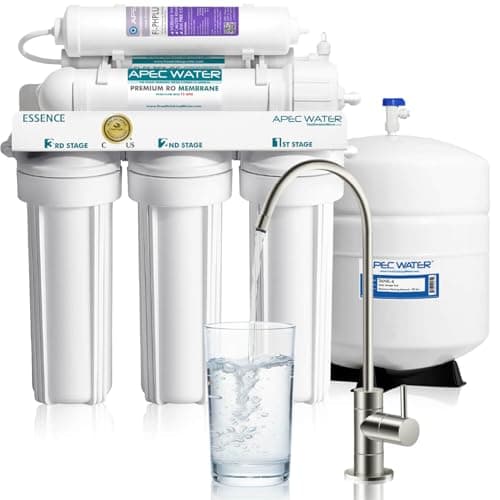 APEC ROES-PH75 Essence 6-Stage Alkaline RO SystemStandard 10-inch cartridges keep replacement pricing in a competitive market. APEC ROES-PH75 Essence 6-Stage Alkaline RO SystemStandard 10-inch cartridges keep replacement pricing in a competitive market. | Cheapest over ten years | $189.99 - View on Amazon $294.99 — 36% off #ad Price as of October 17, 2026. We may earn a commission. Disclosure. |
| 2 | 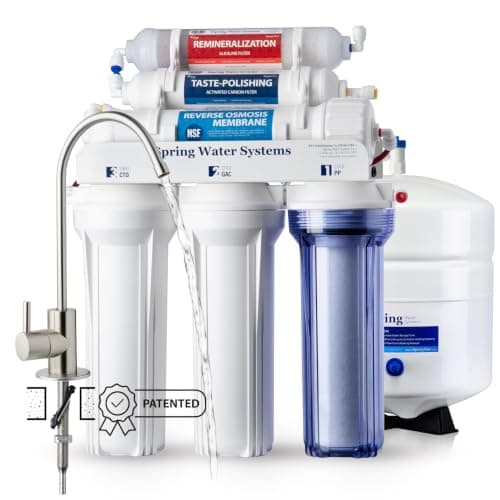 iSpring RCC7AK 6-Stage Reverse Osmosis SystemThe lowest entry price here that still carries a real certification. iSpring RCC7AK 6-Stage Reverse Osmosis SystemThe lowest entry price here that still carries a real certification. | Cheapest to buy | $211.49 - View on Amazon $234.99 — 10% off #ad Price as of October 17, 2026. We may earn a commission. Disclosure. |
| 3 | 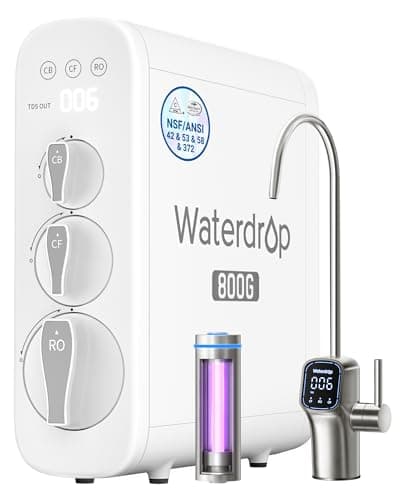 Waterdrop G3P800 Tankless Reverse Osmosis System3:1 pure-to-drain, which matters on a metered supply or a septic system. Waterdrop G3P800 Tankless Reverse Osmosis System3:1 pure-to-drain, which matters on a metered supply or a septic system. | Cheapest on water | $759.00 - View on Amazon $999.00 — 24% off #ad Price as of October 17, 2026. We may earn a commission. Disclosure. |
The five costs, in the order people forget them
- The system. The number on the box, and the only one most people compare.
- Installation. Free if you do it and everything cooperates. A plumber if the counter needs drilling, if the cabinet is awkward, or if a drain saddle is beyond you.
- Pre-filters, typically every six to twelve months for the life of the system.
- The membrane, typically every two to five years depending on feed water quality.
- Wastewater, which is invisible until you see it on a meter.
The single biggest lever: cartridge type
Proprietary cartridges mean one supplier sets the price for as long as you own the system. Standard 10-inch cartridges are made by dozens of manufacturers and sold by every filtration supplier, so the price stays competitive.
| System | Cartridge type | What that means over ten years |
|---|---|---|
| APEC ROES-PH75 | Standard 10-inch | Competitive market pricing for every replacement |
| iSpring RCC7AK | Proprietary | Manufacturer sets the price |
| Waterdrop G3P800 | Proprietary | Manufacturer sets the price |
| Aquasana AQ-5300 | Proprietary | Manufacturer sets the price, on a 600-gallon cycle |
None of these are bad systems, and proprietary cartridges are not a scam — they are often better integrated. But the ten-year cost difference is real and it is invisible on the day you buy, which is exactly why it deserves a section.
Wastewater, as a number rather than a vibe
Ratios are published. A conventional system running around 1:3 sends three gallons to the drain for every gallon it produces. The Waterdrop G3P800 publishes 3:1 in the product's favor — roughly a third of a gallon to drain per gallon produced.
For a household producing a few gallons a day of drinking and cooking water, that difference is thousands of gallons a year. On municipal water it is a modest line item; on a metered supply with a sewer charge, or on a septic system where volume genuinely matters, it is worth the comparison.
Installation honestly
- Cold water connection: quick-connect on modern systems. Easy.
- Drain saddle: a clamp on the drain line. Straightforward but fiddly, and the most common source of a slow leak nobody notices for a week.
- Faucet hole: the hard one. Granite and quartz need a diamond bit and patience. If your sink has a spare hole under a blanking cap or an unused soap dispenser, you have just saved yourself the worst part of the job — check before assuming.
- Power outlet, for tankless systems only. If there is none in the cabinet, that is an electrician, and it changes the arithmetic entirely.
Against the alternatives
The comparison worth making is not RO versus nothing, it is RO versus what else would solve your problem:
- Versus a pitcher: RO costs far more up front and much less per gallon. The crossover is usually inside a year or two for a household of three or more.
- Versus a carbon block: the carbon block is cheaper on every axis — purchase, install, running cost, wastewater. It simply cannot do fluoride, nitrate, arsenic or TDS. Buy RO for those, not for a chlorine taste.
- Versus bottled water: this is the comparison that makes RO look trivially cheap. Work out your household's annual bottled spend and put it next to a system plus a decade of cartridges.
Building your own ten-year number
Take the purchase price. Add installation if you are hiring it out. Add the pre-filter set price multiplied by ten to twenty cycles. Add the membrane price multiplied by two to five cycles. If your water is metered, add your daily production multiplied by 3,650 and by the published drain ratio, at your local rate per gallon.
Do that for two systems — one with proprietary cartridges and one with standard ones — and the answer is frequently not the one the sticker prices suggested. We do not print prices here because we will not show a figure we cannot verify today; use the prices in front of you.
We show the arithmetic rather than a verdict so you can redo it with the price you actually pay. Filter prices move; the rated capacities above do not.
The picks in full
Cheapest over ten years
APEC ROES-PH75 Essence 6-Stage Alkaline RO System
APEC Water Systems
A conventional tank system that uses ordinary 10-inch cartridges rather than proprietary pods, which keeps the ten-year running cost sane. The sixth stage puts minerals back for people who dislike RO's flat taste.
Certification status
WQA Gold Seal certified.
Published specifications
| Output | 75 GPD at 60 psi and 77 degrees F |
|---|---|
| Tank capacity | 4 gallons |
| Stages | 6, including a calcite remineralization stage |
| Feed pressure | 40-85 psi |
| Max feed TDS | 2,000 ppm |
| System dimensions | 15.5" L x 5.25" W x 17.5" H, plus a separate tank |
| Certification | WQA Gold Seal |
What we like
- Standard-size cartridges, so replacements are cheap and sourceable from many brands
- Calcite stage restores minerals and lifts the pH of reverse-osmosis water
- No electricity required
What we do not
- The 4-gallon tank plus housing takes most of an under-sink cabinet
- Slower than tankless systems, and it pauses while the tank refills
- Conventional wastewater ratio, well short of the G3P800's 3:1
Skip it if
Small cabinets. Measure before you buy — the tank alone is roughly 11 x 11 x 15 inches, and people discover this after delivery.
$294.99 — 36% off
#ad Price as of October 17, 2026. We may earn a commission. Disclosure.
Where these specifications came from
Cheapest to buy
iSpring RCC7AK 6-Stage Reverse Osmosis System
iSpring
The value pick of the reverse-osmosis tier: a WQA Gold Seal system with an alkaline stage, usually at the lowest price of anything here that carries a real certification.
Certification status
Certified against NSF/ANSI 58 for TDS reduction and carries the WQA Gold Seal, with 97.2% TDS removal certified.
Published specifications
| Output | 75 GPD |
|---|---|
| Stages | 6, including alkaline remineralization |
| Certified TDS reduction | 97.2% |
| Feed pressure | 45-70 psi |
| Feed temperature | 40-100 degrees F |
| Assembled size | 15.5" deep x 19.5" high, 25 lb |
| Certification | NSF/ANSI 58, WQA Gold Seal |
What we like
- Certified performance at the lowest price in the tier
- Push-fit tubing makes a first-time install genuinely manageable
- Alkaline stage included rather than sold as an upgrade
What we do not
- Narrow 45-70 psi feed window — low-pressure homes may need a booster pump
- Tank plus housing needs real cabinet depth
- Conventional reverse-osmosis drain ratio
Skip it if
Homes with feed pressure below 45 psi that will not add a booster pump, and anyone who wants a tankless footprint.
$234.99 — 10% off
#ad Price as of October 17, 2026. We may earn a commission. Disclosure.
Where these specifications came from
Cheapest on water
Waterdrop G3P800 Tankless Reverse Osmosis System
Waterdrop
Tankless reverse osmosis that gives back the cupboard a pressure tank would eat, fills a glass without the pause, and sends markedly less water down the drain than a classic tank system.
Certification status
Certified to NSF/ANSI 42 for chlorine reduction, NSF/ANSI 53 and 58 for TDS, fluoride, cadmium, hexavalent chromium and selenium, and NSF/ANSI 372 for lead-free materials.
Published specifications
| Output | 800 GPD |
|---|---|
| Pure-to-drain ratio | 3:1 |
| Format | Tankless — no pressure tank |
| Certified standards | NSF/ANSI 42, 53, 58, 372 |
| Installation | Two holes: smart LED faucet and drain |
| Faucet | Included, with TDS display |
What we like
- No pressure tank, so it fits cabinets a tank system cannot
- 3:1 pure-to-drain is far better than the ratio typical of older reverse osmosis
- 800 GPD means no waiting for a tank to refill
What we do not
- Needs a power outlet under the sink — a real constraint in older kitchens
- Proprietary filter cartridges, so you are tied to Waterdrop's pricing
- Requires drilling for the included faucet unless you have a spare hole
Skip it if
Renters, and anyone with no outlet under the sink. It is a permanent, powered installation — a countertop unit is the answer if you cannot commit to that.
$999.00 — 24% off
#ad Price as of October 17, 2026. We may earn a commission. Disclosure.
Where these specifications came from
Questions people actually ask
How much does an under-sink RO system cost to run per year?
Pre-filters on a six to twelve month cycle plus a membrane every two to five years, and wastewater if your supply is metered. The dominant variable is whether the cartridges are proprietary or standard 10-inch, because that determines whether you are buying in a competitive market.
Is reverse osmosis cheaper than bottled water?
By a wide margin for any household that buys bottled water regularly. Work out your annual bottled spend and set it against a system plus ten years of cartridges — for most households the system pays for itself within the first year.
Do I need a plumber to install reverse osmosis?
Not necessarily. The connections are quick-connect on modern systems. The two things that push people toward a plumber are drilling a faucet hole in stone and fitting a drain saddle in a cramped cabinet. If your sink has a spare hole, DIY becomes much more realistic.
How often do I replace the RO membrane?
Typically every two to five years, depending on feed water quality and how well the pre-filters are maintained. Neglected pre-filters shorten membrane life significantly, which is the expensive way to save money on the cheap consumable.