Filtered water wins on evidence and on cost. GAO found FDA's bottled water protections often less stringent than EPA's tap water rules, and a 2024 PNAS study counted roughly 240,000 plastic particles per liter of bottled water. A certified dispenser costs pennies per gallon against dollars.
Quick picks
Tap any row to jump to the full write-up. The button goes straight to the retailer.
| # | Product | Best for | Price |
|---|---|---|---|
| 1 | 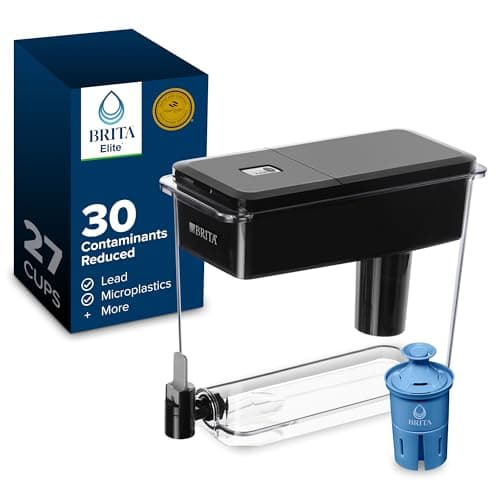 Brita UltraMax 27-Cup Dispenser with Elite Filter27 cups in the fridge, so the convenience argument for cases mostly disappears. Brita UltraMax 27-Cup Dispenser with Elite Filter27 cups in the fridge, so the convenience argument for cases mostly disappears. | Best bottled-water replacement | $49.98 - View on Amazon #ad Price as of October 17, 2026. We may earn a commission. Disclosure. |
| 2 | 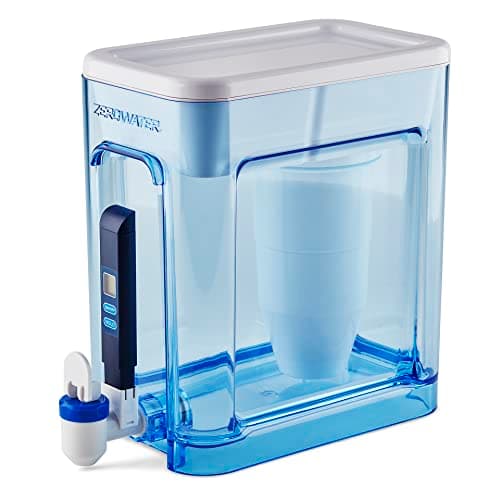 ZeroWater 22-Cup Ready-Read DispenserA built-in TDS readout, which is the closest thing in this category to the report bottled water does not send you. ZeroWater 22-Cup Ready-Read DispenserA built-in TDS readout, which is the closest thing in this category to the report bottled water does not send you. | If you want to verify it yourself | $36.99 - View on Amazon #ad Price as of October 17, 2026. We may earn a commission. Disclosure. |
| 3 | 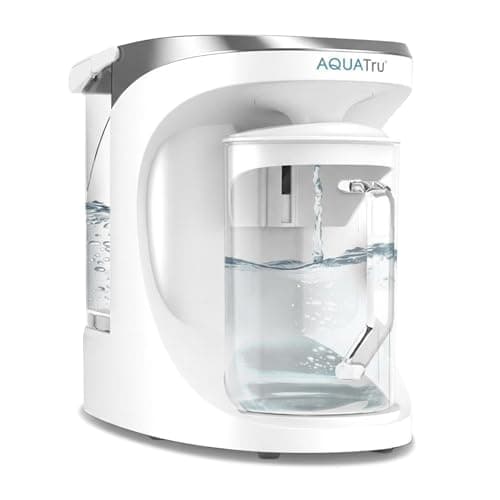 AquaTru Carafe Countertop Reverse Osmosis PurifierReverse osmosis is what most 'purified' bottled water is made with. This makes it on your counter. AquaTru Carafe Countertop Reverse Osmosis PurifierReverse osmosis is what most 'purified' bottled water is made with. This makes it on your counter. | If you are replacing 'purified' bottled water | $356.25 - View on Amazon $375.00 — 5% off #ad Price as of October 17, 2026. We may earn a commission. Disclosure. |
| 4 | 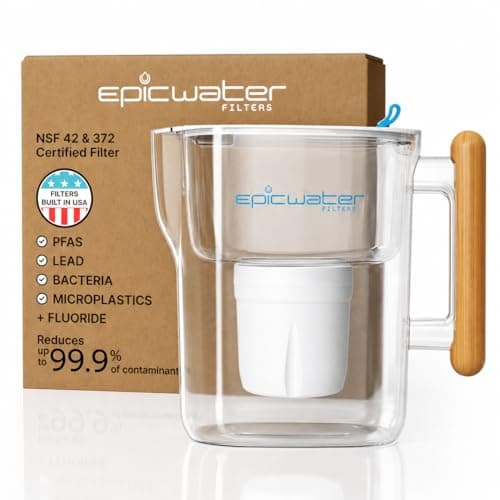 Epic Pure XP Water Filter PitcherA pitcher with a real NSF certification and published fluoride and PFAS test data. Epic Pure XP Water Filter PitcherA pitcher with a real NSF certification and published fluoride and PFAS test data. | Best for a single person | $89.00 - View on Amazon #ad Price as of October 17, 2026. We may earn a commission. Disclosure. |
The regulation question, which is the one that actually decides it
Almost everyone assumes bottled water is held to a higher standard than tap. The contaminant limits are in fact close to identical. The difference is in what each regulator can make a supplier do, and that is where the honest comparison lives.
The Government Accountability Office examined precisely this and titled its report plainly: Bottled Water: FDA Safety and Consumer Protections Are Often Less Stringent Than Comparable EPA Protections for Tap Water. The numeric standards of quality largely mirror EPA's national primary drinking water regulations — that is a statutory requirement — but FDA regulates bottled water as a food, and food law does not give it the monitoring and public-reporting powers the Safe Drinking Water Act gives EPA.
The concrete asymmetry is easiest to see in what lands in your hands. Your water utility must send you a Consumer Confidence Report — EPA requires community water systems to deliver one each year by July 1, listing the source, the regulated contaminants detected, the health effects of any violation and information on nitrate, arsenic, or lead where these may be a concern. A case of bottled water arrives with a brand name and a photograph of a mountain.
That is the real argument, and it is an argument about auditability rather than about purity. Tap water is the only drinking water in your house whose test results you are entitled to read. Reading yours is the single highest-value thing anyone on this page can do before buying anything at all.
What is actually in the bottle
Two findings matter here, and only one of them is about the water.
First, a large share of bottled water is filtered municipal water. "Purified" on a label is a process term, and the process is usually reverse osmosis or deionization applied to a public supply. Which is worth sitting with for a moment: a household buying purified bottled water is paying a per-liter price for the output of the same technology it could own for a few hundred dollars. The AquaTru Carafe in the picks makes exactly that product.
Second, the plastic. A January 2024 study in PNAS from a Columbia and Rutgers team used a new imaging technique and counted, in the average liter of bottled water, about 240,000 plastic particles, around 90% of them nanoplastics smaller than a micrometer — one to two orders of magnitude more than earlier microplastic-focused estimates. The researchers identified seven common polymers including PET and polyamide.
Now the honest caveats, because this finding gets badly oversold. The sample was small: five samples each of three unnamed brands, ranging from roughly 110,000 to 400,000 particles per liter. The health significance is unknown — a co-author put it as plainly as a scientist can, saying they do not know if it is dangerous or how dangerous. And the researchers attributed much of the plastic to the bottle itself and to the reverse osmosis membrane used in production, which means a membrane filter at home is not automatically outside the finding.
What the study does establish is directional rather than quantitative: the bottle is a source, not just a container. If microplastics are your reason for filtering, the microplastics roundup covers which cartridges hold an NSF/ANSI 401 claim for them, and a glass vessel rather than a plastic one is a cheap hedge — the glass pitcher roundup exists for people who have reached that conclusion.
Side by side
| Filtered tap water | Bottled water | |
|---|---|---|
| Who regulates it | EPA, under the Safe Drinking Water Act | FDA, as a food |
| Contaminant limits | National primary drinking water regulations | Standards of quality that largely mirror EPA's |
| Annual test report sent to you | Yes — required by July 1 each year | No |
| You can verify the treatment | Yes — NSF/ANSI certification listings | Only what the label chooses to say |
| Typical cost per gallon | Cents | Dollars |
| Plastic in the product | Depends on the vessel you choose | About 240,000 particles per liter in one 2024 study |
| Works in a boil-water notice | No | Yes |
| Works with no power or plumbing | A pitcher does | Yes |
Two rows are worth not glossing. Bottled water genuinely wins the last two, which is why the skip box above exists. And the contaminant-limits row is a tie, which is why the "bottled water is purer" framing does not survive contact with the regulations.
Spring, purified, mineral and distilled — what the labels mean
If you are going to buy bottled water sometimes, it is worth knowing which words are regulated descriptions of a process and which are scenery.
| Label | What it describes | What it tells you about purity |
|---|---|---|
| Spring water | Source — an underground formation flowing to the surface | Nothing. Untreated spring water carries whatever the aquifer holds |
| Purified | Process — usually reverse osmosis or deionization | That dissolved solids were largely removed. Often from a municipal supply |
| Distilled | Process — boiled and condensed | That essentially everything non-volatile was removed |
| Mineral water | Composition — a minimum dissolved solids content | That it has more dissolved solids, not fewer |
| Artesian | Source — a confined aquifer under pressure | Nothing about treatment |
| Drinking water | A catch-all | Nothing |
The pattern there is the practical point of this section. The two labels that describe real purification — purified and distilled — both name processes you can run at home. The distilled-water page covers when that one is worth it, and the filtration-versus-purification page separates the terms properly.
The honest case for bottled water
A comparison that only argues one way is not worth reading, so here is the other side properly rather than as a concession.
Bottled water needs no power, no plumbing, no installation and no maintenance, and it works when the tap does not. During a boil-water notice it is the recommended answer and no filter on this site substitutes for it. CDC names bottled water or ready-to-feed formula as the route when tap water may be unsafe or when a baby is in the high-risk group — the formula page covers that case in detail.
It also solves a problem filtration cannot: portability. Nothing in the filtered-water world is as convenient as a sealed bottle in a bag, and pretending otherwise is the kind of overreach that makes advice untrustworthy.
What the case does not support is bottled water as the household default. Bought by the case for ordinary daily drinking, it is the most expensive water in the house by a factor of roughly a hundred, it comes with no test report, and on current evidence it carries more plastic than the alternative.
The cost-per-gallon math
This is the comparison where the arithmetic is not close, so it is worth doing with your own numbers rather than taking a verdict.
Cost per gallon of bottled water: take the case price, divide by the number of bottles, divide by the bottle size in gallons. A 16.9 oz bottle is 0.132 gallons, so a 24-pack is about 3.2 gallons. A case at any realistic price lands somewhere in the dollars per gallon.
Cost per gallon of a filter: cartridge price divided by rated gallons, plus the hardware amortized over its life. A dispenser cartridge rated at 120 gallons, or an under-sink cartridge rated at 500, puts you in cents.
Then multiply by your actual consumption. A household drinking two gallons a day uses 730 gallons a year, which is about 230 cases of 24. That number is the whole argument, and it is why the hardware price stops mattering after the first few weeks.
We do not print product prices in this text. The buy buttons carry the live figure and the date it was checked, which is the only price worth quoting.
We show the arithmetic rather than a verdict so you can redo it with the price you actually pay. Filter prices move; the rated capacities above do not.
The picks in full
Best bottled-water replacement
Brita UltraMax 27-Cup Dispenser with Elite Filter
Brita
The dispenser whose filter outlasts its tank. The Elite cartridge it ships with is rated at 120 gallons, which is about 71 fills of this 27-cup reservoir — three times what the other two big dispensers manage.
Certification status
Ships with the Brita Elite filter, certified to NSF/ANSI 42, 53 and 401. Brita states the Elite removes 99% of lead and reduces microplastics. Per Brita's January 2026 performance data sheet the Elite is not certified for PFOA or PFOS. The dispenser also accepts the Standard filter, which is not certified for lead — the certification belongs to the cartridge, not the tank.
Published specifications
| Capacity | 27 cups |
|---|---|
| Dimensions | 9.67" H x 13.94" W x 5.19" L |
| Included filter | Brita Elite |
| Elite rated life | 120 gallons / about 6 months |
| Fills per filter | About 71 (120 gallons / 27 cups) |
| Lead | 99% reduction, Elite filter (Brita) |
| PFOA / PFOS | Not certified (January 2026 data sheet) |
| Fridge fit | Slim profile designed for a fridge shelf |
What we like
- The longest-lived certified filter of any dispenser here, by a factor of three
- Slim enough for a fridge door-side shelf, which the widest dispenser here is not
- Accepts any Brita pitcher filter, so replacements are stocked everywhere
What we do not
- No PFOA or PFOS certification — the wrong answer to a PFAS worry
- Refilling a 27-cup tank through a gravity filter takes a long time
- The cheaper listings ship with the Standard filter, which carries no lead claim — check the box
- Spigots on gravity dispensers drip if the seal is not seated properly
Skip it if
Households whose reason for filtering is PFAS. The Elite is not certified for PFOA or PFOS, and a bigger tank does not change that.
#ad Price as of October 17, 2026. We may earn a commission. Disclosure.
If you want to verify it yourself
ZeroWater 22-Cup Ready-Read Dispenser
ZeroWater
The PFAS answer in the dispenser format, with the TDS meter moved into the unit so you never have to guess. It also has the shortest filter life on the site, and on a 22-cup tank that turns into roughly eleven fills.
Certification status
Uses the ZeroWater 5-stage filter, which ZeroWater reports is certified by IAPMO against NSF/ANSI 42 and 53, with published reductions of 99% for PFOA/PFOS, 95% for lead and 99% for chromium-6. ZeroWater's own instruction is to replace the filter when the meter reads 006.
Published specifications
| Capacity | 22 cups |
|---|---|
| Dimensions | 5.5" L x 10.4" W x 11.3" H |
| Filter | ZeroWater 5-stage, ion exchange |
| Estimated filter life | About 15 gallons |
| Fills per filter | About 11 (15 gallons / 22 cups) |
| Meter | Built-in TDS readout — replace at 006 |
| PFOA / PFOS | 99% (IAPMO, NSF/ANSI 53) |
| Lead / chromium-6 | 95% / 99% |
What we like
- Certified for PFOA and PFOS, with the reduction published as a percentage
- The meter is built into the unit, so the change point is a reading rather than a guess
- Ion exchange drives dissolved solids far lower than any carbon filter
What we do not
- About 15 gallons per filter — the highest cost per gallon of anything on this page
- On hard or high-TDS water the filter life falls further, sometimes dramatically
- ZeroWater itself says exhausted filters make water taste acidic or fishy
- Some people find near-zero-TDS water tastes flat
Skip it if
Households on hard water who drink a lot. A 22-cup tank on a high-TDS supply can exhaust a filter in days, and an under-sink system becomes cheaper within months.
#ad Price as of October 17, 2026. We may earn a commission. Disclosure.
If you are replacing 'purified' bottled water
AquaTru Carafe Countertop Reverse Osmosis Purifier
AquaTru
The Classic's certification table in two-thirds of the footprint, pouring into glass instead of a plastic tank. You give up capacity and gain a published 63% recovery rate, which is better than almost any plumbed system manages.
Certification status
IAPMO publishes a performance data sheet covering Carafe models AT100, AT110, AT120, AT130 and AT140, certified under NSF/ANSI 42, 53 and 58, with additional testing to NSF/ANSI 401 and NSF Protocol 53 for PFOA and PFOS. The NSF/ANSI 58 table records average reductions of 99.2% for lead, 99.9% for cysts, 96.4% for fluoride, 98.8% for pentavalent arsenic, 97.5% for hexavalent chromium, 98.3% for nitrate and 94.4% for TDS. PFOA and PFOS average 99% under NSF Protocol 53.
Published specifications
| Filtration | 4-stage countertop reverse osmosis |
|---|---|
| Carafe | 64 oz borosilicate glass |
| Clean water tank | 0.5 gallons (1.9 L) |
| Tap water tank | 0.66 gallons (2.5 L) |
| Daily production rate | 35 GPD |
| Efficiency rating | 63% (IAPMO) |
| Certified standards | NSF/ANSI 42, 53, 58 (IAPMO) |
| Dimensions | 13 in H x 14 in D x 7.5 in W |
| Power | 120 V, 60 Hz |
| Max inlet hardness | 10 gpg (171 mg/L) |
What we like
- A published 63% efficiency rating — most tank reverse osmosis systems send three or four gallons to drain per gallon produced
- The NSF/ANSI 58 claim list reaches lead, fluoride, nitrate, arsenic, chromium-6 and cysts, which carbon cannot
- Glass carafe rather than a plastic holding tank, and it goes in the fridge
- No plumbing, no drilling and no drain saddle — the whole certification travels with a renter
What we do not
- A 0.5 gallon clean tank against the Classic's 0.75 — you refill it more often for the same household
- Three cartridges on three different clocks, and the manufacturer's web page and the certifier's data sheet disagree on the pre/carbon interval
- Needs a counter outlet and 7.5 inches of width it does not share
- Not for water above 10 gpg hardness without softening first, or the membrane scales
Skip it if
A household that drinks a lot of water. The clean tank holds half a gallon and refills at 35 gallons a day, so a family of four will be waiting on it. Buy the Classic for its larger tanks, or a plumbed under-sink system if you can install one.
$375.00 — 5% off
#ad Price as of October 17, 2026. We may earn a commission. Disclosure.
Best for a single person
Epic Pure XP Water Filter Pitcher
Epic Water Filters
The newer Epic pitcher, and the more honest one: NSF certified for chlorine and materials, lab-tested for the rest, with a shorter cartridge life than the original Pure and a shorter headline claim count. Better paperwork, fewer gallons.
Certification status
Epic states the Pure XP is NSF certified to NSF/ANSI 42 and NSF/ANSI/CAN 372, and lab-tested to NSF/ANSI 53, 401 and P231 methods. NSF's own listing records Epic's PureXP and NanoXP filters under NSF/ANSI 42. Published laboratory figures include 99.2% fluoride, 99.9% lead and 99.9% PFAS — test data rather than certified claims.
Published specifications
| Rated filter life | 100 gallons / about 3-4 months |
|---|---|
| Certified | NSF/ANSI 42 and 372 (NSF) |
| Lab-tested | NSF/ANSI 53, 401 and P231 methods |
| Contaminants claimed | 70+ |
| Fluoride | 99.2% (laboratory data) |
| Lead | 99.9% (laboratory data) |
| PFAS | 99.9% (laboratory data) |
What we like
- A genuine NSF certification, which most wide-claim pitchers do not hold at all
- Published fluoride and PFAS figures, which certified mainstream pitchers do not claim
- Clear separation on Epic's own pages between what is certified and what is tested
What we do not
- 100 rated gallons against the original Pure's 150 — fewer gallons for better paperwork
- The certification covers chlorine, taste, odor and materials, not the headline claim list
- Premium cartridge price, so cost per gallon is high next to a certified mainstream pitcher
- Gravity flow through dense media is slow
Skip it if
Anyone who needs a certification listing naming fluoride or PFAS. No pitcher holds one; reverse osmosis is the certified route for both.
#ad Price as of October 17, 2026. We may earn a commission. Disclosure.
Questions people actually ask
Is filtered water better than bottled water?
On evidence and cost, yes. GAO's report is titled 'FDA Safety and Consumer Protections Are Often Less Stringent Than Comparable EPA Protections for Tap Water', and your utility must send you an annual report of what it detected while a bottle arrives with no test data at all. A 2024 PNAS study also counted roughly 240,000 plastic particles per liter of bottled water. Bottled water still wins during a boil-water notice and for portability.
Is bottled water more regulated than tap water?
No. FDA's numeric standards of quality for bottled water largely mirror EPA's national primary drinking water regulations — that is required by statute — but FDA regulates bottled water as a food and lacks the monitoring and public-reporting powers EPA has under the Safe Drinking Water Act. GAO found FDA's protections often less stringent than EPA's comparable protections for tap water.
How much plastic is in bottled water?
A January 2024 PNAS study from Columbia and Rutgers counted about 240,000 plastic particles in the average liter, roughly 90% of them nanoplastics under one micrometer, across five samples each of three unnamed brands ranging from about 110,000 to 400,000 per liter. Health effects are unknown — a co-author said they do not know if it is dangerous or how dangerous. The researchers attributed much of it to the bottle and to the reverse osmosis membrane used in production.
Is bottled water just filtered tap water?
Often, yes. 'Purified' is a process description rather than a source description, and the process is usually reverse osmosis or deionization applied to a municipal supply. A household buying purified bottled water is paying by the liter for the output of a technology it could own outright.
What is the cheapest way to stop buying bottled water?
A filtered dispenser in the fridge, because convenience is the real reason people buy cases rather than purity. A 27-cup dispenser such as the Brita UltraMax removes the 'there is nothing cold to grab' problem that bottles solve. Work the cost out per gallon: a cartridge price divided by its rated gallons lands in cents, against dollars per gallon for cases.
When should I use bottled water instead of filtered?
During a boil-water notice, when your tap water has a chemical contaminant your filter is not certified to remove, when you need portability, and when CDC's infant guidance points to it — for babies under two months, born preterm or immunocompromised, where bottled water or ready-to-feed formula is the alternative to boiling. Outside those cases it is the most expensive water in the house.
Does spring water mean it is cleaner?
No. 'Spring water' describes where the water came from, not what was done to it, and an aquifer carries whatever minerals and contaminants it runs through. The only bottled-water labels that describe actual purification are process words — purified and distilled — and both name processes you can run at home.
Sources
- GAO-09-610 — Bottled Water: FDA Safety and Consumer Protections Are Often Less Stringent Than Comparable EPA Protections for Tap Water
- EPA — Consumer Confidence Reports: information for consumers
- Qian, Gao, Yan, Min et al., PNAS (2024) — rapid single-particle chemical imaging of nanoplastics in bottled water
- CDC — Infant formula preparation and storage
- NSF — Certified Products and Systems