
A remineralizing reverse osmosis system adds a cartridge after the membrane that puts calcium and magnesium back into the water, raising pH and restoring the mineral taste that pure RO water lacks. It is a taste and palatability upgrade with a modest running cost, not a health claim.
Quick picks
Tap any row to jump to the full write-up. The button goes straight to the retailer.
| # | Product | Best for | Price |
|---|---|---|---|
| 1 | 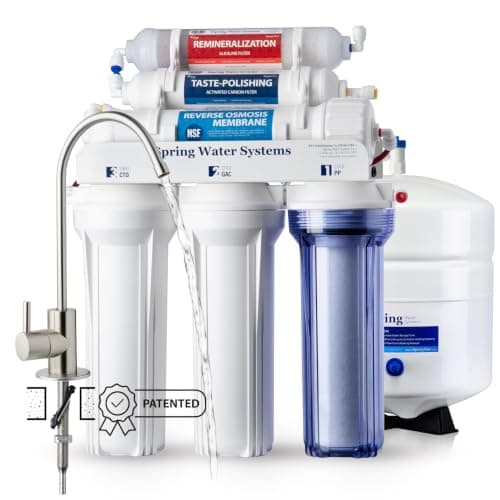 iSpring RCC7AK 6-Stage Reverse Osmosis SystemSix stages with an alkaline remineralization cartridge, NSF/ANSI 58 certified, 97.4% fluoride published. iSpring RCC7AK 6-Stage Reverse Osmosis SystemSix stages with an alkaline remineralization cartridge, NSF/ANSI 58 certified, 97.4% fluoride published. | Best overall | $188.81 - View on Amazon $234.99 — 20% off #ad Price as of October 7, 2026. We may earn a commission. Disclosure. |
| 2 | 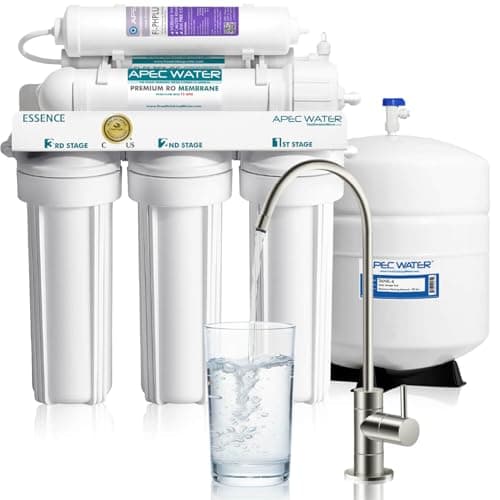 APEC ROES-PH75 Essence 6-Stage Alkaline RO SystemCalcite remineralization stage, WQA Gold Seal certified, and no power requirement anywhere. APEC ROES-PH75 Essence 6-Stage Alkaline RO SystemCalcite remineralization stage, WQA Gold Seal certified, and no power requirement anywhere. | Best built | $189.99 - View on Amazon $294.99 — 36% off #ad Price as of October 7, 2026. We may earn a commission. Disclosure. |
| 3 | 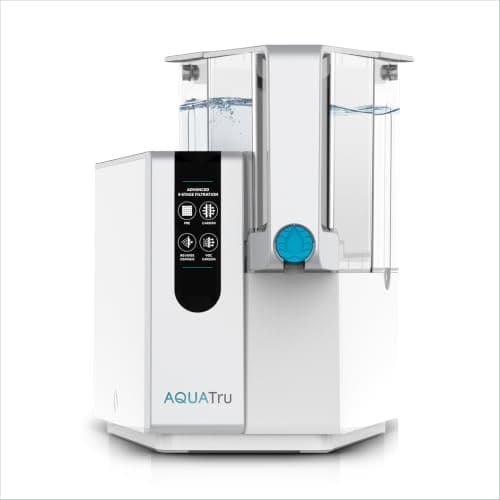 AquaTru Classic Countertop Reverse Osmosis PurifierCountertop RO certified by IAPMO across 84 contaminants; the alkaline cartridge is a separate purchase. AquaTru Classic Countertop Reverse Osmosis PurifierCountertop RO certified by IAPMO across 84 contaminants; the alkaline cartridge is a separate purchase. | No plumbing | $403.75 - View on Amazon $475.00 — 15% off #ad Price as of October 7, 2026. We may earn a commission. Disclosure. |
What the extra cartridge does
A reverse osmosis membrane does not choose. It rejects dissolved solids, and calcium and magnesium are dissolved solids, so they leave with the nitrate and the fluoride. What comes out is water with a total dissolved solids reading near zero and a pH that typically sits slightly acidic because there is nothing left to buffer it.
A remineralizing stage — sold as "alkaline", "pH+" or "mineral boost" depending on the brand — is a small cartridge after the membrane, packed with calcium and magnesium mineral media. Water flows through it on the way to the faucet, dissolves a little of the media, and arrives with some mineral content and a pH nearer neutral or slightly above.
That is the whole mechanism. It is simple, it works, and the marketing around it is considerably larger than the effect.
How we judged these
- Is the base system certified? The remineralizing cartridge is an accessory to a reverse osmosis system, and the system is what has to hold a certification. A mineral stage on an uncertified system is a garnish on an unverified meal.
- Is the mineral stage a separate cartridge with its own cost? It usually is, and it usually needs replacing on its own schedule.
- Does the system need power? Tankless systems do. Conventional tank systems generally do not, which matters in a cabinet with no outlet.
- Is the claim honest? We discount any product that sells the mineral stage as a health benefit, because no certification covers that and the dietary contribution is small.
The three systems
| iSpring RCC7AK | APEC ROES-PH75 | AquaTru Classic | |
|---|---|---|---|
| Format | Under-sink, tank | Under-sink, tank | Countertop, no plumbing |
| Stages | 6 including alkaline | 6 including calcite | 4, alkaline cartridge sold separately |
| Certification | NSF/ANSI 58 and WQA Gold Seal | WQA Gold Seal | IAPMO, 84 contaminants |
| Power needed | No | No | Yes, it is an appliance |
| Rated production | 75 GPD | 75 GPD | Batch, tank to tank |
| Mineral stage | Alkaline remineralization cartridge | Calcite remineralization cartridge | Alkaline carbon cartridge |
What it does to the water, honestly
Taste. This is the real reason to buy one. Water with almost no dissolved solids tastes flat or thin to many people — it is the most common complaint from new reverse osmosis owners, and a remineralizing stage fixes it directly.
pH. Reverse osmosis water often reads slightly acidic. A mineral stage moves it back toward neutral. Manufacturers market bigger numbers than that; treat any promise of dramatically alkaline water from a passive mineral cartridge with suspicion.
Health. Very little. We went through the mineral question in detail, and the short version is that drinking water is a minor contributor of calcium and magnesium next to food. If a company implies otherwise, that is a marketing claim with no certification behind it.
Coffee and tea. Genuinely affected, and not always in the direction you expect. Extraction needs some mineral content; pure reverse osmosis water sits below the range the Specialty Coffee Association recommends. The coffee water page has the numbers.
What it does not change
Everything the membrane already did. The system still reduces the same contaminants, still carries the same certification, still makes wastewater. A remineralizing cartridge is downstream of all of it, so it does not restore fluoride, nitrate or anything else the membrane rejected — the fluoride question comes up constantly here and the answer is no.
It also does not soften anything. If you have hard water, the scale problem is upstream, in the whole house, and a softener and a reverse osmosis system solve different problems.
The cost-per-gallon math
The remineralizing stage adds a cartridge to the rotation. On the tank systems here it is typically an annual part, on top of the sediment and carbon prefilters and a membrane every two to three years.
Set against the purchase price of the system, that is a small addition. Set against the alternative — buying bottled mineral water because your RO water tastes flat — it is trivially worth it. Set against a health claim, it is money spent on nothing, which is why this page keeps saying the reason to buy it is taste.
We show the arithmetic rather than a verdict so you can redo it with the price you actually pay. Filter prices move; the rated capacities above do not.
The picks in full
Best overall
iSpring RCC7AK 6-Stage Reverse Osmosis System
iSpring
The value pick of the reverse-osmosis tier: a WQA Gold Seal system with an alkaline stage, usually at the lowest price of anything here that carries a real certification.
Certification status
Certified against NSF/ANSI 58 for TDS reduction and carries the WQA Gold Seal, with 97.2% TDS removal certified.
Published specifications
| Output | 75 GPD |
|---|---|
| Stages | 6, including alkaline remineralization |
| Certified TDS reduction | 97.2% |
| Feed pressure | 45-70 psi |
| Feed temperature | 40-100 degrees F |
| Assembled size | 15.5" deep x 19.5" high, 25 lb |
| Certification | NSF/ANSI 58, WQA Gold Seal |
What we like
- Certified performance at the lowest price in the tier
- Push-fit tubing makes a first-time install genuinely manageable
- Alkaline stage included rather than sold as an upgrade
What we do not
- Narrow 45-70 psi feed window — low-pressure homes may need a booster pump
- Tank plus housing needs real cabinet depth
- Conventional reverse-osmosis drain ratio
Skip it if
Homes with feed pressure below 45 psi that will not add a booster pump, and anyone who wants a tankless footprint.
$234.99 — 20% off
#ad Price as of October 7, 2026. We may earn a commission. Disclosure.
Where these specifications came from
Best built
APEC ROES-PH75 Essence 6-Stage Alkaline RO System
APEC Water Systems
A conventional tank system that uses ordinary 10-inch cartridges rather than proprietary pods, which keeps the ten-year running cost sane. The sixth stage puts minerals back for people who dislike RO's flat taste.
Certification status
WQA Gold Seal certified.
Published specifications
| Output | 75 GPD at 60 psi and 77 degrees F |
|---|---|
| Tank capacity | 4 gallons |
| Stages | 6, including a calcite remineralization stage |
| Feed pressure | 40-85 psi |
| Max feed TDS | 2,000 ppm |
| System dimensions | 15.5" L x 5.25" W x 17.5" H, plus a separate tank |
| Certification | WQA Gold Seal |
What we like
- Standard-size cartridges, so replacements are cheap and sourceable from many brands
- Calcite stage restores minerals and lifts the pH of reverse-osmosis water
- No electricity required
What we do not
- The 4-gallon tank plus housing takes most of an under-sink cabinet
- Slower than tankless systems, and it pauses while the tank refills
- Conventional wastewater ratio, well short of the G3P800's 3:1
Skip it if
Small cabinets. Measure before you buy — the tank alone is roughly 11 x 11 x 15 inches, and people discover this after delivery.
$294.99 — 36% off
#ad Price as of October 7, 2026. We may earn a commission. Disclosure.
Where these specifications came from
No plumbing
AquaTru Classic Countertop Reverse Osmosis Purifier
AquaTru
Reverse osmosis performance with no plumbing, no drilling and no landlord conversation. You pay for that with counter space, a wait, and two tanks you fill and empty by hand.
Certification status
Certified by IAPMO to NSF/ANSI 53, 58, 401 and P473, covering lead, reverse-osmosis performance, emerging compounds and the PFOA/PFOS protocol.
Published specifications
| Filtration | 4-stage countertop reverse osmosis |
|---|---|
| Clean water tank | 0.75 gallons |
| Tap water tank | 1 gallon |
| Installation | None — no plumbing connection |
| Certified standards | NSF/ANSI 53, 58, 401, P473 (IAPMO) |
What we like
- Real reverse osmosis with a P473 PFOA/PFOS certification and zero installation
- The strongest answer available to a renter with a lead or PFAS problem
- No drilling, no drain saddle, no landlord permission needed
What we do not
- Takes up substantial counter space
- You refill and empty tanks by hand — it is not on-demand
- Highest purchase price in the no-plumbing tier by a wide margin
Skip it if
Anyone who can plumb in an under-sink system. A permanent under-sink RO is cheaper per gallon, on-demand, and out of sight. Buy this when you genuinely cannot install.
$475.00 — 15% off
#ad Price as of October 7, 2026. We may earn a commission. Disclosure.
Where these specifications came from
Questions people actually ask
What does a remineralizing reverse osmosis system do?
It adds a cartridge after the membrane containing calcium and magnesium media. Water dissolves a small amount on its way to the faucet, which restores some mineral content and raises pH from slightly acidic toward neutral. It is a taste and palatability change, not a treatment step.
Is alkaline reverse osmosis water healthier?
There is no certification for that claim and the dietary contribution is small — most calcium and magnesium comes from food. The honest reasons to buy the stage are taste, pH and brewing. Anything beyond that is marketing.
Does remineralization put contaminants back?
No. The cartridge sits after the membrane and adds calcium and magnesium salts only. It does not restore fluoride, nitrate, lead or anything else the membrane rejected.
Do I need a remineralizing filter for coffee?
If you brew with reverse osmosis water, some mineral content helps. The Specialty Coffee Association's standard targets 150 mg/L of total dissolved solids, and untreated RO water sits far below that, which tends to make coffee taste thin and flat.
How often does the mineral cartridge need changing?
Typically annually on the under-sink systems here, though it depends on how much water you draw. It is an additional cartridge on top of the prefilters and the membrane, so factor it into the running cost rather than the purchase price.