
Yes — a reverse osmosis membrane rejects calcium and magnesium along with the contaminants. USDA's nationally representative survey of US tap water found that at two liters a day, only four minerals supply more than 1% of the Daily Value: copper at 10%, calcium 6%, magnesium 5% and sodium 3%.
Quick picks
Tap any row to jump to the full write-up. The button goes straight to the retailer.
| # | Product | Best for | Price |
|---|---|---|---|
| 1 | 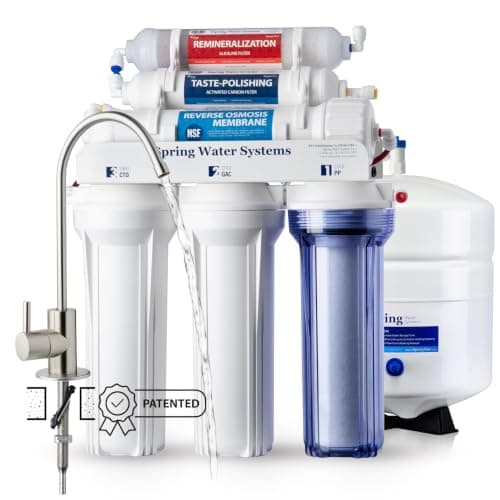 iSpring RCC7AK 6-Stage Reverse Osmosis SystemThe alkaline stage is part of the standard 6-stage build, not an upsell. iSpring RCC7AK 6-Stage Reverse Osmosis SystemThe alkaline stage is part of the standard 6-stage build, not an upsell. | Best with remineralization included | $198.75 - View on Amazon $234.99 — 15% off #ad Price as of October 6, 2026. We may earn a commission. Disclosure. |
| 2 | 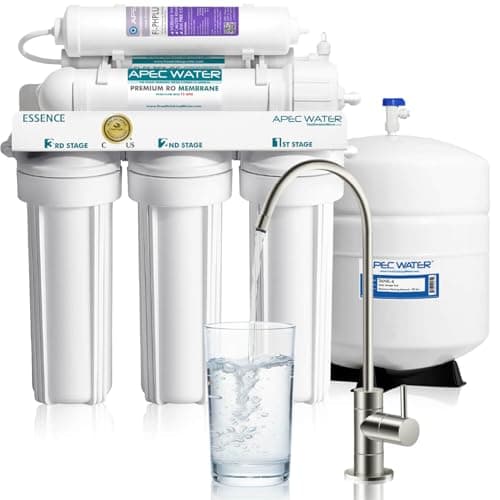 APEC ROES-PH75 Essence 6-Stage Alkaline RO SystemCalcite stage using standard 10-inch cartridges, so replacements stay inexpensive. APEC ROES-PH75 Essence 6-Stage Alkaline RO SystemCalcite stage using standard 10-inch cartridges, so replacements stay inexpensive. | Cheapest to keep remineralized | $189.99 - View on Amazon $294.99 — 36% off #ad Price as of October 6, 2026. We may earn a commission. Disclosure. |
| 3 | 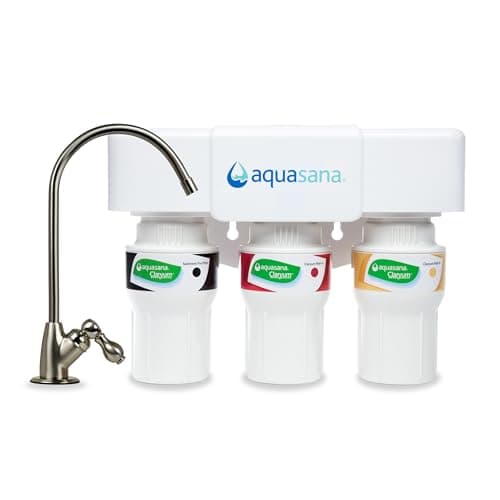 Aquasana Claryum 3-Stage Under-Sink Filter (AQ-5300)Certified carbon block: it never removes them, so nothing has to be added back. Aquasana Claryum 3-Stage Under-Sink Filter (AQ-5300)Certified carbon block: it never removes them, so nothing has to be added back. | Best if you want to keep the minerals | $154.99 - View on Amazon $349.99 — 56% off #ad Price as of October 6, 2026. We may earn a commission. Disclosure. |
What reverse osmosis actually does to minerals
Reverse osmosis works by exclusion rather than adsorption: household pressure pushes water against a semipermeable membrane, water molecules pass, and dissolved ions are rejected on the basis of size and charge. The membrane has no way to distinguish a calcium ion you might want from a fluoride or nitrate ion you do not. Both are rejected together.
So the answer to the headline question is an unqualified yes, and the interesting question is the next one: how much did those minerals matter?
The measurement nobody quotes
USDA's Agricultural Research Service ran a nationally representative survey of residential tap water — 144 locations selected by a probability-proportional-to-size method across census regions, sampled twice, analyzed by ICP atomic emission spectrometry. It is the first nationally representative data set of mineral values for US municipal drinking water, and it answers this question directly.
Their finding, in their own framing: assuming two liters of tap water are consumed daily, only four minerals provided more than 1% of the US Daily Value: copper, 10%; calcium, 6%; magnesium, 5%; and sodium, 3%.
| Mineral | Share of Daily Value from 2 L of US tap water | What RO does to it |
|---|---|---|
| Copper | 10% | Removed — and this one you generally want removed |
| Calcium | 6% | Removed |
| Magnesium | 5% | Removed |
| Sodium | 3% | Removed |
| Everything else measured | Under 1% each | Removed |
Read that honestly in both directions. Five or six percent of a daily value is not nothing, particularly for someone whose diet is already short on those minerals. It is also not the "dead water" of RO marketing's opponents, and it is comfortably replaceable by ordinary food. The USDA study also notes that its authors found, on average, that the calcium and magnesium content of US drinking water already meets the 20 to 30 mg/L calcium and 10 mg/L magnesium suggested by epidemiological research — which is the level the remineralization debate is actually about.
The detail that catches softener owners
The same study found significant decreases in calcium in homes with chemical water softeners — mean 3.2 versus 2.0 mg per 100 g, with a much larger drop in the medians. An ion-exchange softener is already removing the calcium and magnesium from your water before the RO system ever sees it.
Which means the mineral argument against reverse osmosis mostly evaporates in a softened house: those minerals left at the softener. The softener versus filter guide covers how the two interact, and softener-plus-RO remains one of the most common combinations in hard-water homes for good reasons.
Taste is the real complaint
Almost everyone who dislikes RO water describes it in flavor terms rather than health terms: flat, thin, soft, empty. That is a real perception. Dissolved minerals contribute to how water feels in the mouth, and stripping them out changes it — for some people pleasantly, for others noticeably worse.
It is also personal. Households moving from very hard water often prefer the change immediately; people who liked their mineral-rich supply frequently do not. This is the rare specification you can only settle by tasting it, which is why the honest advice is to try the system unremineralized before paying to add a stage.
How remineralization works, and what it costs
| Approach | How | Trade-off |
|---|---|---|
| Calcite / alkaline cartridge | Water passes over mineral media after the membrane | One more cartridge to buy and replace |
| Mineral drops or salts | Added by hand to the pitcher or bottle | Cheap, fiddly, easy to forget |
| Blend a small unfiltered fraction | Not available on consumer systems | Reintroduces what you filtered out |
| Do nothing | Drink it as it comes | Free. Works for most people |
On this site's picks the difference is mostly whether the stage is included. The iSpring RCC7AK ships with an alkaline remineralization stage as part of the standard six-stage build. The APEC ROES-PH75 includes a calcite stage and uses ordinary 10-inch cartridges, which is what keeps its long-run running cost low. The Waterdrop G3P800 offers remineralization as a variant rather than a default.
A caution on the language: "alkaline" on these products means the water leaves slightly higher in pH because minerals were added back. It is a taste and mineral-content claim, not a health claim, and no NSF/ANSI standard certifies alkalinity as a benefit.
What a TDS meter is telling you
If you own an RO system you will probably end up with a TDS meter, and it is easy to misread. The number is total dissolved solids — every dissolved ion together, wanted and unwanted. A low reading after the membrane means the membrane is working. It does not mean the water is safe, and a higher reading after a remineralization stage does not mean the system has failed. It means minerals were deliberately added back.
The useful way to use one is as a trend: record the reading when the system is new, then watch for the day it starts climbing. That is your membrane telling you it is nearing the end.
If the mineral question bothers you, consider skipping RO
Reverse osmosis is the right answer for fluoride, nitrate, arsenic and total dissolved solids. It is over-engineering for chlorine and lead, and a certified carbon block reaches both of those without touching the minerals at all.
If your only concerns are taste and lead, the Aquasana Claryum 3-Stage is certified to NSF/ANSI 42, 53 and 401, wastes no water, needs no drain connection and leaves the calcium and magnesium exactly where they were. The under-sink roundup lays out which contaminant belongs to which technology, and filtration versus reverse osmosis makes the same case in more depth. Buying RO and then paying to add minerals back is a long way round to water a carbon block would have given you directly.
The cost-per-gallon math
Remineralization is a small recurring cost attached to a larger one, and it is worth sizing before you commit.
A calcite or alkaline stage is one more cartridge on the annual schedule. Where it uses a standard 10-inch housing, replacements are competitively priced from many manufacturers; where it is proprietary, the system's maker sets the price for the life of the unit.
Set that against what you are buying: on the USDA numbers, the calcium in two liters of tap water is about 6% of a daily value. If the stage exists for taste, it is worth whatever the taste is worth to you. If it is being sold to you on nutrition, that is the figure to weigh it against.
We show the arithmetic rather than a verdict so you can redo it with the price you actually pay. Filter prices move; the rated capacities above do not.
The picks in full
Best with remineralization included
iSpring RCC7AK 6-Stage Reverse Osmosis System
iSpring
The value pick of the reverse-osmosis tier: a WQA Gold Seal system with an alkaline stage, usually at the lowest price of anything here that carries a real certification.
Certification status
Certified against NSF/ANSI 58 for TDS reduction and carries the WQA Gold Seal, with 97.2% TDS removal certified.
Published specifications
| Output | 75 GPD |
|---|---|
| Stages | 6, including alkaline remineralization |
| Certified TDS reduction | 97.2% |
| Feed pressure | 45-70 psi |
| Feed temperature | 40-100 degrees F |
| Assembled size | 15.5" deep x 19.5" high, 25 lb |
| Certification | NSF/ANSI 58, WQA Gold Seal |
What we like
- Certified performance at the lowest price in the tier
- Push-fit tubing makes a first-time install genuinely manageable
- Alkaline stage included rather than sold as an upgrade
What we do not
- Narrow 45-70 psi feed window — low-pressure homes may need a booster pump
- Tank plus housing needs real cabinet depth
- Conventional reverse-osmosis drain ratio
Skip it if
Homes with feed pressure below 45 psi that will not add a booster pump, and anyone who wants a tankless footprint.
$234.99 — 15% off
#ad Price as of October 6, 2026. We may earn a commission. Disclosure.
Where these specifications came from
Cheapest to keep remineralized
APEC ROES-PH75 Essence 6-Stage Alkaline RO System
APEC Water Systems
A conventional tank system that uses ordinary 10-inch cartridges rather than proprietary pods, which keeps the ten-year running cost sane. The sixth stage puts minerals back for people who dislike RO's flat taste.
Certification status
WQA Gold Seal certified.
Published specifications
| Output | 75 GPD at 60 psi and 77 degrees F |
|---|---|
| Tank capacity | 4 gallons |
| Stages | 6, including a calcite remineralization stage |
| Feed pressure | 40-85 psi |
| Max feed TDS | 2,000 ppm |
| System dimensions | 15.5" L x 5.25" W x 17.5" H, plus a separate tank |
| Certification | WQA Gold Seal |
What we like
- Standard-size cartridges, so replacements are cheap and sourceable from many brands
- Calcite stage restores minerals and lifts the pH of reverse-osmosis water
- No electricity required
What we do not
- The 4-gallon tank plus housing takes most of an under-sink cabinet
- Slower than tankless systems, and it pauses while the tank refills
- Conventional wastewater ratio, well short of the G3P800's 3:1
Skip it if
Small cabinets. Measure before you buy — the tank alone is roughly 11 x 11 x 15 inches, and people discover this after delivery.
$294.99 — 36% off
#ad Price as of October 6, 2026. We may earn a commission. Disclosure.
Where these specifications came from
Best if you want to keep the minerals
Aquasana Claryum 3-Stage Under-Sink Filter (AQ-5300)
Aquasana
Carbon-block filtration rather than reverse osmosis: it keeps the minerals, wastes nothing, and fits where a reverse-osmosis system will not. It also cannot do what RO does for fluoride or nitrate.
Certification status
WQA tested and certified to NSF/ANSI 42, 53 — which includes the P473 protocol for PFOA and PFOS — and 401, for the reduction of 78 contaminants. Aquasana publishes 99.6% for lead and microplastics, 99.7% for PFOA and PFOS, 99.99% for cysts and 97% for chlorine across the Claryum 3-Stage line.
Published specifications
| Filter life | 600 gallons / up to 6 months |
|---|---|
| Certified standards | NSF/ANSI 42, 53 (includes P473), 401 (WQA) |
| Flow rate | 0.5 gpm |
| Wastewater | None |
| Format | 3-stage carbon block with a dedicated faucet |
| Contaminants claimed | 78 |
| Lead / PFOA and PFOS | 99.6% / 99.7% |
What we like
- No drain line, no wastewater, no tank — much easier to install than reverse osmosis
- NSF/ANSI 401 certification covers pharmaceutical-class trace compounds
- Full flow rate, unlike reverse osmosis, so filling a pot is not a project
What we do not
- Not reverse osmosis: no meaningful fluoride, nitrate or TDS reduction
- 600-gallon filter life is short next to an inline system's tens of thousands
- Proprietary cartridges
Skip it if
Anyone whose problem is fluoride, nitrate or total dissolved solids. Carbon block does not remove those; you need reverse osmosis for that job.
$349.99 — 56% off
#ad Price as of October 6, 2026. We may earn a commission. Disclosure.
Questions people actually ask
Does reverse osmosis remove all minerals from water?
It removes the great majority of dissolved minerals, because the membrane rejects ions by size and charge without distinguishing useful from unwanted. Systems with a remineralization or alkaline stage add a portion back after the membrane.
Is drinking demineralized RO water bad for you?
The measured contribution being lost is small: USDA's nationally representative survey found that two liters of US tap water supplies about 6% of the calcium Daily Value and 5% of the magnesium. For a normal diet that is easily covered by food. If your diet is genuinely low in those minerals, that is a conversation with a clinician rather than a filter salesperson.
Do I need a remineralization filter?
Only if you dislike the taste. It is a flavor and mouthfeel decision on the published numbers, and it adds a cartridge to buy and replace. Drink the water unremineralized first, then decide.
Does a water softener remove minerals too?
Yes — that is exactly what it does. It exchanges calcium and magnesium for sodium, and the USDA survey measured significantly lower calcium in homes with chemical softeners. In a softened house the minerals are already gone before the RO system sees the water.
Why does reverse osmosis water taste flat?
Dissolved minerals contribute to mouthfeel, and removing them changes how water tastes. Whether that reads as clean or as flat is genuinely personal, which is why remineralization stages exist and why we suggest tasting before buying one.