
The Rhino EQ-1000 is certified by NSF International to NSF/ANSI 42 with the tank certified to NSF/ANSI 61, rated for 1,000,000 gallons or up to ten years, with published chlorine reduction over 97%. It is a chlorine and aesthetics system and does not claim to be more.
Quick picks
Tap any row to jump to the full write-up. The button goes straight to the retailer.
| # | Product | Best for | Price |
|---|---|---|---|
| 1 | 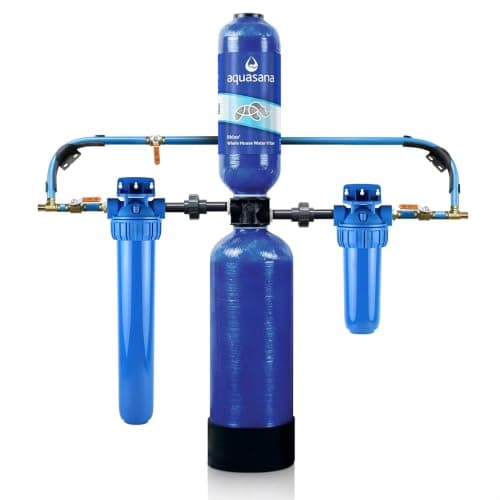 Aquasana Rhino EQ-1000 Whole-House FilterNSF/ANSI 42, tank to NSF/ANSI 61, 1,000,000 gallons, 7.0 gpm. Aquasana Rhino EQ-1000 Whole-House FilterNSF/ANSI 42, tank to NSF/ANSI 61, 1,000,000 gallons, 7.0 gpm. | The system reviewed here | $1,123.00 - View on Amazon #ad Price as of October 17, 2026. We may earn a commission. Disclosure. |
| 2 | Sno photoSpringWell CF1 Whole-House Carbon FilterCatalytic carbon, which handles chloramine better than standard activated carbon. | If you have chloramine | Sold direct by SpringWell Water. No affiliate link, so nothing to click and nothing for us to earn. The maker's page is in the sources below. Disclosure. |
| 3 | Wno photoWhirlpool WHES40E 40,000-Grain Water SoftenerThe Rhino does nothing for hardness. This is the machine that does. | What it does not do | Check price on Amazon #ad We do not show a price we cannot verify today. We may earn a commission. Disclosure. |
What it is for
Chlorine at every tap, for a decade, with essentially no maintenance routine. That is the product. If your municipal supply carries a strong disinfectant residual and you notice it in the shower as much as in the glass, this is the tier and this is the mainstream system in it.
People who install these consistently report the shower rather than the kitchen as the noticeable change, which makes sense: a pitcher already fixes the drinking water and nothing fixes the shower except point-of-entry treatment.
Specifications
| Specification | Published figure |
|---|---|
| Rated capacity | 1,000,000 gallons / up to 10 years |
| Rated flow | 7.0 gpm |
| Max operating pressure | 100 psi |
| Operating temperature | 40-90 degrees F |
| Dimensions | 46" L x 9" W x 44" H |
| Weight | 44.1 lb |
| Certification | NSF/ANSI 42; tank to NSF/ANSI 61 |
| Published chlorine reduction | Greater than 97% |
| Media | Copper-zinc (KDF) and activated carbon |
| Components | 20" pre-filter, filter tank, 10" post-filter, assembly kit |
The certification, precisely
Certified by NSF International to NSF/ANSI 42. That standard covers aesthetic effects: taste, odor and chlorine. It is a real, verified certification from the body that writes the standards, and it is not a health-effects claim.
Separately, the tank is certified to NSF/ANSI 61 for material safety — meaning the tank itself does not contribute contaminants to the water passing through it. That is a meaningful certification for a vessel your entire household supply flows through, and not every point-of-entry system publishes it.
The maintenance story is the selling point
A million gallons or ten years of media life means the main tank is not something you think about. The pre-filter is a routine change; the tank is not.
Set that against a cartridge system asking for two or three heavy, wet cartridges every year for ten years. Some households will do that reliably. Many will not, and a cartridge system two years overdue is restricting flow and no longer performing.
Installation
It is a main-line install: cutting into where water enters the building, ideally with a bypass loop so the system can be serviced without shutting the house off. The unit is 46 inches long and 44 inches high, so it needs a real location — a garage, a basement or a utility space, with headroom.
Budget for a plumber unless you are comfortable cutting and joining the main. A mistake here does not drip quietly under a cabinet.
What it does not do, restated
- Hardness. No softening at all. Your kettle scales exactly as before.
- Lead. NSF/ANSI 42 is not a lead certification, and lead enters downstream of this system anyway.
- PFAS. No claim at this certification level.
- Well water iron and sulfide. Those foul carbon media. A well needs oxidation first.
The cost-per-gallon math
Purchase plus installation, then pre-filters for ten years, then nothing. That is genuinely the whole cost model, and it is the simplest on this site.
Against a cartridge system: lower purchase, plus a full cartridge set every year for ten years. Price a set locally, multiply by ten, add the purchase price, and compare.
The figure that does not appear in either column is your time. Ten annual cartridge changes on a 20 by 4.5 inch housing, in a garage, with a wrench and a bucket, is a real cost even if it is not a monetary one.
We show the arithmetic rather than a verdict so you can redo it with the price you actually pay. Filter prices move; the rated capacities above do not.
The picks in full
The system reviewed here
Aquasana Rhino EQ-1000 Whole-House Filter
Aquasana
A million-gallon point-of-entry filter for chlorinated municipal supply. It fixes the shower and the laundry as well as the kitchen tap, and it does not pretend to be a health-contaminant system.
Certification status
Certified by NSF International to NSF/ANSI 42, with the tank certified to NSF/ANSI 61 for material safety. NSF/ANSI 42 is an aesthetic-effects standard — taste, odor and chlorine — not a health-effects claim.
Published specifications
| Rated capacity | 1,000,000 gallons / up to 10 years |
|---|---|
| Rated flow | 7.0 gpm |
| Max operating pressure | 100 psi |
| Operating temperature | 40-90 degrees F |
| Dimensions | 46" L x 9" W x 44" H, 44.1 lb |
| Certified standards | NSF/ANSI 42; tank to NSF/ANSI 61 |
| Published chlorine reduction | Greater than 97% |
What we like
- Ten years or a million gallons before the main media is due — effectively no maintenance routine
- Treats every tap, so showers and laundry benefit, not just drinking water
- NSF/ANSI 61 material certification on the tank
What we do not
- NSF/ANSI 42 only — this is a chlorine and aesthetics system, not a lead or PFAS system
- Needs a main-line install, usually a plumber, and space where the water enters
- Does nothing for hardness
Skip it if
Anyone buying it to solve lead, PFAS or hard water. It is certified for aesthetic effects. Pair it with an under-sink system for drinking-water health contaminants, and a softener for hardness.
#ad Price as of October 17, 2026. We may earn a commission. Disclosure.
Where these specifications came from
If you have chloramine
SpringWell CF1 Whole-House Carbon Filter
SpringWell
Catalytic carbon and KDF rather than plain carbon, which is the meaningful difference on chloraminated supply. Sold direct rather than through Amazon, and we earn nothing when you buy it.
Certification status
SpringWell publishes its own media specifications rather than a system-level NSF certification listing for the CF1. Treat the contaminant list as manufacturer claim, not certified performance, and weigh it accordingly.
Published specifications
| Sizing | CF1 covers 1-3 bathrooms |
|---|---|
| Rated capacity | 1,000,000 gallons / about 10 years of media life |
| Service flow | 9 gpm |
| Tank | 9" diameter x 48" (52" with the head) |
| Connection size | 1" |
| Operating pressure | 25-80 psi |
| Media | 4-stage catalytic carbon and KDF |
| Warranty | Lifetime on tanks and valves |
What we like
- Catalytic carbon handles chloramine, which standard activated carbon struggles with
- Lifetime warranty on tanks and valves
- Works down to 25 psi, lower than most point-of-entry systems
What we do not
- No system-level NSF certification listing published — the contaminant list is manufacturer claim
- Direct-sale only; not reliably available on Amazon
- We earn no commission on this link, which is worth knowing when you read the recommendation
Skip it if
Well water. The CF1 is a city-water filter — a well with iron or sulfur needs an oxidizing system, not a carbon tank, and putting one in front of untreated well water fouls the media.
Sold direct by SpringWell Water. No affiliate link, so nothing to click and nothing for us to earn. The maker's page is in the sources below. Disclosure.
Where these specifications came from
What it does not do
Whirlpool WHES40E 40,000-Grain Water Softener
Whirlpool
A demand-regenerating softener sized for most houses, sold in a single carton with a manual anyone can follow. It is a softener, not a filter, and that is exactly the point — nothing else on this site touches hardness.
Certification status
NSF certified. Softening capacity and iron tolerance are published by the manufacturer.
Published specifications
| Capacity | 40,000 grains |
|---|---|
| Hardness handled | Up to 125 grains per gallon |
| Clear-water iron tolerance | Up to 10 ppm |
| Service flow | 8.5 gpm |
| Dimensions | 19" D x 18" W x 47 7/8" H |
| Regeneration | Demand — regenerates on usage, not a timer |
| Power | 110/120 V AC, transformer included |
| Warranty | 10 years on salt and resin tanks; 3 years on the control board |
What we like
- Demand regeneration uses noticeably less salt and water than a timer-based unit
- One carton, one manual, no dealer visit required
- Handles up to 10 ppm clear-water iron, which many softeners in this class do not
What we do not
- Softening only — it does nothing for chlorine, lead or PFAS
- Adds sodium to the softened water, which matters on a sodium-restricted diet
- Needs a drain and a power outlet at the install point
Skip it if
Anyone whose problem is taste, odor or a health contaminant. A softener swaps calcium and magnesium for sodium; it is not a purifier and it is not marketed as one.
#ad We do not show a price we cannot verify today. We may earn a commission. Disclosure.
Where these specifications came from
Questions people actually ask
Is the Aquasana Rhino NSF certified?
Yes — certified by NSF International to NSF/ANSI 42, with the tank certified to NSF/ANSI 61 for material safety. NSF/ANSI 42 covers taste, odor and chlorine, which is aesthetic rather than health-effects certification.
Does the Rhino remove chloramine?
Its certification is to NSF/ANSI 42 for chlorine reduction, with published reduction over 97%. Chloramine is more stable than free chlorine and is better handled by catalytic carbon. If your utility uses chloramine, check your annual report and consider a catalytic carbon system instead.
Do I need a plumber to install it?
For most people, yes. It is a cut into the main line where water enters the building, ideally with a bypass loop for servicing. If you are comfortable with that work you can do it, but the consequences of getting it wrong are a flood rather than a drip.
Does it need salt or electricity?
Neither. It is passive media in a tank — water flows through, chlorine is reduced, nothing regenerates and nothing is powered. That is a real advantage over softeners and backwashing iron systems, which need both a drain and a supply of salt or power.