
The CF1 is a four-stage catalytic carbon and KDF point-of-entry system rated for 1,000,000 gallons at 9 gpm service flow, with a lifetime warranty on tanks and valves. Catalytic carbon is genuinely better than standard carbon on chloramine.
Quick picks
Tap any row to jump to the full write-up. The button goes straight to the retailer.
| # | Product | Best for | Price |
|---|---|---|---|
| 1 | Sno photoSpringWell CF1 Whole-House Carbon FilterCatalytic carbon and KDF, 1,000,000 gallons, 9 gpm, lifetime warranty. | The system reviewed here | Sold direct by SpringWell Water. No affiliate link, so nothing to click and nothing for us to earn. The maker's page is in the sources below. Disclosure. |
| 2 | 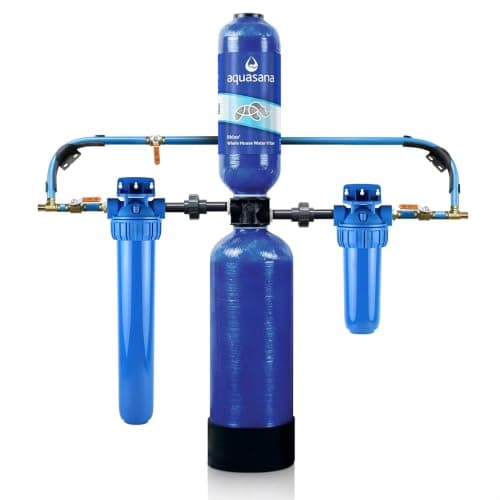 Aquasana Rhino EQ-1000 Whole-House FilterCertified by NSF International to NSF/ANSI 42, tank to NSF/ANSI 61. Aquasana Rhino EQ-1000 Whole-House FilterCertified by NSF International to NSF/ANSI 42, tank to NSF/ANSI 61. | If you want an NSF listing | $1,123.00 - View on Amazon #ad Price as of October 17, 2026. We may earn a commission. Disclosure. |
| 3 | 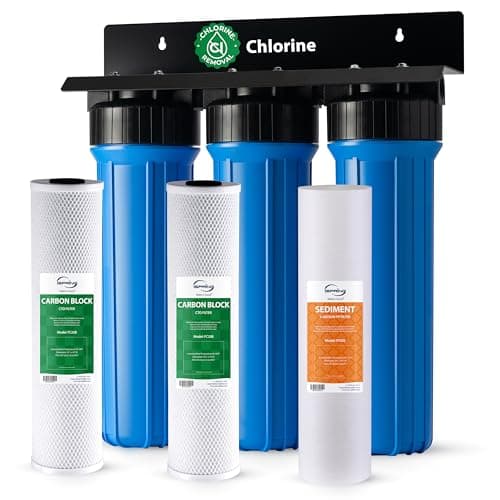 iSpring WGB32B 3-Stage Whole-House FilterCartridge system at a fraction of the price, with annual changes. iSpring WGB32B 3-Stage Whole-House FilterCartridge system at a fraction of the price, with annual changes. | If the budget is the constraint | $420.00 - View on Amazon $516.99 — 19% off #ad Price as of October 17, 2026. We may earn a commission. Disclosure. |
The disclosure first, because it changes how you should read this
We earn nothing if you buy the CF1. SpringWell sells direct and is not reliably available on Amazon, so there is no commission on this recommendation. We list it because catalytic carbon is the correct media for chloramine and that is a real technical distinction, not because it pays.
You should know that when weighing what we say about it, in both directions. See the full disclosure.
Why catalytic carbon matters
Standard activated carbon works by adsorption — trapping molecules on an enormous internal surface. Chloramine is chemically stable by design, and adsorption handles it poorly.
Catalytic carbon is treated to promote a chemical reaction rather than only adsorption, which breaks chloramine down instead of trying to hold it. On a chloraminated supply the difference is real and noticeable, and it is the reason to consider this system specifically.
KDF is a copper-zinc alloy media used alongside carbon. It reduces chlorine through a redox reaction and inhibits bacterial growth in the media bed — useful in a tank that will sit wet for a decade.
Specifications
| Specification | Published figure |
|---|---|
| Sizing | CF1 covers 1-3 bathrooms |
| Rated capacity | 1,000,000 gallons / about 10 years of media life |
| Service flow | 9 gpm |
| Tank | 9" diameter x 48" (52" with the head) |
| Connection size | 1" |
| Operating pressure | 25-80 psi |
| Media | 4-stage catalytic carbon and KDF |
| Warranty | Lifetime on tanks and valves |
Two figures stand out. The 25 psi lower pressure limit is unusually forgiving — most point-of-entry systems want more, and homes at the end of a long run or on a marginal well pressure tank sit lower than people expect. And a lifetime warranty on tanks and valves is a genuine commitment on a component that will sit under pressure for a decade.
The certification gap, stated plainly
SpringWell publishes media specifications and a contaminant list rather than a system-level NSF certification listing for the CF1. That is a meaningful difference from the Aquasana Rhino, which is certified by NSF International to NSF/ANSI 42.
What it means practically: the CF1's contaminant claims are manufacturer statements supported by media data, not third-party verified system performance. That is not evidence of a bad product, and it is less evidence than a certification listing. If a listing is what you need to see, the Rhino is the system that has one.
Sizing matters more than it looks
The CF1 is specified for one to three bathrooms at 9 gpm service flow. Larger homes need the larger models in the range. Undersizing a point-of-entry system is the classic cause of a pressure complaint six months after install, and it is entirely avoidable by reading the sizing table before ordering.
The cost-per-gallon math
A million gallons of media life and no consumables means the running cost is essentially a pre-filter and nothing else, the same model as the Rhino.
The lifetime warranty on tanks and valves is worth pricing into the comparison, because the valve is the component most likely to fail on a decade-old system and it is not a cheap part.
Against a cartridge system, run the ten-year comparison: ten annual cartridge sets plus the lower purchase price, versus this purchase price plus nothing. On chloraminated supply there is also a performance difference in the CF1's favor that the arithmetic does not capture.
We show the arithmetic rather than a verdict so you can redo it with the price you actually pay. Filter prices move; the rated capacities above do not.
The picks in full
The system reviewed here
SpringWell CF1 Whole-House Carbon Filter
SpringWell
Catalytic carbon and KDF rather than plain carbon, which is the meaningful difference on chloraminated supply. Sold direct rather than through Amazon, and we earn nothing when you buy it.
Certification status
SpringWell publishes its own media specifications rather than a system-level NSF certification listing for the CF1. Treat the contaminant list as manufacturer claim, not certified performance, and weigh it accordingly.
Published specifications
| Sizing | CF1 covers 1-3 bathrooms |
|---|---|
| Rated capacity | 1,000,000 gallons / about 10 years of media life |
| Service flow | 9 gpm |
| Tank | 9" diameter x 48" (52" with the head) |
| Connection size | 1" |
| Operating pressure | 25-80 psi |
| Media | 4-stage catalytic carbon and KDF |
| Warranty | Lifetime on tanks and valves |
What we like
- Catalytic carbon handles chloramine, which standard activated carbon struggles with
- Lifetime warranty on tanks and valves
- Works down to 25 psi, lower than most point-of-entry systems
What we do not
- No system-level NSF certification listing published — the contaminant list is manufacturer claim
- Direct-sale only; not reliably available on Amazon
- We earn no commission on this link, which is worth knowing when you read the recommendation
Skip it if
Well water. The CF1 is a city-water filter — a well with iron or sulfur needs an oxidizing system, not a carbon tank, and putting one in front of untreated well water fouls the media.
Sold direct by SpringWell Water. No affiliate link, so nothing to click and nothing for us to earn. The maker's page is in the sources below. Disclosure.
Where these specifications came from
If you want an NSF listing
Aquasana Rhino EQ-1000 Whole-House Filter
Aquasana
A million-gallon point-of-entry filter for chlorinated municipal supply. It fixes the shower and the laundry as well as the kitchen tap, and it does not pretend to be a health-contaminant system.
Certification status
Certified by NSF International to NSF/ANSI 42, with the tank certified to NSF/ANSI 61 for material safety. NSF/ANSI 42 is an aesthetic-effects standard — taste, odor and chlorine — not a health-effects claim.
Published specifications
| Rated capacity | 1,000,000 gallons / up to 10 years |
|---|---|
| Rated flow | 7.0 gpm |
| Max operating pressure | 100 psi |
| Operating temperature | 40-90 degrees F |
| Dimensions | 46" L x 9" W x 44" H, 44.1 lb |
| Certified standards | NSF/ANSI 42; tank to NSF/ANSI 61 |
| Published chlorine reduction | Greater than 97% |
What we like
- Ten years or a million gallons before the main media is due — effectively no maintenance routine
- Treats every tap, so showers and laundry benefit, not just drinking water
- NSF/ANSI 61 material certification on the tank
What we do not
- NSF/ANSI 42 only — this is a chlorine and aesthetics system, not a lead or PFAS system
- Needs a main-line install, usually a plumber, and space where the water enters
- Does nothing for hardness
Skip it if
Anyone buying it to solve lead, PFAS or hard water. It is certified for aesthetic effects. Pair it with an under-sink system for drinking-water health contaminants, and a softener for hardness.
#ad Price as of October 17, 2026. We may earn a commission. Disclosure.
Where these specifications came from
If the budget is the constraint
iSpring WGB32B 3-Stage Whole-House Filter
iSpring
A cartridge system rather than a tank system. It costs a fraction of a tank install and asks for a filter change roughly once a year in exchange.
Certification status
Uses standard 20 x 4.5 inch cartridges. Certification travels with the cartridge fitted rather than the housing — check the specific cartridge's listing for any health claim you intend to rely on.
Published specifications
| Cartridge size | 20" x 4.5", 3 stages |
|---|---|
| Peak flow | 15 gpm |
| Rated capacity | 100,000 gallons — typically about a year for a family of four |
| Working pressure | 25-80 psi |
| Operating temperature | 40-100 degrees F |
| Ports | 1" NPT |
What we like
- Far cheaper up front than any tank-based point-of-entry system
- Standard 20 x 4.5 inch cartridges, available from many manufacturers
- You can change the media mix by changing cartridges as your water changes
What we do not
- Annual cartridge changes, and they are heavy and messy
- Certification depends on the cartridge you fit, not the housing
- Cartridge capacity is a fraction of a tank system's million gallons
Skip it if
Anyone who wants to install a system and forget it. A tank system is the right answer if an annual cartridge change is not realistically going to happen.
$516.99 — 19% off
#ad Price as of October 17, 2026. We may earn a commission. Disclosure.
Where these specifications came from
Questions people actually ask
Is the SpringWell CF1 NSF certified?
SpringWell publishes media specifications and a contaminant list rather than a system-level NSF certification listing for the CF1. Treat the contaminant claims as manufacturer statements. If a third-party listing matters to you, the Aquasana Rhino is certified by NSF International to NSF/ANSI 42.
Does catalytic carbon really work better on chloramine?
Yes, and the mechanism explains why. Standard carbon adsorbs; catalytic carbon promotes a reaction that breaks chloramine down. Chloramine is deliberately stable, so adsorption alone underperforms on it. This is a genuine technical distinction rather than marketing.
Can I use the CF1 on well water?
No. It is a city-water carbon filter, and iron and hydrogen sulfide in untreated well water foul carbon media quickly. Well water needs oxidation before any carbon stage, which is a different class of system entirely.
How do I know which SpringWell size I need?
By bathroom count, which is the manufacturer's proxy for peak simultaneous demand. The CF1 covers one to three bathrooms at 9 gpm service flow. Undersizing produces a pressure complaint that no amount of maintenance fixes.