
Chlorine taste is the easiest and cheapest water problem to fix. Any carbon filter certified to NSF/ANSI 42 handles free chlorine. Chloramine is the exception and needs catalytic carbon, so check the certification wording rather than the marketing.
Quick picks
Tap any row to jump to the full write-up. The button goes straight to the retailer.
| # | Product | Best for | Price |
|---|---|---|---|
| 1 | 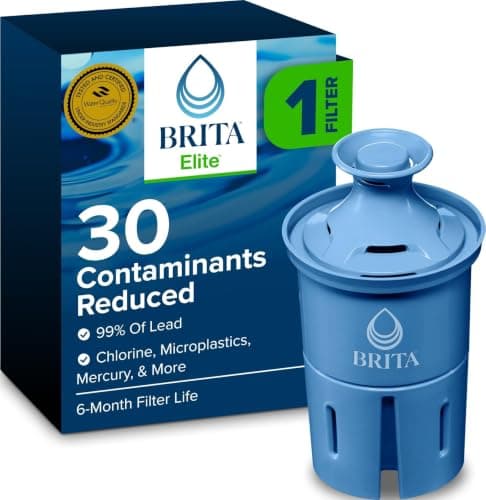 Brita Elite Filter (with any Brita pitcher)NSF/ANSI 42 for taste and odor plus a lead certification, at 120 rated gallons. Brita Elite Filter (with any Brita pitcher)NSF/ANSI 42 for taste and odor plus a lead certification, at 120 rated gallons. | Best value | $19.88 - View on Amazon #ad Price as of October 17, 2026. We may earn a commission. Disclosure. |
| 2 | 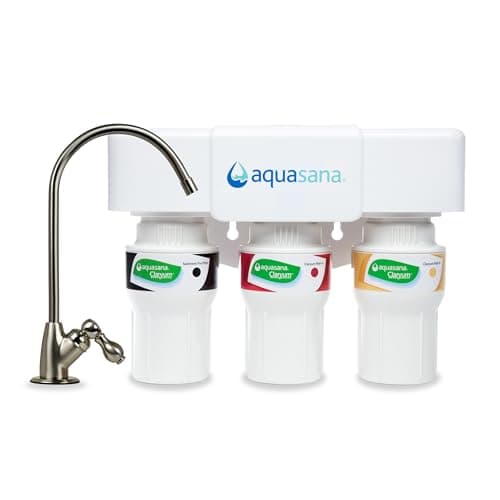 Aquasana Claryum 3-Stage Under-Sink Filter (AQ-5300)Certified for chloramine as well as chlorine, at full tap flow with no wastewater. Aquasana Claryum 3-Stage Under-Sink Filter (AQ-5300)Certified for chloramine as well as chlorine, at full tap flow with no wastewater. | Best for chloramine | $154.99 - View on Amazon $349.99 — 56% off #ad Price as of October 17, 2026. We may earn a commission. Disclosure. |
| 3 | 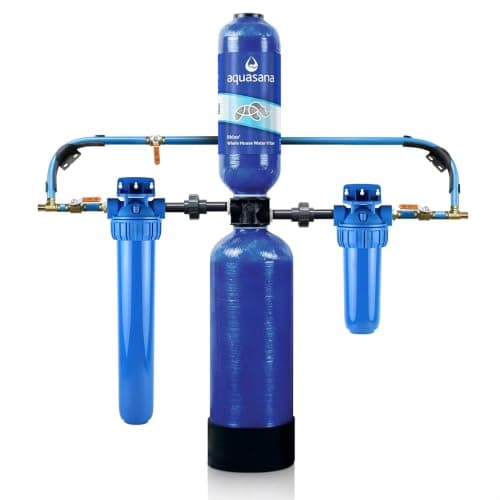 Aquasana Rhino EQ-1000 Whole-House FilterNSF/ANSI 42 certified, over 97% chlorine reduction, a million gallons of media life. Aquasana Rhino EQ-1000 Whole-House FilterNSF/ANSI 42 certified, over 97% chlorine reduction, a million gallons of media life. | Best for the whole house | $1,123.00 - View on Amazon #ad Price as of October 17, 2026. We may earn a commission. Disclosure. |
| 4 | Sno photoSpringWell CF1 Whole-House Carbon FilterCatalytic carbon and KDF, which is what chloramine actually needs. We earn nothing here. | Best catalytic carbon | Sold direct by SpringWell Water. No affiliate link, so nothing to click and nothing for us to earn. The maker's page is in the sources below. Disclosure. |
| 5 | Wno photoWaterdrop 17UA Direct-Connect Under-Sink FilterDirect-connect to the existing faucet, 24,000 rated gallons, no second tap. | Best no-drilling option | Check price on Amazon #ad We do not show a price we cannot verify today. We may earn a commission. Disclosure. |
The certification you need is the cheap one
Chlorine taste and odor is covered by NSF/ANSI 42 — the aesthetic-effects standard. It is the most widely held certification in home water treatment and the least expensive to satisfy, which is why almost every carbon filter on the market carries it.
That is genuinely good news. It means the cheapest certified pitcher on the shelf does the job, and you do not need to spend up. Everything above the cheapest certified option on this page is buying something else — a lead certification, chloramine capability, or coverage of the whole house.
The chloramine exception
This is the one thing that turns an easy purchase into a wrong one. Chloramine is deliberately more stable than free chlorine, and standard activated carbon removes it poorly. Buy a chlorine filter for a chloramine supply and you will conclude the filter is defective when it is simply the wrong media.
Catalytic carbon is the media that handles chloramine, and certifications that cover it say so by name. Check your annual water quality report to find out which disinfectant you are on before choosing, and if the certification does not mention chloramine, assume it does not address it.
Choosing a tier for a taste problem
| What bothers you | The right tier | Why |
|---|---|---|
| Drinking water and coffee | Certified pitcher | Cheapest certified fix; nothing more is needed |
| Everything from the kitchen tap | Under-sink carbon block | Full flow, larger capacity, out of sight |
| The shower and the skin | Whole-house | The only tier that reaches the shower at all |
| Chloramine supply | Catalytic carbon, any tier | Standard activated carbon underperforms on it |
The shower row is the one worth pausing on. It is the single legitimate case for spending whole-house money on a taste-and-odor problem, and it is a real one — people who install point-of-entry carbon consistently report the shower as the noticeable change.
The cost-per-gallon math
Chlorine is the cheapest problem on this site because the certification is cheap and the capacities are large. The arithmetic is filter price divided by rated gallons.
A Brita Elite is rated for 120 gallons. A Waterdrop 17 series inline filter is rated for 24,000. An Aquasana Rhino tank is rated for a million gallons or ten years. The cost per gallon falls by orders of magnitude as you go up the tiers — but so does the fraction of that water you actually drink, which is why the pitcher stays sensible for most people.
The honest way to run it: work out how many gallons you drink versus how many gallons pass through your house, then decide which of those two numbers you are trying to treat.
We show the arithmetic rather than a verdict so you can redo it with the price you actually pay. Filter prices move; the rated capacities above do not.
The picks in full
Best value
Brita Elite Filter (with any Brita pitcher)
Brita
The cheapest route to an NSF/ANSI 53 lead certification. It drops into a pitcher most households already have, and it is emphatically not the same filter as the white Brita Standard.
Certification status
Certified to NSF/ANSI 42, 53 and 401. The lead certification belongs to the Elite (blue) filter only — the Standard (white) filter is certified to NSF/ANSI 42 for taste and odor and is not certified for lead. Per Brita's January 2026 performance data sheet the Elite is not certified for PFOA or PFOS, and no Brita pitcher filter is certified for fluoride.
Published specifications
| Rated filter life | 120 gallons / about 6 months |
|---|---|
| Standard filter life, for comparison | 40 gallons / about 2 months |
| Certified standards | NSF/ANSI 42, 53, 401 |
| Lead | Certified under NSF/ANSI 53 |
| PFOA / PFOS | Not certified (January 2026 performance data sheet) |
| Fluoride | Not certified, not claimed |
What we like
- Genuine NSF/ANSI 53 lead certification at the lowest entry price of anything on this site
- Fits Brita pitchers and dispensers already in millions of kitchens — no new hardware
- Three times the rated life of the Standard filter, which changes the cost-per-gallon math
What we do not
- Not certified for PFOA or PFOS, so it is the wrong answer to a PFAS worry
- No fluoride claim at all
- Slow gravity flow, like every pitcher
Skip it if
Anyone whose actual worry is PFAS or fluoride. The Elite is not certified for either, and buying it for those is buying the wrong thing.
#ad Price as of October 17, 2026. We may earn a commission. Disclosure.
Where these specifications came from
Best for chloramine
Aquasana Claryum 3-Stage Under-Sink Filter (AQ-5300)
Aquasana
Carbon-block filtration rather than reverse osmosis: it keeps the minerals, wastes nothing, and fits where a reverse-osmosis system will not. It also cannot do what RO does for fluoride or nitrate.
Certification status
WQA tested and certified to NSF/ANSI 42, 53 — which includes the P473 protocol for PFOA and PFOS — and 401, for the reduction of 78 contaminants. Aquasana publishes 99.6% for lead and microplastics, 99.7% for PFOA and PFOS, 99.99% for cysts and 97% for chlorine across the Claryum 3-Stage line.
Published specifications
| Filter life | 600 gallons / up to 6 months |
|---|---|
| Certified standards | NSF/ANSI 42, 53 (includes P473), 401 (WQA) |
| Flow rate | 0.5 gpm |
| Wastewater | None |
| Format | 3-stage carbon block with a dedicated faucet |
| Contaminants claimed | 78 |
| Lead / PFOA and PFOS | 99.6% / 99.7% |
What we like
- No drain line, no wastewater, no tank — much easier to install than reverse osmosis
- NSF/ANSI 401 certification covers pharmaceutical-class trace compounds
- Full flow rate, unlike reverse osmosis, so filling a pot is not a project
What we do not
- Not reverse osmosis: no meaningful fluoride, nitrate or TDS reduction
- 600-gallon filter life is short next to an inline system's tens of thousands
- Proprietary cartridges
Skip it if
Anyone whose problem is fluoride, nitrate or total dissolved solids. Carbon block does not remove those; you need reverse osmosis for that job.
$349.99 — 56% off
#ad Price as of October 17, 2026. We may earn a commission. Disclosure.
Best for the whole house
Aquasana Rhino EQ-1000 Whole-House Filter
Aquasana
A million-gallon point-of-entry filter for chlorinated municipal supply. It fixes the shower and the laundry as well as the kitchen tap, and it does not pretend to be a health-contaminant system.
Certification status
Certified by NSF International to NSF/ANSI 42, with the tank certified to NSF/ANSI 61 for material safety. NSF/ANSI 42 is an aesthetic-effects standard — taste, odor and chlorine — not a health-effects claim.
Published specifications
| Rated capacity | 1,000,000 gallons / up to 10 years |
|---|---|
| Rated flow | 7.0 gpm |
| Max operating pressure | 100 psi |
| Operating temperature | 40-90 degrees F |
| Dimensions | 46" L x 9" W x 44" H, 44.1 lb |
| Certified standards | NSF/ANSI 42; tank to NSF/ANSI 61 |
| Published chlorine reduction | Greater than 97% |
What we like
- Ten years or a million gallons before the main media is due — effectively no maintenance routine
- Treats every tap, so showers and laundry benefit, not just drinking water
- NSF/ANSI 61 material certification on the tank
What we do not
- NSF/ANSI 42 only — this is a chlorine and aesthetics system, not a lead or PFAS system
- Needs a main-line install, usually a plumber, and space where the water enters
- Does nothing for hardness
Skip it if
Anyone buying it to solve lead, PFAS or hard water. It is certified for aesthetic effects. Pair it with an under-sink system for drinking-water health contaminants, and a softener for hardness.
#ad Price as of October 17, 2026. We may earn a commission. Disclosure.
Where these specifications came from
Best catalytic carbon
SpringWell CF1 Whole-House Carbon Filter
SpringWell
Catalytic carbon and KDF rather than plain carbon, which is the meaningful difference on chloraminated supply. Sold direct rather than through Amazon, and we earn nothing when you buy it.
Certification status
SpringWell publishes its own media specifications rather than a system-level NSF certification listing for the CF1. Treat the contaminant list as manufacturer claim, not certified performance, and weigh it accordingly.
Published specifications
| Sizing | CF1 covers 1-3 bathrooms |
|---|---|
| Rated capacity | 1,000,000 gallons / about 10 years of media life |
| Service flow | 9 gpm |
| Tank | 9" diameter x 48" (52" with the head) |
| Connection size | 1" |
| Operating pressure | 25-80 psi |
| Media | 4-stage catalytic carbon and KDF |
| Warranty | Lifetime on tanks and valves |
What we like
- Catalytic carbon handles chloramine, which standard activated carbon struggles with
- Lifetime warranty on tanks and valves
- Works down to 25 psi, lower than most point-of-entry systems
What we do not
- No system-level NSF certification listing published — the contaminant list is manufacturer claim
- Direct-sale only; not reliably available on Amazon
- We earn no commission on this link, which is worth knowing when you read the recommendation
Skip it if
Well water. The CF1 is a city-water filter — a well with iron or sulfur needs an oxidizing system, not a carbon tank, and putting one in front of untreated well water fouls the media.
Sold direct by SpringWell Water. No affiliate link, so nothing to click and nothing for us to earn. The maker's page is in the sources below. Disclosure.
Where these specifications came from
Best no-drilling option
Waterdrop 17UA Direct-Connect Under-Sink Filter
Waterdrop
The answer to the most common under-sink objection: it plumbs into the cold line feeding the faucet you already have, so there is no extra tap, no drilled counter and nothing visible.
Certification status
The 17 series is certified against NSF/ANSI 42 for chlorine reduction and NSF/ANSI 372 for lead-free materials. Verify the listing for the specific variant before buying — the 17UB (dedicated faucet) and 17UA (direct connect) are listed separately.
Published specifications
| Rated capacity | 24,000 gallons / about 3 years |
|---|---|
| Format | Direct connect to the existing cold line — no separate faucet |
| Certified standards | NSF/ANSI 42, 372 |
| Connection | Quick-connect fittings, no threading |
What we like
- No counter drilling and no second tap — the single biggest objection to under-sink filtration, removed
- 24,000-gallon rated capacity means a filter change roughly every three years
- Quick-connect install is a genuinely realistic first-time DIY job
What we do not
- NSF/ANSI 42 is an aesthetic standard — chlorine, taste and odor, not a health claim
- Filters everything the tap delivers, including draws for cooking, which shortens life
- Not a lead or PFAS answer at this certification level
Skip it if
Anyone with a health-driven contaminant worry. NSF/ANSI 42 covers taste and odor. If lead or PFAS is the reason you are shopping, this is the wrong tier of certification.
#ad We do not show a price we cannot verify today. We may earn a commission. Disclosure.
Where these specifications came from
Questions people actually ask
Will any carbon filter remove chlorine?
Essentially any carbon filter reduces free chlorine, and certification to NSF/ANSI 42 confirms it was verified. Chloramine is the exception — that needs catalytic carbon, and a filter certified only for chlorine will disappoint you on a chloraminated supply.
Do shower filters work for chlorine?
Some genuinely reduce chlorine, and people with sensitive skin often notice. Contact time in a shower head is very short, so performance is limited compared with a point-of-entry system, and shower filters are much less consistently certified. Read the certification, not the packaging.
How long does a chlorine filter last?
Follow rated gallons rather than months. Rated capacities in this category range from 40 gallons for a basic pitcher filter to 24,000 for an inline under-sink cartridge to a million for a whole-house tank. The months figure on the box assumes a household size that may not be yours.
Is it worth buying a whole-house filter just for chlorine?
If the shower is part of your complaint, yes — nothing else reaches it. If you only care about what you drink, no. A pitcher solves the drinking-water taste for a small fraction of the cost, and the extra spending buys coverage you were not asking for.