
Both are million-gallon whole-house carbon systems for city water, and neither carries a system-level NSF certification for health claims. Aquasana publishes an independent NSF/ANSI 42 test result of up to 97% chlorine reduction; SpringWell offers catalytic carbon for chloramine and a lifetime warranty on tanks and valves.
Quick picks
Tap any row to jump to the full write-up. The button goes straight to the retailer.
| # | Product | Best for | Price |
|---|---|---|---|
| 1 | 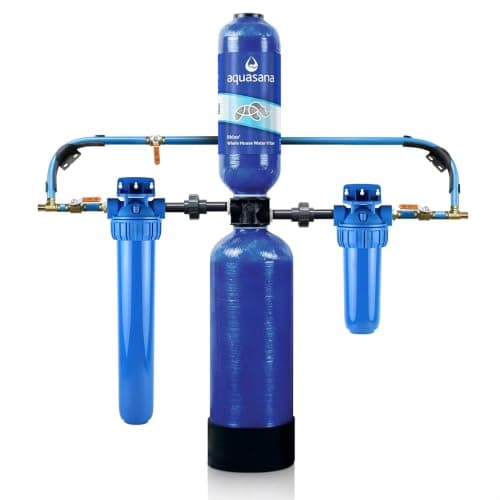 Aquasana Rhino EQ-1000 Whole-House FilterIndependently tested to NSF/ANSI 42 for up to 97% chlorine, with a WQA-certified tank. Aquasana Rhino EQ-1000 Whole-House FilterIndependently tested to NSF/ANSI 42 for up to 97% chlorine, with a WQA-certified tank. | If you want published evidence | $939.55 - View on Amazon $1,123.00 — 16% off #ad Price as of October 6, 2026. We may earn a commission. Disclosure. |
| 2 | Sno photoSpringWell CF1 Whole-House Carbon FilterCatalytic carbon and KDF, 9 gpm service flow, lifetime warranty on tanks and valves. | If you have chloramine, or want the warranty | Sold direct by SpringWell Water. No affiliate link, so nothing to click and nothing for us to earn. The maker's page is in the sources below. Disclosure. |
| 3 | 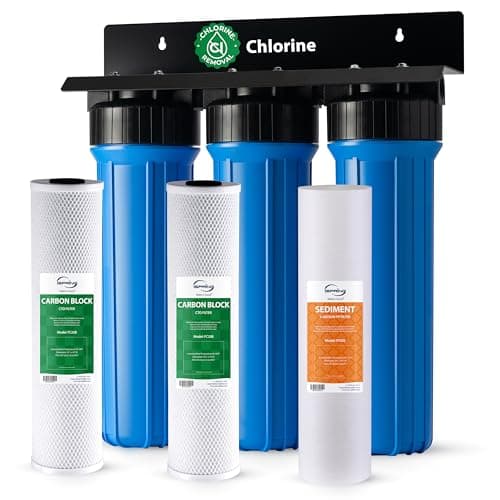 iSpring WGB32B 3-Stage Whole-House FilterCartridge system at a fraction of the price, in exchange for an annual filter change. iSpring WGB32B 3-Stage Whole-House FilterCartridge system at a fraction of the price, in exchange for an annual filter change. | If neither budget works | $359.10 - View on Amazon $516.99 — 31% off #ad Price as of October 6, 2026. We may earn a commission. Disclosure. |
The comparison that matters
| Aquasana Rhino EQ-1000 | SpringWell CF1 | |
|---|---|---|
| Rated capacity | 1,000,000 gallons or up to 10 years | 1,000,000 gallons, about 10 years of media life |
| Evidence | Independently tested to NSF/ANSI 42, up to 97% chlorine; tank WQA certified to NSF/ANSI 61 | Manufacturer's own media specifications; no system-level certification listing published |
| Media | Activated carbon plus KDF, dual tank, upflow | Catalytic carbon plus KDF, four stages, upflow |
| Chloramine | A separate Rhino Chloramines model with upgraded catalytic carbon | Catalytic carbon in the standard build |
| Rated flow | 7 gpm rated, 14.6 gpm peak | 9 gpm service flow |
| Sediment stage | 20-inch pre-filter and post-filter included | 5-micron sediment filtration as one of four stages |
| Warranty | 10-year limited, plus a 90-day satisfaction guarantee | Lifetime on tanks and valves |
| Operating pressure | Not published on the product page | 25-80 psi |
| Sold through | Direct and Amazon | Direct only |
| Do we earn on it? | No | No |
What separates them, honestly
These two systems are more alike than either brand's marketing suggests. Both are upflow tanks combining activated carbon with KDF media, both are rated at a million gallons, both are sized for a normal house, and both are aimed squarely at municipal water. Anyone telling you one is transformatively better than the other is selling something.
Three differences are real.
Published evidence. Aquasana states that the Rhino is independently tested to NSF/ANSI Standard 42 to remove up to 97% of chlorine, and that the tank is WQA certified to NSF/ANSI/CAN Standard 61 — a materials-safety certification for the vessel rather than a performance one. SpringWell publishes its media specifications and contaminant list without an equivalent system-level listing. Neither is a health-effects certification under NSF/ANSI 53; the difference is that one of them has a number attached to a named standard and a named test.
Chloramine. SpringWell puts catalytic carbon in the standard CF1. Aquasana's standard Rhino uses activated carbon and the company sells a separate Rhino Chloramines model with upgraded catalytic media for that job. If your utility uses chloramine — and EPA says more than one in five Americans is served chloraminated water — this is the single most consequential line in the table, because ordinary activated carbon handles chloramine much less effectively than free chlorine.
Warranty. SpringWell advertises a lifetime warranty on tanks and valves against Aquasana's 10-year limited warranty. On a system with a ten-year media life, the practical value of that difference is in the hardware surviving its second media change, not in the media itself.
Which one to buy
| Your situation | The answer | Why |
|---|---|---|
| Your utility uses chloramine | SpringWell CF1, or Aquasana's Chloramines model | Catalytic carbon is the media that handles it |
| You want a published test result | Aquasana Rhino | Independently tested to NSF/ANSI 42, up to 97% chlorine |
| You want the longest hardware cover | SpringWell CF1 | Lifetime on tanks and valves |
| You want it from Amazon with fast returns | Aquasana Rhino | SpringWell is direct-sale only |
| Budget is the constraint | iSpring WGB32B | Cartridge system, a fraction of the price, annual changes |
| You are on a private well | Neither | Carbon tanks belong after iron and sulfur treatment, not in front of it |
Check your utility's disinfectant before you choose. It is on your annual water quality report, and reading that report takes ten minutes and settles the chloramine question, which is the one that actually separates these two systems.
What neither of them does
- Soften water. Carbon does not touch hardness. If you have scale, that is a softener or a conditioner, and the combo systems guide covers pairing them.
- Disinfect. Aquasana states plainly that a UV filter must be added to tackle bacteria and viruses. Neither system is a microbiological barrier.
- Remove fluoride, nitrate or dissolved solids. Those need reverse osmosis at the drinking tap, not carbon at the point of entry.
- Earn us anything. Both brands sell direct and neither has an affiliate connection we have joined, so every link to them on this site pays us nothing. That is visible on the buttons and it is why they can sit at the top of a page without us flinching.
Where a cartridge system beats both
Tank systems are the right answer for a household that wants to install once and forget it for a decade. They are not the only answer. A three-stage cartridge system such as the iSpring WGB32B costs a fraction of either tank and asks for a filter change roughly once a year in exchange — and because certification travels with the cartridge you fit rather than the housing, you can change what the system does as your water changes.
The whole-house roundup compares all three formats, and what whole-house filtration costs puts the installation figures beside the equipment ones, which is where most of the real difference between these systems disappears.
The cost-per-gallon math
Both systems are priced in the same band and rated for the same million gallons, so the purchase price is not where the difference lives.
Media replacement at roughly ten years is the large recurring cost on either. Ahead of that, both need their sediment stage serviced — Aquasana ships a 20-inch pre-filter and a post-filter, SpringWell integrates 5-micron sediment filtration — and that is the consumable you will actually buy repeatedly.
Add installation. Both are tank systems that need plumbing into the main, and in most markets a plumber's day is a meaningful fraction of the equipment price. A cartridge system is cheaper to install as well as to buy, which is why it wins on a five-year horizon and loses on a fifteen-year one.
We show the arithmetic rather than a verdict so you can redo it with the price you actually pay. Filter prices move; the rated capacities above do not.
The picks in full
If you want published evidence
Aquasana Rhino EQ-1000 Whole-House Filter
Aquasana
A million-gallon point-of-entry filter for chlorinated municipal supply. It fixes the shower and the laundry as well as the kitchen tap, and it does not pretend to be a health-contaminant system.
Certification status
Certified by NSF International to NSF/ANSI 42, with the tank certified to NSF/ANSI 61 for material safety. NSF/ANSI 42 is an aesthetic-effects standard — taste, odor and chlorine — not a health-effects claim.
Published specifications
| Rated capacity | 1,000,000 gallons / up to 10 years |
|---|---|
| Rated flow | 7.0 gpm |
| Max operating pressure | 100 psi |
| Operating temperature | 40-90 degrees F |
| Dimensions | 46" L x 9" W x 44" H, 44.1 lb |
| Certified standards | NSF/ANSI 42; tank to NSF/ANSI 61 |
| Published chlorine reduction | Greater than 97% |
What we like
- Ten years or a million gallons before the main media is due — effectively no maintenance routine
- Treats every tap, so showers and laundry benefit, not just drinking water
- NSF/ANSI 61 material certification on the tank
What we do not
- NSF/ANSI 42 only — this is a chlorine and aesthetics system, not a lead or PFAS system
- Needs a main-line install, usually a plumber, and space where the water enters
- Does nothing for hardness
Skip it if
Anyone buying it to solve lead, PFAS or hard water. It is certified for aesthetic effects. Pair it with an under-sink system for drinking-water health contaminants, and a softener for hardness.
$1,123.00 — 16% off
#ad Price as of October 6, 2026. We may earn a commission. Disclosure.
Where these specifications came from
If you have chloramine, or want the warranty
SpringWell CF1 Whole-House Carbon Filter
SpringWell
Catalytic carbon and KDF rather than plain carbon, which is the meaningful difference on chloraminated supply. Sold direct rather than through Amazon, and we earn nothing when you buy it.
Certification status
SpringWell publishes its own media specifications rather than a system-level NSF certification listing for the CF1. Treat the contaminant list as manufacturer claim, not certified performance, and weigh it accordingly.
Published specifications
| Sizing | CF1 covers 1-3 bathrooms |
|---|---|
| Rated capacity | 1,000,000 gallons / about 10 years of media life |
| Service flow | 9 gpm |
| Tank | 9" diameter x 48" (52" with the head) |
| Connection size | 1" |
| Operating pressure | 25-80 psi |
| Media | 4-stage catalytic carbon and KDF |
| Warranty | Lifetime on tanks and valves |
What we like
- Catalytic carbon handles chloramine, which standard activated carbon struggles with
- Lifetime warranty on tanks and valves
- Works down to 25 psi, lower than most point-of-entry systems
What we do not
- No system-level NSF certification listing published — the contaminant list is manufacturer claim
- Direct-sale only; not reliably available on Amazon
- We earn no commission on this link, which is worth knowing when you read the recommendation
Skip it if
Well water. The CF1 is a city-water filter — a well with iron or sulfur needs an oxidizing system, not a carbon tank, and putting one in front of untreated well water fouls the media.
Sold direct by SpringWell Water. No affiliate link, so nothing to click and nothing for us to earn. The maker's page is in the sources below. Disclosure.
Where these specifications came from
If neither budget works
iSpring WGB32B 3-Stage Whole-House Filter
iSpring
A cartridge system rather than a tank system. It costs a fraction of a tank install and asks for a filter change roughly once a year in exchange.
Certification status
Uses standard 20 x 4.5 inch cartridges. Certification travels with the cartridge fitted rather than the housing — check the specific cartridge's listing for any health claim you intend to rely on.
Published specifications
| Cartridge size | 20" x 4.5", 3 stages |
|---|---|
| Peak flow | 15 gpm |
| Rated capacity | 100,000 gallons — typically about a year for a family of four |
| Working pressure | 25-80 psi |
| Operating temperature | 40-100 degrees F |
| Ports | 1" NPT |
What we like
- Far cheaper up front than any tank-based point-of-entry system
- Standard 20 x 4.5 inch cartridges, available from many manufacturers
- You can change the media mix by changing cartridges as your water changes
What we do not
- Annual cartridge changes, and they are heavy and messy
- Certification depends on the cartridge you fit, not the housing
- Cartridge capacity is a fraction of a tank system's million gallons
Skip it if
Anyone who wants to install a system and forget it. A tank system is the right answer if an annual cartridge change is not realistically going to happen.
$516.99 — 31% off
#ad Price as of October 6, 2026. We may earn a commission. Disclosure.
Where these specifications came from
Questions people actually ask
Is Aquasana or SpringWell better?
They are close. Aquasana publishes an independent NSF/ANSI 42 test result of up to 97% chlorine reduction and a WQA-certified tank; SpringWell puts catalytic carbon in the standard build and covers tanks and valves for life. Chloramine in your supply favors SpringWell or Aquasana's Chloramines model; wanting a published test result favors Aquasana.
Are either of these NSF certified?
Not at the system level for health claims. Aquasana states the Rhino is independently tested to NSF/ANSI 42 and that its tank is WQA certified to NSF/ANSI 61, a materials-safety standard. SpringWell publishes its own media specifications without an equivalent listing. Treat both contaminant lists as manufacturer claims unless a listing says otherwise.
Do these filters work on well water?
Not on their own. Both are city-water carbon systems, and a carbon tank in front of untreated well water carrying iron, manganese or hydrogen sulfide fouls quickly. Wells need oxidation or air injection first, and Aquasana is explicit that UV must be added for bacteria and viruses.
Which one handles chloramine?
SpringWell uses catalytic carbon in the standard CF1. Aquasana sells a separate Rhino Chloramines model with upgraded catalytic media for that purpose. Ordinary activated carbon is much less effective against chloramine than against free chlorine, so check your utility's disinfectant first.
How long do they last?
Both are rated at 1,000,000 gallons, which the manufacturers translate to roughly ten years for a typical household. Sediment prefilters are serviced far more often than that, and they are the consumable that actually determines your running cost.