
Nitrate is a dissolved ion, so activated carbon does not touch it and boiling concentrates it. The treatment methods that work at home are reverse osmosis, anion exchange and distillation. EPA's enforceable limit is 10 mg/L as nitrate-nitrogen, set to protect infants.
Quick picks
Tap any row to jump to the full write-up. The button goes straight to the retailer.
| # | Product | Best for | Price |
|---|---|---|---|
| 1 | 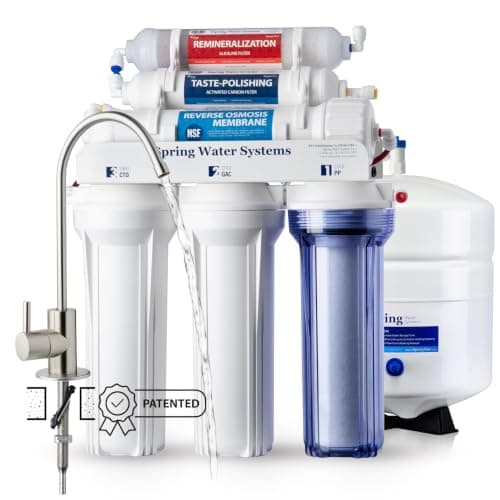 iSpring RCC7AK 6-Stage Reverse Osmosis SystemNSF/ANSI 58 certified reverse osmosis with published per-contaminant reduction figures. iSpring RCC7AK 6-Stage Reverse Osmosis SystemNSF/ANSI 58 certified reverse osmosis with published per-contaminant reduction figures. | Best overall | $198.75 - View on Amazon $234.99 — 15% off #ad Price as of October 6, 2026. We may earn a commission. Disclosure. |
| 2 | 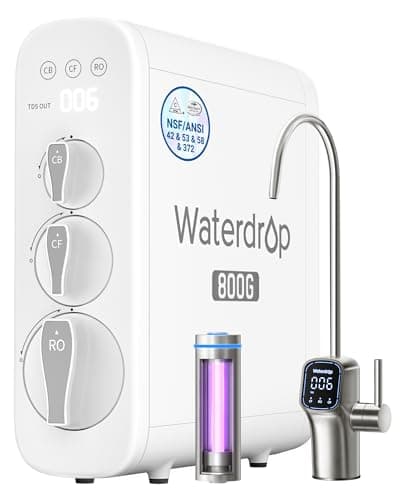 Waterdrop G3P800 Tankless Reverse Osmosis System800 GPD tankless RO certified by IAPMO R&T to NSF/ANSI 42, 53 and 58. Waterdrop G3P800 Tankless Reverse Osmosis System800 GPD tankless RO certified by IAPMO R&T to NSF/ANSI 42, 53 and 58. | Best for a busy household | $699.00 - View on Amazon $999.00 — 30% off #ad Price as of October 6, 2026. We may earn a commission. Disclosure. |
| 3 | 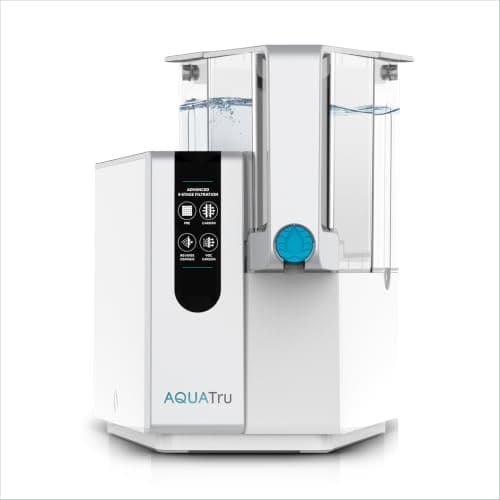 AquaTru Classic Countertop Reverse Osmosis PurifierCountertop RO certified across 53, 58, 401 and P473 — the rental-friendly answer. AquaTru Classic Countertop Reverse Osmosis PurifierCountertop RO certified across 53, 58, 401 and P473 — the rental-friendly answer. | Best without plumbing | $403.75 - View on Amazon $475.00 — 15% off #ad Price as of October 6, 2026. We may earn a commission. Disclosure. |
| 4 | 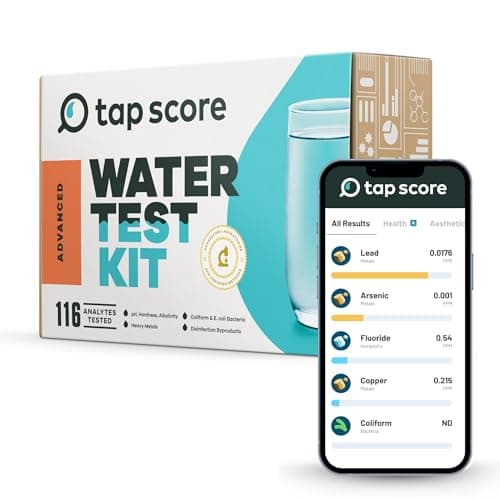 Tap Score Advanced Water Test (SimpleLab)A laboratory number for nitrate before you spend anything on treating it. Tap Score Advanced Water Test (SimpleLab)A laboratory number for nitrate before you spend anything on treating it. | Buy this first | $215.20 - View on Amazon $269.00 — 20% off #ad Price as of October 6, 2026. We may earn a commission. Disclosure. |
Why nitrate is the contaminant to take seriously on a well
Nitrate is the most common man-made contaminant found above the federal drinking water standard in private wells, and the reason is agricultural geography: fertilizer, livestock manure and septic systems put nitrogen into shallow groundwater, and shallow groundwater is what most domestic wells draw from.
The Water Quality Association's technical fact sheet lists the regulatory numbers plainly: EPA's MCL for nitrate is 10.0 mg/L as N, with the MCLG at the same figure, and nitrite is limited to 1.0 mg/L as N. Unusually, the goal and the enforceable limit are identical — EPA concluded that 10 mg/L protects the most sensitive members of the population, which here means infants.
The health effect behind that number is methemoglobinemia, still commonly called blue baby syndrome, and the population at risk is infants under six months. That specificity matters for shopping: nitrate is not a taste or odor problem you will notice, and it is not a slow-accumulation worry for most adults. It is a number you either have or do not, and you only find out by testing.
The criteria, in the order that decides it
- Do you have a number? Nitrate is invisible, tasteless and odorless. Test before you buy, and test again after heavy rain or spring application if you are in farming country — nitrate moves seasonally.
- Is the technology capable at all? WQA lists the point-of-entry and point-of-use methods for nitrate as reverse osmosis with a thin film composite membrane, anion exchange in the chloride form, distillation and electrodialysis. Activated carbon does not appear, because it does not work.
- Does the certification name nitrate? Under NSF/ANSI 58, nitrate reduction is an optional claim. A system can be legitimately 58-certified for total dissolved solids and never have been tested for nitrate specifically.
- Point of use, not point of entry. Nitrate matters when you drink it. Treating the whole house means treating the laundry and the lawn to fix the two liters you swallow, at several times the price.
- What happens if the system fails quietly? Anion exchange has a specific failure mode worth knowing about, covered below.
The three technologies, compared honestly
| Reverse osmosis | Anion exchange | Distillation | |
|---|---|---|---|
| Removes nitrate | Yes | Yes | Yes |
| Also removes | Arsenic, fluoride, TDS, PFAS | Nitrate and sulfate | Nearly everything |
| Wastewater | Yes, to the drain | Brine on regeneration | None |
| Running cost | Cartridges and a membrane | Salt and resin | Energy, and a lot of it |
| Household fit | Under sink or countertop | Point of entry, specialist install | Countertop, slow |
| Failure mode | Gradual, TDS creep | Sudden dumping when exhausted | Obvious |
For a household, reverse osmosis is almost always the answer. It is the only one of the three that is cheap, common and certified against a standard you can check, and it deals with the other things that tend to travel with agricultural nitrate — arsenic in some regions, and the general dissolved load.
Anion exchange deserves one specific warning. WQA notes that the resins are subject to competing sulfates. In practice that means a sulfate-heavy water can strip nitrate off an exhausted bed and push a slug of it downstream — the water can briefly come out worse than it went in. That is a system for a professional to size and monitor, not a weekend purchase.
Why carbon cannot do it, in one paragraph
Activated carbon works by adsorption: large organic molecules stick to an enormous internal surface area. Nitrate is a small, negatively charged ion that stays dissolved and passes through. This is a mechanism problem, not a quality problem — the most expensive carbon block on this site removes exactly as much nitrate as the cheapest, which is none.
The same logic applies to fluoride and to arsenic, which is why those pages reach the same conclusion about the same technology — though arsenic adds a wrinkle neither of the others has, because one of its two forms will not come out without being oxidized first. And it is the reason a pitcher is the wrong tool here regardless of price.
Boiling: the mistake that makes it worse
Boiling is the instinctive response to a water scare, and for bacteria it is correct. For nitrate it is actively harmful. Water leaves the pot as steam and the nitrate does not, so every minute of boiling raises the concentration in what is left behind.
If a test comes back above the limit and there is an infant in the house, the correct interim measure is bottled or trucked water for formula and drinking, and a call to your state or county health department. The nitrate guide covers where it comes from and how it moves through a season.
Testing, and re-testing
Nitrate is on nearly every general well panel because it is cheap to measure and common. What people miss is the timing: concentrations rise after fertilizer application and after heavy rain moves it into the aquifer, so a clean result in February says little about May.
Annual testing for coliform and nitrate is the standard recommendation for private wells, and in an agricultural area a second nitrate test in the wet season is cheap insurance. If you are on municipal supply, nitrate is a regulated parameter and appears on your annual water quality report with the measured range.
The cost-per-gallon math
The arithmetic here is unusually easy, because the technology choice is nearly made for you.
A test costs a small fraction of any treatment system and tells you whether you need one at all. Skipping it is how people end up with a whole-house system for a problem that lives in a glass of water.
If treatment is warranted, price an under-sink RO system over five years — purchase, pre-filters annually, membrane every few years — and divide by the gallons you actually drink and cook with. Then compare that to the cost of bottled water for a household that cannot drink its own well. In nitrate country that second number is what most people are already paying.
We show the arithmetic rather than a verdict so you can redo it with the price you actually pay. Filter prices move; the rated capacities above do not.
The picks in full
Best overall
iSpring RCC7AK 6-Stage Reverse Osmosis System
iSpring
The value pick of the reverse-osmosis tier: a WQA Gold Seal system with an alkaline stage, usually at the lowest price of anything here that carries a real certification.
Certification status
Certified against NSF/ANSI 58 for TDS reduction and carries the WQA Gold Seal, with 97.2% TDS removal certified.
Published specifications
| Output | 75 GPD |
|---|---|
| Stages | 6, including alkaline remineralization |
| Certified TDS reduction | 97.2% |
| Feed pressure | 45-70 psi |
| Feed temperature | 40-100 degrees F |
| Assembled size | 15.5" deep x 19.5" high, 25 lb |
| Certification | NSF/ANSI 58, WQA Gold Seal |
What we like
- Certified performance at the lowest price in the tier
- Push-fit tubing makes a first-time install genuinely manageable
- Alkaline stage included rather than sold as an upgrade
What we do not
- Narrow 45-70 psi feed window — low-pressure homes may need a booster pump
- Tank plus housing needs real cabinet depth
- Conventional reverse-osmosis drain ratio
Skip it if
Homes with feed pressure below 45 psi that will not add a booster pump, and anyone who wants a tankless footprint.
$234.99 — 15% off
#ad Price as of October 6, 2026. We may earn a commission. Disclosure.
Where these specifications came from
Best for a busy household
Waterdrop G3P800 Tankless Reverse Osmosis System
Waterdrop
Tankless reverse osmosis that gives back the cupboard a pressure tank would eat, fills a glass without the pause, and sends markedly less water down the drain than a classic tank system.
Certification status
Certified to NSF/ANSI 42 for chlorine reduction, NSF/ANSI 53 and 58 for TDS, fluoride, cadmium, hexavalent chromium and selenium, and NSF/ANSI 372 for lead-free materials.
Published specifications
| Output | 800 GPD |
|---|---|
| Pure-to-drain ratio | 3:1 |
| Format | Tankless — no pressure tank |
| Certified standards | NSF/ANSI 42, 53, 58, 372 |
| Installation | Two holes: smart LED faucet and drain |
| Faucet | Included, with TDS display |
What we like
- No pressure tank, so it fits cabinets a tank system cannot
- 3:1 pure-to-drain is far better than the ratio typical of older reverse osmosis
- 800 GPD means no waiting for a tank to refill
What we do not
- Needs a power outlet under the sink — a real constraint in older kitchens
- Proprietary filter cartridges, so you are tied to Waterdrop's pricing
- Requires drilling for the included faucet unless you have a spare hole
Skip it if
Renters, and anyone with no outlet under the sink. It is a permanent, powered installation — a countertop unit is the answer if you cannot commit to that.
$999.00 — 30% off
#ad Price as of October 6, 2026. We may earn a commission. Disclosure.
Where these specifications came from
Best without plumbing
AquaTru Classic Countertop Reverse Osmosis Purifier
AquaTru
Reverse osmosis performance with no plumbing, no drilling and no landlord conversation. You pay for that with counter space, a wait, and two tanks you fill and empty by hand.
Certification status
Certified by IAPMO to NSF/ANSI 53, 58, 401 and P473, covering lead, reverse-osmosis performance, emerging compounds and the PFOA/PFOS protocol.
Published specifications
| Filtration | 4-stage countertop reverse osmosis |
|---|---|
| Clean water tank | 0.75 gallons |
| Tap water tank | 1 gallon |
| Installation | None — no plumbing connection |
| Certified standards | NSF/ANSI 53, 58, 401, P473 (IAPMO) |
What we like
- Real reverse osmosis with a P473 PFOA/PFOS certification and zero installation
- The strongest answer available to a renter with a lead or PFAS problem
- No drilling, no drain saddle, no landlord permission needed
What we do not
- Takes up substantial counter space
- You refill and empty tanks by hand — it is not on-demand
- Highest purchase price in the no-plumbing tier by a wide margin
Skip it if
Anyone who can plumb in an under-sink system. A permanent under-sink RO is cheaper per gallon, on-demand, and out of sight. Buy this when you genuinely cannot install.
$475.00 — 15% off
#ad Price as of October 6, 2026. We may earn a commission. Disclosure.
Where these specifications came from
Buy this first
Tap Score Advanced Water Test (SimpleLab)
SimpleLab
Mail-in testing through certified laboratories, with a report that names contaminants, gives concentrations, and compares them against health guidelines. This is the number every system on this site is sized from.
Certification status
Samples are analyzed by laboratories in the SimpleLab network certified to ISO/IEC 17025, and Tap Score is recognized by the Water Quality Association.
Published specifications
| Method | Mail-in sample, certified laboratory analysis |
|---|---|
| Lab accreditation | ISO/IEC 17025 certified network laboratories |
| Panels available | City water, well water, and contaminant-specific tests |
| What you get | Concentrations plus health-guideline comparison |
What we like
- Certified-laboratory analysis, not a color-matching strip
- The report explains what each result means rather than dumping numbers
- Contaminant-specific panels exist when you only need one answer
What we do not
- Costs meaningfully more than a strip kit
- Turnaround is days, not minutes
- You have to actually collect the sample correctly, which is where home tests usually go wrong
Skip it if
Somebody whose entire complaint is a chlorine taste. That diagnosis is free — you can smell it — and a certified carbon filter costs less than the test.
$269.00 — 20% off
#ad Price as of October 6, 2026. We may earn a commission. Disclosure.
Where these specifications came from
Questions people actually ask
What removes nitrate from drinking water?
Reverse osmosis, anion exchange and distillation — the methods the Water Quality Association lists for nitrate reduction. For a household, reverse osmosis at the drinking tap is almost always the right one, and the certification to look for is NSF/ANSI 58 with nitrate named as a claim.
Does a Brita or any carbon filter remove nitrates?
No. Nitrate is a small dissolved ion and activated carbon works by adsorbing larger organic molecules, so nothing in the pitcher or faucet-mount tier reduces it at any price.
Does boiling water remove nitrates?
No — it concentrates them. Water leaves as steam and the nitrate stays behind, so boiled water contains more nitrate per liter than it did before. Boiling is the correct response to bacteria, not to nitrate.
What nitrate level is dangerous?
EPA's enforceable limit is 10 mg/L as nitrate-nitrogen, and the health goal is set at the same figure because it is intended to protect infants under six months from methemoglobinemia. Nitrite is limited separately at 1.0 mg/L as N.
Do I need to treat the whole house for nitrate?
Almost never. Nitrate matters through ingestion, so treating the drinking tap addresses the exposure. A point-of-entry anion exchange system is a specialist install with a real failure mode, and it is rarely the proportionate answer for a household.