
Nitrate is tasteless and colorless, comes from fertilizer and septic influence, and is specifically dangerous for infants under six months. Carbon filtration does not remove it and boiling concentrates it — reverse osmosis at the drinking tap is the household answer.
Quick picks
Tap any row to jump to the full write-up. The button goes straight to the retailer.
| # | Product | Best for | Price |
|---|---|---|---|
| 1 | 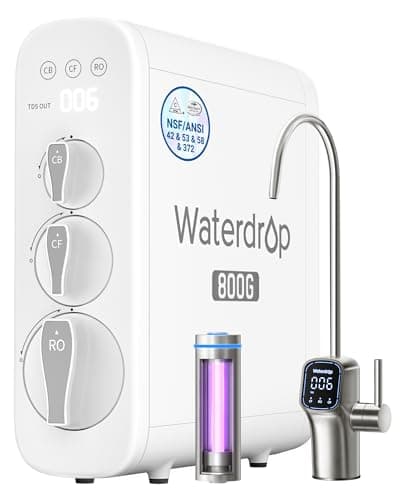 Waterdrop G3P800 Tankless Reverse Osmosis SystemReverse osmosis certified to NSF/ANSI 58, which covers nitrate reduction. Waterdrop G3P800 Tankless Reverse Osmosis SystemReverse osmosis certified to NSF/ANSI 58, which covers nitrate reduction. | Best under-sink | $759.00 - View on Amazon $999.00 — 24% off #ad Price as of October 17, 2026. We may earn a commission. Disclosure. |
| 2 | 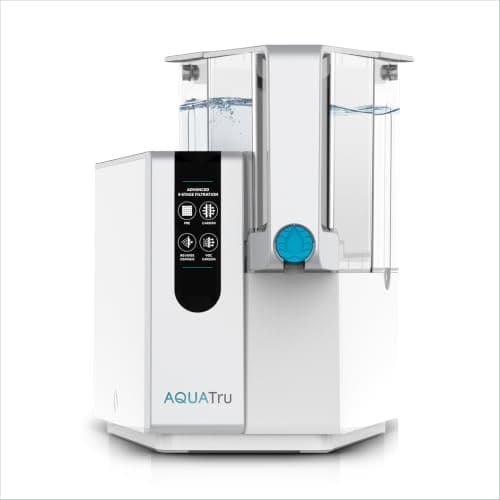 AquaTru Classic Countertop Reverse Osmosis PurifierCertified countertop RO — the no-install route to nitrate reduction. AquaTru Classic Countertop Reverse Osmosis PurifierCertified countertop RO — the no-install route to nitrate reduction. | Best without plumbing | $451.25 - View on Amazon $475.00 — 5% off #ad Price as of October 17, 2026. We may earn a commission. Disclosure. |
| 3 | 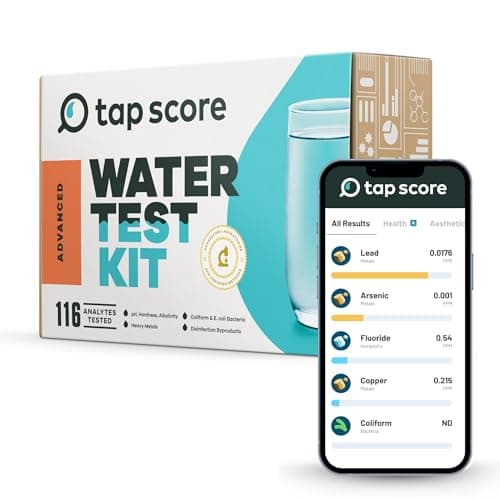 Tap Score Advanced Water Test (SimpleLab)Nitrate has no taste or smell. A number is the only way to know. Tap Score Advanced Water Test (SimpleLab)Nitrate has no taste or smell. A number is the only way to know. | Test before you buy | $269.00 - View on Amazon #ad Price as of October 17, 2026. We may earn a commission. Disclosure. |
Where it comes from
Nitrate is highly soluble and moves readily through soil into groundwater. The main sources are agricultural fertilizer, animal waste from feedlots and manure application, and septic system leachate. Shallow wells in farming areas are the classic high-risk case, and levels frequently rise after heavy rain or spring application.
Because it is entirely tasteless, odorless and colorless, there is no version of noticing it. Testing is the only route to knowing.
Why it matters, specifically
The primary concern is infant methemoglobinemia — sometimes called blue baby syndrome — which affects babies under about six months. Nitrate is converted to nitrite in an infant's digestive system, and nitrite interferes with the blood's ability to carry oxygen.
The EPA maximum contaminant level for nitrate in public water is 10 mg/L as nitrogen. That limit exists principally to protect infants. If you have a well, an infant, and no test result, that combination is the reason this page exists.
What does not work
| Approach | Removes nitrate? | Why |
|---|---|---|
| Carbon pitcher or under-sink carbon | No | Adsorption does not act on the nitrate ion |
| Sediment filtration | No | Nitrate is dissolved, not particulate |
| Boiling | No — makes it worse | Water evaporates, nitrate stays, concentration rises |
| Water softener | No | Standard softening resin does not target nitrate |
| UV | No | UV addresses organisms, not dissolved chemicals |
| Reverse osmosis | Yes | Nitrate is within the scope of NSF/ANSI 58 |
| Anion exchange | Yes | Specialist nitrate-selective resin, usually whole-house |
| Distillation | Yes | Effective, slow, and energy-hungry |
Two rows deserve emphasis. Boiling makes it worse, and that is counterintuitive enough that people do it in good faith. And a carbon filter — the thing most households already own — does nothing at all here.
The household answer
Reverse osmosis at the drinking tap. Nitrate is explicitly within the scope of NSF/ANSI 58, which is the reverse-osmosis standard, and both an under-sink system and a countertop unit reach it.
Point-of-use is the right scope for nitrate. You are protecting what people drink and what formula is made with — nitrate is not absorbed through the skin in showering, so treating the whole house buys nothing extra for a great deal more money.
Testing and timing
Nitrate levels vary through the year. Spring fertilizer application and heavy rain both push them up, so a single test in a dry autumn may not represent the annual picture.
Test annually, and test in spring if you are near cropland. If you have an infant, test before relying on the water for formula — this is the one case on this site where the honest advice is to use an alternative source until you have a number. How to test.
The cost-per-gallon math
The arithmetic here is unusually simple because the scope is small: you are treating drinking and cooking water for one tap, not a house.
A certified under-sink reverse osmosis system plus a decade of cartridges, divided by the gallons your household actually drinks, is the number. Compare it against bottled water for the same volume over the same period — for any household using bottled water because of a nitrate result, the system pays for itself quickly.
Whole-house anion exchange is available and is a much larger purchase. It is worth considering only when nitrate is very high or when there is a specific reason to treat beyond the drinking tap.
We show the arithmetic rather than a verdict so you can redo it with the price you actually pay. Filter prices move; the rated capacities above do not.
The picks in full
Best under-sink
Waterdrop G3P800 Tankless Reverse Osmosis System
Waterdrop
Tankless reverse osmosis that gives back the cupboard a pressure tank would eat, fills a glass without the pause, and sends markedly less water down the drain than a classic tank system.
Certification status
Certified to NSF/ANSI 42 for chlorine reduction, NSF/ANSI 53 and 58 for TDS, fluoride, cadmium, hexavalent chromium and selenium, and NSF/ANSI 372 for lead-free materials.
Published specifications
| Output | 800 GPD |
|---|---|
| Pure-to-drain ratio | 3:1 |
| Format | Tankless — no pressure tank |
| Certified standards | NSF/ANSI 42, 53, 58, 372 |
| Installation | Two holes: smart LED faucet and drain |
| Faucet | Included, with TDS display |
What we like
- No pressure tank, so it fits cabinets a tank system cannot
- 3:1 pure-to-drain is far better than the ratio typical of older reverse osmosis
- 800 GPD means no waiting for a tank to refill
What we do not
- Needs a power outlet under the sink — a real constraint in older kitchens
- Proprietary filter cartridges, so you are tied to Waterdrop's pricing
- Requires drilling for the included faucet unless you have a spare hole
Skip it if
Renters, and anyone with no outlet under the sink. It is a permanent, powered installation — a countertop unit is the answer if you cannot commit to that.
$999.00 — 24% off
#ad Price as of October 17, 2026. We may earn a commission. Disclosure.
Where these specifications came from
Best without plumbing
AquaTru Classic Countertop Reverse Osmosis Purifier
AquaTru
Reverse osmosis performance with no plumbing, no drilling and no landlord conversation. You pay for that with counter space, a wait, and two tanks you fill and empty by hand.
Certification status
Certified by IAPMO to NSF/ANSI 53, 58, 401 and P473, covering lead, reverse-osmosis performance, emerging compounds and the PFOA/PFOS protocol.
Published specifications
| Filtration | 4-stage countertop reverse osmosis |
|---|---|
| Clean water tank | 0.75 gallons |
| Tap water tank | 1 gallon |
| Installation | None — no plumbing connection |
| Certified standards | NSF/ANSI 53, 58, 401, P473 (IAPMO) |
What we like
- Real reverse osmosis with a P473 PFOA/PFOS certification and zero installation
- The strongest answer available to a renter with a lead or PFAS problem
- No drilling, no drain saddle, no landlord permission needed
What we do not
- Takes up substantial counter space
- You refill and empty tanks by hand — it is not on-demand
- Highest purchase price in the no-plumbing tier by a wide margin
Skip it if
Anyone who can plumb in an under-sink system. A permanent under-sink RO is cheaper per gallon, on-demand, and out of sight. Buy this when you genuinely cannot install.
$475.00 — 5% off
#ad Price as of October 17, 2026. We may earn a commission. Disclosure.
Where these specifications came from
Test before you buy
Tap Score Advanced Water Test (SimpleLab)
SimpleLab
Mail-in testing through certified laboratories, with a report that names contaminants, gives concentrations, and compares them against health guidelines. This is the number every system on this site is sized from.
Certification status
Samples are analyzed by laboratories in the SimpleLab network certified to ISO/IEC 17025, and Tap Score is recognized by the Water Quality Association.
Published specifications
| Method | Mail-in sample, certified laboratory analysis |
|---|---|
| Lab accreditation | ISO/IEC 17025 certified network laboratories |
| Panels available | City water, well water, and contaminant-specific tests |
| What you get | Concentrations plus health-guideline comparison |
What we like
- Certified-laboratory analysis, not a color-matching strip
- The report explains what each result means rather than dumping numbers
- Contaminant-specific panels exist when you only need one answer
What we do not
- Costs meaningfully more than a strip kit
- Turnaround is days, not minutes
- You have to actually collect the sample correctly, which is where home tests usually go wrong
Skip it if
Somebody whose entire complaint is a chlorine taste. That diagnosis is free — you can smell it — and a certified carbon filter costs less than the test.
#ad Price as of October 17, 2026. We may earn a commission. Disclosure.
Where these specifications came from
Questions people actually ask
Does boiling water remove nitrates?
No, and it raises the concentration. Water evaporates and the nitrate stays behind, so boiled water contains more nitrate per volume than you started with. Boiling addresses microbiological risk only.
Will a carbon filter remove nitrate?
No. Carbon works by adsorbing organic molecules, and the nitrate ion is not adsorbed. Neither a pitcher nor an under-sink carbon block reduces nitrate meaningfully — reverse osmosis is the household route.
What nitrate level is safe?
The EPA maximum contaminant level for public water is 10 mg/L as nitrogen, set principally to protect infants under six months. If you have an infant and a result at or above that, use an alternative water source until treatment is in place and speak to your doctor.
Do I need whole-house nitrate treatment?
Usually not. Nitrate is a concern through ingestion, not skin contact, so treating the drinking tap covers the actual risk. Whole-house anion exchange exists for very high levels or specific circumstances, and it is a much larger purchase.