
Every public water system publishes an annual Consumer Confidence Report listing detected contaminants, their levels and the regulatory limits. It is free, it arrives every year, and it answers most water questions — except lead, which enters downstream of every sample it covers.
Quick picks
Tap any row to jump to the full write-up. The button goes straight to the retailer.
| # | Product | Best for | Price |
|---|---|---|---|
| 1 | 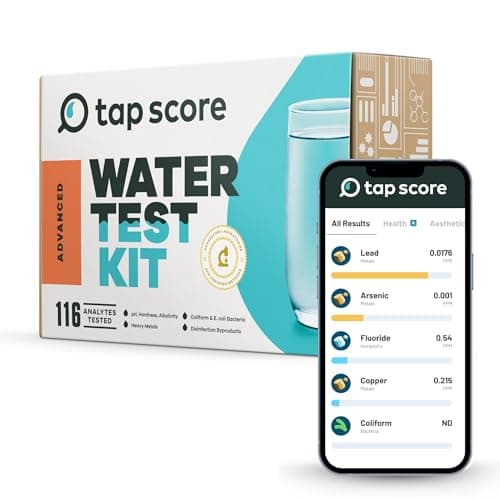 Tap Score Advanced Water Test (SimpleLab)Lead enters from your own plumbing, downstream of every utility sample. Tap Score Advanced Water Test (SimpleLab)Lead enters from your own plumbing, downstream of every utility sample. | For what the report cannot cover | $269.00 - View on Amazon #ad Price as of October 17, 2026. We may earn a commission. Disclosure. |
| 2 | 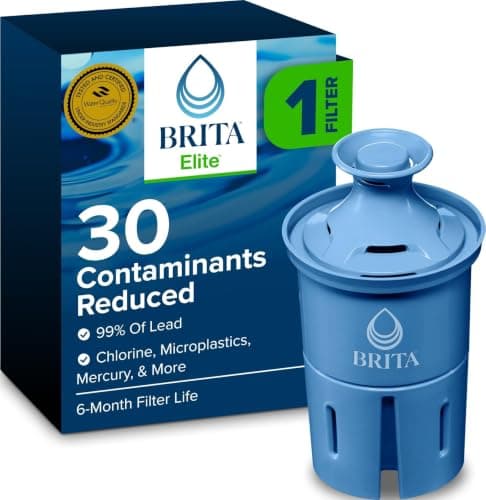 Brita Elite Filter (with any Brita pitcher)Certified to NSF/ANSI 42 for taste and odor, and to 53 for lead. Brita Elite Filter (with any Brita pitcher)Certified to NSF/ANSI 42 for taste and odor, and to 53 for lead. | If the report shows chlorine | $19.88 - View on Amazon #ad Price as of October 17, 2026. We may earn a commission. Disclosure. |
| 3 | 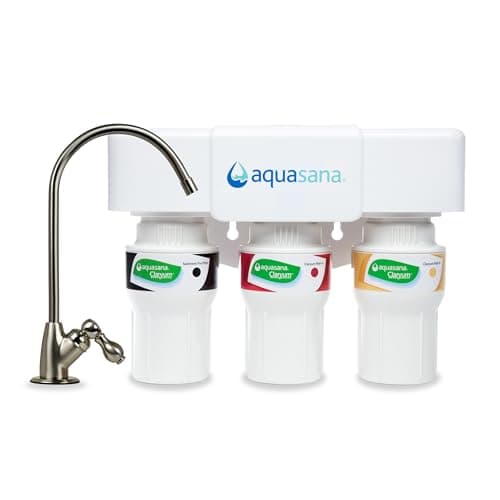 Aquasana Claryum 3-Stage Under-Sink Filter (AQ-5300)Certified to NSF/ANSI 42, 53 and 401, covering chloramine and trace compounds. Aquasana Claryum 3-Stage Under-Sink Filter (AQ-5300)Certified to NSF/ANSI 42, 53 and 401, covering chloramine and trace compounds. | If it shows chloramine or by-products | $154.99 - View on Amazon $349.99 — 56% off #ad Price as of October 17, 2026. We may earn a commission. Disclosure. |
Finding it
Every community water system in the United States must publish a Consumer Confidence Report annually, usually by 1 July, covering the previous calendar year. It is delivered to customers and published online.
If you rent, the report goes to the account holder, which may be your landlord. Search for your utility's name plus "consumer confidence report" or "water quality report" — it will be on their site.
The vocabulary
| Term | What it means |
|---|---|
| MCL — Maximum Contaminant Level | The enforceable legal limit. Above it is a violation. |
| MCLG — Maximum Contaminant Level Goal | The level with no known health risk. Not enforceable. For lead it is zero. |
| Detected level | What was actually measured, usually as a range and an average |
| ND | Not detected — below the laboratory's reporting limit |
| ppm / mg/L | Parts per million. Same thing. |
| ppb / ug/L | Parts per billion. A thousand times smaller. |
| ppt / ng/L | Parts per trillion. The unit PFAS limits are written in. |
| AL — Action Level | For lead and copper: the level triggering required utility action |
| TT — Treatment Technique | A required process, where measuring the contaminant directly is impractical |
The MCL-versus-MCLG distinction is the most useful thing on this page. The goal is the health-based number; the limit is what is enforceable given what treatment can achieve at reasonable cost. For lead the goal is zero and the action level is not, and that gap is the honest reason people filter water that is legally compliant.
What to look at, in order
- Any violations. Listed prominently and rare. If there are none, the system met every enforceable limit.
- The disinfectant. Chlorine or chloramine — this decides which filter media you need. Chloramine wants catalytic carbon.
- Disinfection by-products. Trihalomethanes and haloacetic acids. Compare the detected level against the MCL; if it is close, a carbon filter certified to NSF/ANSI 53 is a reasonable response.
- Hardness, if published. Often in a separate table since it is not a regulated health contaminant. It sizes a softener.
- Lead and copper. Reported as a 90th-percentile figure from a sample of homes — see the caveat below.
- PFAS, if published. Many systems have not completed monitoring yet; initial monitoring is required by 26 April 2027.
The thing the report deliberately cannot tell you
Your lead risk. Lead almost never comes from the treatment plant — it dissolves into the water from the service line, from pre-1986 solder and from brass fixtures, all of which sit downstream of every sample the utility takes.
The lead figure in the report is a 90th-percentile value across a sample of homes selected for being high-risk. It describes the system. It does not describe your house, and a utility can be fully compliant while a specific home has a genuine problem.
That gap is closed by one thing: a first-draw test at your own tap. See the lead page for who should prioritize it.
Reading it into a purchase
| What the report shows | What it means for you |
|---|---|
| Chloramine as the disinfectant | Buy catalytic carbon, not standard activated carbon |
| By-products near the MCL | A carbon filter certified to NSF/ANSI 53 |
| Hardness above 7 gpg | Consider a softener; above 10.5 it usually pays |
| PFAS detected | A certified PFAS filter — see the PFAS roundup |
| Nothing notable | A pitcher for taste, and nothing else. That is a legitimate outcome. |
What a clean report is worth
A great deal, honestly. If your report shows no violations, a disinfectant you can filter for a few dollars a month, and no contaminant near a limit, then the correct purchase is a certified pitcher and nothing else.
We would rather tell you that than sell you a system. The report is the cheapest piece of information in this entire category, and often the most reassuring.
The picks in full
For what the report cannot cover
Tap Score Advanced Water Test (SimpleLab)
SimpleLab
Mail-in testing through certified laboratories, with a report that names contaminants, gives concentrations, and compares them against health guidelines. This is the number every system on this site is sized from.
Certification status
Samples are analyzed by laboratories in the SimpleLab network certified to ISO/IEC 17025, and Tap Score is recognized by the Water Quality Association.
Published specifications
| Method | Mail-in sample, certified laboratory analysis |
|---|---|
| Lab accreditation | ISO/IEC 17025 certified network laboratories |
| Panels available | City water, well water, and contaminant-specific tests |
| What you get | Concentrations plus health-guideline comparison |
What we like
- Certified-laboratory analysis, not a color-matching strip
- The report explains what each result means rather than dumping numbers
- Contaminant-specific panels exist when you only need one answer
What we do not
- Costs meaningfully more than a strip kit
- Turnaround is days, not minutes
- You have to actually collect the sample correctly, which is where home tests usually go wrong
Skip it if
Somebody whose entire complaint is a chlorine taste. That diagnosis is free — you can smell it — and a certified carbon filter costs less than the test.
#ad Price as of October 17, 2026. We may earn a commission. Disclosure.
Where these specifications came from
If the report shows chlorine
Brita Elite Filter (with any Brita pitcher)
Brita
The cheapest route to an NSF/ANSI 53 lead certification. It drops into a pitcher most households already have, and it is emphatically not the same filter as the white Brita Standard.
Certification status
Certified to NSF/ANSI 42, 53 and 401. The lead certification belongs to the Elite (blue) filter only — the Standard (white) filter is certified to NSF/ANSI 42 for taste and odor and is not certified for lead. Per Brita's January 2026 performance data sheet the Elite is not certified for PFOA or PFOS, and no Brita pitcher filter is certified for fluoride.
Published specifications
| Rated filter life | 120 gallons / about 6 months |
|---|---|
| Standard filter life, for comparison | 40 gallons / about 2 months |
| Certified standards | NSF/ANSI 42, 53, 401 |
| Lead | Certified under NSF/ANSI 53 |
| PFOA / PFOS | Not certified (January 2026 performance data sheet) |
| Fluoride | Not certified, not claimed |
What we like
- Genuine NSF/ANSI 53 lead certification at the lowest entry price of anything on this site
- Fits Brita pitchers and dispensers already in millions of kitchens — no new hardware
- Three times the rated life of the Standard filter, which changes the cost-per-gallon math
What we do not
- Not certified for PFOA or PFOS, so it is the wrong answer to a PFAS worry
- No fluoride claim at all
- Slow gravity flow, like every pitcher
Skip it if
Anyone whose actual worry is PFAS or fluoride. The Elite is not certified for either, and buying it for those is buying the wrong thing.
#ad Price as of October 17, 2026. We may earn a commission. Disclosure.
Where these specifications came from
If it shows chloramine or by-products
Aquasana Claryum 3-Stage Under-Sink Filter (AQ-5300)
Aquasana
Carbon-block filtration rather than reverse osmosis: it keeps the minerals, wastes nothing, and fits where a reverse-osmosis system will not. It also cannot do what RO does for fluoride or nitrate.
Certification status
WQA tested and certified to NSF/ANSI 42, 53 — which includes the P473 protocol for PFOA and PFOS — and 401, for the reduction of 78 contaminants. Aquasana publishes 99.6% for lead and microplastics, 99.7% for PFOA and PFOS, 99.99% for cysts and 97% for chlorine across the Claryum 3-Stage line.
Published specifications
| Filter life | 600 gallons / up to 6 months |
|---|---|
| Certified standards | NSF/ANSI 42, 53 (includes P473), 401 (WQA) |
| Flow rate | 0.5 gpm |
| Wastewater | None |
| Format | 3-stage carbon block with a dedicated faucet |
| Contaminants claimed | 78 |
| Lead / PFOA and PFOS | 99.6% / 99.7% |
What we like
- No drain line, no wastewater, no tank — much easier to install than reverse osmosis
- NSF/ANSI 401 certification covers pharmaceutical-class trace compounds
- Full flow rate, unlike reverse osmosis, so filling a pot is not a project
What we do not
- Not reverse osmosis: no meaningful fluoride, nitrate or TDS reduction
- 600-gallon filter life is short next to an inline system's tens of thousands
- Proprietary cartridges
Skip it if
Anyone whose problem is fluoride, nitrate or total dissolved solids. Carbon block does not remove those; you need reverse osmosis for that job.
$349.99 — 56% off
#ad Price as of October 17, 2026. We may earn a commission. Disclosure.
Questions people actually ask
Where do I find my water quality report?
Search your utility's name plus 'consumer confidence report'. Public water systems must publish one annually, usually by 1 July, covering the previous calendar year. If you rent, it goes to the account holder but is published online regardless.
What is the difference between MCL and MCLG?
The MCL is the enforceable legal limit. The MCLG is the level at which no health risk is known, and it is not enforceable. For lead the goal is zero, which is why people filter water that is fully compliant with the limit.
Does the report tell me if I have lead?
No, and this is its main limitation. Lead enters from the service line and household plumbing, downstream of every utility sample. The reported figure is a 90th-percentile value across selected high-risk homes — it describes the system, not your house.
Why does my report not mention PFAS?
Many systems have not completed PFAS monitoring yet. The EPA rule finalized in April 2024 requires initial monitoring by 26 April 2027, so for a lot of utilities the measurement is genuinely still under way rather than being withheld.