
Reverse osmosis needs an air gap faucet; a carbon under-sink filter does not. Get that one choice right and the rest is cosmetic. The Kohler Wellspring is the only pick here whose maker publishes its NSF/ANSI/CAN 372 and 61 certifications — but buy the AG model number, not the plain one.
Quick picks
Tap any row to jump to the full write-up. The button goes straight to the retailer.
| # | Product | Best for | Price |
|---|---|---|---|
| 1 | Kno photoKohler Wellspring Beverage Faucet (K-6665-AG)The only pick whose manufacturer spec sheet names NSF/ANSI/CAN 372 and 61, and states it is reverse osmosis compatible. | Best certified filtered water faucet | Check price on Amazon #ad We do not show a price we cannot verify today. We may earn a commission. Disclosure. |
| 2 | 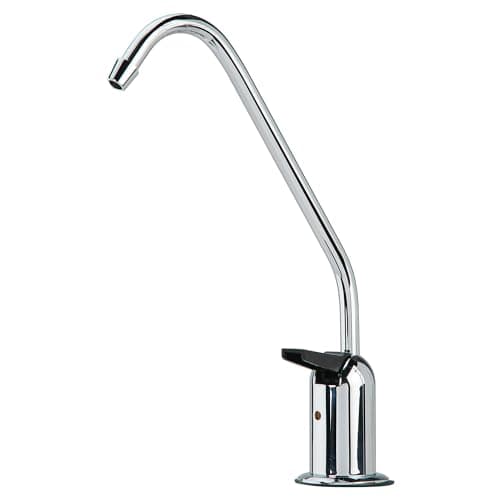 Watts Premier Air Gap RO Auxiliary FaucetThree lines and a drain connection, from a plumbing manufacturer, at a price that makes buying the right variant easy. | Best air gap faucet | $34.05 - View on Amazon #ad Price as of November 2, 2026. We may earn a commission. Disclosure. |
| 3 | 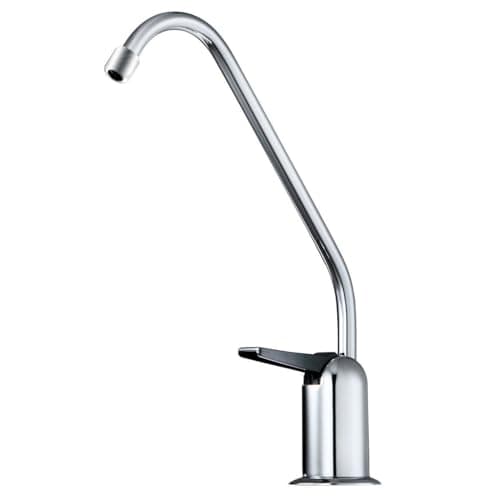 Watts Premier Non-Air Gap RO Auxiliary FaucetThe correct default for a carbon under-sink filter: one hole, one tube, no drain saddle. | Best non-air-gap faucet | $35.42 - View on Amazon #ad Price as of November 2, 2026. We may earn a commission. Disclosure. |
| 4 | 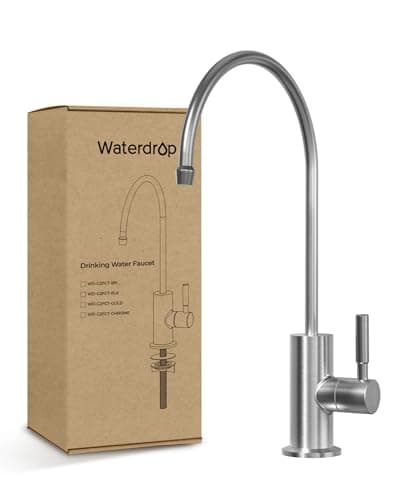 Waterdrop G2FCT Drinking Water FaucetBrushed nickel and black, with an NSF/ANSI 372 claim on the listing — recorded here as the seller's claim. | Best finish range with a 372 claim | $38.99 - View on Amazon #ad Price as of November 2, 2026. We may earn a commission. Disclosure. |
| 5 | 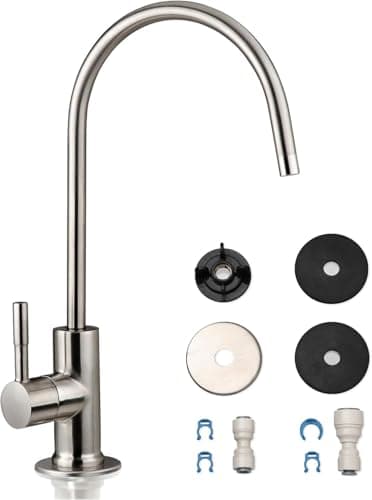 iSpring GA1-BN Drinking Water FaucetA half-inch stem hole and a 1/4 in adapter in the box. Non-air-gap, and iSpring says so itself. | Cheapest with a published hole size | $36.35 - View on Amazon $39.99 — 9% off #ad Price as of November 2, 2026. We may earn a commission. Disclosure. |
First, what this page is not about
Two completely different products get called a water filter faucet, and buying the wrong one is the most common mistake in this corner of the category.
A faucet-mounted filter screws onto the end of your existing tap and filters the water as it comes out. That is a filter. The faucet-mount roundup covers those, and there are only three certified ones worth buying.
A filtered water faucet is a second, smaller tap you install in the counter or sink deck, fed by a filter living in the cabinet below. It contains no media and removes nothing. It is plumbing hardware, and this page is about choosing it.
If you are not sure which you need: under-sink systems and reverse osmosis systems almost all want a dedicated tap, and most ship with one. You are reading this page either because the one in the box is ugly, or because your system did not include one.
How we judged these, before any product appears
There is no performance claim to rank a faucet on. It does not reduce anything, so there is no certification for reduction and no cost per gallon. That makes the criteria short and unusually concrete:
- Air gap or not. This is a compatibility question with a right answer for your system, and getting it wrong means the faucet does not work or does not meet code. It decides everything, so it goes first.
- Material certification. The faucet is the last thing your water touches. NSF/ANSI/CAN 372 covers lead-free materials and NSF/ANSI/CAN 61 covers health effects of drinking water system components. Almost nothing in this category holds either.
- Published fitting dimensions. Hole diameter, deck thickness and tubing size. A faucet that does not publish these is a gamble on a hole you have already drilled.
- Finish and form. Last, and honestly the reason most people are here, because the faucet in the box is usually chrome.
Note what is absent: flow rate as a ranking factor. A filtered water faucet is supposed to be slow, and the section below explains why a high figure would be a warning rather than a feature.
Air gap or non-air-gap, decided properly
The air gap is not a feature, an upgrade or a style. It is a backflow-prevention arrangement, and whether you need one is determined by whether your filter connects to a drain.
Reverse osmosis does. An RO system requires an air gap faucet, because plumbing code requires a backflow prevention device like an air gap wherever an appliance is connected to both feed water and a drain line. The gap physically interrupts the drain path so that drain water can never back up to the RO or potable water side. That is why an air gap faucet has three lines underneath it rather than one.
A carbon under-sink filter does not. It produces no wastewater, has no drain connection, and the question never arises — which is why most under-sink water filters are compatible with all drinking water faucet types.
| Air gap faucet | Non-air-gap faucet | |
|---|---|---|
| Lines underneath | Three | One |
| Drain connection | Required | None |
| Correct for reverse osmosis | Yes — code wants backflow protection | Only if the system handles it another way |
| Correct for a carbon under-sink filter | No — adds a hole and two unused ports | Yes |
| Noise | Can gurgle as the system flushes | Silent |
| Holes in the counter | One, plus the drain saddle under the sink | One |
The practical identification tip comes from iSpring, which tells buyers to check whether the faucet their system needs has three connections on the bottom. Count the ports before you order, and read your system's instructions rather than assuming — some newer reverse osmosis systems route their drain differently and ship a single-line faucet deliberately.
One warning in the other direction, since it comes up: fitting an air gap faucet and simply not connecting the drain lines is not a clever workaround. The gap is the protection; unused means absent.
The Kohler trap: one suffix, two different products
This is the single most useful thing on this page, and it is checkable in thirty seconds against two documents on Kohler's own site.
The Wellspring beverage faucet exists as K-6665-AG and as K-6665. They look nearly identical on a retailer listing. They are not the same purchase.
The AG sheet lists the faucet as RO (reverse osmosis) compatible and says it works with KOHLER filtration systems or as a cold water tap, at a 1.5 gpm (5.7 lpm) maximum flow rate at 60 psi.
The plain K-6665 sheet carries a notice in bold: Do not use this product with instant hot water systems or reverse osmosis (RO) filtration systems.
So a buyer who wants a Kohler faucet for their RO system, searches "Kohler Wellspring beverage faucet", and buys the first in-stock listing has a real chance of owning a faucet the manufacturer explicitly tells them not to connect to it. The suffix is the whole difference.
This is also why no ASIN is recorded against the Kohler pick on this page. No in-stock Amazon listing we checked names the variant in its title, and this site only records an ASIN when the listing title matches the brand, model and variant being featured. The buy button runs a search instead, which is the honest behavior when the listing cannot be pinned — how we pick covers that rule.
What "lead-free" legally means
Every faucet in this category says lead-free. The phrase is regulated, so it is worth knowing what it actually promises and what it does not.
EPA puts it at a weighted average of 0.25% lead calculated across the wetted surfaces of the product, a figure set by Section 1417 of the Safe Drinking Water Act as revised by the Reduction of Lead in Drinking Water Act of 2011. Manufacturers and importers must certify compliance using a consistent verification process.
Two things follow. First, lead-free does not mean lead-absent — it means below a threshold. Second, and more usefully, the claim is supposed to be certified, which means there should be a body and a standard behind it. The standard is NSF/ANSI/CAN 372, and Kohler names it, alongside NSF/ANSI/CAN 61 and ASME A112.18.1/CSA B125.1, right on the spec sheet.
Of the other picks here, Waterdrop states a 372 certification on its listing — we could not match it to a public database entry, so this page records it as the seller's claim — and the Watts and iSpring faucets describe lead-free brass construction without naming a certifier at all. That is the honest ranking of the evidence, and it is why the premium pick is premium. The certification guide explains why "certified to" and "claims" are different sentences.
Why this matters more on reverse osmosis water
There is a specific reason to care about faucet materials on an RO system rather than on a carbon filter, and it is not squeamishness.
Reverse osmosis strips dissolved minerals — certified listings put the reduction in the 94% to 97% band. Water with very little dissolved in it is more aggressive toward metals than ordinary tap water, which is why the Fresh Water Systems guide specifically advises avoiding faucets that have internal components made of lead, copper, or brass in contact with RO water especially, and recommends NSF/ANSI 61 or 372 certified materials.
Put plainly: the more thoroughly your filter works, the more the last fitting matters. If you have spent real money on a certified RO system and are about to finish it with the cheapest tap on the listings page, that is the argument against doing it.
The three measurements that decide whether it fits
More returns in this category come from dimensions than from anything else, and all three numbers are knowable before you buy.
Hole diameter. There is no standard. Kohler's plain Wellspring sheet specifies a hole from 1" (25 mm) minimum to 1-1/2" (38 mm) maximum, while iSpring's GA1 listings say a 1/2-inch hole is all that is needed for the faucet stem. That is a threefold difference between two faucets doing the same job. Measure the hole you intend to use, or check the spec before drilling one.
Tubing size. Most under-sink systems run 1/4 in line, and both the Watts faucets and the iSpring take it, with iSpring including the 1/4 in adapter in the box. The Kohler uses a 3/8 in compression connection, so a 1/4 in system needs a reducing fitting — cheap, but you want it in the same order rather than discovered on a Sunday.
Deck thickness. Rarely a problem on a sink deck and frequently a problem on thick stone. Check the maximum deck thickness against your counter if it is a slab.
If you do not have a spare hole at all, you have a different decision to make before this one. The no-drilling page covers the direct-connect route, and the touchless-faucet page covers reusing a redundant side-sprayer position, which is the cleanest version of this install.
Low flow is the design, not a defect
New owners regularly conclude their faucet is faulty because it fills a glass slowly. It is not.
Filtered water faucets generally have a lower flow rate than standard faucets, and on reverse osmosis the constraint is upstream of the tap anyway: the system produces into a tank or on demand at a rate set by the membrane, not by the spout. Kohler's 1.5 gpm figure is a maximum the faucet can pass, not a promise about what your filter will deliver into it.
So do not shop on flow rate here. If your filtered water is slower than you expected, the answer is in the system — production rate and format — rather than in the tap.
A second tap, or one faucet that does both?
This comes up constantly now that all-in-one filtering faucets are sold, and the honest answer depends on one thing: what you need removed.
An all-in-one filtering faucet puts the filter and the tap in a single fixture. It saves a hole and looks tidier. The limit is the cartridge: there is only room for a small carbon element, so it belongs to the same performance class as a faucet-mount filter rather than to the under-sink class. For chlorine, taste and odor that is fine. For lead, fluoride, nitrate or arsenic it is not, because carbon of that size does not reach them.
A dedicated second tap fed by a cabinet system is the opposite trade: an extra hole, and access to the whole certified range — lead, fluoride and the rest. It also keeps the filter off your main tap, so rinsing and pot-filling do not spend cartridge life.
For a small household with no specific contaminant, the all-in-one is a reasonable buy. For anybody who has a test result they are trying to fix, it is not, and the second tap is the only route. The tier guide starts from the contaminant rather than from the fixture.
The cost-per-gallon math
A faucet has no cartridges, so the usual cost-per-gallon arithmetic does not apply. The comparison that does is the faucet against the system it finishes.
Work out what you are about to spend on the filter, then look at the faucet as a percentage of it. A utility faucet is a rounding error on an under-sink reverse osmosis system; the Kohler is a visible fraction of it. Both are small next to the ten-year cost of the system, which is dominated by cartridges.
The only expensive mistake available here is buying the wrong variant and discovering it after the hole is drilled. Count the lines your system needs, check the model suffix, and the rest of this decision is cosmetic.
We do not print product prices in this text. The buy buttons carry the live figure and the date it was checked, which is the only price worth quoting.
We show the arithmetic rather than a verdict so you can redo it with the price you actually pay. Filter prices move; the rated capacities above do not.
The picks in full
Best certified filtered water faucet
Kohler Wellspring Beverage Faucet (K-6665-AG)
Kohler
A proper fixture rather than an accessory, and the only pick whose material certifications are printed on a manufacturer specification sheet. Buy the AG model number or you have bought a faucet Kohler says not to put on a reverse osmosis system.
Certification status
Kohler's specification sheet for the K-6665-AG lists ASME A112.18.1/CSA B125.1, NSF/ANSI/CAN 372 and NSF/ANSI/CAN 61, and states the faucet is ADA and CSA B651 compliant when installed to the requirements of those regulations. NSF/ANSI/CAN 372 is the lead-free materials standard; NSF/ANSI/CAN 61 covers health effects of drinking water system components. The sheet also states plainly that the faucet is RO (reverse osmosis) compatible.
Published specifications
| Air gap | Yes — the AG model number |
|---|---|
| Flow rate | 1.5 gpm (5.7 l/min) max at 60 psi |
| Certified standards | NSF/ANSI/CAN 372 and 61; ASME A112.18.1/CSA B125.1 |
| Spout height | 8-5/8 in (219 mm) |
| Spout rotation | 360 degrees |
| Connection | 3/8 in compression |
| Mounting | Single hole |
| Valve | Ceramic disc |
What we like
- Material certifications named on the manufacturer's own spec sheet, which almost nothing else in this category can show
- Explicitly stated as reverse osmosis compatible, rather than left for you to infer
- Ceramic disc valve and a real fixture warranty behind it
- Finishes that actually match a Kohler kitchen, which is the reason most people look at it
What we do not
- Several times the price of a functional RO faucet that does the same job
- The AG and non-AG variants look nearly identical and differ by one suffix in the model number
- Kohler's non-AG sheet forbids reverse osmosis use, so buying the wrong variant is a real risk
- No ASIN is recorded here because no in-stock Amazon listing names the variant — the buy link is a search
Skip it if
Anyone whose faucet will live behind a sink skirt or in a utility room. You are paying for a visible fixture and a published spec sheet; if neither is visible, the Watts faucets do the same plumbing for a fraction of it.
#ad We do not show a price we cannot verify today. We may earn a commission. Disclosure.
Best air gap faucet
Watts Premier Air Gap RO Auxiliary Faucet
Watts Premier
The plumbing-trade answer: an air gap faucet from a company that makes backflow preventers for a living, at a price that makes the decision easy. The air gap is a code requirement on reverse osmosis, not a feature.
Certification status
No certification listing was found for this faucet. Watts publishes it as an air gap auxiliary faucet requiring a drain connection, in contrast to its non-air-gap sibling which does not. The air gap itself is a backflow-prevention arrangement rather than a filtration claim, so there is no reduction performance to certify — but the absence of an NSF/ANSI 372 materials listing is a real gap next to the Kohler.
Published specifications
| Air gap | Yes — three lines, drain connection required |
|---|---|
| Supply tubing | 1/4 in |
| Handle | Touch N'Flow |
| Finish | Chrome |
| Certified standards | None found — see certification note |
What we like
- An air gap faucet from a plumbing manufacturer rather than an unbranded import
- Matched non-air-gap sibling, so you can buy the correct one for your system from the same range
- 1/4 in tubing matches the line almost every under-sink RO system ships with
- Cheap enough that buying the right variant is not an expensive mistake
What we do not
- No NSF/ANSI 372 or 61 listing we could find, which matters more on reverse osmosis water than on carbon-filtered water
- Chrome only in this listing, so it will not match a brushed or matte kitchen
- An air gap can gurgle while the system flushes — normal, and still irritating
- The published detail is thinner than a fixture manufacturer's spec sheet
Skip it if
A carbon under-sink filter with no drain line. An air gap on a system that produces no wastewater adds a hole, two unused ports and a noise source for nothing. Buy the non-air-gap version.
#ad Price as of November 2, 2026. We may earn a commission. Disclosure.
Best non-air-gap faucet
Watts Premier Non-Air Gap RO Auxiliary Faucet
Watts Premier
The same faucet with the air gap deleted, which is the correct purchase for every under-sink filter that has no drain line. One hole, one tube, nothing to gurgle.
Certification status
No certification listing was found for this faucet. Watts publishes it as a non-air-gap auxiliary faucet that does not require a drain connection. As with the air gap version, there is no filtration claim to certify and no NSF/ANSI 372 materials listing we could locate.
Published specifications
| Air gap | No — single line, no drain connection |
|---|---|
| Supply tubing | 1/4 in |
| Handle | Touch N'Flow spring-loaded |
| Finish | Chrome |
| Certified standards | None found — see certification note |
What we like
- The right default for carbon under-sink filters, which are most of this tier
- No drain saddle, no second penetration, nothing to gurgle
- Spring-loaded one-touch handle rather than a tap you leave open
- Cheapest honest way to put a dedicated drinking tap on a filter
What we do not
- Wrong for any RO system whose instructions call for an air gap faucet
- No NSF/ANSI 372 or 61 listing we could find
- Chrome only, and the styling is utility rather than fixture
- Easy to confuse with the air gap model on a retailer listing page — read the title
Skip it if
A reverse osmosis system that specifies an air gap faucet. Fitting this instead removes the backflow protection the code asks for, and no price saving justifies that.
#ad Price as of November 2, 2026. We may earn a commission. Disclosure.
Best finish range with a 372 claim
Waterdrop G2FCT Drinking Water Faucet
Waterdrop
The finish options a Watts faucet does not have, from a brand this site already covers, with an NSF/ANSI 372 claim printed on the listing. Read that claim as the seller's, because we could not find it in a certifier's own database.
Certification status
Waterdrop's retailer listing states the faucet is NSF/ANSI 372 certified — the lead-free materials standard. We could not match that claim to a public listing in a certifier's database, so it is recorded here as a manufacturer claim rather than a verified certification. That is a weaker form of evidence than the Kohler spec sheet and a stronger one than the no-name faucets that say only 'lead-free'.
Published specifications
| Air gap | No — single line |
|---|---|
| Claimed standard | NSF/ANSI 372 (manufacturer claim) |
| Finishes | Brushed nickel; black on a sibling model |
| Intended use | RO systems and under-sink filters |
What we like
- An explicit NSF/ANSI 372 lead-free claim, which most faucets in this price bracket do not make at all
- Brushed nickel and black options, so it can match a kitchen rather than fight it
- From a brand whose filtration certifications this site has already checked in detail
- Priced with the utility faucets rather than with the fixtures
What we do not
- The 372 claim is on the listing, not in a certifier's searchable database that we could find
- Non-air-gap only, so it is wrong for an RO system that specifies an air gap
- No published flow rate or hole-size figure we could verify
- Waterdrop's model codes are close together and easy to mis-order
Skip it if
An RO system whose manual calls for an air gap faucet, and anyone who wants the certification verified rather than claimed. For the latter, the Kohler is the only pick here with a spec sheet naming the standards.
#ad Price as of November 2, 2026. We may earn a commission. Disclosure.
Cheapest with a published hole size
iSpring GA1-BN Drinking Water Faucet
iSpring
The cheapest pick from a brand whose reverse osmosis systems this site already reviews, with the one spec that actually governs installation published: a half-inch hole. Non-air-gap only, and iSpring says so in its own listings.
Certification status
No certification listing was found. Retailer listings describe the faucet as 100% lead-free with solid brass construction, and iSpring states it should not be used with RO systems that require an air gap faucet. Treat 'lead-free' here as a manufacturer description rather than a certified claim — EPA's legal definition of lead free is a weighted average of 0.25% lead across wetted surfaces, and nothing in the listing points to a body that verified it.
Published specifications
| Air gap | No — iSpring states it is not for air-gap RO systems |
|---|---|
| Mounting hole | 1/2 in for the faucet stem |
| Tubing adapter | 1/4 in included; 3/8 in on request |
| Construction | Solid brass, described as 100% lead-free |
| Certified standards | None found — see certification note |
What we like
- Published hole size, which is the measurement that decides whether you can fit it at all
- 1/4 in adapter in the box matches standard RO tubing
- Several finishes across the GA1 range, including brushed nickel and oil-rubbed bronze
- Natural pairing with the iSpring RO systems already reviewed here
What we do not
- No certification listing of any kind for the materials
- Non-air-gap, and iSpring's own listings warn against using it where an air gap is required
- Model codes across the GA1, GA3, GB1 and GK1 ranges differ mainly by finish and fitting, which is easy to get wrong
- Utility styling that will look like an accessory beside a designer faucet
Skip it if
An RO system that specifies an air gap faucet — iSpring says to check for three connections on the bottom of the faucet your system needs. Also not for anyone who wants verified lead-free materials rather than a stated claim.
$39.99 — 9% off
#ad Price as of November 2, 2026. We may earn a commission. Disclosure.
Questions people actually ask
Do I need an air gap faucet for reverse osmosis?
Usually yes. An RO system connects to both the potable feed and a drain line, and plumbing code requires a backflow prevention device like an air gap wherever that is true — the gap stops drain water from ever backing up to the filtered side. An air gap faucet has three lines underneath it rather than one. Read your system's instructions, because some newer systems route the drain differently and ship a single-line faucet deliberately.
What is the difference between an air gap and a non-air-gap faucet?
The number of lines and whether a drain is connected. An air gap faucet has three lines and needs a drain connection; a non-air-gap faucet has one line and needs none. Air gap is for reverse osmosis, where code wants backflow protection. Non-air-gap is correct for a carbon under-sink filter, which produces no wastewater and has no drain connection at all.
Which Kohler faucet works with an under-sink filter or reverse osmosis system?
The Kohler Wellspring K-6665-AG. Its specification sheet states the faucet is RO compatible and works with Kohler filtration systems or as a cold water tap, at 1.5 gpm maximum at 60 psi. The plain K-6665 looks nearly identical and carries the opposite instruction: do not use this product with instant hot water systems or reverse osmosis filtration systems. Check the AG suffix before ordering.
Does a filtered water faucet filter the water?
No. A filtered water faucet is a dedicated tap containing no media — the filtration happens in the system under the sink that feeds it. The product that does filter at the tap is a faucet-mounted filter, which screws onto your existing spout and is a different purchase entirely.
What does lead-free mean on a water faucet?
A weighted average of 0.25% lead across the wetted surfaces of the product. That figure comes from Section 1417 of the Safe Drinking Water Act as revised by the Reduction of Lead in Drinking Water Act of 2011, and manufacturers must certify compliance. So lead-free means below a threshold rather than lead-absent, and the claim should have a standard behind it — NSF/ANSI/CAN 372 is the one to look for.
What size hole does a filtered water faucet need?
There is no standard, and the range is wide. Kohler specifies a 1 in (25 mm) minimum to 1-1/2 in (38 mm) maximum hole for the Wellspring, while iSpring's GA1 listings say a 1/2 in hole is all the faucet stem needs. Check the spec sheet for your model before drilling, and if your sink has a redundant side-sprayer position, reusing that hole avoids drilling entirely.
Why is my filtered water faucet so slow?
Because it is designed to be. Filtered water faucets generally run at a lower flow rate than standard faucets, and on reverse osmosis the limit is the membrane's production rate rather than the spout. A faucet's gpm figure is the maximum it can pass, not a promise about what the system will deliver into it. If the flow is genuinely a problem, the fix is a higher-production system, not a different tap.
Is an all-in-one filtering faucet better than a separate tap?
Only if chlorine and taste are all you need fixed. An all-in-one fixture has room for a small carbon cartridge, which puts it in the same performance class as a faucet-mount filter — fine for taste and odor, and not capable of lead, fluoride, nitrate or arsenic. A dedicated second tap fed by a cabinet system costs you a hole and gives you access to the whole certified range.
Sources
- Kohler — K-6665-AG Wellspring beverage faucet specification sheet
- Kohler — K-6665 Wellspring beverage faucet specification sheet (the non-air-gap variant)
- EPA — use of lead free pipes, fittings, fixtures, solder and flux for drinking water (Safe Drinking Water Act section 1417)
- Fresh Water Systems — faucet buying guide for a water filter or dispenser
- iSpring GA1 series lead-free drinking water faucet — Tractor Supply specification listing
- Watts Premier — sink faucet datasheets, air gap and non-air-gap auxiliary faucets
- NSF — Certified Products and Systems