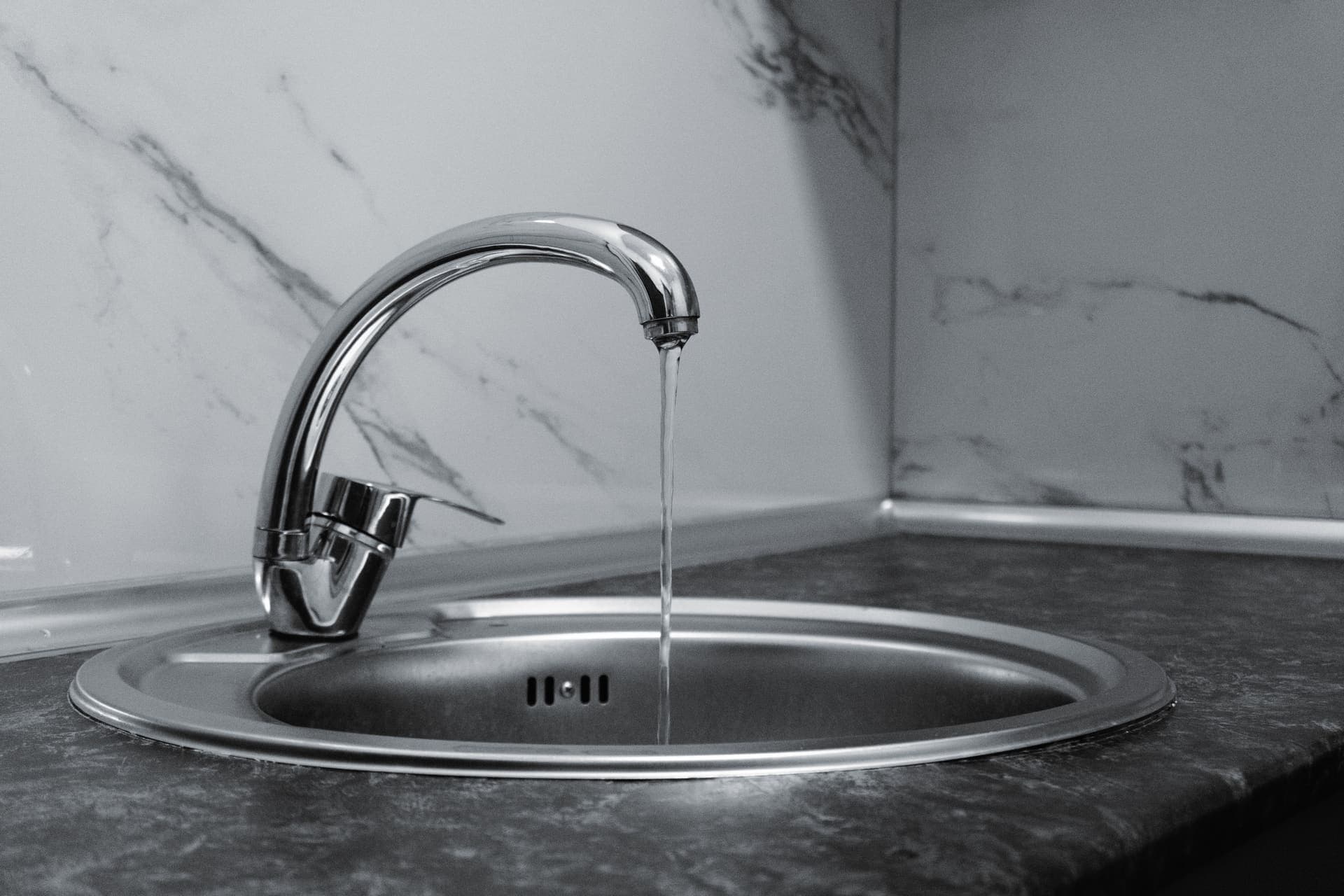
Faucet-mounted filters are the smallest real upgrade available: no plumbing, no fridge space, filtered water on demand. Only a few carry a health certification that covers lead, and none of the three we verified fits a pull-out or pull-down sprayer faucet, so check your tap before you shop.
Quick picks
Tap any row to jump to the full write-up. The button goes straight to the retailer.
| # | Product | Best for | Price |
|---|---|---|---|
| 1 | 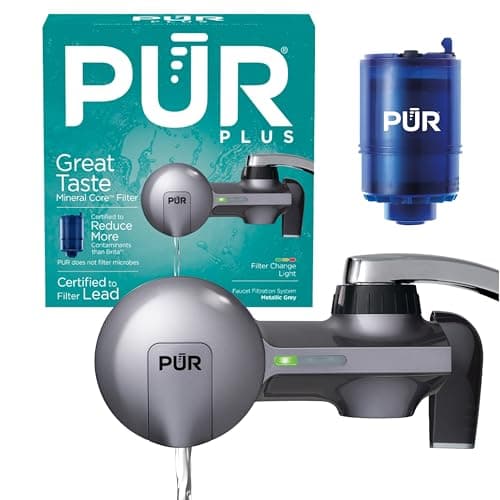 PUR PLUS Faucet Mount Filtration System (PFM400H)The longest published contaminant table in the category: lead, total PFAS, microplastics, VOCs and a fifteen-row NSF/ANSI 401 list. PUR PLUS Faucet Mount Filtration System (PFM400H)The longest published contaminant table in the category: lead, total PFAS, microplastics, VOCs and a fifteen-row NSF/ANSI 401 list. | Best overall | $32.99 - View on Amazon #ad Price as of October 6, 2026. We may earn a commission. Disclosure. |
| 2 | 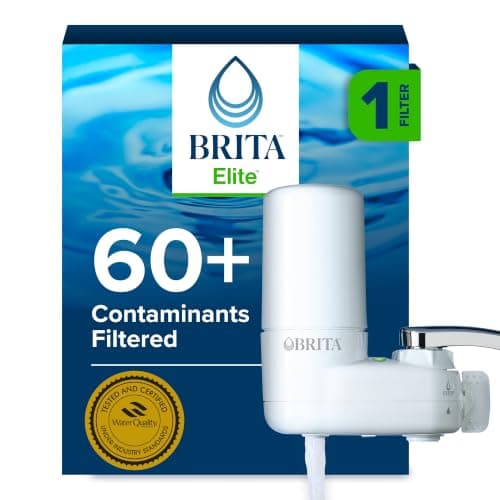 Brita Faucet Mount System (SAFF-100 / FF-100)WQA certified against NSF/ANSI 42, 53 and 401. Lead 99.9%, microplastics 99.9%. Brita Faucet Mount System (SAFF-100 / FF-100)WQA certified against NSF/ANSI 42, 53 and 401. Lead 99.9%, microplastics 99.9%. | Best certification | $22.86 - View on Amazon #ad Price as of October 6, 2026. We may earn a commission. Disclosure. |
| 3 | Cno photoCulligan FM-25 Faucet Mount Filter200 rated gallons per cartridge, certified by IAPMO R&T to NSF/ANSI 42 and 53. | Longest cartridge life | Check price on Amazon #ad We do not show a price we cannot verify today. We may earn a commission. Disclosure. |
| 4 | 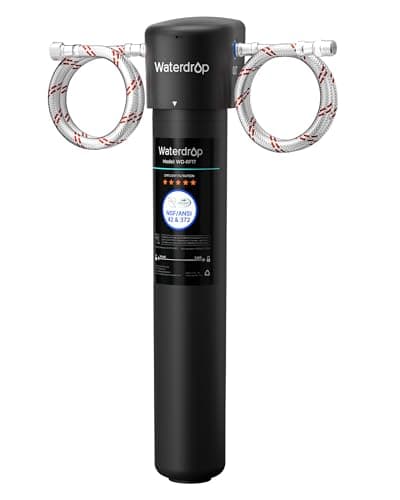 Waterdrop 17UA Direct-Connect Under-Sink FilterDirect connect under the sink: nothing on the tap, 24,000 rated gallons, no drilling. Waterdrop 17UA Direct-Connect Under-Sink FilterDirect connect under the sink: nothing on the tap, 24,000 rated gallons, no drilling. | Best when a mount will not fit | Check price on Amazon #ad We do not show a price we cannot verify today. We may earn a commission. Disclosure. |
Check your faucet first. Everything else is second.
A faucet-mounted filter unscrews your aerator and clamps a housing onto the spout. That only works on a spout with a conventional threaded end that stays still: a fixed gooseneck, a standard kitchen tap, most bathroom taps. It does not work on a pull-out or pull-down sprayer, and those are now standard in new kitchens.
Nothing on the rest of this page matters if your tap is a sprayer. Go and look at yours before reading further — unscrew the aerator, check that there are threads under it, and check that the spout is not a hose that pulls out of the neck. If it is, a direct-connect under-sink filter is the version of this idea that works for you, and it is the fourth pick above.
Two smaller compatibility notes. Some taps have an aerator recessed inside the spout, which needs a key you probably do not have. And every one of these units hangs a few hundred grams off the end of the spout, so a light or already-loose faucet gets more wobble than it had.
The criteria, in the order that actually decides it
- Does it physically fit? Covered above, and it eliminates more buyers than every other criterion combined.
- Is the certification a health certification, or an aesthetic one? NSF/ANSI 42 covers taste, odor and chlorine — it is not a lead standard, and a filter with only a 42 claim is a taste product. NSF/ANSI 53 is the health-effects standard that covers lead, and 401 covers the emerging compounds. All three picks in the faucet-mount category here hold 53. Most of the cheap mounts online hold 42 alone. The standards, in plain words.
- Rated gallons, not months. Months assume a household size somebody else invented. Gallons are the certified figure, and they are what your cost per gallon is built from.
- Cartridge price and availability. Every mount here uses a proprietary cartridge, so the manufacturer sets your running cost for the life of the unit. Check the replacement is still stocked before you buy the housing.
- What the tier cannot do at any price. The list is longer than the marketing suggests, and it is the last section on this page.
The three certified mounts, side by side
| PUR PLUS PFM400H | Brita SAFF-100 / FF-100 | Culligan FM-25 | |
|---|---|---|---|
| Standards | 42, 53, 401 | 42, 53, 401 | 42, 53 |
| Data sheet wording | Tested according to | Certified by WQA against | Tested and certified by IAPMO R&T |
| Lead | 99.70% at pH 6.5, 99.60% at pH 8.5 | 99.9% at both pH values | Claimed, no percentage published |
| Microplastics | 99.65% | 99.9% at 0.5-1 micron | No claim |
| Emerging compounds (401) | 15 substances with figures | 6 substances with figures | No claim |
| Total PFAS | 99.92% (tested according to) | No claim | No claim |
| Rated capacity | 100 gallons | 100 gallons | 200 gallons |
| Manufacturer's interval | Up to 3 months | About 4 months | About 2 months |
| Service flow | 0.52 gpm | 0.58 gpm | 0.5 gpm |
| Replacement | RF-9999 / RF-3375 | FR-200 | FM-25R |
Certified, or tested? The three sheets do not say the same thing
This is the distinction the category hides, and it is the reason the ranking above is not simply the order of the contaminant lists.
Brita is unambiguous. Its performance data sheet ends with the sentence that the faucet filtration system has been certified by WQA against NSF/ANSI Standards 42, 53 and 401 for the reduction of the contaminants specified on that sheet. A named certifying body, a named set of standards, a named model.
Culligan is similarly clear in its own listing: tested and certified by IAPMO R&T, against 42 and 53. IAPMO R&T is an accredited certifier, and that is a real claim. It just covers fewer standards and comes with fewer published numbers.
PUR publishes the most data and the least certain framing. The shared performance data sheet for its RF-9999 and RF-3375 filters, dated October 2025, says the systems have been tested according to NSF/ANSI 42, 53 and 401. PUR's product page says the system is certified by NSF and WQA, but the sheet itself names no certifying body. We quote the sheet, because the sheet is the document with the numbers on it.
It still leads this page, because the sheet contains more verifiable information than anything else in the category: reduction percentages for lead at two pH values, mercury, total PFAS at 99.92%, a chloroform-surrogate VOC list of roughly fifty compounds, and a fifteen-row NSF/ANSI 401 table that includes microplastics. If you want the wording to be watertight as well, buy the Brita. The PUR brand page covers the pitcher side, where the same company uses certified-by wording.
The picks, by situation
| Your situation | The pick | Why |
|---|---|---|
| Standard tap, want the most documented filter | PUR PLUS PFM400H | Longest published reduction table in the category |
| Want the certification wording to be airtight | Brita SAFF-100 / FF-100 | WQA certified against 42, 53 and 401, lead at 99.9% |
| Hate changing cartridges | Culligan FM-25 | 200 rated gallons, double the other two |
| Worried about microplastics | Brita SAFF-100 / FF-100 | The only published microplastics figure here, at 99.9% |
| Pull-out or pull-down sprayer tap | Waterdrop 17UA | Goes under the sink instead. Nothing touches the faucet |
| Need certified lead and cannot mount anything | Aquasana Claryum 3-Stage | Certified to 42, 53 and 401 under the sink — but it comes with its own faucet, so you drill |
The last two rows leave this tier deliberately. If a mount will not fit your tap, the honest answer is not a worse mount — it is the under-sink tier, where the certifications are broader, the cartridges last for years rather than weeks, and the cost per gallon is in a different league.
Rated gallons, months, and the diverter
Every mount here has a diverter: a lever or tab that sends water past the filter instead of through it. Used properly it is the most valuable feature on the unit, because washing up, rinsing vegetables and filling the kettle for cleaning do not need filtration and consume rated gallons if you let them.
That is also why the manufacturers' month figures diverge so widely from each other on near-identical capacities. Brita rates 100 gallons and suggests about four months. PUR rates 100 gallons and suggests up to three. Culligan rates 200 gallons and suggests about two. Those months are assumptions about your household, not measurements of the cartridge, and only the gallons are certified.
Use the gallons. A two-person household drinking and cooking with filtered water uses roughly half a gallon per person per day — call it a gallon a day, so a 100-gallon cartridge is about three months and a 200-gallon cartridge about six. Fill water bottles for a family of four and you will halve both figures.
The cost-per-gallon math
Faucet mounts are cheap to buy and expensive to run, and the second number is the one nobody checks.
The arithmetic is one division: cartridge price divided by rated gallons. On a 100-gallon cartridge, every dollar the replacement costs adds a cent per gallon. On the Culligan's 200 gallons, the same dollar adds half a cent.
Set that against the tier below. A direct-connect under-sink cartridge rated at 24,000 gallons is rated for 240 times the volume of a 100-gallon faucet cartridge, and it does not cost 240 times as much. Anyone still using a faucet mount three years in has spent more on cartridges than the under-sink system would have cost.
We do not print cartridge prices here, because a price we cannot verify today is worse than no price. Look up the replacement for whichever unit you are considering, divide by the rated gallons in the table above, and compare the two results before you decide.
We show the arithmetic rather than a verdict so you can redo it with the price you actually pay. Filter prices move; the rated capacities above do not.
What no faucet mount does
This is a certified-carbon tier in a very small housing, and the physical limits are the same for every product in it.
- PFAS. Only the PUR sheet carries a figure — total PFAS at 99.92% — and it is tested-to wording, not a certification. The Brita and Culligan mounts make no PFAS claim. If PFAS is your reason for shopping, read the PFAS roundup — the certified answers are a pitcher, a countertop unit or reverse osmosis.
- Fluoride. No mount on this page reduces it, and carbon does not remove fluoride at any size. That is a reverse osmosis job, as the Brita fluoride verdict explains at more length.
- Nitrate and arsenic. Same answer: reverse osmosis, under the sink.
- Hardness and scale. A faucet mount does nothing about limescale in the kettle or on the fixtures, because it treats one tap and does not soften anything.
- Microbes. None of these is a purifier. Brita's sheet says the system is not intended to purify water; PUR states its filters do not remove microbes. On water of unknown microbiological quality, neither is the right tool.
- Anything past the kitchen. Your shower, laundry and water heater are untouched. That is the whole-house tier.
Where this tier does earn its place
Read the last section and it would be easy to conclude the category is pointless. It is not, and the reason is behavioral rather than technical.
A pitcher only filters the water you remember to refill. The single most common way a water filter fails is that its owner stops using it, and a mount that sits on the tap and delivers on demand does not get abandoned at the back of a cupboard in March. If your concern is lead or chlorine and your tap will take one, a certified mount is a genuinely good answer that costs less than a month of bottled water.
It is also the most rental-friendly certified option there is. It installs by hand in about two minutes, leaves no mark, and comes with you. The renter guide covers what else comes out cleanly at the end of a lease, and the pitcher-versus-mount comparison works through the same decision from the other direction.
The picks in full
Best overall
PUR PLUS Faucet Mount Filtration System (PFM400H)
PUR
The broadest performance data sheet in the faucet-mount category — lead, total PFAS, microplastics, a chloroform-surrogate VOC list and a fifteen-row NSF/ANSI 401 table, each with a published figure. The catch is the wording on that sheet: tested according to, not certified by.
Certification status
PUR's October 2025 performance data sheet for the RF-9999 and RF-3375 filters covers the PFM400H faucet unit and states that these systems have been tested according to NSF/ANSI 42, 53 and 401 for the substances listed on it. PUR's product page says the system is NSF and WQA certified; the data sheet itself names no certifying body, so we report the sheet's own wording. The sheet lists total PFAS at 99.92% and microplastics at 99.65%, carries no fluoride claim, and PUR states plainly that its filters do not remove microbes.
Published specifications
| Rated filter life | 100 gallons / up to 3 months |
|---|---|
| Replacement filter | RF-9999 (PUR PLUS) or RF-3375 |
| Standards tested to | NSF/ANSI 42, 53 and 401 (October 2025 data sheet) |
| Lead, pH 6.5 | 99.70% reduction (0.15 mg/L challenge) |
| Lead, pH 8.5 | 99.60% reduction |
| Total PFAS | 99.92%, seven-compound mixture |
| Microplastics | 99.65% |
| Mercury | 78.59% at pH 6.5, 81.58% at pH 8.5 |
| Chlorine taste and odor | 98.71% |
| VOCs (chloroform surrogate) | 99.51%; trihalomethanes 95% |
| Rated service flow | 0.52 gpm |
| Fluoride | No claim |
What we like
- The only mount here with a published NSF/ANSI 401 table — fifteen rows including bisphenol A, DEET, estrone and microplastics, each with its own reduction figure
- Total PFAS at 99.92% on the sheet, which neither of the other two certified mounts claims
- Lead is documented at both test pH values, including the harder pH 8.5 case that most municipal water actually resembles
- The diverter sends washing-up water past the filter, so the 100 rated gallons go to drinking and cooking rather than dishes
What we do not
- The data sheet says tested according to, not certified by, and the marketing does not preserve that distinction
- 100 rated gallons is one of the shortest replacement intervals on this site
- Proprietary RF-9999 and RF-3375 cartridges, so PUR sets the replacement price for the life of the unit
- Does not fit a pull-out or pull-down sprayer faucet, which rules out most modern kitchens
- Mercury is the weakest row on the current sheet, 78.59% and 81.58% — inside the standard's limit, but well below the lead figures
- One column of figures covers both the RF-9999 and RF-3375, so the sheet does not say which cartridge earned them
Skip it if
Anyone whose actual worry is fluoride, which appears nowhere on the data sheet, and anyone with a sprayer faucet, which no amount of adapters will solve.
#ad Price as of October 6, 2026. We may earn a commission. Disclosure.
Best certification
Brita Faucet Mount System (SAFF-100 / FF-100)
Brita
The only faucet mount on this page whose data sheet says certified rather than tested, and it certifies 99.9% lead at both test pH values plus 99.9% of microplastics. It is also the slowest thing here, by design.
Certification status
Certified by WQA against NSF/ANSI 42, 53 and 401 for the contaminants listed on the FF-100 / SAFF-100 performance data sheet, using the FR-200 filter. Lead is 99.9% at pH 6.5 and pH 8.5; microplastics in the 0.5-1 micron range are 99.9% under NSF/ANSI 401. The sheet carries no PFOA or PFOS claim and states the system is not intended to purify water.
Published specifications
| Rated capacity | 100 gallons (378 liters) |
|---|---|
| Manufacturer's stated interval | About 4 months for a typical household |
| Replacement filter | FR-200 |
| Service flow rate | 0.58 gpm (2.19 L/min) |
| Working pressure | 20-100 psig (138-689 kPa) |
| Lead, pH 6.5 and pH 8.5 | 99.9% reduction |
| Chlorine | 99.0% reduction |
| Asbestos | 99.9% reduction |
| Microplastics, 0.5-1 micron | 99.9% (NSF/ANSI 401) |
| PFOA / PFOS | No claim on the data sheet |
What we like
- Certified by WQA against all three standards rather than tested against them — the strongest paperwork in the category
- 99.9% lead at both test pH values, matching what certified pitcher filters achieve
- A published microplastics figure, which almost nothing at this price carries
What we do not
- 0.58 gpm is the slowest published service flow of the three certified mounts, and it is noticeable at the sink
- The 100-gallon rating and the 4-month claim only agree if you divert most of your tap use
- No PFOA, PFOS or fluoride claim of any kind
- Does not fit pull-out or pull-down sprayer faucets
Skip it if
PFAS households, and anyone who will resent the flow rate. Filling a stockpot through a 0.58 gpm cartridge is a genuinely slow experience, and the diverter exists precisely so you do not have to.
#ad Price as of October 6, 2026. We may earn a commission. Disclosure.
Longest cartridge life
Culligan FM-25 Faucet Mount Filter
Culligan
Two hundred rated gallons against the other two mounts' hundred, tested and certified by IAPMO R&T to NSF/ANSI 42 and 53. What you give up is the emerging-compounds standard and the per-contaminant percentages the other two publish.
Certification status
Tested and certified by IAPMO R&T against NSF/ANSI 42 and 53 for the claims Culligan lists: aesthetic chlorine taste and odor, sediment, lead, turbidity, atrazine, lindane and nominal particulate class I. There is no NSF/ANSI 401 claim, and Culligan does not publish per-contaminant percentage reductions on its retail listing, so we cannot quote the numbers the way we can for PUR and Brita.
Published specifications
| Rated cartridge life | 200 gallons / about 2 months |
|---|---|
| Replacement cartridge | FM-25R |
| Standards | NSF/ANSI 42 and 53, tested and certified by IAPMO R&T |
| Flow rate | 0.5 gpm |
| Operating pressure | 30-100 psi |
| Water temperature | 40-100 degrees F |
| Claimed reductions | Lead, chlorine taste and odor, sediment, turbidity, atrazine, lindane, nominal particulate class I |
| Published reduction percentages | Not published on the retail listing |
| PFOA / PFOS | No claim |
What we like
- 200 rated gallons per cartridge — double what the PUR and Brita mounts are rated for
- A lead claim carried by an IAPMO R&T certification, not a self-reported test
- The FM-25R cartridge is stocked by general retailers as well as filter specialists, so replacements are easy to source
What we do not
- Culligan's own guidance says about two months, which undercuts the 200-gallon figure for anyone filtering less than 100 gallons a month
- No NSF/ANSI 401 claim, so the emerging-compounds list the other two carry is simply absent
- We could not find published percentage reductions for any single contaminant
- 0.5 gpm, and it does not fit pull-out or pull-down sprayer faucets either
Skip it if
Anyone who wants to read the actual reduction percentages before spending money. The certification is real; the published detail behind it is thinner than either alternative here.
#ad We do not show a price we cannot verify today. We may earn a commission. Disclosure.
Where these specifications came from
Best when a mount will not fit
Waterdrop 17UA Direct-Connect Under-Sink Filter
Waterdrop
The answer to the most common under-sink objection: it plumbs into the cold line feeding the faucet you already have, so there is no extra tap, no drilled counter and nothing visible.
Certification status
The 17 series is certified against NSF/ANSI 42 for chlorine reduction and NSF/ANSI 372 for lead-free materials. Verify the listing for the specific variant before buying — the 17UB (dedicated faucet) and 17UA (direct connect) are listed separately.
Published specifications
| Rated capacity | 24,000 gallons / about 3 years |
|---|---|
| Format | Direct connect to the existing cold line — no separate faucet |
| Certified standards | NSF/ANSI 42, 372 |
| Connection | Quick-connect fittings, no threading |
What we like
- No counter drilling and no second tap — the single biggest objection to under-sink filtration, removed
- 24,000-gallon rated capacity means a filter change roughly every three years
- Quick-connect install is a genuinely realistic first-time DIY job
What we do not
- NSF/ANSI 42 is an aesthetic standard — chlorine, taste and odor, not a health claim
- Filters everything the tap delivers, including draws for cooking, which shortens life
- Not a lead or PFAS answer at this certification level
Skip it if
Anyone with a health-driven contaminant worry. NSF/ANSI 42 covers taste and odor. If lead or PFAS is the reason you are shopping, this is the wrong tier of certification.
#ad We do not show a price we cannot verify today. We may earn a commission. Disclosure.
Where these specifications came from
Questions people actually ask
Will a faucet water filter fit my tap?
Only if the spout has a conventional threaded end after the aerator is unscrewed. Pull-out and pull-down sprayer faucets do not accept any faucet-mounted filter, and no adapter fixes that. Check before you buy anything — this is the category's biggest limitation and its most common return.
Do faucet filters remove lead?
The certified ones do. The Brita faucet system is certified by WQA against NSF/ANSI 53 with 99.9% lead reduction at both test pH values, the Culligan FM-25 carries an IAPMO R&T certification to 42 and 53 that includes lead, and PUR's data sheet reports lead reduction above 99.7% at pH 6.5. A mount with only an NSF/ANSI 42 claim is a taste filter and does nothing for lead.
Do any faucet filters remove PFAS?
One does, with a caveat. PUR's October 2025 data sheet lists total PFAS at 99.92% for its faucet filters, but describes the systems as tested according to NSF/ANSI 53 rather than certified, and names no certifying body. The Brita and Culligan mounts make no PFAS claim. For a certified PFAS claim the answers are a certified pitcher, a countertop system or reverse osmosis.
How often do you replace a faucet filter cartridge?
By gallons, not by calendar. The PUR and Brita mounts are rated at 100 gallons each and the Culligan FM-25 at 200. Manufacturers translate those into roughly three, four and two months respectively, but those months assume a household size — a family filling water bottles will reach the rated gallons in half the stated time.
Does a faucet filter slow the water down?
Yes, in filtered mode. Published service flow is 0.52 gpm for the PUR, 0.58 gpm for the Brita and 0.5 gpm for the Culligan, against a normal kitchen tap of well over a gallon a minute. Flipping the diverter to unfiltered restores full flow, which is what you should do for washing up anyway.
Sources
- NSF — Certified Products and Systems
- Brita — performance data sheet, faucet mount system FF-100 / SAFF-100 with FR-200 filter
- PUR — performance data sheet, RF-9999 and RF-3375 faucet filters
- PUR — PLUS Faucet Filtration System, horizontal chrome (PFM400H)
- Culligan — FM-25 faucet mount filter system, specifications and certification
- Aquasana — Claryum 3-Stage replacement filters and certification