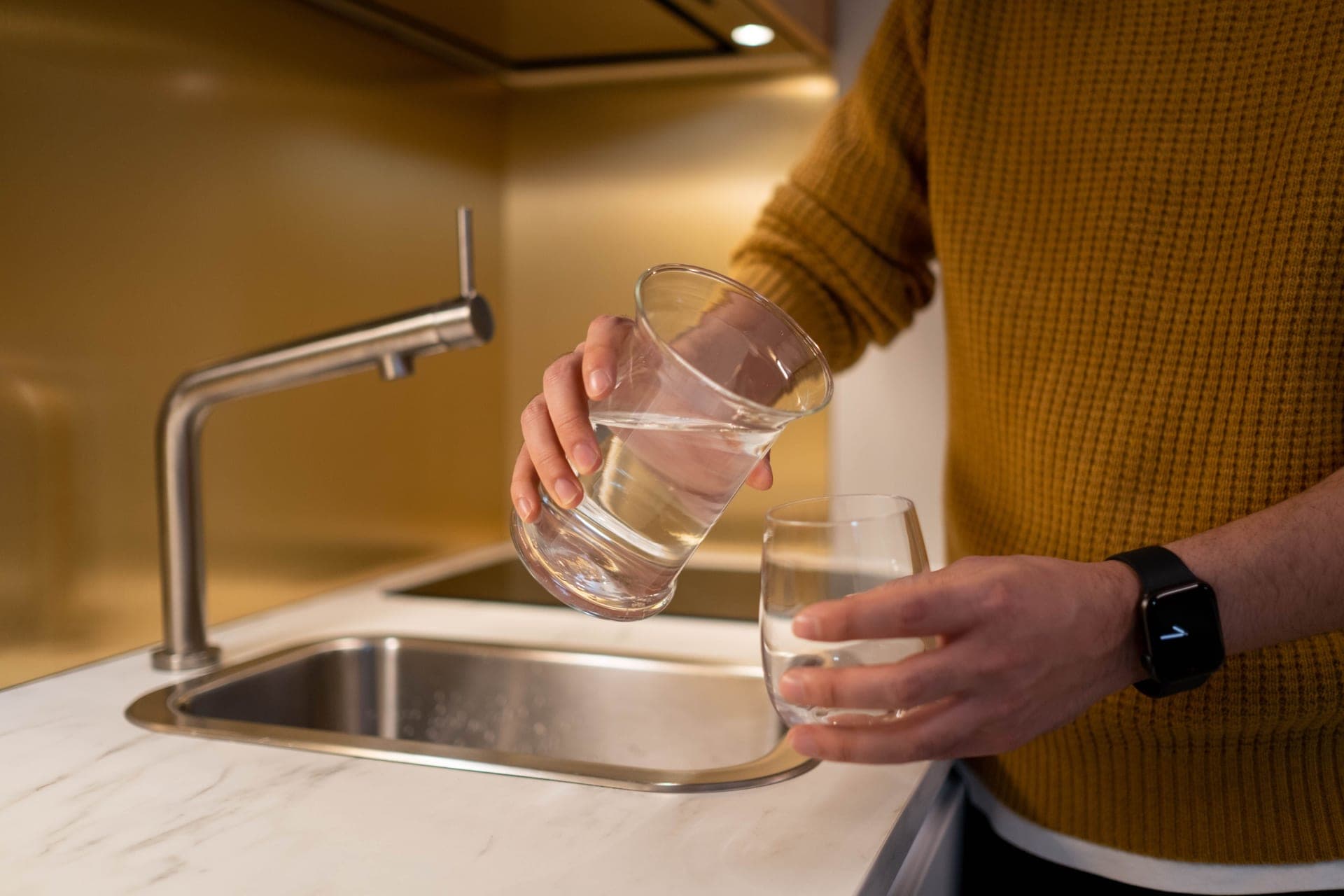
With a touchless faucet, a dedicated filtered-water spout is the cleaner architecture. It runs as its own circuit, so nothing is added to the supply line feeding the solenoid, and the cartridge only treats what you drink rather than everything you rinse. The cost is one hole.
Quick picks
Tap any row to jump to the full write-up. The button goes straight to the retailer.
| # | Product | Best for | Price |
|---|---|---|---|
| 1 | 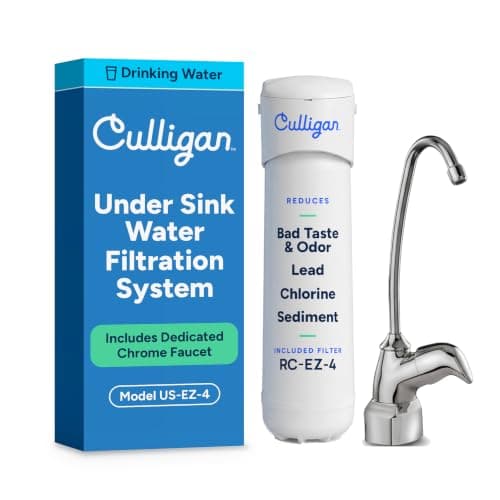 Culligan US-EZ-4 Under-Sink Filtration SystemDedicated faucet in the box, IAPMO certified for chloramine under 42 and lead under 53. Culligan US-EZ-4 Under-Sink Filtration SystemDedicated faucet in the box, IAPMO certified for chloramine under 42 and lead under 53. | Cheapest certified second tap | $92.96 - View on Amazon #ad Price as of October 17, 2026. We may earn a commission. Disclosure. |
| 2 | 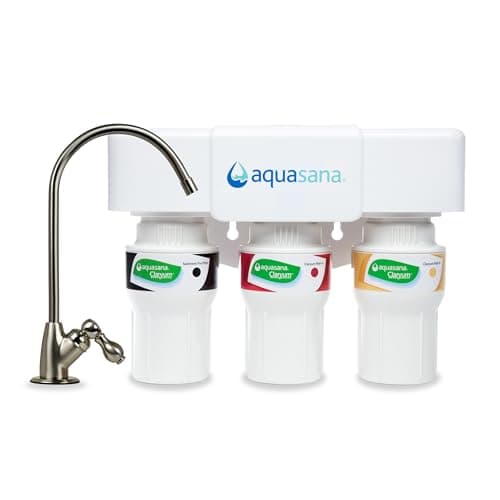 Aquasana Claryum 3-Stage Under-Sink Filter (AQ-5300)WQA certified to NSF/ANSI 42, 53 and 401 across 78 contaminants, with its own faucet. Aquasana Claryum 3-Stage Under-Sink Filter (AQ-5300)WQA certified to NSF/ANSI 42, 53 and 401 across 78 contaminants, with its own faucet. | Best claim list on a second tap | $154.99 - View on Amazon $349.99 — 56% off #ad Price as of October 17, 2026. We may earn a commission. Disclosure. |
| 3 | 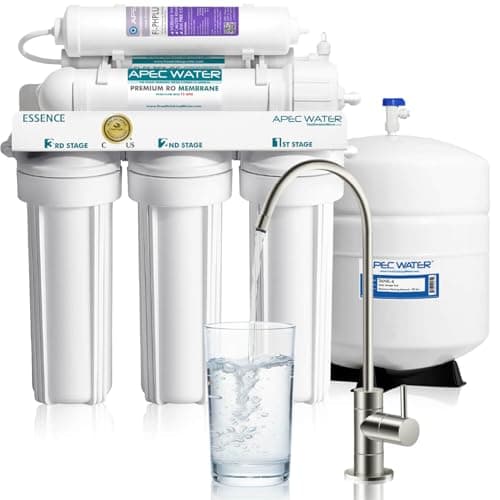 APEC ROES-PH75 Essence 6-Stage Alkaline RO SystemRuns on line pressure, so nothing competes with the faucet's transformer for an outlet. APEC ROES-PH75 Essence 6-Stage Alkaline RO SystemRuns on line pressure, so nothing competes with the faucet's transformer for an outlet. | Best reverse osmosis with no power | $189.99 - View on Amazon $294.99 — 36% off #ad Price as of October 17, 2026. We may earn a commission. Disclosure. |
| 4 | 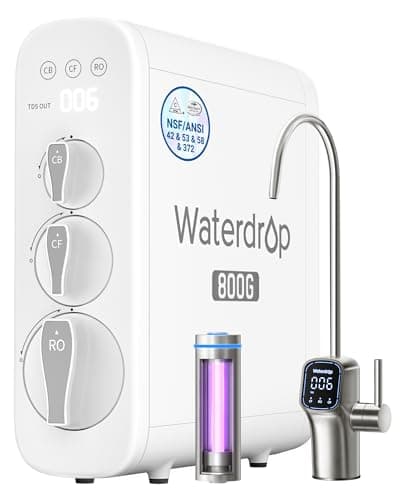 Waterdrop G3P800 Tankless Reverse Osmosis SystemTwo holes rather than one: its own LED faucet plus a drain connection. Waterdrop G3P800 Tankless Reverse Osmosis SystemTwo holes rather than one: its own LED faucet plus a drain connection. | If you want flow and a readout | $759.00 - View on Amazon $999.00 — 24% off #ad Price as of October 17, 2026. We may earn a commission. Disclosure. |
| 5 | 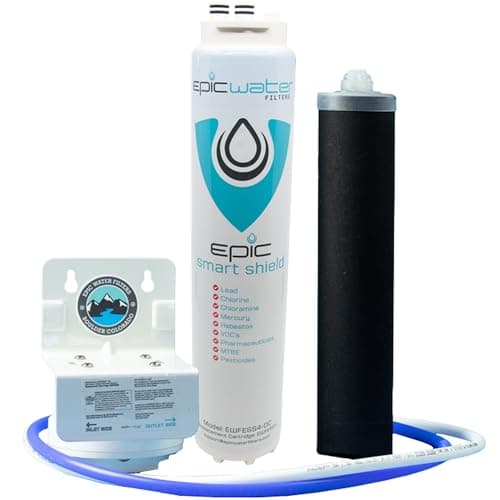 Epic Smart Shield Under-Sink FilterDirect connect at 651 rated gallons, IAPMO certified to 42, 53 and 401. No second hole. Epic Smart Shield Under-Sink FilterDirect connect at 651 rated gallons, IAPMO certified to 42, 53 and 401. No second hole. | If you genuinely cannot drill | $135.00 - View on Amazon #ad Price as of October 17, 2026. We may earn a commission. Disclosure. |
What the faucet already put under your sink
Start with the cabinet, because that is the constraint people discover last. A touchless faucet is not just a tap: it is a tap plus a control box, plus a power source, plus the cabling between them, and all of it lives in the space you were planning to put a filter.
Moen is specific about this for its MotionSense faucets. You will need to mount the control box and battery pack under the sink, the company says, and there are four extra hose connections, but they are simple push-fit connections. The control box normally mounts to the faucet body, or to a cabinet wall where there is not enough clearance — which tells you how tight that space can get.
So before choosing anything, open the cabinet and look. A single carbon canister needs a few inches of vertical clearance on a wall or the cabinet floor. A tank reverse osmosis system needs room for a pressure tank as well, which is usually the thing that does not fit. Measure first; everything below assumes you know what space you have.
The faucet-mount shortcut is out
It is worth killing one option immediately, because it is the cheapest and people reach for it first. A screw-on faucet-mounted filter will not work here.
The reason is the spout shape rather than the electronics: pull-down, pull-out, or integrated sprayer faucets are not compatible with faucet-mounted water filters. Essentially every touchless kitchen faucet is a pull-down, so the aerator is not a fitting a filter housing can hang from. The faucet-mount roundup covers the tier in general, and the compatibility note there is the same.
That leaves two real architectures, and the rest of this page is about choosing between them.
The two architectures
| Dedicated filtered spout | Direct connect to the existing faucet | |
|---|---|---|
| Extra hole in the counter or sink | Yes — one | No |
| Touches the touchless faucet's supply line | No — separate circuit | Yes |
| What passes through the cartridge | Only what you draw to drink and cook | Everything the cold tap delivers |
| Effect on cartridge life | Long — it only treats drinking water | Shorter — rinsing and pot-filling count against it |
| Flow at the filtered outlet | Deliberately low | Full tap flow |
| Works with reverse osmosis | Yes — this is the normal RO install | No |
| Reversible if you move | The hole is not | Yes |
The second row is the one that matters for a touchless faucet specifically. A direct-connect filter installs into the cold supply feeding the tap you already have, which on a touchless faucet means adding fittings to the line that runs through an electronically operated valve. Nothing about that is forbidden, and plenty of people do it — but it is more connections on the most expensive and least serviceable fixture in the kitchen, and a dedicated spout avoids the question entirely by running its own line to its own outlet.
The cartridge economics that settle it
Here is the argument that would hold even if your faucet were an ordinary lever.
A direct-connect filter treats every drop the cold tap delivers. That includes rinsing plates, filling pots, washing hands and topping up the dog bowl — water where filtration buys you nothing. A dedicated spout is only opened when somebody wants a glass of water, so the same cartridge covers months instead of weeks.
A touchless faucet makes that gap wider rather than narrower, because the whole point of one is that you use it more freely. Hands-free operation means the tap runs for jobs where you would previously have left it off. Every one of those runs is cartridge life on a direct-connect system and none of it is on a dedicated spout.
The filtered spout also runs at a deliberately low flow, and that is by design rather than a defect: filtered water faucets generally have a lower flow rate than standard faucets, which is what ensures the water is thoroughly filtered. It is also why the dedicated spout is the normal answer in this tier at all — most under-sink systems require the lower flow rate of a dedicated drinking water faucet installed in an extra hole.
The hole, honestly
This is the part that stops people, so it deserves a straight accounting rather than reassurance.
First, check whether you already have the hole. Many sinks have a fourth position occupied by a side sprayer, a soap dispenser or a blanking plate, and on a pull-down faucet the side sprayer is redundant anyway. Pulling the sprayer and fitting the filtered tap in its place is the cleanest version of this install and involves no drilling at all.
Second, if you do have to make a hole, the material decides the difficulty. Stainless steel and composite sink decks are a reasonable DIY job with the right bit. Granite and quartz countertops are not — that is a diamond-bit job, usually wet-drilled, and a chipped slab is an expensive mistake. If the only candidate position is stone and you are not hiring somebody, treat the direct-connect route as the answer instead.
Third, hole diameters are model-specific rather than standard, and the ranges genuinely differ between filtered-water faucets. Read the spec sheet for the faucet that ships with your system before putting a bit anywhere near the counter, and check that it fits the hole you intend to use rather than assuming.
Air gap: only if it is reverse osmosis
One extra wrinkle applies to reverse osmosis and nothing else on this page, because RO is the only format here that produces a waste stream.
An RO system requires an air gap faucet, and the reason is backflow protection: whenever an appliance is connected to both feed water and the drain line, plumbing code wants a device that stops drain water reaching the filtered side. Carbon systems have no drain connection, so the question does not arise for them — most under-sink water filters are compatible with all drinking water faucet types.
Practically, this means an RO install on a touchless-faucet kitchen is two penetrations rather than one: the faucet and the drain saddle. Local code governs the air gap, so it is worth a call to your jurisdiction or a plumber if you are unsure. The reverse osmosis cost page covers what the whole install adds up to.
Choosing between the systems
- Decide carbon or reverse osmosis first, not brand. If a laboratory result named fluoride, nitrate or arsenic, you need a membrane and the air gap that comes with it. If the concern is chlorine, chloramine, lead or taste, a certified carbon block is smaller, cheaper and has no drain line. The tier guide settles that in a few minutes.
- Count your outlets before buying a pumped system. A touchless faucet may already be using the cabinet outlet through an AC adapter, and tankless reverse osmosis needs power of its own. A tank system that runs on line pressure sidesteps the competition entirely.
- Measure the cabinet against the format. A single canister fits almost anywhere. A tank needs a footprint, and the control box is already in there.
- Read the certification for the contaminant you actually have. A dedicated tap is an installation choice and says nothing about performance. What the standards cover is the part that decides whether the system does your job.
If you cannot drill at all
Renting, stone counters, no spare hole, or simply no appetite for making a permanent modification — all of those are good reasons, and the answer is not to give up on filtered water.
A direct-connect system plumbs into the cold line and delivers filtered water from the tap you already have, at the cost of cartridge life. The no-drilling page goes through that route properly, including the certification catch that most of the category runs into. For renters specifically, the renter page covers what can be removed without a trace when the lease ends.
The cost-per-gallon math
The arithmetic here is a one-time install cost against a recurring cartridge cost, and the direction of the answer is not obvious until you run it.
A dedicated spout costs a hole once — nothing, if you are reusing a sprayer position, or a tradesman's call-out if the counter is stone. After that the cartridge only sees drinking water, so you replace it on the manufacturer's published schedule rather than ahead of it.
A direct-connect system costs nothing to install and then spends cartridge on every rinse. Work out roughly how much water the cold tap actually delivers in a week, compare that to the cartridge's rated gallons, and you will usually find the replacement interval is a fraction of the headline figure. Over a few years that difference is larger than any plausible drilling cost.
We do not print product prices in this text. The buy buttons carry the live figure and the date it was checked, which is the only price worth quoting.
We show the arithmetic rather than a verdict so you can redo it with the price you actually pay. Filter prices move; the rated capacities above do not.
The picks in full
Cheapest certified second tap
Culligan US-EZ-4 Under-Sink Filtration System
Culligan
The cheapest certified under-sink filter on this site, and the claim list is better than the price suggests: chloramine under 42, and lead plus PFOA and PFOS under 53. The catch is a dedicated faucet and a 500-gallon cartridge.
Certification status
Certified by IAPMO R&T to NSF/ANSI 42 for chlorine taste and odor, chloramines and nominal particulate Class I, and to NSF/ANSI 53 for cysts, lead, mercury, VOCs, MTBE, turbidity, PFOA and PFOS. Rated at 500 gallons or about six months, at a 0.5 gpm service flow.
Published specifications
| Rated capacity | 500 gallons / about 6 months |
|---|---|
| Certified standards | NSF/ANSI 42 and 53 (IAPMO R&T) |
| Chloramine | Included in the NSF/ANSI 42 claim |
| PFOA / PFOS | Included in the NSF/ANSI 53 claim |
| Also certified for | Lead, mercury, cysts, VOCs, MTBE, turbidity |
| Service flow | 0.5 gpm |
| Operating pressure | 30-100 psi |
| Replacement cartridge | RC-EZ-4 |
| Faucet | Dedicated faucet included — needs a hole |
What we like
- A certified chloramine claim, which most filters do not carry and most chloraminated supplies need
- PFOA and PFOS named in the 53 certification on an inexpensive cartridge
- Twist-on, twist-off cartridge change with quick-connect fittings and a double shut-off
What we do not
- Needs a dedicated faucet, which means drilling the counter or using a spare hole
- 500 gallons is a modest cartridge life next to direct-connect inline filters
- No fluoride, nitrate or arsenic claim — the limit of carbon, not of this product
- Proprietary RC-EZ-4 cartridge
Skip it if
Fluoride, nitrate or hardness, and anyone who cannot drill or spare a hole in the sink deck for the faucet.
#ad Price as of October 17, 2026. We may earn a commission. Disclosure.
Where these specifications came from
Best claim list on a second tap
Aquasana Claryum 3-Stage Under-Sink Filter (AQ-5300)
Aquasana
Carbon-block filtration rather than reverse osmosis: it keeps the minerals, wastes nothing, and fits where a reverse-osmosis system will not. It also cannot do what RO does for fluoride or nitrate.
Certification status
WQA tested and certified to NSF/ANSI 42, 53 — which includes the P473 protocol for PFOA and PFOS — and 401, for the reduction of 78 contaminants. Aquasana publishes 99.6% for lead and microplastics, 99.7% for PFOA and PFOS, 99.99% for cysts and 97% for chlorine across the Claryum 3-Stage line.
Published specifications
| Filter life | 600 gallons / up to 6 months |
|---|---|
| Certified standards | NSF/ANSI 42, 53 (includes P473), 401 (WQA) |
| Flow rate | 0.5 gpm |
| Wastewater | None |
| Format | 3-stage carbon block with a dedicated faucet |
| Contaminants claimed | 78 |
| Lead / PFOA and PFOS | 99.6% / 99.7% |
What we like
- No drain line, no wastewater, no tank — much easier to install than reverse osmosis
- NSF/ANSI 401 certification covers pharmaceutical-class trace compounds
- Full flow rate, unlike reverse osmosis, so filling a pot is not a project
What we do not
- Not reverse osmosis: no meaningful fluoride, nitrate or TDS reduction
- 600-gallon filter life is short next to an inline system's tens of thousands
- Proprietary cartridges
Skip it if
Anyone whose problem is fluoride, nitrate or total dissolved solids. Carbon block does not remove those; you need reverse osmosis for that job.
$349.99 — 56% off
#ad Price as of October 17, 2026. We may earn a commission. Disclosure.
Best reverse osmosis with no power
APEC ROES-PH75 Essence 6-Stage Alkaline RO System
APEC Water Systems
A conventional tank system that uses ordinary 10-inch cartridges rather than proprietary pods, which keeps the ten-year running cost sane. The sixth stage puts minerals back for people who dislike RO's flat taste.
Certification status
WQA Gold Seal certified.
Published specifications
| Output | 75 GPD at 60 psi and 77 degrees F |
|---|---|
| Tank capacity | 4 gallons |
| Stages | 6, including a calcite remineralization stage |
| Feed pressure | 40-85 psi |
| Max feed TDS | 2,000 ppm |
| System dimensions | 15.5" L x 5.25" W x 17.5" H, plus a separate tank |
| Certification | WQA Gold Seal |
What we like
- Standard-size cartridges, so replacements are cheap and sourceable from many brands
- Calcite stage restores minerals and lifts the pH of reverse-osmosis water
- No electricity required
What we do not
- The 4-gallon tank plus housing takes most of an under-sink cabinet
- Slower than tankless systems, and it pauses while the tank refills
- Conventional wastewater ratio, well short of the G3P800's 3:1
Skip it if
Small cabinets. Measure before you buy — the tank alone is roughly 11 x 11 x 15 inches, and people discover this after delivery.
$294.99 — 36% off
#ad Price as of October 17, 2026. We may earn a commission. Disclosure.
Where these specifications came from
If you want flow and a readout
Waterdrop G3P800 Tankless Reverse Osmosis System
Waterdrop
Tankless reverse osmosis that gives back the cupboard a pressure tank would eat, fills a glass without the pause, and sends markedly less water down the drain than a classic tank system.
Certification status
Certified to NSF/ANSI 42 for chlorine reduction, NSF/ANSI 53 and 58 for TDS, fluoride, cadmium, hexavalent chromium and selenium, and NSF/ANSI 372 for lead-free materials.
Published specifications
| Output | 800 GPD |
|---|---|
| Pure-to-drain ratio | 3:1 |
| Format | Tankless — no pressure tank |
| Certified standards | NSF/ANSI 42, 53, 58, 372 |
| Installation | Two holes: smart LED faucet and drain |
| Faucet | Included, with TDS display |
What we like
- No pressure tank, so it fits cabinets a tank system cannot
- 3:1 pure-to-drain is far better than the ratio typical of older reverse osmosis
- 800 GPD means no waiting for a tank to refill
What we do not
- Needs a power outlet under the sink — a real constraint in older kitchens
- Proprietary filter cartridges, so you are tied to Waterdrop's pricing
- Requires drilling for the included faucet unless you have a spare hole
Skip it if
Renters, and anyone with no outlet under the sink. It is a permanent, powered installation — a countertop unit is the answer if you cannot commit to that.
$999.00 — 24% off
#ad Price as of October 17, 2026. We may earn a commission. Disclosure.
Where these specifications came from
If you genuinely cannot drill
Epic Smart Shield Under-Sink Filter
Epic Water Filters
The product that changes how this brand should be read. Where Epic's pitchers lean on laboratory data, the Smart Shield carries an IAPMO certification across three standards — and it runs 651 gallons on the existing cold line with no second faucet.
Certification status
Epic states the Smart Shield is certified by IAPMO to NSF/ANSI 42, 53 and 401. That is the aesthetic standard, the health-effects standard and the emerging-compounds standard together, which is a stronger position than most direct-connect filters, and stronger than Epic's own pitcher line.
Published specifications
| Rated capacity | 651 gallons |
|---|---|
| Certified standards | NSF/ANSI 42, 53 and 401 (IAPMO) |
| Format | Direct connect to the existing cold line — no second faucet |
| Dimensions | 19.75" tall x 4.5" deep x 4.25" wide |
| Install time | About 15 minutes, per Epic |
| Media | Solid carbon block |
| Tested claim list | 70+ contaminants, laboratory data beyond the certified claims |
What we like
- An IAPMO certification across 42, 53 and 401 — most direct-connect filters hold 42 alone
- 651 rated gallons, several times a premium pitcher cartridge
- No dedicated faucet, no drain line and no power: the easiest certified install in the tier
What we do not
- Every drop through the kitchen tap goes through the cartridge, including washing-up water
- Proprietary cartridge at a premium price
- No fluoride claim — carbon block cannot reach it
- Nearly 20 inches tall, so it needs real vertical clearance under the sink
Skip it if
Fluoride, nitrate or dissolved solids, and cabinets too shallow for a 20-inch housing. Reverse osmosis is the answer to the first three.
#ad Price as of October 17, 2026. We may earn a commission. Disclosure.
Where these specifications came from
Questions people actually ask
What is the best under-sink water filter for a touchless faucet with a separate filtered spout?
Any certified under-sink system that ships with its own faucet, chosen by what you need removed rather than by the faucet you own. For chlorine, chloramine and lead the Culligan US-EZ-4 is the cheapest IAPMO certified option with a dedicated tap, and the Aquasana AQ-5300 carries the broader claim list across NSF/ANSI 42, 53 and 401. For fluoride, nitrate or arsenic you need reverse osmosis, which uses a dedicated air-gap faucet as standard.
Can you install a water filter with a touchless faucet?
Yes, and a dedicated filtered spout is the tidier way to do it. The spout runs as its own circuit from the cold supply, so nothing is added to the line feeding the faucet's solenoid and control box. A direct-connect filter also works, but it puts extra fittings on the supply of your most expensive fixture and treats all your rinsing water as well as your drinking water.
Why does a filtered water faucet need its own hole?
Because the flow rate is different. Filtered water faucets run deliberately slower than a standard tap, which is what gives the water enough contact time with the media, and most under-sink systems are built around that lower flow. A separate outlet lets the main faucet stay at full flow for everything else.
Can I use my sink's sprayer hole for the filtered faucet?
Usually yes, and it is the best version of this install because it involves no drilling. A side sprayer is redundant on a pull-down faucet anyway, which is what nearly every touchless faucet is. Check the filtered faucet's spec sheet for its hole range before assuming the existing hole is the right diameter, since those ranges are model-specific rather than standard.
Do I need an air gap faucet?
Only for reverse osmosis. An RO system connects to both the feed water and the drain line, and plumbing code wants backflow protection wherever that is true, so RO ships with an air-gap faucet. Carbon under-sink filters have no drain connection and are compatible with ordinary drinking-water faucets. Local code governs, so confirm it if you are unsure.
Will a faucet-mounted filter fit a touchless faucet?
No. Pull-down, pull-out and integrated sprayer faucets are not compatible with faucet-mounted filters, and essentially every touchless kitchen faucet is a pull-down. The choice is between a dedicated filtered spout and a direct-connect under-sink filter.