
No. No Brita pitcher filter is certified for fluoride and none claims it. This is a limit of carbon filtration rather than of Brita specifically — fluoride is a small dissolved ion that carbon does not adsorb. Reverse osmosis is the mainstream answer.
Quick picks
Tap any row to jump to the full write-up. The button goes straight to the retailer.
| # | Product | Best for | Price |
|---|---|---|---|
| 1 | 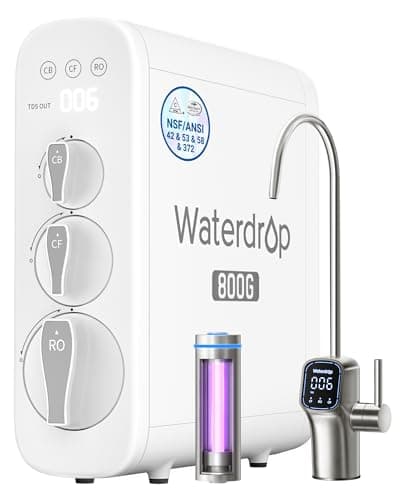 Waterdrop G3P800 Tankless Reverse Osmosis SystemReverse osmosis certified to NSF/ANSI 53 and 58, which covers fluoride explicitly. Waterdrop G3P800 Tankless Reverse Osmosis SystemReverse osmosis certified to NSF/ANSI 53 and 58, which covers fluoride explicitly. | Best for fluoride | $759.00 - View on Amazon $999.00 — 24% off #ad Price as of October 17, 2026. We may earn a commission. Disclosure. |
| 2 | 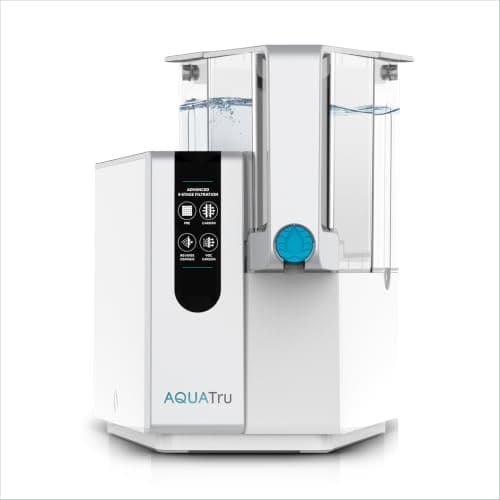 AquaTru Classic Countertop Reverse Osmosis PurifierCertified countertop reverse osmosis — the no-install route to fluoride reduction. AquaTru Classic Countertop Reverse Osmosis PurifierCertified countertop reverse osmosis — the no-install route to fluoride reduction. | Best without plumbing | $451.25 - View on Amazon $475.00 — 5% off #ad Price as of October 17, 2026. We may earn a commission. Disclosure. |
| 3 | 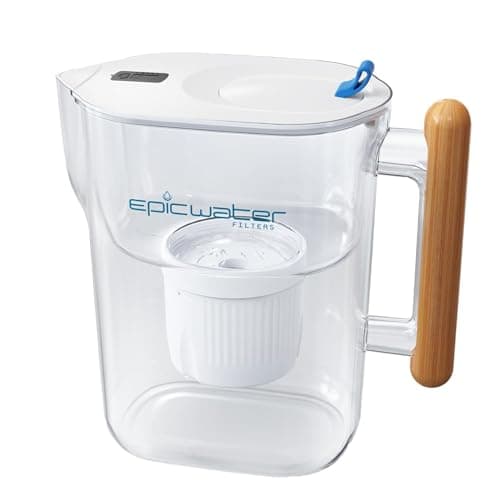 Epic Pure Water Filter PitcherAddresses fluoride in independent testing. Tested, not certified — read that carefully. Epic Pure Water Filter PitcherAddresses fluoride in independent testing. Tested, not certified — read that carefully. | The only pitcher route | $82.00 - View on Amazon #ad Price as of October 17, 2026. We may earn a commission. Disclosure. |
The answer
No Brita pitcher filter is certified for fluoride, and Brita does not claim fluoride reduction. Per Brita's January 2026 performance data sheet, as reported by Tap Score, fluoride is not among the contaminants covered.
Why carbon cannot do this
This is a mechanism limit, not a quality limit, so no amount of paying more for a carbon filter changes it.
Activated carbon works by adsorption: organic molecules stick to an enormous internal surface. Fluoride is a small, charged, inorganic ion — there is nothing for carbon to grip. The same reason carbon does not remove hardness or nitrate applies here.
What does remove fluoride
| Technology | Removes fluoride? | Notes |
|---|---|---|
| Carbon filter or pitcher | No | Wrong mechanism entirely |
| Reverse osmosis | Yes | Fluoride is explicitly within NSF/ANSI 58 |
| Activated alumina | Yes | Specialist media, used in dedicated fluoride filters |
| Bone char | Yes | Used in some gravity systems |
| Distillation | Yes | Effective, slow, energy-hungry |
| Boiling | No — concentrates it | Water evaporates, fluoride stays |
| Water softener | No | Ion exchange for hardness does not target fluoride |
Reverse osmosis is the mainstream household answer, and NSF/ANSI 58 lists fluoride explicitly among the contaminants a certified RO system addresses. Both under-sink and countertop options exist.
The pitcher exception
Two pitchers on this site address fluoride: Epic Pure and Clearly Filtered. Both do so within independent test results rather than a certification listing.
That distinction matters and we flag it every time. Tested means a laboratory ran the NSF method once and the result was published. Certified means a body verified it, lists it publicly and maintains surveillance. No certified pitcher on this site claims fluoride — if a listing is what you need, reverse osmosis is the route.
Should you remove it?
We are going to be straightforward here. Community water fluoridation is a long-standing public health measure supported by mainstream dental and public health organizations, and we are not going to manufacture doubt about it in order to sell filters.
People choose to remove fluoride for a range of reasons, some of them medical. That is a personal decision, and the useful thing we can do is tell you accurately what works and what does not — which is this page. What we will not do is imply your water is dangerous because it is fluoridated.
Finding out how much is in your water
Your utility's annual water quality report publishes fluoride levels, whether it is naturally occurring or added. How to read it.
Some groundwater carries naturally high fluoride, occasionally above the EPA limit. That is a different situation from optimally fluoridated municipal water, and it is worth knowing which one you have before buying anything.
The cost-per-gallon math
Fluoride removal costs more than chlorine or lead removal, because it needs a different technology rather than a better filter.
A certified reverse osmosis system plus a decade of pre-filters and membranes, divided by the gallons you drink, is the honest per-gallon figure. It is several times a carbon pitcher's cost per gallon, and there is no cheaper certified route.
The tested-not-certified pitchers are cheaper up front. Whether that trade is acceptable depends on how much weight you put on a certification listing, which is a judgment only you can make.
We show the arithmetic rather than a verdict so you can redo it with the price you actually pay. Filter prices move; the rated capacities above do not.
The picks in full
Best for fluoride
Waterdrop G3P800 Tankless Reverse Osmosis System
Waterdrop
Tankless reverse osmosis that gives back the cupboard a pressure tank would eat, fills a glass without the pause, and sends markedly less water down the drain than a classic tank system.
Certification status
Certified to NSF/ANSI 42 for chlorine reduction, NSF/ANSI 53 and 58 for TDS, fluoride, cadmium, hexavalent chromium and selenium, and NSF/ANSI 372 for lead-free materials.
Published specifications
| Output | 800 GPD |
|---|---|
| Pure-to-drain ratio | 3:1 |
| Format | Tankless — no pressure tank |
| Certified standards | NSF/ANSI 42, 53, 58, 372 |
| Installation | Two holes: smart LED faucet and drain |
| Faucet | Included, with TDS display |
What we like
- No pressure tank, so it fits cabinets a tank system cannot
- 3:1 pure-to-drain is far better than the ratio typical of older reverse osmosis
- 800 GPD means no waiting for a tank to refill
What we do not
- Needs a power outlet under the sink — a real constraint in older kitchens
- Proprietary filter cartridges, so you are tied to Waterdrop's pricing
- Requires drilling for the included faucet unless you have a spare hole
Skip it if
Renters, and anyone with no outlet under the sink. It is a permanent, powered installation — a countertop unit is the answer if you cannot commit to that.
$999.00 — 24% off
#ad Price as of October 17, 2026. We may earn a commission. Disclosure.
Where these specifications came from
Best without plumbing
AquaTru Classic Countertop Reverse Osmosis Purifier
AquaTru
Reverse osmosis performance with no plumbing, no drilling and no landlord conversation. You pay for that with counter space, a wait, and two tanks you fill and empty by hand.
Certification status
Certified by IAPMO to NSF/ANSI 53, 58, 401 and P473, covering lead, reverse-osmosis performance, emerging compounds and the PFOA/PFOS protocol.
Published specifications
| Filtration | 4-stage countertop reverse osmosis |
|---|---|
| Clean water tank | 0.75 gallons |
| Tap water tank | 1 gallon |
| Installation | None — no plumbing connection |
| Certified standards | NSF/ANSI 53, 58, 401, P473 (IAPMO) |
What we like
- Real reverse osmosis with a P473 PFOA/PFOS certification and zero installation
- The strongest answer available to a renter with a lead or PFAS problem
- No drilling, no drain saddle, no landlord permission needed
What we do not
- Takes up substantial counter space
- You refill and empty tanks by hand — it is not on-demand
- Highest purchase price in the no-plumbing tier by a wide margin
Skip it if
Anyone who can plumb in an under-sink system. A permanent under-sink RO is cheaper per gallon, on-demand, and out of sight. Buy this when you genuinely cannot install.
$475.00 — 5% off
#ad Price as of October 17, 2026. We may earn a commission. Disclosure.
Where these specifications came from
The only pitcher route
Epic Pure Water Filter Pitcher
Epic Water Filters
One of very few pitchers that addresses fluoride at all, with a 150-gallon rated life that partly offsets a high filter price. Like Clearly Filtered, it is tested against the standards rather than certified under them.
Certification status
Tested against NSF/ANSI 42, 53, 401 and P473. Tested to the standards, not certified under them — read the claim precisely.
Published specifications
| Rated filter life | Up to 150 gallons |
|---|---|
| Standards tested against | NSF/ANSI 42, 53, 401, P473 |
| Manufacturer claim | Over 200 contaminants, including lead, PFAS, chromium-6 and fluoride |
What we like
- Addresses fluoride, which certified pitchers essentially never do
- 150-gallon rated life is the longest in the pitcher tier
- Published test data spans an unusually broad contaminant list
What we do not
- Tested to, not certified under, the NSF standards
- Expensive per filter, though the long life narrows the gap per gallon
- Slow flow — the trade-off for a dense media block
Skip it if
Anyone who needs a certification listing rather than a test report, or anyone whose only problem is chlorine taste — this is a lot of filter for that job.
#ad Price as of October 17, 2026. We may earn a commission. Disclosure.
Where these specifications came from
Questions people actually ask
Does any Brita filter remove fluoride?
No. No Brita pitcher filter is certified for fluoride and none claims it. Carbon adsorption does not act on the fluoride ion, so this is a limitation of the technology rather than of Brita specifically.
What removes fluoride from water?
Reverse osmosis is the mainstream household answer, and fluoride is explicitly within NSF/ANSI 58. Activated alumina, bone char and distillation also work. Carbon filtration, boiling and water softening do not.
Does boiling remove fluoride?
No, and it concentrates it. Water evaporates and the fluoride stays behind, so boiled water contains more fluoride per volume than you started with.
Should I remove fluoride from my water?
That is a personal decision, and community water fluoridation is a long-standing public health measure supported by mainstream dental and health organizations. We will tell you accurately what removes it; we are not going to argue you into or out of wanting to.