
PUR sells two pitcher filters that fit every PUR pitcher and dispenser. The PUR PLUS filter (PPF951K) is certified by IAPMO R&T to NSF/ANSI 42, 53 and 401, with lead, total PFAS and microplastics figures on its sheet. The basic PUR filter (PPF900Z) carries none of those three. The faucet filters are tested to the same standards, not certified.
Quick picks
Tap any row to jump to the full write-up. The button goes straight to the retailer.
| # | Product | Best for | Price |
|---|---|---|---|
| 1 | 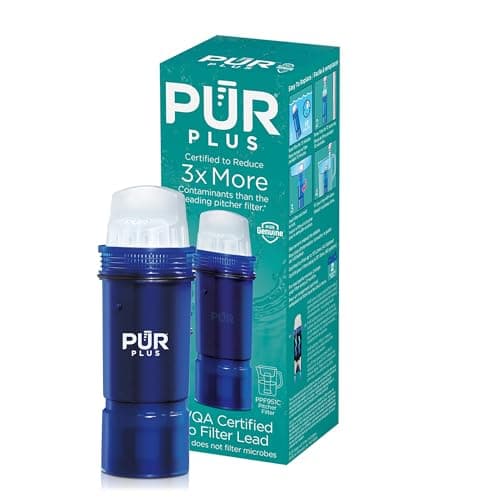 PUR PLUS Pitcher and Dispenser Replacement Filter (PPF951K)IAPMO R&T certified to NSF/ANSI 42, 53 and 401. Lead, total PFAS and microplastics, each with a figure. PUR PLUS Pitcher and Dispenser Replacement Filter (PPF951K)IAPMO R&T certified to NSF/ANSI 42, 53 and 401. Lead, total PFAS and microplastics, each with a figure. | The one to buy | $13.77 - View on Amazon #ad Price as of October 6, 2026. We may earn a commission. Disclosure. |
| 2 | 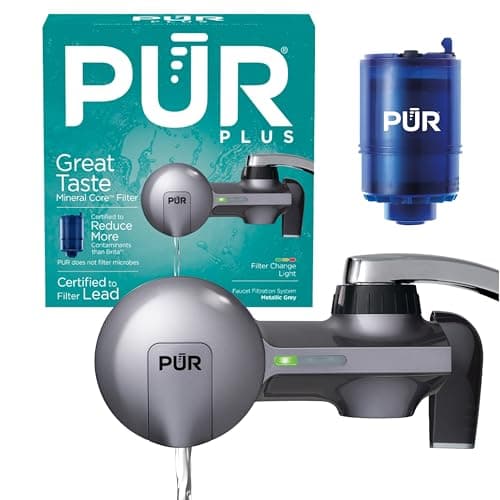 PUR PLUS Faucet Mount Filtration System (PFM400H)The longest published table in the faucet-mount category, including total PFAS — tested according to, not certified by. PUR PLUS Faucet Mount Filtration System (PFM400H)The longest published table in the faucet-mount category, including total PFAS — tested according to, not certified by. | For the tap | $32.99 - View on Amazon #ad Price as of October 6, 2026. We may earn a commission. Disclosure. |
| 3 | 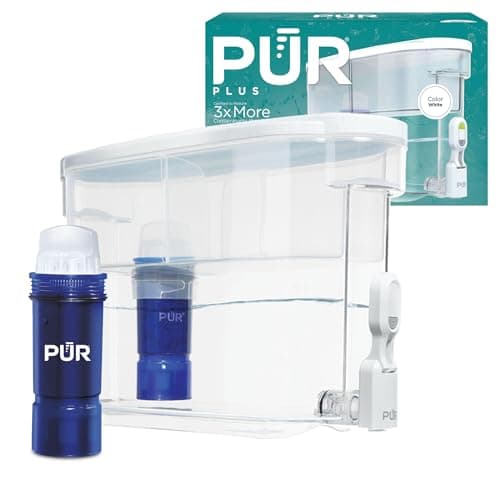 PUR PLUS 30-Cup Dispenser (DS1811Z)The same PLUS cartridge in a 30-cup tank. About 21 fills per filter, so budget for the cadence. PUR PLUS 30-Cup Dispenser (DS1811Z)The same PLUS cartridge in a 30-cup tank. About 21 fills per filter, so budget for the cadence. | For a household | $39.99 - View on Amazon $44.14 — 9% off #ad Price as of October 6, 2026. We may earn a commission. Disclosure. |
| 4 | 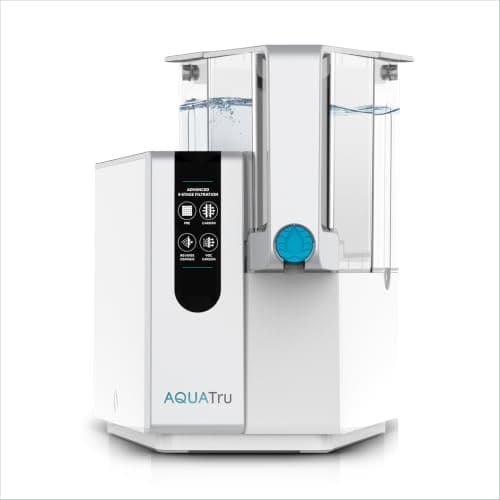 AquaTru Classic Countertop Reverse Osmosis PurifierNo PUR filter claims fluoride. Countertop reverse osmosis is the certified route. AquaTru Classic Countertop Reverse Osmosis PurifierNo PUR filter claims fluoride. Countertop reverse osmosis is the certified route. | If you need fluoride | $403.75 - View on Amazon $475.00 — 15% off #ad Price as of October 6, 2026. We may earn a commission. Disclosure. |
The only thing you really need to know
PUR sells two pitcher filters. They fit the same pitchers and dispensers, sit next to each other on the shelf, and share a single performance data sheet — which is where the similarity ends. The sheet has two columns, one per filter, and most of the rows in the basic column are blank.
| PUR (PPF900Z) | PUR PLUS (PPF951K) | |
|---|---|---|
| Certified standards | NSF/ANSI 42, 53, 401 (fewer claims) | NSF/ANSI 42, 53, 401 |
| Lead | No figure on the sheet | 99.9% at pH 6.5, 99.2% at pH 8.5 |
| Chlorine taste and odor | 97.50% | 97.50% |
| Total PFAS | No figure on the sheet | 99.75% |
| Microplastics | No figure on the sheet | 99.8% |
| Mercury | 96.5% / 88.8% | >96.4% at both pH values |
| Substances with a figure | 11 | About two dozen |
| Rated life | 40 gallons / ~2 months | 40 gallons / ~2 months |
| Fluoride | No claim | No claim |
If you bought a PUR pitcher because you were worried about lead and the cartridge in it is the basic PUR filter, you do not have a lead filter. The same sheet that lists lead at 99.9% for the PLUS filter lists nothing at all for the basic one — not a lower number, no number. The fix costs a few dollars and takes ten seconds, which is why this page exists.
Why the pitcher you own does not matter
The data sheet names a dozen pitcher and dispenser models — the 7-cup and 11-cup pitchers, the 30-cup dispensers and several more — and then two replacement filters. Every one of those pitchers takes either cartridge. That means three things in practice.
- The certification belongs to the cartridge. A PUR PLUS pitcher is a PUR pitcher with the PLUS filter in the box. Put a basic filter in it next time and you own a basic pitcher. This is the same trap Brita sets with its Standard and Elite filters, and it is the single most common mismatch in home water filtration.
- You can upgrade for the price of a filter. If you already own a PUR pitcher or dispenser of any size, the PLUS cartridge gives it the lead, PFAS and microplastics figures on the sheet. There is no reason to buy a new pitcher.
- Bigger tanks do not change the arithmetic. The PLUS filter is rated for 40 gallons whatever it sits in. In an 11-cup pitcher that is about 58 fills; in the 30-cup dispenser it is about 21. The dispenser roundup runs those numbers against Brita and ZeroWater.
A small decoding aid, because PUR's model numbers are less friendly than Brita's colors: the last letter of a PUR model number is the color code, so PPT111W, PPT111B and PPT111M are the same 11-cup PLUS pitcher in three colors. The digits are what matter.
| Model | What it is | Which filter |
|---|---|---|
| PPF951K | PUR PLUS pitcher and dispenser filter | This is the lead / PFAS / microplastics cartridge |
| PPF900Z | Basic PUR pitcher and dispenser filter | Chlorine and a short metals list; no lead figure |
| PPT111 | PUR PLUS 11-cup pitcher | Ships with the PPF951K |
| DS1811Z | PUR PLUS 30-cup dispenser | Ships with the PPF951K |
| DS1800Z | Older 30-cup dispenser, nearly identical | Ships a different filter — check the cartridge |
| PFM400H | PUR PLUS faucet mount, horizontal | Ships with the RF-9999 |
| RF-9999 | PUR PLUS faucet filter | Ships in the PLUS faucet systems |
| RF-3375 | Basic PUR faucet filter | Shares one sheet and one column of figures with the RF-9999 |
What changed in 2026: PFAS
For years the honest summary of PUR was "lead yes, PFAS no." That was true of the sheets PUR published, and it is what this site said until this page went up. It is no longer true, and the change is worth understanding precisely rather than as a headline.
PUR's current pitcher sheet lists Total PFAS at 99.75% for the PLUS filter, against a challenge concentration of 0.00216 mg/L, and it footnotes exactly what "total" means: a test mixture of PFOA, PFOS, PFHxS, PFNA, PFHpA, PFBS and PFDA. That is seven compounds — the ones NSF/ANSI 53 now tests as a group — not the thousands in the PFAS family. The sheet's own footnote says the systems are certified by IAPMO R&T for the claims on it, which is the wording that separates a certification from a test report.
Three consequences follow. First, the PLUS filter now belongs in the PFAS roundup alongside ZeroWater, as the second certified pitcher cartridge rather than a footnote. Second, the Brita comparison has tilted: the Brita Elite is not certified for PFOA or PFOS per its January 2026 sheet, so on PFAS the two supermarket brands have split for the first time. Third — and this is the part to hold onto — a pitcher with a 40-gallon cartridge is still a 40-gallon cartridge. If PFAS is your reason for filtering and your household drinks several gallons a day, under-sink reverse osmosis reaches the same certification at a fraction of the cost per gallon.
The faucet filters: more data, weaker wording
PUR's faucet mounts run on two cartridges, the RF-9999 (PUR PLUS) and the RF-3375, and both appear on a single sheet dated October 2025 — with one column of figures between them, so the sheet does not tell you which figures belong to which cartridge. The column itself is the longest in the faucet-mount category: chlorine at 98.71%, lead at 99.70% and 99.60% at the two test pH values, total PFAS at 99.92%, a chloroform-surrogate VOC list of roughly fifty compounds, and a fifteen-row NSF/ANSI 401 table that includes microplastics at 99.65%. Capacity is 100 gallons; the rated service flow is 0.52 gallons per minute.
The wording is the catch. The pitcher sheet says certified by IAPMO R&T. The faucet sheet says the systems have been tested according to NSF/ANSI 42, 53 and 401, and names no certifying body — while PUR's product page for the same unit says it is NSF and WQA certified and "certified to reduce 70 contaminants." We quote the sheet, because the sheet is the document with the numbers on it, and we would rather under-claim a good product than repeat marketing. The mercury row is also the weakest on the sheet at 78.59% and 81.58% — inside the standard's limit, but well below the lead figures. The faucet-mount roundup puts the PFM400H against the Brita and Culligan mounts on exactly this question.
One physical limit matters more than any of it: a faucet mount does not fit a pull-out or pull-down sprayer faucet, and no adapter fixes that. If your kitchen has one, the pitcher filter is the PUR product for you.
Is Brita or PUR better?
On the thing most people buy either for — lead — they tie: the Brita Elite and the PUR PLUS filter are both certified to NSF/ANSI 53. From there the two brands trade blows.
- Filter life: Brita. The Elite is rated for 120 gallons, the PUR PLUS for 40. At two gallons a day that is roughly six cartridges a year against eighteen, and unless PUR's price per filter is under a third of Brita's on the day, the Elite is cheaper to run.
- PFAS: PUR. The PLUS filter now carries a certified total PFAS figure; the Elite is not certified for PFOA or PFOS.
- Microplastics: a tie on the sheet. PUR PLUS at 99.8%, Brita Elite at 99.6%, both under the NSF/ANSI 401 microplastics claim, which is tested with particles between 0.5 and 1 micron.
- Availability: a tie. Both are in every supermarket, and whichever is in stock and on promotion is a legitimate reason to choose it.
The short version: if PFAS is on your list, PUR; if it is not, Brita is cheaper per gallon for the same lead certification. The full Brita vs PUR comparison runs the cost math.
What PUR is genuinely good at
- Breadth on the sheet. The PLUS pitcher filter publishes figures for about two dozen substances, including cadmium, copper, benzene and a nine-row NSF/ANSI 401 list. Most pitcher cartridges publish a fraction of that.
- A named certifying body. IAPMO R&T appears on the pitcher sheet by name, which is more than several premium "tested to" pitchers can say.
- Dispenser capacity. The 30-cup PLUS dispenser is the largest mainstream tank you can put a lead-and-PFAS cartridge in, and it pours while filtering.
- Availability. Filters are in supermarkets and pharmacies, which matters more than enthusiasts admit — a filter you can buy on the way home is a filter that gets changed.
What PUR does not do
Fluoride. No claim on either sheet, and no PUR product on this site claims it. The fluoride roundup covers what does.
Microbes. Both sheets say it in as many words: PUR does not filter microbes. A PUR pitcher changes nothing during a boil-water notice.
Hardness, sulfur, iron. Standard limits of the pitcher tier, not PUR-specific.
Long filter life. 40 gallons in the pitcher, 100 at the faucet. Both are at the short end of this site, and a filter left in past its rating is a filter doing less than the sheet says.
The cost-per-gallon math
A household drinking two gallons a day uses about 730 gallons a year.
At 40 rated gallons, the PUR PLUS pitcher filter needs about eighteen cartridges a year. At 100 rated gallons, the faucet filter needs about seven. For the pitcher route, the Brita Elite's 120-gallon rating means about six — so PUR's pitcher filter has to sell for under a third of the Elite's price to match it per gallon. It usually does not. What the PUR PLUS has that the Elite does not is the PFAS row, and that is the only reason to pay the difference.
We show the arithmetic rather than a verdict so you can redo it with the price you actually pay. Filter prices move; the rated capacities above do not.
The picks in full
The one to buy
PUR PLUS Pitcher and Dispenser Replacement Filter (PPF951K)
PUR
The filter is the product. Every PUR pitcher and dispenser takes the same two cartridges, and this is the one whose data sheet carries lead, total PFAS and microplastics figures under an IAPMO R&T certification. The basic PUR filter in the same slot carries none of the three. The catch is 40 rated gallons.
Certification status
PUR's July 2026 performance data sheet states the pitcher systems are certified by IAPMO R&T to NSF/ANSI 42, 53 and 401 for the claims on the sheet. The PPF951K column lists lead at 99.9% (pH 6.5) and 99.2% (pH 8.5), total PFAS at 99.75% against a seven-compound test mixture (PFOA, PFOS, PFHxS, PFNA, PFHpA, PFBS, PFDA), microplastics at 99.8% and about two dozen substances in all. The same sheet's PPF900Z column carries no lead, PFAS or microplastics figure. PUR states its filters do not remove microbes.
Published specifications
| Fits | Every PUR pitcher and dispenser on the data sheet (PPT, DS, CR and PDS models) |
|---|---|
| Rated filter life | 40 gallons / about 2 months |
| Certification | IAPMO R&T to NSF/ANSI 42, 53 and 401 (July 2026 data sheet) |
| Lead | 99.9% at pH 6.5, 99.2% at pH 8.5 |
| Total PFAS | 99.75%, seven-compound mixture |
| Microplastics | 99.8% |
| Mercury | >96.4% at both pH values |
| Chlorine taste and odor | 97.50% |
| Fluoride | No claim |
What we like
- Lead, total PFAS and microplastics on one sheet, with a named certifying body
- Fits every PUR pitcher and dispenser sold, so upgrading from the basic filter is a cartridge swap
- Stocked in supermarkets and pharmacies, which is what keeps a filter changed on schedule
What we do not
- 40 rated gallons — a third of the Brita Elite's 120, so three times the replacement cadence
- The basic PUR filter (PPF900Z) fits the same slot and carries no lead, PFAS or microplastics figure — check the model number on the pack
- The PFAS figure is against a seven-compound test mixture, not the whole PFAS family
- No fluoride claim
Skip it if
Fluoride, which appears nowhere on the sheet, and anyone who will resent changing a cartridge every two months.
#ad Price as of October 6, 2026. We may earn a commission. Disclosure.
For the tap
PUR PLUS Faucet Mount Filtration System (PFM400H)
PUR
The broadest performance data sheet in the faucet-mount category — lead, total PFAS, microplastics, a chloroform-surrogate VOC list and a fifteen-row NSF/ANSI 401 table, each with a published figure. The catch is the wording on that sheet: tested according to, not certified by.
Certification status
PUR's October 2025 performance data sheet for the RF-9999 and RF-3375 filters covers the PFM400H faucet unit and states that these systems have been tested according to NSF/ANSI 42, 53 and 401 for the substances listed on it. PUR's product page says the system is NSF and WQA certified; the data sheet itself names no certifying body, so we report the sheet's own wording. The sheet lists total PFAS at 99.92% and microplastics at 99.65%, carries no fluoride claim, and PUR states plainly that its filters do not remove microbes.
Published specifications
| Rated filter life | 100 gallons / up to 3 months |
|---|---|
| Replacement filter | RF-9999 (PUR PLUS) or RF-3375 |
| Standards tested to | NSF/ANSI 42, 53 and 401 (October 2025 data sheet) |
| Lead, pH 6.5 | 99.70% reduction (0.15 mg/L challenge) |
| Lead, pH 8.5 | 99.60% reduction |
| Total PFAS | 99.92%, seven-compound mixture |
| Microplastics | 99.65% |
| Mercury | 78.59% at pH 6.5, 81.58% at pH 8.5 |
| Chlorine taste and odor | 98.71% |
| VOCs (chloroform surrogate) | 99.51%; trihalomethanes 95% |
| Rated service flow | 0.52 gpm |
| Fluoride | No claim |
What we like
- The only mount here with a published NSF/ANSI 401 table — fifteen rows including bisphenol A, DEET, estrone and microplastics, each with its own reduction figure
- Total PFAS at 99.92% on the sheet, which neither of the other two certified mounts claims
- Lead is documented at both test pH values, including the harder pH 8.5 case that most municipal water actually resembles
- The diverter sends washing-up water past the filter, so the 100 rated gallons go to drinking and cooking rather than dishes
What we do not
- The data sheet says tested according to, not certified by, and the marketing does not preserve that distinction
- 100 rated gallons is one of the shortest replacement intervals on this site
- Proprietary RF-9999 and RF-3375 cartridges, so PUR sets the replacement price for the life of the unit
- Does not fit a pull-out or pull-down sprayer faucet, which rules out most modern kitchens
- Mercury is the weakest row on the current sheet, 78.59% and 81.58% — inside the standard's limit, but well below the lead figures
- One column of figures covers both the RF-9999 and RF-3375, so the sheet does not say which cartridge earned them
Skip it if
Anyone whose actual worry is fluoride, which appears nowhere on the data sheet, and anyone with a sprayer faucet, which no amount of adapters will solve.
#ad Price as of October 6, 2026. We may earn a commission. Disclosure.
For a household
PUR PLUS 30-Cup Dispenser (DS1811Z)
PUR
The biggest tank here and the only one that lets you pour while it is still filtering. The catch is arithmetic: a 40-gallon filter behind a 30-cup reservoir is finished after about 21 fills.
Certification status
Ships with the PUR PLUS filter (PPF951K). PUR states the filter is IAPMO R&T certified to reduce lead and microplastics, and its July 2026 performance data sheet lists total PFAS at 99.75% for that cartridge under the same certification. Rated at 40 gallons or up to two months. No fluoride claim.
Published specifications
| Capacity | 30 cups |
|---|---|
| Dimensions | W 15.3" x H 10.1" x L 5.3" |
| Filter | PUR PLUS lead-reducing |
| Certification | IAPMO R&T — lead, microplastics and total PFAS (July 2026 sheet) |
| Total PFAS | 99.75% (PPF951K column) |
| Rated filter life | 40 gallons / up to 2 months |
| Fills per filter | About 21 (40 gallons / 30 cups) |
| Features | Pour-while-filtering spout, filter change light, LockFit seal |
What we like
- The largest capacity of the three dispensers
- The pull-down spout pours while water is still filtering, so an empty tank is not a wait
- A named certifying body for both lead and microplastics
What we do not
- 40 rated gallons — the shortest-lived lead filter here, and a big tank uses it up fast
- 15.3 inches wide: measure the fridge shelf before ordering, because this is the common return
- No fluoride claim, and a 40-gallon cartridge behind a 30-cup tank is a two-month cadence at best
- PUR's older DS1800Z dispenser looks almost identical and ships a different filter — check the model number
Skip it if
Anyone who will not change a filter every couple of months. The Brita UltraMax reaches a lead certification with a filter that lasts three times as long.
$44.14 — 9% off
#ad Price as of October 6, 2026. We may earn a commission. Disclosure.
If you need fluoride
AquaTru Classic Countertop Reverse Osmosis Purifier
AquaTru
Reverse osmosis performance with no plumbing, no drilling and no landlord conversation. You pay for that with counter space, a wait, and two tanks you fill and empty by hand.
Certification status
Certified by IAPMO to NSF/ANSI 53, 58, 401 and P473, covering lead, reverse-osmosis performance, emerging compounds and the PFOA/PFOS protocol.
Published specifications
| Filtration | 4-stage countertop reverse osmosis |
|---|---|
| Clean water tank | 0.75 gallons |
| Tap water tank | 1 gallon |
| Installation | None — no plumbing connection |
| Certified standards | NSF/ANSI 53, 58, 401, P473 (IAPMO) |
What we like
- Real reverse osmosis with a P473 PFOA/PFOS certification and zero installation
- The strongest answer available to a renter with a lead or PFAS problem
- No drilling, no drain saddle, no landlord permission needed
What we do not
- Takes up substantial counter space
- You refill and empty tanks by hand — it is not on-demand
- Highest purchase price in the no-plumbing tier by a wide margin
Skip it if
Anyone who can plumb in an under-sink system. A permanent under-sink RO is cheaper per gallon, on-demand, and out of sight. Buy this when you genuinely cannot install.
$475.00 — 15% off
#ad Price as of October 6, 2026. We may earn a commission. Disclosure.
Where these specifications came from
Questions people actually ask
Is Brita or PUR better?
For lead they tie: the Brita Elite and the PUR PLUS filter are both certified to NSF/ANSI 53. Brita wins on filter life, 120 rated gallons against 40, so it is cheaper per gallon. PUR wins on PFAS: its July 2026 data sheet lists total PFAS at 99.75% under an IAPMO R&T certification, and the Brita Elite is not certified for PFOA or PFOS.
Does PUR remove PFAS?
The PUR PLUS pitcher filter (PPF951K) does, per PUR's current data sheet: total PFAS at 99.75%, certified by IAPMO R&T under NSF/ANSI 53, against a seven-compound test mixture of PFOA, PFOS, PFHxS, PFNA, PFHpA, PFBS and PFDA. The basic PUR filter carries no PFAS figure. The faucet sheet lists total PFAS at 99.92% but describes the systems as tested according to the standard rather than certified.
Does PUR remove lead?
The PUR PLUS filter is certified by IAPMO R&T to NSF/ANSI 53 for lead, at 99.9% reduction at pH 6.5 and 99.2% at pH 8.5. The basic PUR filter has no lead figure on the same sheet. Both fit every PUR pitcher and dispenser, so the cartridge in your pitcher is the entire answer.
Which PUR filter should I buy?
The PUR PLUS (PPF951K), in almost every case. It is the only PUR pitcher filter with lead, PFAS and microplastics figures, it fits every PUR pitcher and dispenser, and it costs a few dollars more than the basic filter for the same 40-gallon rated life.
Does PUR remove fluoride?
No. Neither PUR data sheet lists fluoride, and no PUR product claims it. Reverse osmosis is the certified route for fluoride; a handful of pitchers address it in independent testing rather than under a certification.
How long does a PUR filter last?
PUR rates its pitcher and dispenser filters at 40 gallons or about two months, and its faucet filters at 100 gallons or about three months. A household drinking two gallons a day reaches 40 gallons in under three weeks, so the gallon figure matters more than the month figure.
Sources
- PUR — performance data sheet, pitcher and dispenser filters PPF951K and PPF900Z (July 2026)
- PUR — performance data sheet, RF-9999 and RF-3375 faucet filters (October 2025)
- PUR — PLUS 11 Cup Pitcher with Lead Reducing Filter (PPT111)
- PUR — PLUS Faucet Filtration System, horizontal chrome (PFM400H)
- NSF — Certified Products and Systems