A faucet-mounted filter gives filtered water on demand with no refilling; a pitcher gives you a far wider selection of certified filters and leaves your tap alone. Both sit in the no-plumbing tier, and the deciding factor is usually how much water you actually filter.
Quick picks
Tap any row to jump to the full write-up. The button goes straight to the retailer.
| # | Product | Best for | Price |
|---|---|---|---|
| 1 | Wno photoWaterdrop 17UA Direct-Connect Under-Sink FilterUnder-sink direct connect: on-demand filtered water with nothing on the tap. | Best on-demand, hidden | Check price on Amazon #ad We do not show a price we cannot verify today. We may earn a commission. Disclosure. |
| 2 | 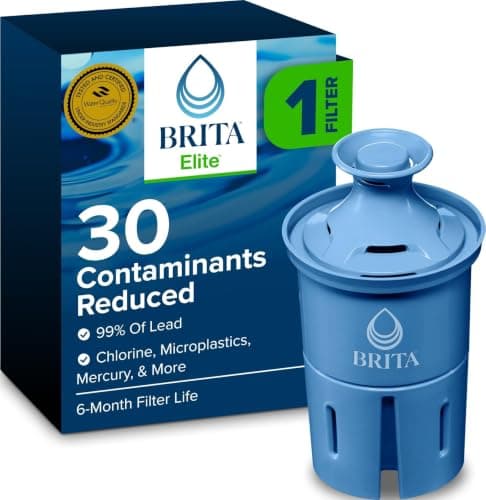 Brita Elite Filter (with any Brita pitcher)Certified for lead, 120 rated gallons, no hardware anywhere. Brita Elite Filter (with any Brita pitcher)Certified for lead, 120 rated gallons, no hardware anywhere. | Best pitcher | $19.88 - View on Amazon #ad Price as of October 17, 2026. We may earn a commission. Disclosure. |
| 3 | 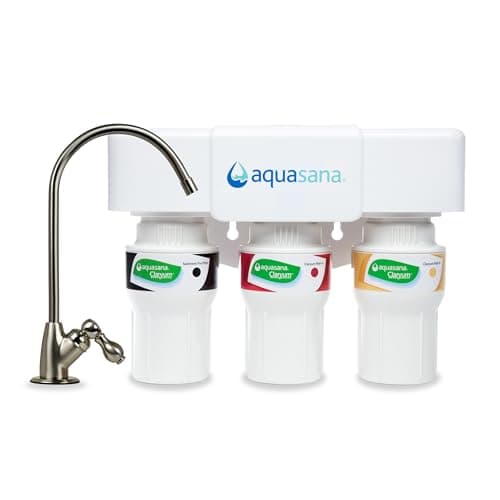 Aquasana Claryum 3-Stage Under-Sink Filter (AQ-5300)Full flow, 600-gallon cartridges, and certified to NSF/ANSI 42, 53 and 401. Aquasana Claryum 3-Stage Under-Sink Filter (AQ-5300)Full flow, 600-gallon cartridges, and certified to NSF/ANSI 42, 53 and 401. | Best if you filter a lot | $154.99 - View on Amazon $349.99 — 56% off #ad Price as of October 17, 2026. We may earn a commission. Disclosure. |
The honest comparison
| Pitcher | Faucet mount | |
|---|---|---|
| Filtered water on demand | No — you refill and wait | Yes |
| Fridge space needed | Yes | No |
| Fits your tap? | Always | Not on pull-out or pull-down sprayers |
| Choice of certified filters | Wide | Narrow |
| Visible hardware | None on the tap | A unit hanging on the faucet |
| Switchable to unfiltered | N/A | Yes — saves filter life for washing up |
| Typical rated life | 40-150 gallons | Around 100 gallons |
| Landlord-friendly | Completely | Yes, and reversible |
Where the faucet mount genuinely wins
You never wait and you never refill. The single most common reason people abandon a pitcher is the refill ritual — an empty pitcher when you are thirsty is a small, repeated irritation, and it is why so many pitchers end up at the back of a cupboard.
You can switch it off. Faucet units have a diverter, so washing up runs unfiltered and the filter's life goes entirely to drinking and cooking. That is a real efficiency a pitcher cannot match.
No fridge space. Which matters more than it sounds in a small kitchen.
Where the pitcher wins
It fits every tap, because it fits no tap. The faucet-mount category has a hard compatibility problem: it does not fit pull-out or pull-down sprayer faucets, and those dominate modern kitchens. Check yours before shopping.
Far more certified filters to choose from. The whole pitcher tier is available to you — certified lead options, a certified PFAS option, and the broad tested filters. The faucet mounts that carry a health certification come down to three.
Nothing hangs off the tap. Aesthetic, and also practical: faucet units add weight and leverage to the spout, and connection leaks are the most common failure mode in the category.
The option that beats both
If you own the home, there is a third answer that removes the compromise entirely: an under-sink direct-connect filter. It plumbs into the cold line feeding the faucet you already have — filtered water on demand, nothing visible, no refilling, no drilling, and a rated capacity measured in tens of thousands of gallons rather than hundreds.
The Waterdrop 17UA is rated at 24,000 gallons. That is a filter change roughly every three years against a pitcher's every two months. Installation is quick-connect fittings and takes about an hour.
Choosing
- Renting, filtering a little: pitcher. Cheapest, simplest, widest certified choice.
- Renting, filtering a lot, standard faucet: faucet mount, if it fits.
- Renting with a sprayer faucet: pitcher, or a direct-connect under-sink filter if your lease allows a reversible install.
- Own the home: under-sink. Neither of these is the right long-term answer for you.
The cost-per-gallon math
Faucet filters are typically rated around 100 gallons, comparable to a Clearly Filtered pitcher and below the Brita Elite's 120 or the Epic Pure's 150.
But the diverter changes the real-world figure. If half your tap use is washing up and you divert it, the filter's rated life covers roughly twice as many days as the same capacity in a pitcher, where every gallon that passes through counts.
The comparison that should end the discussion for homeowners: an under-sink direct-connect filter rated at 24,000 gallons. Divide the cartridge price by that and the cost per gallon is not in the same league as either format on this page.
We show the arithmetic rather than a verdict so you can redo it with the price you actually pay. Filter prices move; the rated capacities above do not.
The picks in full
Best on-demand, hidden
Waterdrop 17UA Direct-Connect Under-Sink Filter
Waterdrop
The answer to the most common under-sink objection: it plumbs into the cold line feeding the faucet you already have, so there is no extra tap, no drilled counter and nothing visible.
Certification status
The 17 series is certified against NSF/ANSI 42 for chlorine reduction and NSF/ANSI 372 for lead-free materials. Verify the listing for the specific variant before buying — the 17UB (dedicated faucet) and 17UA (direct connect) are listed separately.
Published specifications
| Rated capacity | 24,000 gallons / about 3 years |
|---|---|
| Format | Direct connect to the existing cold line — no separate faucet |
| Certified standards | NSF/ANSI 42, 372 |
| Connection | Quick-connect fittings, no threading |
What we like
- No counter drilling and no second tap — the single biggest objection to under-sink filtration, removed
- 24,000-gallon rated capacity means a filter change roughly every three years
- Quick-connect install is a genuinely realistic first-time DIY job
What we do not
- NSF/ANSI 42 is an aesthetic standard — chlorine, taste and odor, not a health claim
- Filters everything the tap delivers, including draws for cooking, which shortens life
- Not a lead or PFAS answer at this certification level
Skip it if
Anyone with a health-driven contaminant worry. NSF/ANSI 42 covers taste and odor. If lead or PFAS is the reason you are shopping, this is the wrong tier of certification.
#ad We do not show a price we cannot verify today. We may earn a commission. Disclosure.
Where these specifications came from
Best pitcher
Brita Elite Filter (with any Brita pitcher)
Brita
The cheapest route to an NSF/ANSI 53 lead certification. It drops into a pitcher most households already have, and it is emphatically not the same filter as the white Brita Standard.
Certification status
Certified to NSF/ANSI 42, 53 and 401. The lead certification belongs to the Elite (blue) filter only — the Standard (white) filter is certified to NSF/ANSI 42 for taste and odor and is not certified for lead. Per Brita's January 2026 performance data sheet the Elite is not certified for PFOA or PFOS, and no Brita pitcher filter is certified for fluoride.
Published specifications
| Rated filter life | 120 gallons / about 6 months |
|---|---|
| Standard filter life, for comparison | 40 gallons / about 2 months |
| Certified standards | NSF/ANSI 42, 53, 401 |
| Lead | Certified under NSF/ANSI 53 |
| PFOA / PFOS | Not certified (January 2026 performance data sheet) |
| Fluoride | Not certified, not claimed |
What we like
- Genuine NSF/ANSI 53 lead certification at the lowest entry price of anything on this site
- Fits Brita pitchers and dispensers already in millions of kitchens — no new hardware
- Three times the rated life of the Standard filter, which changes the cost-per-gallon math
What we do not
- Not certified for PFOA or PFOS, so it is the wrong answer to a PFAS worry
- No fluoride claim at all
- Slow gravity flow, like every pitcher
Skip it if
Anyone whose actual worry is PFAS or fluoride. The Elite is not certified for either, and buying it for those is buying the wrong thing.
#ad Price as of October 17, 2026. We may earn a commission. Disclosure.
Where these specifications came from
Best if you filter a lot
Aquasana Claryum 3-Stage Under-Sink Filter (AQ-5300)
Aquasana
Carbon-block filtration rather than reverse osmosis: it keeps the minerals, wastes nothing, and fits where a reverse-osmosis system will not. It also cannot do what RO does for fluoride or nitrate.
Certification status
WQA tested and certified to NSF/ANSI 42, 53 — which includes the P473 protocol for PFOA and PFOS — and 401, for the reduction of 78 contaminants. Aquasana publishes 99.6% for lead and microplastics, 99.7% for PFOA and PFOS, 99.99% for cysts and 97% for chlorine across the Claryum 3-Stage line.
Published specifications
| Filter life | 600 gallons / up to 6 months |
|---|---|
| Certified standards | NSF/ANSI 42, 53 (includes P473), 401 (WQA) |
| Flow rate | 0.5 gpm |
| Wastewater | None |
| Format | 3-stage carbon block with a dedicated faucet |
| Contaminants claimed | 78 |
| Lead / PFOA and PFOS | 99.6% / 99.7% |
What we like
- No drain line, no wastewater, no tank — much easier to install than reverse osmosis
- NSF/ANSI 401 certification covers pharmaceutical-class trace compounds
- Full flow rate, unlike reverse osmosis, so filling a pot is not a project
What we do not
- Not reverse osmosis: no meaningful fluoride, nitrate or TDS reduction
- 600-gallon filter life is short next to an inline system's tens of thousands
- Proprietary cartridges
Skip it if
Anyone whose problem is fluoride, nitrate or total dissolved solids. Carbon block does not remove those; you need reverse osmosis for that job.
$349.99 — 56% off
#ad Price as of October 17, 2026. We may earn a commission. Disclosure.
Questions people actually ask
Do faucet filters fit all taps?
No, and this is the category's biggest limitation. They do not fit pull-out or pull-down sprayer faucets, which are standard in most modern kitchens. Check your faucet type before buying anything.
Are faucet filters as good as pitchers at removing contaminants?
Certified faucet filters exist and perform, but the selection is much narrower. The pitcher tier gives you certified lead options, a certified PFAS option and the broad tested filters; the faucet category offers far fewer choices.
Do faucet-mounted filters slow the water down?
Yes, noticeably, in filtered mode — water has to pass through media rather than straight out. Switching the diverter to unfiltered restores normal flow, which is exactly what you should do for washing up.
Which is cheaper over a year?
Roughly comparable per gallon, with the faucet mount usually ahead in practice because the diverter means you only filter water you actually drink. Both are considerably more expensive per gallon than an under-sink system.