
ZeroWater is certified for PFOA and PFOS and Brita is not; the Brita Elite is rated for 120 gallons against ZeroWater's 15 to 20. Both are certified for lead. That single trade — PFAS coverage against filter life — decides almost every case.
Quick picks
Tap any row to jump to the full write-up. The button goes straight to the retailer.
| # | Product | Best for | Price |
|---|---|---|---|
| 1 | 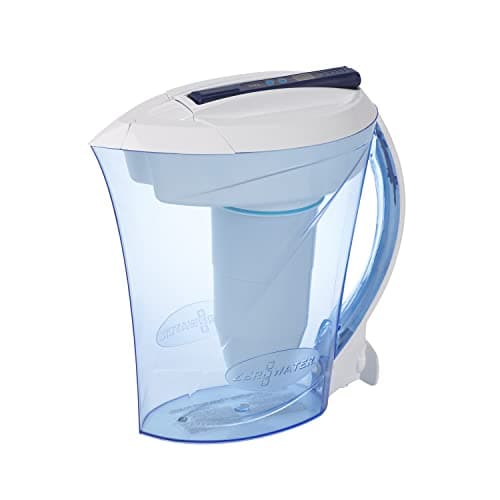 ZeroWater 10-Cup Ready-Pour PitcherIAPMO certified for PFOA and PFOS, 99% published reduction, TDS meter included. ZeroWater 10-Cup Ready-Pour PitcherIAPMO certified for PFOA and PFOS, 99% published reduction, TDS meter included. | If you need PFAS | $27.94 - View on Amazon #ad Price as of October 17, 2026. We may earn a commission. Disclosure. |
| 2 | 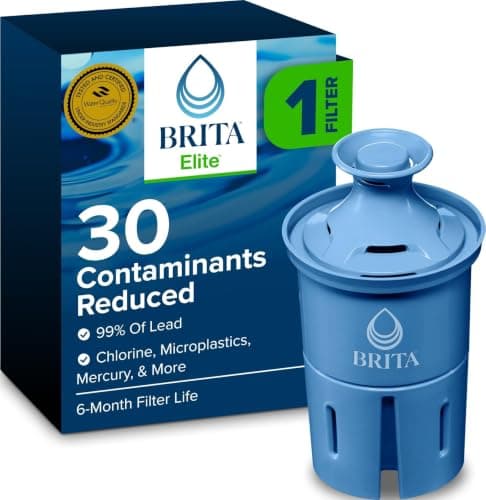 Brita Elite Filter (with any Brita pitcher)Same lead certification, 120 rated gallons, and it fits pitchers you may own. Brita Elite Filter (with any Brita pitcher)Same lead certification, 120 rated gallons, and it fits pitchers you may own. | If you need lead cheaply | $19.88 - View on Amazon #ad Price as of October 17, 2026. We may earn a commission. Disclosure. |
| 3 | 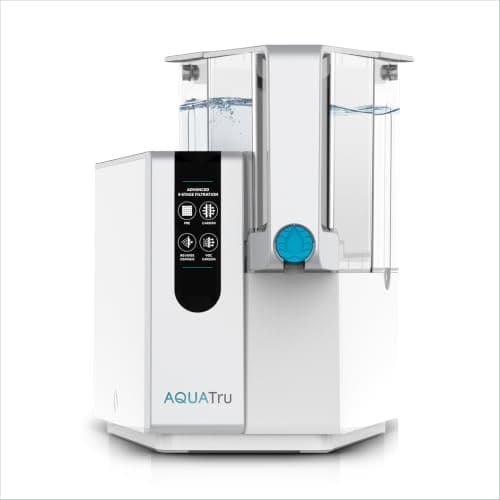 AquaTru Classic Countertop Reverse Osmosis PurifierCertified reverse osmosis with no plumbing — covers everything both pitchers do, plus fluoride. AquaTru Classic Countertop Reverse Osmosis PurifierCertified reverse osmosis with no plumbing — covers everything both pitchers do, plus fluoride. | If neither is enough | $451.25 - View on Amazon $475.00 — 5% off #ad Price as of October 17, 2026. We may earn a commission. Disclosure. |
The certification comparison, which is the whole thing
| ZeroWater 5-stage | Brita Elite | Brita Standard | |
|---|---|---|---|
| Lead | Certified (53), 95% | Certified (53) | Not certified |
| PFOA / PFOS | Certified (53), 99% | Not certified | Not certified |
| Chromium 6 | Certified (53), 99% | Not claimed | Not claimed |
| Mercury | Certified (53), 96% | Not claimed | Not claimed |
| Chlorine taste and odor | Certified (42), 97% | Certified (42) | Certified (42) |
| Fluoride | Not claimed | Not claimed | Not claimed |
| Rated filter life | ~15-20 gallons | 120 gallons | 40 gallons |
| TDS meter included | Yes | No | No |
Where ZeroWater wins
PFAS. This is decisive if you need it. ZeroWater is IAPMO certified against NSF/ANSI 53 for PFOA and PFOS at 99% published reduction. Brita is not certified for either.
Chromium 6 and mercury. Also within ZeroWater's certification, and not claimed by Brita.
Verifiability. The bundled TDS meter lets you check whether the filter is still working rather than trusting a timer. No other pitcher on this site offers that.
Very low TDS. Ion exchange drives dissolved solids toward zero in a way carbon simply cannot.
Where Brita wins
Filter life, by a factor of six. 120 rated gallons against roughly 15 to 20. This is not a marginal difference — it is the difference between changing a filter every two months and every ten days.
Cost per gallon. Follows directly from the above, and it is not close.
Availability. Brita filters are in every supermarket. A filter you can buy on the way home is a filter that actually gets changed.
Fit. Millions of households already own a Brita pitcher, so the upgrade is a filter rather than a purchase.
Choosing
| Your situation | Buy |
|---|---|
| Lead is the only concern | Brita Elite — same certification, six times the life |
| PFAS is a concern | ZeroWater — Brita is not certified for it |
| Chlorine taste only | Brita Elite, or even the Standard |
| You want to verify the filter is working | ZeroWater, for the TDS meter |
| Hard, high-TDS water | Brita Elite — ZeroWater's life collapses on high TDS |
| Fluoride is a concern | Neither. Reverse osmosis, or a tested pitcher. |
The high-TDS irony
People with visibly poor, high-TDS water are the ones most drawn to ZeroWater — and they are exactly the ones for whom its filter life collapses, because the ion-exchange resin is consumed by everything dissolved in the water rather than only the target contaminant.
Above about 400 ppm source TDS, a fortnightly filter change is realistic. That is the honest catch and it deserves stating plainly, because the meter that makes ZeroWater trustworthy is also the meter that shows you how fast it is being used up.
The comparison neither of them wins
If you are drinking more than a couple of gallons a day, both pitchers lose to a certified under-sink system on cost per gallon within about a year, and to countertop reverse osmosis on capability. Pitchers exist because they require nothing of the building — that is their entire advantage.
The cost-per-gallon math
A household drinking two gallons a day uses about 730 gallons a year.
Brita Elite at 120 rated gallons: about six filters. ZeroWater at 20: about 36 — and on high-TDS water where the life drops toward 10, closer to 70. Multiply each by the shelf price on the day.
The gap is large enough that on lead alone the Elite is the obvious answer. ZeroWater earns its cost when the PFAS certification is something you actually need — at which point the honest comparison is not Brita, it is a reverse osmosis system.
We show the arithmetic rather than a verdict so you can redo it with the price you actually pay. Filter prices move; the rated capacities above do not.
The picks in full
If you need PFAS
ZeroWater 10-Cup Ready-Pour Pitcher
ZeroWater
The only mainstream pitcher that hands you a TDS meter and invites you to check its work. It buys you a PFOA/PFOS certification the Brita Elite does not have, and it costs you filter life.
Certification status
The 5-stage filter is system-certified by IAPMO against NSF/ANSI 42 for chlorine taste and odor and NSF/ANSI 53 for lead, hexavalent chromium, mercury and PFOA/PFOS.
Published specifications
| Filtration | 5-stage, including ion-exchange resin |
|---|---|
| Rated filter life | About 15-20 gallons, varying with source TDS |
| Certified standards | NSF/ANSI 42 and 53 (IAPMO) |
| PFOA / PFOS | Certified under NSF/ANSI 53 |
| Published reduction — PFOA/PFOS | 99% |
| Published reduction — lead | 95% |
| Published reduction — chromium 6 | 99% |
| Included | Handheld TDS meter |
What we like
- Carries a PFOA/PFOS certification, which the Brita Elite does not
- The bundled TDS meter turns 'is it still working' from a guess into a reading
- Ion exchange drives total dissolved solids far lower than carbon alone
What we do not
- Filter life is the shortest of any pitcher here, and it collapses further on hard or high-TDS water
- Cost per gallon is the highest in the pitcher tier as a result
- Some owners find the taste flat or faintly sour at very low TDS — a real preference issue, not a defect
Skip it if
Anyone on hard, high-TDS water who will not tolerate changing a filter every few weeks. On 400+ ppm supply the running cost is genuinely painful and an under-sink system is cheaper inside a year.
#ad Price as of October 17, 2026. We may earn a commission. Disclosure.
Where these specifications came from
If you need lead cheaply
Brita Elite Filter (with any Brita pitcher)
Brita
The cheapest route to an NSF/ANSI 53 lead certification. It drops into a pitcher most households already have, and it is emphatically not the same filter as the white Brita Standard.
Certification status
Certified to NSF/ANSI 42, 53 and 401. The lead certification belongs to the Elite (blue) filter only — the Standard (white) filter is certified to NSF/ANSI 42 for taste and odor and is not certified for lead. Per Brita's January 2026 performance data sheet the Elite is not certified for PFOA or PFOS, and no Brita pitcher filter is certified for fluoride.
Published specifications
| Rated filter life | 120 gallons / about 6 months |
|---|---|
| Standard filter life, for comparison | 40 gallons / about 2 months |
| Certified standards | NSF/ANSI 42, 53, 401 |
| Lead | Certified under NSF/ANSI 53 |
| PFOA / PFOS | Not certified (January 2026 performance data sheet) |
| Fluoride | Not certified, not claimed |
What we like
- Genuine NSF/ANSI 53 lead certification at the lowest entry price of anything on this site
- Fits Brita pitchers and dispensers already in millions of kitchens — no new hardware
- Three times the rated life of the Standard filter, which changes the cost-per-gallon math
What we do not
- Not certified for PFOA or PFOS, so it is the wrong answer to a PFAS worry
- No fluoride claim at all
- Slow gravity flow, like every pitcher
Skip it if
Anyone whose actual worry is PFAS or fluoride. The Elite is not certified for either, and buying it for those is buying the wrong thing.
#ad Price as of October 17, 2026. We may earn a commission. Disclosure.
Where these specifications came from
If neither is enough
AquaTru Classic Countertop Reverse Osmosis Purifier
AquaTru
Reverse osmosis performance with no plumbing, no drilling and no landlord conversation. You pay for that with counter space, a wait, and two tanks you fill and empty by hand.
Certification status
Certified by IAPMO to NSF/ANSI 53, 58, 401 and P473, covering lead, reverse-osmosis performance, emerging compounds and the PFOA/PFOS protocol.
Published specifications
| Filtration | 4-stage countertop reverse osmosis |
|---|---|
| Clean water tank | 0.75 gallons |
| Tap water tank | 1 gallon |
| Installation | None — no plumbing connection |
| Certified standards | NSF/ANSI 53, 58, 401, P473 (IAPMO) |
What we like
- Real reverse osmosis with a P473 PFOA/PFOS certification and zero installation
- The strongest answer available to a renter with a lead or PFAS problem
- No drilling, no drain saddle, no landlord permission needed
What we do not
- Takes up substantial counter space
- You refill and empty tanks by hand — it is not on-demand
- Highest purchase price in the no-plumbing tier by a wide margin
Skip it if
Anyone who can plumb in an under-sink system. A permanent under-sink RO is cheaper per gallon, on-demand, and out of sight. Buy this when you genuinely cannot install.
$475.00 — 5% off
#ad Price as of October 17, 2026. We may earn a commission. Disclosure.
Where these specifications came from
Questions people actually ask
Is ZeroWater better than Brita?
For PFAS, chromium 6 and mercury, yes — it carries certifications Brita does not. For lead alone, no: both are certified and the Brita Elite lasts roughly six times as long at a lower price per filter.
Which lasts longer, ZeroWater or Brita?
Brita, by a wide margin. The Elite is rated for 120 gallons and ZeroWater for roughly 15 to 20, falling further on high-TDS water. The mechanism explains it — ion-exchange resin is consumed by every dissolved solid, not just the target contaminant.
Do both remove lead?
Yes, both the ZeroWater 5-stage filter and the Brita Elite are certified against NSF/ANSI 53 for lead. The Brita Standard is not — it is certified to NSF/ANSI 42 for taste and odor only.
Which tastes better?
A preference question. ZeroWater drives TDS toward zero, which some people find flat or faintly sour. Brita leaves minerals in and tastes more like familiar tap water without the chlorine. Neither is wrong; try before committing to a case of filters.