Buy the AquaTru Carafe if you want certified reverse osmosis without plumbing and your kitchen cannot spare the counter for the Classic. IAPMO certifies it under NSF/ANSI 42, 53 and 58 with 99.2% average lead and 96.4% fluoride reduction. The compromise is a half-gallon clean tank.
Quick picks
Tap any row to jump to the full write-up. The button goes straight to the retailer.
| # | Product | Best for | Price |
|---|---|---|---|
| 1 | 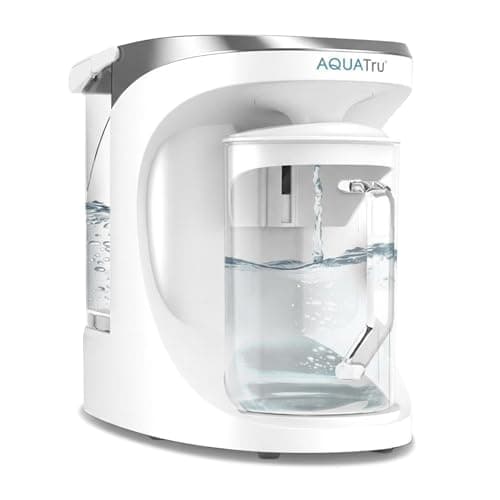 AquaTru Carafe Countertop Reverse Osmosis PurifierIAPMO certified under NSF/ANSI 42, 53 and 58, with a published 63% efficiency rating. AquaTru Carafe Countertop Reverse Osmosis PurifierIAPMO certified under NSF/ANSI 42, 53 and 58, with a published 63% efficiency rating. | Best small-kitchen reverse osmosis | $356.25 - View on Amazon $375.00 — 5% off #ad Price as of October 17, 2026. We may earn a commission. Disclosure. |
| 2 | 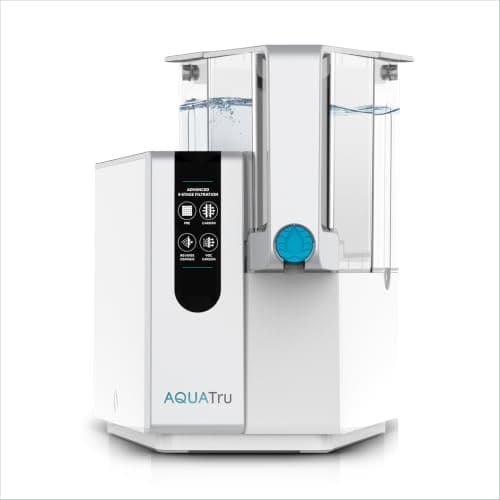 AquaTru Classic Countertop Reverse Osmosis PurifierSame no-plumbing idea with a 0.75 gallon clean tank instead of 0.5 — buy it if the counter allows. AquaTru Classic Countertop Reverse Osmosis PurifierSame no-plumbing idea with a 0.75 gallon clean tank instead of 0.5 — buy it if the counter allows. | The larger sibling | $451.25 - View on Amazon $475.00 — 5% off #ad Price as of October 17, 2026. We may earn a commission. Disclosure. |
What this is, and what the Carafe changes
AquaTru's pitch has always been reverse osmosis for people who cannot install anything. The Carafe is that same idea compressed: a four-stage countertop unit that produces into a 64 oz borosilicate glass carafe rather than a plastic holding tank, in a footprint of 7.5 inches wide by 14 deep.
Mechanically it is the familiar batch arrangement. You fill a tap-water tank — 0.66 gallons, 2.5 liters — the unit pushes that through sediment and carbon pre-filtration, a reverse osmosis membrane and a final carbon stage, and the product water collects in the carafe, which holds 0.5 gallons. It runs on a 120 V outlet and nothing else: no feed line, no drain saddle, no hole in the counter.
The glass is the headline feature in the marketing and it is a real one — the carafe lifts out and goes in the fridge door, which no tanked countertop system does. But the interesting number on this product is not the glass. It is the efficiency rating, and it is further down the page.
What it is certified for, read off the certifier's sheet
IAPMO publishes a full performance data sheet for the Carafe, covering AquaTru Carafe Model AT100, At110, AT120, AT130, and AT140. That document is the reason this review exists in the shape it does — the whole reduction table is public, so there is no need to accept a contaminant count on trust.
The system is certified under NSF/ANSI 42, 53 and 58, with additional testing to NSF/ANSI 401 and to NSF Protocol 53 for PFOA and PFOS. The NSF/ANSI 58 table is where the claims people actually care about live:
| Substance | Challenge (mg/L) | Required | Minimum | Average |
|---|---|---|---|---|
| Lead | 0.15 | 96% | 98% | 99.2% |
| Fluoride | 8 | 81% | 94.2% | 96.4% |
| Arsenic (pentavalent) | 0.05 | 80% | 97.2% | 98.8% |
| Hexavalent chromium | 0.3 | 66% | 90.1% | 97.5% |
| Trivalent chromium | 0.3 | 66% | 99% | 99.6% |
| Nitrate (as N) | 27 | — | 97.5% | 98.3% |
| Perchlorate | 0.10 | 94% | 97.2% | 98.3% |
| Selenium | 0.10 | 50% | 92.6% | 98.1% |
| Barium | 10.0 | 80% | 93.8% | 95.4% |
| Copper | 3 | 57% | 91.2% | 96.8% |
| Radium 226/228 | 25 pCi/L | 80% | 88% | 96.4% |
| TDS | 750 | 75% | 94.5% | 94.4% |
| Cyst | 50,000 organisms | 99% | 99.9% | 99.9% |
Three rows deserve a sentence each. The fluoride row is the one that separates this tier from every carbon filter on the market — the challenge is 8 mg/L, well above anything a utility doses, reduced to the 1.5 mg/L permissible limit. The cyst row carries a footnote defining the organisms: includes Giardia Lamblia, Entamoeba Histolyca and Cryptosporidium, which is a named-organism claim rather than a vague pathogen percentage. And TDS at 94.5% minimum is the honest ceiling on this technology: reverse osmosis is a high-rejection membrane, not a zero-solids process.
PFOA and PFOS sit outside that table, under NSF Protocol 53: a 1.5 ppm challenge reduced to a permissible 0.07 µg/L, with a minimum allowable reduction of 86% and a 99% average. Under NSF/ANSI 42 the sheet records 94% average free chlorine reduction over the cartridge's 300 gallons. Under NSF/ANSI 401 fifteen pharmaceutical and industrial compounds are listed, averaging between 89.5% for ibuprofen and 99.7% for meprobamate.
The efficiency rating, which is the real find
Here is the specification almost nobody compares, and on this unit it is unusually good.
The sheet publishes an efficiency rating of 63%, and defines it the way the standard does: the percentage of the influent water to the system that is available to the user as reverse osmosis treated water under operating conditions that approximate typical daily usage.
Put that next to the tier. Conventional tank reverse osmosis systems commonly run around one part product water to three or four parts drain — the roundup covers the published ratios and most of them are poor. A 63% efficiency rating means roughly 0.6 gallons rejected per gallon produced. For a household that finds the wastewater argument against reverse osmosis persuasive, this is the format that answers it, and it answers it with a certifier's figure rather than a marketing claim.
There is a mundane reason the batch format wins here, worth stating so the number does not look like magic: a countertop unit has no pressurised storage tank to keep topped up, so it is not re-rejecting water to maintain tank pressure. It makes what you asked for and stops.
The operating limits, which decide whether it will work at your house
This is the section that saves returns, and all of it is published rather than inferred.
| Parameter | Limit |
|---|---|
| Total dissolved solids | 1,500 mg/L maximum |
| Hardness | 10 gpg (171 mg/L) maximum |
| Sulphide, iron and manganese | Under 0.1 mg/L |
| Chlorine | Under 2 ppm |
| pH | 3 to 11 |
| Turbidity | 5 NTU maximum |
| Temperature | 39 to 100 degrees F |
| Daily production rate | 35 GPD |
The hardness limit is the one that catches people. The sheet is explicit about why: if the hardness of your water is above 10 gpg (171 mg/L), lime scale will build up rapidly on the membrane inside of the RO membrane cartridge, and AquaTru does not recommend the unit above that figure unless the water is softened first. Ten grains is not an exotic threshold — a great deal of US groundwater is harder than that. If you have scale on your kettle, check your hardness figure before buying this rather than after.
The iron and manganese limits matter on well water for the same reason, and the arsenic claim comes with a real condition. The sheet states the system reduces pentavalent arsenic but may not remove other forms of arsenic, and that it is to be used on supplies with a detectable free chlorine residual or demonstrated to contain only pentavalent arsenic — because treatment with chloramine (combined chlorine) is not sufficient to ensure complete conversion of trivalent arsenic to pentavalent arsenic. On a chloraminated supply, or a well, that caveat is doing real work.
One more limit, in bold on the sheet and worth repeating: do not use with water that is microbiologically unsafe or of unknown quality without adequate disinfection before or after the system. The cyst certification is a second barrier on treated water, not a primary treatment.
Living with it: three cartridges, three clocks, and a discrepancy
The maintenance story is the weakest part of the product, and it is worth being precise about rather than waving at.
There are three consumables with three different intervals. The IAPMO sheet's replacement list gives the pre/carbon filter (SKU 10AT100SF01) every three months or 300 gallons, the VOC filter (10AT100VF01) every six months or 300 gallons, and the reverse osmosis membrane (10AT100RF01) every 24 months or 600 gallons, whichever comes first in each case. An alkaline mineral-boost version of the VOC filter is offered on the same interval.
Now the discrepancy: AquaTru's own product page lists the pre/carbon filter at six months or 300 gallons, and the VOC at one year or 300 gallons. The certifier sheet says three and six. The gallon figures agree in both places, which is the clue to what to do — ignore the months and count gallons, the way every filter on this site should be counted. The rated capacity is the specification; the calendar interval is a convenience estimate, and here the two sources do not even agree on it.
For a two-person household drinking two gallons a day, 300 gallons is about five months. So the certifier's three-month figure is conservative for a light user and the manufacturer's six-month figure is optimistic for a heavy one. Both are wrong in the same way: they are guesses about your consumption.
Carafe or Classic
These are near-siblings and the choice is almost entirely about volume, so it is a short comparison.
| Carafe | Classic | |
|---|---|---|
| Clean water vessel | 0.5 gal — 64 oz glass carafe | 0.75 gal plastic tank |
| Tap water tank | 0.66 gal | 1 gal |
| Vessel goes in the fridge | Yes | No |
| Width on the counter | 7.5 in | Wider |
| Installation | None | None |
| Format | Batch countertop reverse osmosis | Batch countertop reverse osmosis |
Buy the Carafe if the counter is the constraint, or if drinking out of glass matters to you enough to refill more often. Buy the Classic if you have the space, because a third more clean-water capacity is the difference between filling it once a day and twice. If you are weighing either against a pitcher, the countertop roundup sets them against the rest of the tier, and the Clearly Filtered comparison covers the certified-versus-tested question that usually comes next.
The cost-per-gallon math
Three cartridges on three clocks means the running cost is not a single number, so build it from the gallon ratings rather than from a filter price.
Take a household drinking two gallons a day — 730 gallons a year. That is roughly 2.4 pre/carbon cartridges, 2.4 VOC cartridges and 1.2 membranes a year at the rated capacities of 300, 300 and 600 gallons. Price those three line items at whatever the current filter pack costs and divide by 730 for a real cost per gallon.
The comparison that matters is not against a pitcher, which cannot do fluoride or nitrate at all. It is against a plumbed under-sink reverse osmosis system, where the ten-year arithmetic is laid out — and where the cartridges are larger, cheaper per gallon and changed less often. The premium you are paying here buys the absence of a plumber.
We do not print product prices in this text. The buy buttons carry the live figure and the date it was checked, which is the only price worth quoting.
We show the arithmetic rather than a verdict so you can redo it with the price you actually pay. Filter prices move; the rated capacities above do not.
The picks in full
Best small-kitchen reverse osmosis
AquaTru Carafe Countertop Reverse Osmosis Purifier
AquaTru
The Classic's certification table in two-thirds of the footprint, pouring into glass instead of a plastic tank. You give up capacity and gain a published 63% recovery rate, which is better than almost any plumbed system manages.
Certification status
IAPMO publishes a performance data sheet covering Carafe models AT100, AT110, AT120, AT130 and AT140, certified under NSF/ANSI 42, 53 and 58, with additional testing to NSF/ANSI 401 and NSF Protocol 53 for PFOA and PFOS. The NSF/ANSI 58 table records average reductions of 99.2% for lead, 99.9% for cysts, 96.4% for fluoride, 98.8% for pentavalent arsenic, 97.5% for hexavalent chromium, 98.3% for nitrate and 94.4% for TDS. PFOA and PFOS average 99% under NSF Protocol 53.
Published specifications
| Filtration | 4-stage countertop reverse osmosis |
|---|---|
| Carafe | 64 oz borosilicate glass |
| Clean water tank | 0.5 gallons (1.9 L) |
| Tap water tank | 0.66 gallons (2.5 L) |
| Daily production rate | 35 GPD |
| Efficiency rating | 63% (IAPMO) |
| Certified standards | NSF/ANSI 42, 53, 58 (IAPMO) |
| Dimensions | 13 in H x 14 in D x 7.5 in W |
| Power | 120 V, 60 Hz |
| Max inlet hardness | 10 gpg (171 mg/L) |
What we like
- A published 63% efficiency rating — most tank reverse osmosis systems send three or four gallons to drain per gallon produced
- The NSF/ANSI 58 claim list reaches lead, fluoride, nitrate, arsenic, chromium-6 and cysts, which carbon cannot
- Glass carafe rather than a plastic holding tank, and it goes in the fridge
- No plumbing, no drilling and no drain saddle — the whole certification travels with a renter
What we do not
- A 0.5 gallon clean tank against the Classic's 0.75 — you refill it more often for the same household
- Three cartridges on three different clocks, and the manufacturer's web page and the certifier's data sheet disagree on the pre/carbon interval
- Needs a counter outlet and 7.5 inches of width it does not share
- Not for water above 10 gpg hardness without softening first, or the membrane scales
Skip it if
A household that drinks a lot of water. The clean tank holds half a gallon and refills at 35 gallons a day, so a family of four will be waiting on it. Buy the Classic for its larger tanks, or a plumbed under-sink system if you can install one.
$375.00 — 5% off
#ad Price as of October 17, 2026. We may earn a commission. Disclosure.
The larger sibling
AquaTru Classic Countertop Reverse Osmosis Purifier
AquaTru
Reverse osmosis performance with no plumbing, no drilling and no landlord conversation. You pay for that with counter space, a wait, and two tanks you fill and empty by hand.
Certification status
Certified by IAPMO to NSF/ANSI 53, 58, 401 and P473, covering lead, reverse-osmosis performance, emerging compounds and the PFOA/PFOS protocol.
Published specifications
| Filtration | 4-stage countertop reverse osmosis |
|---|---|
| Clean water tank | 0.75 gallons |
| Tap water tank | 1 gallon |
| Installation | None — no plumbing connection |
| Certified standards | NSF/ANSI 53, 58, 401, P473 (IAPMO) |
What we like
- Real reverse osmosis with a P473 PFOA/PFOS certification and zero installation
- The strongest answer available to a renter with a lead or PFAS problem
- No drilling, no drain saddle, no landlord permission needed
What we do not
- Takes up substantial counter space
- You refill and empty tanks by hand — it is not on-demand
- Highest purchase price in the no-plumbing tier by a wide margin
Skip it if
Anyone who can plumb in an under-sink system. A permanent under-sink RO is cheaper per gallon, on-demand, and out of sight. Buy this when you genuinely cannot install.
$475.00 — 5% off
#ad Price as of October 17, 2026. We may earn a commission. Disclosure.
Where these specifications came from
Questions people actually ask
Is the AquaTru Carafe certified, and to what?
Yes. IAPMO publishes a performance data sheet covering Carafe models AT100 through AT140, certified under NSF/ANSI 42, 53 and 58, with additional testing to NSF/ANSI 401 and NSF Protocol 53 for PFOA and PFOS. Average reductions in the NSF/ANSI 58 table include 99.2% for lead, 96.4% for fluoride, 99.9% for cysts, 98.8% for pentavalent arsenic, 98.3% for nitrate and 94.4% for TDS.
How much water does the AquaTru Carafe hold?
The glass carafe holds 64 oz, which is half a gallon of finished water, and the tap-water tank holds 0.66 gallons. The system's daily production rate is 35 gallons. That is comfortable for one or two people and tight for a family, which is the main reason to consider the larger Classic instead.
Does the AquaTru Carafe waste a lot of water?
Less than most reverse osmosis systems. The IAPMO sheet publishes a 63% efficiency rating, meaning about 63% of the water entering the system is available as treated water — roughly 0.6 gallons to drain per gallon produced. Conventional tank systems commonly run one part product to three or four parts drain, so this format is unusually efficient for the technology.
Does the AquaTru Carafe remove fluoride?
Yes, and it is certified for it. The IAPMO performance data sheet records fluoride reduction under NSF/ANSI 58 from an 8 mg/L challenge to the 1.5 mg/L permissible limit, with a 94.2% minimum and 96.4% average reduction. No carbon filter or pitcher can make that claim, because carbon does not remove fluoride.
How often do the AquaTru Carafe filters need changing?
Count gallons rather than months, because the two published sources disagree on the calendar. The IAPMO sheet lists the pre/carbon filter at three months or 300 gallons and the VOC filter at six months or 300 gallons; AquaTru's own product page lists six months and one year for the same two filters. Both sources agree the reverse osmosis membrane runs 24 months or about 600 gallons, and both agree on the 300-gallon ratings.
Will the AquaTru Carafe work on hard water or well water?
Only within published limits. The sheet caps inlet hardness at 10 gpg (171 mg/L), warning that above that figure lime scale will build up rapidly on the membrane, and caps sulphide, iron and manganese at under 0.1 mg/L. It also notes the arsenic claim covers pentavalent arsenic only and needs a free chlorine residual, which chloramine does not provide. On a well, test first.
Carafe or Classic?
Capacity against footprint. The Carafe gives you a 0.5 gallon glass carafe you can put in the fridge in 7.5 inches of counter width; the Classic gives you a 0.75 gallon clean tank and a 1 gallon fill tank in a larger body. Neither needs plumbing. For one or two people the Carafe is the better-shaped product; for a family the Classic's extra capacity is worth the space.