Countertop reverse osmosis is the strongest filtration available without touching the plumbing. A certified unit reaches fluoride, nitrate and arsenic that no pitcher addresses, at the cost of counter space, a wait, and tanks you fill by hand.
Quick picks
Tap any row to jump to the full write-up. The button goes straight to the retailer.
| # | Product | Best for | Price |
|---|---|---|---|
| 1 | 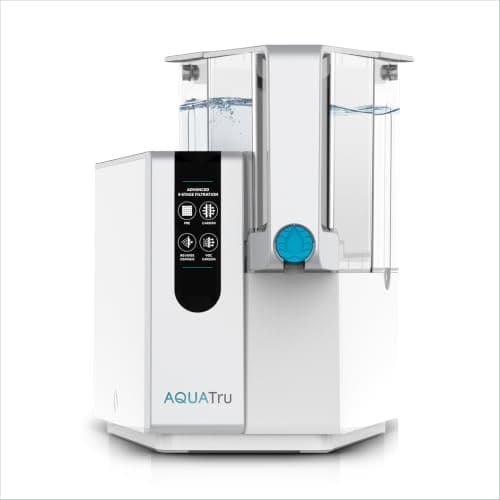 AquaTru Classic Countertop Reverse Osmosis PurifierIAPMO certified to NSF/ANSI 53, 58, 401 and P473 with no plumbing connection at all. AquaTru Classic Countertop Reverse Osmosis PurifierIAPMO certified to NSF/ANSI 53, 58, 401 and P473 with no plumbing connection at all. | Best countertop RO | $451.25 - View on Amazon $475.00 — 5% off #ad Price as of October 17, 2026. We may earn a commission. Disclosure. |
| 2 | 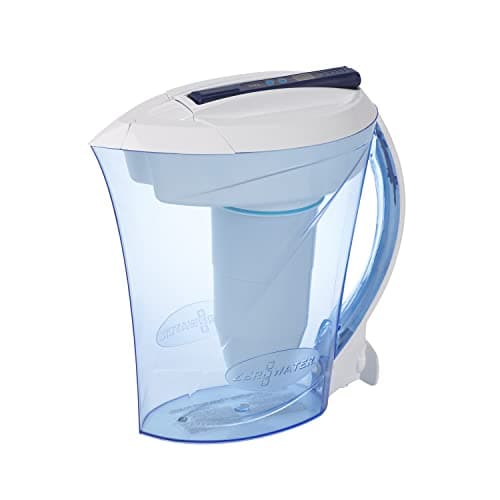 ZeroWater 10-Cup Ready-Pour PitcherIon exchange rather than RO, with a TDS meter to prove it is still working. ZeroWater 10-Cup Ready-Pour PitcherIon exchange rather than RO, with a TDS meter to prove it is still working. | Cheapest way to zero TDS | $27.94 - View on Amazon #ad Price as of October 17, 2026. We may earn a commission. Disclosure. |
| 3 | 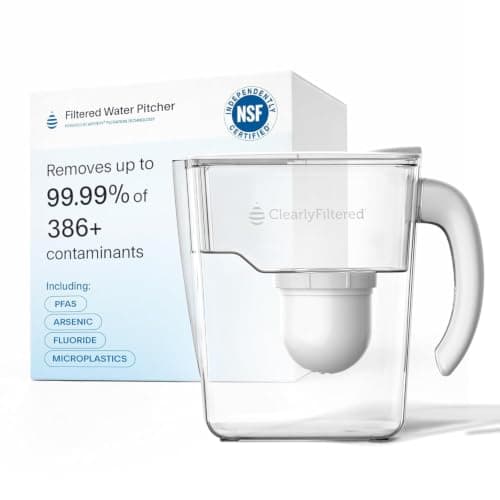 Clearly Filtered Water Pitcher (Affinity)Tested to a wider contaminant list than most, with no counter footprint at all. Clearly Filtered Water Pitcher (Affinity)Tested to a wider contaminant list than most, with no counter footprint at all. | Best gravity alternative | $109.99 - View on Amazon #ad Price as of October 17, 2026. We may earn a commission. Disclosure. |
What countertop actually means
"Countertop filter" covers two very different things, and conflating them is how people end up disappointed:
- Countertop carbon units — essentially a bigger, faster pitcher. Same mechanism, same limits, more capacity.
- Countertop reverse osmosis — a genuinely different technology that reaches contaminants carbon cannot: fluoride, nitrate, arsenic, dissolved solids. This is the reason the category is interesting.
The rest of this page is about the second kind, because the first is covered adequately by the pitcher roundup.
Why this is the renter's answer
If you have a confirmed lead or PFAS problem and a lease that forbids modifying the plumbing, your options are narrow. A certified pitcher covers lead well and PFAS narrowly. Countertop RO covers both, plus fluoride and nitrate, with a certification listing behind it.
The AquaTru Classic is certified by IAPMO to NSF/ANSI 53, 58, 401 and P473 — the protocol written specifically for PFOA and PFOS. It connects to nothing: you fill a tank, it produces into a second tank, you pour from that. No drain saddle, no drilled counter, no landlord conversation.
The honest costs
| What you give up | How much it matters |
|---|---|
| Counter space | Genuinely significant. Measure your counter before ordering — this is the most common regret. |
| Immediacy | It produces into a tank. You are not filling a pot on demand the way an under-sink system lets you. |
| Manual filling and emptying | Two tanks, both by hand. Fine for one or two people; tedious for a family of five. |
| Purchase price | The highest in the no-plumbing tier by a wide margin. |
| Wastewater | Reverse osmosis produces some. Less of an issue than on plumbed systems since you see it. |
The comparison people should actually run
Not countertop RO versus a pitcher — countertop RO versus under-sink RO. They reach similar certifications. The differences are practical:
- Under-sink is cheaper per gallon over any reasonable ownership period, and it is on demand.
- Countertop requires nothing of the building. No hole, no drain, no permission, and it comes with you when you move.
If you can install, install. If you cannot, this is the ceiling of what is available to you, and it is a high ceiling.
The ion-exchange alternative
ZeroWater is worth mentioning here even though it is a pitcher, because it reaches near zero total dissolved solids by a different route — ion exchange rather than a membrane — at a fraction of the purchase price, with a certification covering PFOA and PFOS.
The trade is filter life: rated at roughly 15 to 20 gallons and falling on high-TDS water, which is exactly the water people buy it for. It is the cheapest way into very low TDS and the most expensive way to stay there.
The cost-per-gallon math
Countertop RO has a high purchase price and a low running cost; a high-consumption pitcher has the reverse. The crossover point is what to calculate.
An RO system's consumables are pre-filters and a membrane on a multi-month to multi-year cycle. A ZeroWater filter rated at 15 to 20 gallons, for a household drinking two gallons a day, is roughly forty filters a year on soft water and more on hard.
Work out your annual filter spend for the pitcher and set it against the countertop unit's purchase price plus its consumables. On genuinely high-TDS water the countertop unit frequently pays for itself inside two years — which is the honest reason to consider it even if the sticker price looks steep.
We show the arithmetic rather than a verdict so you can redo it with the price you actually pay. Filter prices move; the rated capacities above do not.
The picks in full
Best countertop RO
AquaTru Classic Countertop Reverse Osmosis Purifier
AquaTru
Reverse osmosis performance with no plumbing, no drilling and no landlord conversation. You pay for that with counter space, a wait, and two tanks you fill and empty by hand.
Certification status
Certified by IAPMO to NSF/ANSI 53, 58, 401 and P473, covering lead, reverse-osmosis performance, emerging compounds and the PFOA/PFOS protocol.
Published specifications
| Filtration | 4-stage countertop reverse osmosis |
|---|---|
| Clean water tank | 0.75 gallons |
| Tap water tank | 1 gallon |
| Installation | None — no plumbing connection |
| Certified standards | NSF/ANSI 53, 58, 401, P473 (IAPMO) |
What we like
- Real reverse osmosis with a P473 PFOA/PFOS certification and zero installation
- The strongest answer available to a renter with a lead or PFAS problem
- No drilling, no drain saddle, no landlord permission needed
What we do not
- Takes up substantial counter space
- You refill and empty tanks by hand — it is not on-demand
- Highest purchase price in the no-plumbing tier by a wide margin
Skip it if
Anyone who can plumb in an under-sink system. A permanent under-sink RO is cheaper per gallon, on-demand, and out of sight. Buy this when you genuinely cannot install.
$475.00 — 5% off
#ad Price as of October 17, 2026. We may earn a commission. Disclosure.
Where these specifications came from
Cheapest way to zero TDS
ZeroWater 10-Cup Ready-Pour Pitcher
ZeroWater
The only mainstream pitcher that hands you a TDS meter and invites you to check its work. It buys you a PFOA/PFOS certification the Brita Elite does not have, and it costs you filter life.
Certification status
The 5-stage filter is system-certified by IAPMO against NSF/ANSI 42 for chlorine taste and odor and NSF/ANSI 53 for lead, hexavalent chromium, mercury and PFOA/PFOS.
Published specifications
| Filtration | 5-stage, including ion-exchange resin |
|---|---|
| Rated filter life | About 15-20 gallons, varying with source TDS |
| Certified standards | NSF/ANSI 42 and 53 (IAPMO) |
| PFOA / PFOS | Certified under NSF/ANSI 53 |
| Published reduction — PFOA/PFOS | 99% |
| Published reduction — lead | 95% |
| Published reduction — chromium 6 | 99% |
| Included | Handheld TDS meter |
What we like
- Carries a PFOA/PFOS certification, which the Brita Elite does not
- The bundled TDS meter turns 'is it still working' from a guess into a reading
- Ion exchange drives total dissolved solids far lower than carbon alone
What we do not
- Filter life is the shortest of any pitcher here, and it collapses further on hard or high-TDS water
- Cost per gallon is the highest in the pitcher tier as a result
- Some owners find the taste flat or faintly sour at very low TDS — a real preference issue, not a defect
Skip it if
Anyone on hard, high-TDS water who will not tolerate changing a filter every few weeks. On 400+ ppm supply the running cost is genuinely painful and an under-sink system is cheaper inside a year.
#ad Price as of October 17, 2026. We may earn a commission. Disclosure.
Where these specifications came from
Best gravity alternative
Clearly Filtered Water Pitcher (Affinity)
Clearly Filtered
The broadest claim list of any pitcher we list, and the one that needs the most careful reading: it is independently tested to NSF standards, not certified by a listing body. That distinction is the whole decision.
Certification status
Two different kinds of evidence sit on this pitcher. NSF's own listing records the Filtered Water Pitcher under NSF/ANSI 42 at 100 gallons for chlorine reduction and taste and odor reduction, and Clearly Filtered states it holds NSF/ANSI 42 and 372 certifications and is pursuing 53 and 401. Everything beyond that — the 386+ contaminant list, including fluoride, PFAS, arsenic and chromium-6 — comes from testing at QFT, now IAPMO New Jersey, an ISO 17025 laboratory working to NSF/ANSI protocols. Test data, not a certification listing.
Published specifications
| Capacity | 80 oz / 10 cups |
|---|---|
| Rated filter life | 100 gallons / about 4 months |
| Filtration | 3-stage: stainless mesh, coconut carbon, Affinity composite shell |
| Certified | NSF/ANSI 42 and 372 (chlorine, taste and odor; lead-free materials) |
| Tested, not certified | NSF/ANSI 53, 401 and P473 methods |
| Manufacturer claim | Up to 99.99% of 386+ contaminants |
| Fluoride / lead | >99.54% / 99.34% (laboratory data) |
| PFOA / PFOS | 99.64% / >99.80% (laboratory data) |
| Housing | Tritan, BPA-free |
What we like
- Addresses PFAS and fluoride, which most certified pitchers do not touch
- 100-gallon rated life is far longer than ZeroWater's
- Published test data covers an unusually wide contaminant list
What we do not
- Outside chlorine and materials, every claim is test data rather than a certification listing
- Highest sticker price in the pitcher tier
- Flow is slow even by pitcher standards
Skip it if
Anyone who needs a certification listing for a specific contaminant — for a landlord, a lender, a health directive, or their own peace of mind. If the listing is what you need, buy a certified product instead.
#ad Price as of October 17, 2026. We may earn a commission. Disclosure.
Where these specifications came from
Questions people actually ask
Does countertop reverse osmosis need plumbing?
No, and that is the entire point of the format. You fill a tap-water tank by hand, the unit produces into a clean-water tank, and you pour from that. No connection to the supply, no drain saddle, nothing drilled.
Is countertop RO as good as under-sink RO?
In certification and capability, broadly yes — the AquaTru Classic reaches NSF/ANSI 53, 58, 401 and P473. In convenience, no. Under-sink is on demand, out of sight and cheaper per gallon. Countertop exists for people who cannot install.
How much counter space does one take?
Enough that it is the most common complaint. Check the dimensions against your actual counter before ordering, remembering it needs clearance above for filling. People consistently underestimate this.
Does countertop RO remove fluoride?
Yes. Reverse osmosis is the mainstream technology for fluoride reduction, and NSF/ANSI 58 covers fluoride explicitly. No certified pitcher makes that claim, which is one of the strongest reasons to step up to this tier.