
The pool taste is chlorine or chloramine that your utility added on purpose to keep the water safe all the way to your tap. It is not a fault. Any carbon filter removes it, and a certified pitcher filter costing a few dollars a month is genuinely enough.
Quick picks
Tap any row to jump to the full write-up. The button goes straight to the retailer.
| # | Product | Best for | Price |
|---|---|---|---|
| 1 | 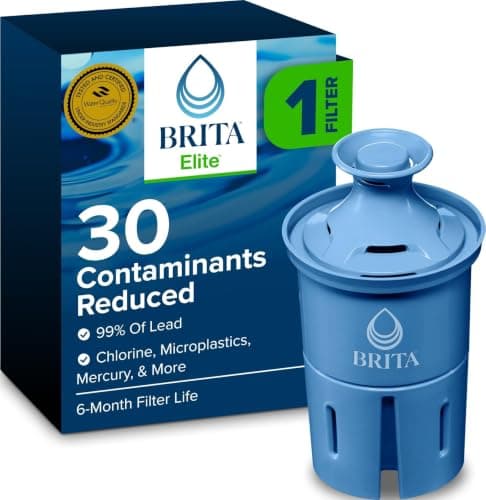 Brita Elite Filter (with any Brita pitcher)Certified to NSF/ANSI 42 for taste and odor, and to 53 for lead as a bonus. Brita Elite Filter (with any Brita pitcher)Certified to NSF/ANSI 42 for taste and odor, and to 53 for lead as a bonus. | Cheapest certified fix | $19.88 - View on Amazon #ad Price as of October 17, 2026. We may earn a commission. Disclosure. |
| 2 | 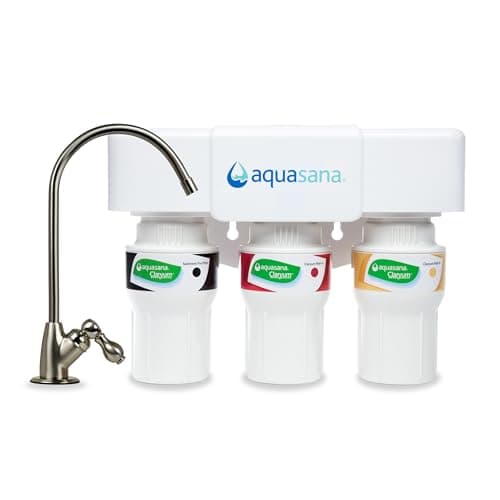 Aquasana Claryum 3-Stage Under-Sink Filter (AQ-5300)Certified for chloramine as well as chlorine, at full tap flow. Aquasana Claryum 3-Stage Under-Sink Filter (AQ-5300)Certified for chloramine as well as chlorine, at full tap flow. | Best for chloramine | $154.99 - View on Amazon $349.99 — 56% off #ad Price as of October 17, 2026. We may earn a commission. Disclosure. |
| 3 | 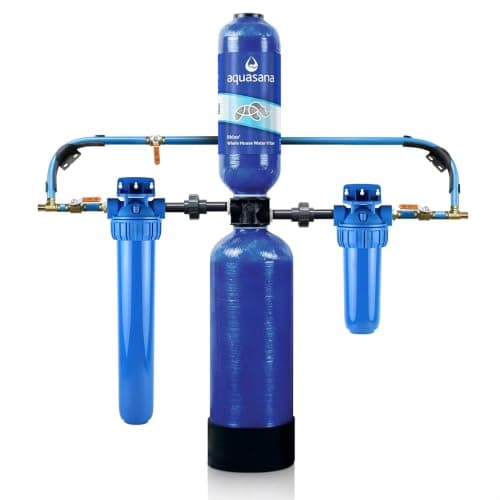 Aquasana Rhino EQ-1000 Whole-House FilterPoint of entry, so the chlorine is gone before it reaches the shower head. Aquasana Rhino EQ-1000 Whole-House FilterPoint of entry, so the chlorine is gone before it reaches the shower head. | Fixes it in the shower too | $1,123.00 - View on Amazon #ad Price as of October 17, 2026. We may earn a commission. Disclosure. |
What you are tasting
Public water systems add a disinfectant and are required to maintain a measurable residual all the way through the distribution network, so that water contaminated by a pipe break on the way to your house is still being treated. That residual is the pool taste. It is the system working, not failing.
Two chemicals are in common use and they behave very differently at your tap:
- Free chlorine is volatile. It dissipates from an open container in a few hours and comes out of carbon easily. If leaving a jug in the fridge overnight fixes the taste, you have free chlorine.
- Chloramine — chlorine combined with ammonia — is deliberately more stable, because it persists further into the distribution system. It does not off-gas overnight, and standard activated carbon removes it poorly. This is the single most common reason a filter "does not work" on chlorine taste.
Your utility's annual Consumer Confidence Report says which one you are on. It is free, it is published every year, and it is worth ninety seconds — how to read one.
Why the strength changes
People often notice the taste getting stronger or weaker and assume something has gone wrong. Usually it has not:
- Warm weather increases disinfectant demand, so utilities dose higher in summer.
- Distance from the treatment plant matters. Homes near the plant get more residual; homes at the end of a long run get less.
- Main flushing — a scheduled maintenance operation — temporarily raises the residual noticeably.
- Some utilities switch between chlorine and chloramine seasonally, which changes both the taste and what removes it.
Is it a health problem?
At typical municipal residual levels, the honest answer is that the taste is the complaint. The more discussed question is disinfection by-products — trihalomethanes and haloacetic acids, formed when chlorine reacts with organic matter in the source water. Those are regulated and reported in your annual report, and a carbon filter certified to NSF/ANSI 53 reduces them.
We are not going to tell you your tap water is dangerous because it tastes of chlorine. It probably is not. It is unpleasant, and unpleasant is a perfectly good reason to spend eight dollars a month fixing it.
What removes it, cheapest first
| Approach | Removes chlorine | Removes chloramine | Where it works |
|---|---|---|---|
| Jug in the fridge overnight | Yes | No | Free, but only what you remember to fill |
| Carbon pitcher (NSF/ANSI 42) | Yes | Varies by model | One pitcher at a time |
| Under-sink carbon block | Yes | Yes, if certified for it | One tap, full flow |
| Whole-house catalytic carbon | Yes | Yes | Every tap, including the shower |
The order to think about it in is: if the complaint is drinking water only, buy a certified pitcher and stop. If you also notice it in the shower — and people on higher-residual supply genuinely do — that is the one honest case for spending whole-house money on a taste problem, because no point-of-use filter treats the shower.
Watch for the chloramine trap
If you have chloramine and you buy a filter that only claims chlorine, you will be disappointed and you will blame the filter. Check the certification wording before buying: it should say chloramine explicitly. Catalytic carbon is the media that handles it; standard activated carbon is not. This is a real specification difference, not marketing.
The picks in full
Cheapest certified fix
Brita Elite Filter (with any Brita pitcher)
Brita
The cheapest route to an NSF/ANSI 53 lead certification. It drops into a pitcher most households already have, and it is emphatically not the same filter as the white Brita Standard.
Certification status
Certified to NSF/ANSI 42, 53 and 401. The lead certification belongs to the Elite (blue) filter only — the Standard (white) filter is certified to NSF/ANSI 42 for taste and odor and is not certified for lead. Per Brita's January 2026 performance data sheet the Elite is not certified for PFOA or PFOS, and no Brita pitcher filter is certified for fluoride.
Published specifications
| Rated filter life | 120 gallons / about 6 months |
|---|---|
| Standard filter life, for comparison | 40 gallons / about 2 months |
| Certified standards | NSF/ANSI 42, 53, 401 |
| Lead | Certified under NSF/ANSI 53 |
| PFOA / PFOS | Not certified (January 2026 performance data sheet) |
| Fluoride | Not certified, not claimed |
What we like
- Genuine NSF/ANSI 53 lead certification at the lowest entry price of anything on this site
- Fits Brita pitchers and dispensers already in millions of kitchens — no new hardware
- Three times the rated life of the Standard filter, which changes the cost-per-gallon math
What we do not
- Not certified for PFOA or PFOS, so it is the wrong answer to a PFAS worry
- No fluoride claim at all
- Slow gravity flow, like every pitcher
Skip it if
Anyone whose actual worry is PFAS or fluoride. The Elite is not certified for either, and buying it for those is buying the wrong thing.
#ad Price as of October 17, 2026. We may earn a commission. Disclosure.
Where these specifications came from
Best for chloramine
Aquasana Claryum 3-Stage Under-Sink Filter (AQ-5300)
Aquasana
Carbon-block filtration rather than reverse osmosis: it keeps the minerals, wastes nothing, and fits where a reverse-osmosis system will not. It also cannot do what RO does for fluoride or nitrate.
Certification status
WQA tested and certified to NSF/ANSI 42, 53 — which includes the P473 protocol for PFOA and PFOS — and 401, for the reduction of 78 contaminants. Aquasana publishes 99.6% for lead and microplastics, 99.7% for PFOA and PFOS, 99.99% for cysts and 97% for chlorine across the Claryum 3-Stage line.
Published specifications
| Filter life | 600 gallons / up to 6 months |
|---|---|
| Certified standards | NSF/ANSI 42, 53 (includes P473), 401 (WQA) |
| Flow rate | 0.5 gpm |
| Wastewater | None |
| Format | 3-stage carbon block with a dedicated faucet |
| Contaminants claimed | 78 |
| Lead / PFOA and PFOS | 99.6% / 99.7% |
What we like
- No drain line, no wastewater, no tank — much easier to install than reverse osmosis
- NSF/ANSI 401 certification covers pharmaceutical-class trace compounds
- Full flow rate, unlike reverse osmosis, so filling a pot is not a project
What we do not
- Not reverse osmosis: no meaningful fluoride, nitrate or TDS reduction
- 600-gallon filter life is short next to an inline system's tens of thousands
- Proprietary cartridges
Skip it if
Anyone whose problem is fluoride, nitrate or total dissolved solids. Carbon block does not remove those; you need reverse osmosis for that job.
$349.99 — 56% off
#ad Price as of October 17, 2026. We may earn a commission. Disclosure.
Fixes it in the shower too
Aquasana Rhino EQ-1000 Whole-House Filter
Aquasana
A million-gallon point-of-entry filter for chlorinated municipal supply. It fixes the shower and the laundry as well as the kitchen tap, and it does not pretend to be a health-contaminant system.
Certification status
Certified by NSF International to NSF/ANSI 42, with the tank certified to NSF/ANSI 61 for material safety. NSF/ANSI 42 is an aesthetic-effects standard — taste, odor and chlorine — not a health-effects claim.
Published specifications
| Rated capacity | 1,000,000 gallons / up to 10 years |
|---|---|
| Rated flow | 7.0 gpm |
| Max operating pressure | 100 psi |
| Operating temperature | 40-90 degrees F |
| Dimensions | 46" L x 9" W x 44" H, 44.1 lb |
| Certified standards | NSF/ANSI 42; tank to NSF/ANSI 61 |
| Published chlorine reduction | Greater than 97% |
What we like
- Ten years or a million gallons before the main media is due — effectively no maintenance routine
- Treats every tap, so showers and laundry benefit, not just drinking water
- NSF/ANSI 61 material certification on the tank
What we do not
- NSF/ANSI 42 only — this is a chlorine and aesthetics system, not a lead or PFAS system
- Needs a main-line install, usually a plumber, and space where the water enters
- Does nothing for hardness
Skip it if
Anyone buying it to solve lead, PFAS or hard water. It is certified for aesthetic effects. Pair it with an under-sink system for drinking-water health contaminants, and a softener for hardness.
#ad Price as of October 17, 2026. We may earn a commission. Disclosure.
Where these specifications came from
Questions people actually ask
Does boiling water remove chlorine?
Boiling drives off free chlorine reasonably well, and doing nothing at all for a few hours drives off most of it too. Boiling does not reliably remove chloramine, and it concentrates anything non-volatile such as lead or nitrate as the water evaporates. It is a poor general-purpose answer.
Why does my filtered water still taste like chlorine?
Three usual causes: the filter is past its rated capacity, your utility uses chloramine and the filter is only certified for chlorine, or the filter was never pre-soaked and is channeling water past the media instead of through it. Check the rated gallons first, then the certification wording.
Is chloramine worse than chlorine?
Not for health at municipal levels. It is harder to remove because it is deliberately more stable, and it is genuinely dangerous for fish and for anyone on home dialysis, both of which need specific removal steps. For a household drinking tap water, the practical difference is which filter media you need.
Will a whole-house filter fix the chlorine smell in my shower?
Yes, and this is one of the few places a whole-house system is clearly the right tool. A pitcher cannot help with a shower by definition. If the shower is your actual complaint, point-of-entry is the answer rather than a bigger point-of-use filter.