You can, with two caveats. A certified drinking-water RO system is rated to cut dissolved solids by about 94% rather than to zero, so a reef tank needs a deionization stage after it — the Aquatic Life RO Buddie adds one for less than a cartridge costs. Never buy a remineralizing system for a tank.
Quick picks
Tap any row to jump to the full write-up. The button goes straight to the retailer.
| # | Product | Best for | Price |
|---|---|---|---|
| 1 | 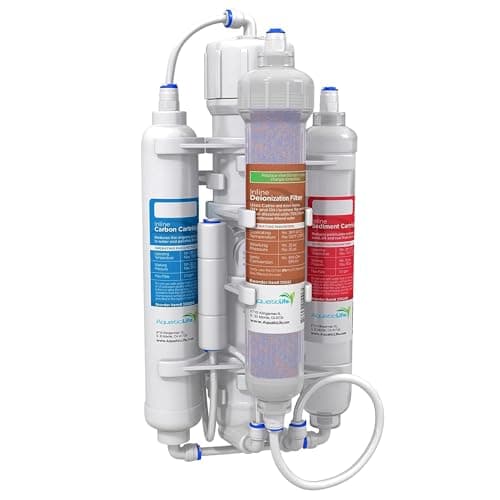 Aquatic Life RO Buddie 4-Stage RO/DI UnitThe deionization stage is the difference between 94% TDS removal and effectively zero. Not a drinking-water system. Aquatic Life RO Buddie 4-Stage RO/DI UnitThe deionization stage is the difference between 94% TDS removal and effectively zero. Not a drinking-water system. | Best for a reef tank | $69.99 - View on Amazon #ad Price as of October 17, 2026. We may earn a commission. Disclosure. |
| 2 | 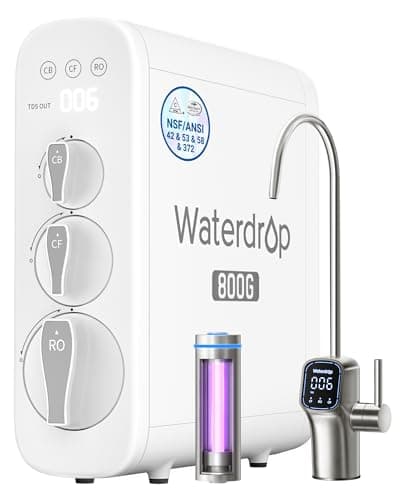 Waterdrop G3P800 Tankless Reverse Osmosis SystemCertified for drinking and efficient enough to fill buckets — tee off before any remineralizing stage. Waterdrop G3P800 Tankless Reverse Osmosis SystemCertified for drinking and efficient enough to fill buckets — tee off before any remineralizing stage. | Best if it has to do both jobs | $759.00 - View on Amazon $999.00 — 24% off #ad Price as of October 17, 2026. We may earn a commission. Disclosure. |
| 3 | 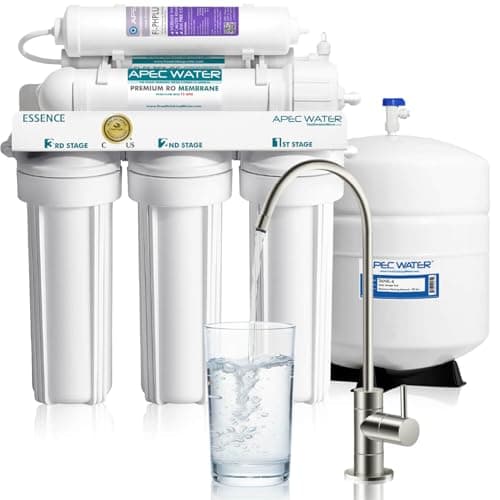 APEC ROES-PH75 Essence 6-Stage Alkaline RO SystemRuns on line pressure alone, so it can sit in a basement or a cabinet with no power. APEC ROES-PH75 Essence 6-Stage Alkaline RO SystemRuns on line pressure alone, so it can sit in a basement or a cabinet with no power. | If you have no outlet near the tank | $189.99 - View on Amazon $294.99 — 36% off #ad Price as of October 17, 2026. We may earn a commission. Disclosure. |
| 4 | 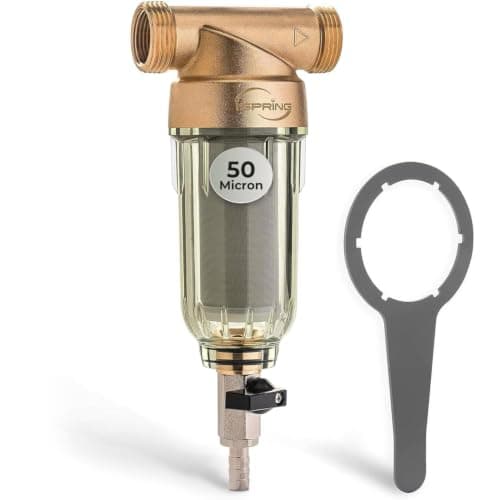 iSpring WSP-50 Spin-Down Sediment PrefilterA spin-down sediment prefilter is the cheapest way to stop a membrane dying early on well or old-pipe water. iSpring WSP-50 Spin-Down Sediment PrefilterA spin-down sediment prefilter is the cheapest way to stop a membrane dying early on well or old-pipe water. | Protect the membrane first | $56.89 - View on Amazon $59.99 — 5% off #ad Price as of October 17, 2026. We may earn a commission. Disclosure. |
The answer, and the number that qualifies it
Yes, a drinking-water reverse osmosis system makes water a tank can use. Whether it is good enough depends on the tank, and the deciding figure is one almost no product page prints.
Reverse osmosis is a high-rejection membrane process, not a zero-solids process. Take the IAPMO performance data sheet for the AquaTru Carafe as a public worked example: against a 750 mg/L TDS challenge, the certified reduction is a minimum of 94.5% and an average of 94.4%, to a permissible product water concentration of 22 mg/L. Certified under-sink systems sit in the same band — the iSpring RCC7AK, for instance, is certified at 97.2% TDS removal.
For drinking water that is excellent. For a reef tank it is the gap that matters. Starting from 300 mg/L tap water, a 95% membrane leaves you around 15 mg/L — and the fraction that passes a membrane preferentially includes the small ions, which is to say the nitrate, phosphate and silicate that feed nuisance algae.
That is the whole case for the fourth stage, and it is why aquarium units are sold as RO/DI rather than RO.
What the DI stage is doing
Deionization is a different mechanism from filtration, which is why it catches what the membrane misses.
A mixed-bed resin exchanges the remaining dissolved ions for hydrogen and hydroxide, which combine into water. It is not a sieve and it has no pore size: it is a chemical trade with a finite number of exchange sites. The Aquatic Life RO Buddie's four stages are sediment, carbon block, the TFC membrane and the deionization cartridge, and retailers describe the division of labor the same way — the membrane removes most of the dissolved solids and the mixed-bed resin takes out the remainder.
Two consequences follow, and both are practical rather than theoretical.
DI resin has no rated gallon figure, and cannot have one. Its life depends entirely on how much the membrane left for it to do. On soft municipal water a cartridge may last for months; on hard water behind a tired membrane it can exhaust in a fortnight. This is why the color-changing resin on the RO Buddie is a genuine feature rather than decoration — it is the only honest indicator available.
The order is load-bearing. DI goes last, after the membrane has removed 94% or more of the work. Put resin in front of a membrane and you will spend a cartridge a week.
Chloramine: the thing that quietly wrecks this setup
This is the failure mode that catches people who did everything else right, and it has nothing to do with the membrane.
Chloramine is harmful to fish for a mechanical reason rather than a toxicological one. The City of High Point's water utility explains that chloramines must be removed from water for fish, amphibians and reptiles because they bind to iron in red blood cell hemoglobin, reducing oxygen delivery. Tampa Bay Water makes the same point: fish absorb monochloramine through their gills, so it has to be removed just as chlorine does.
The trap is that the habits which work for chlorine do not work for chloramine. Letting water stand does not help, and neither does aeration or boiling — chloramine is deliberately more stable than free chlorine, which is why utilities adopted it. A standard 5-micron carbon block in a budget RO/DI unit is not a chloramine filter either; it was specified for chlorine.
What that costs you is resin. Chloramine passes the carbon stage, passes the membrane largely intact, and is then consumed by the DI bed — so the symptom is a DI cartridge that exhausts far faster than it should, and the diagnosis is usually wrong for weeks.
The fixes, in order of how much work they are: find out what your utility doses, which it is required to tell you and which your annual water quality report already states; fit a catalytic carbon prefilter rather than a standard carbon block, which is the stage actually designed for chloramine; and treat with a conditioner that handles ammonia as well as chlorine, since chloramine breaks down into both. The chlorine roundup covers the catalytic carbon distinction in detail.
Freshwater, planted and reef need different answers
"Do I need RO water" has three honest answers depending on what is in the tank, and the hobby tends to give the strictest one to everybody.
| Tank | Does it need RO? | Does it need DI? | Why |
|---|---|---|---|
| Community freshwater, hardy species | No | No | Dechlorinated tap water is fine, and the minerals are useful |
| Soft-water or wild-caught species | Often | Rarely | You need to reach a low hardness target, not zero solids |
| Planted / high-tech | Usually | Sometimes | You dose fertiliser to a target, so a known blank matters |
| Shrimp | Usually | Often | Remineralised to a precise GH/KH from a blank |
| Reef / saltwater | Yes | Yes | Salt mix assumes zero-TDS water; silicate and phosphate drive algae |
The pattern is that the further right you go, the more the point is a reproducible starting point rather than purity for its own sake. A reef keeper is not trying to give fish ultra-pure water; they are trying to make this week's parameters match last week's, and that only works if the water you add salt to is the same every time.
Which also explains the skip box above. A remineralizing stage adds an uncontrolled mineral load back, destroying exactly the property you bought the system for.
If you already have a drinking-water system
This is the cheapest route into tank water and most people miss it, so it is worth spelling out.
A plumbed under-sink system already produces the 94%-plus water above. For a freshwater, planted or shrimp tank, that is very likely all you need — fill buckets from the filtered tap and dose to your target from there. You have bought nothing.
Two cautions. If your system has a remineralizing or alkaline stage, tee off before it, not after. And watch the production rate: an 800 GPD tankless system fills buckets at a reasonable pace, while a 75 GPD tank system refills slowly and you will empty the tank before a water change is done. The roundup's format comparison covers which is which.
For a reef tank, add the deionization stage rather than replacing the system. A dedicated RO/DI unit is cheap enough that running both is usually the right answer anyway — the drinking system stays certified for the kitchen and the tank unit never shares a cartridge schedule with it.
Two honesty notes about aquarium RO/DI units
Since this site judges products on their paperwork, the aquarium tier has to be marked differently and it would be dishonest not to say so.
First, these units carry no NSF/ANSI certification of any kind, and none is expected — they are aquarium equipment, not drinking water treatment units. Every figure on one, including the 50 GPD rating, is a manufacturer specification rather than a certified claim. On this site that normally counts heavily against a product. Here it is simply the state of the category.
Second, the corollary: do not drink from one. Deionised water is the wrong product for a kitchen tap, the unit has no certification to rely on, and the resin is not formulated for it. Keep the certified system for people and the RO/DI for the tank.
The 50 GPD figure also deserves the usual caveat: it is a laboratory number at around 65 PSI and 77 degrees. Cold feed water in February produces materially less, which is true of every membrane and catches every new owner once.
The cost-per-gallon math
The arithmetic here is about water changes rather than drinking water, so the volumes are much larger and the cost per gallon matters more than it does in a kitchen.
Work from your change schedule. A 75-gallon reef tank on a 10% weekly change is 7.5 gallons a week, or about 390 gallons a year, plus evaporation top-off which on a reef can easily match it. Call it 600 to 800 gallons a year of RO/DI water.
Against that, price the three consumables separately: sediment and carbon prefilters on a published interval, the membrane on its rated life, and the DI resin on nothing at all — resin is the variable, and its cost is set by your feed water hardness rather than by the schedule. A household on hard water should expect resin to dominate the running cost.
Compare that honestly to buying RO water by the gallon from an aquarium shop, which is the alternative most people start with. At 600 gallons a year the unit pays for itself quickly; at 50 gallons a year for a single small tank it may never.
We do not print product prices in this text. The buy buttons carry the live figure and the date it was checked, which is the only price worth quoting.
We show the arithmetic rather than a verdict so you can redo it with the price you actually pay. Filter prices move; the rated capacities above do not.
The picks in full
Best for a reef tank
Aquatic Life RO Buddie 4-Stage RO/DI Unit
Aquatic Life
The cheapest honest way to get zero-TDS water for a tank. The fourth stage is the reason it exists: a drinking-water reverse osmosis system reduces dissolved solids by around 94%, and a mixed-bed resin takes out the rest.
Certification status
No NSF/ANSI certification listing, and none is expected — this is aquarium equipment rather than a drinking water treatment unit. Aquatic Life publishes a four-stage configuration (sediment cartridge, carbon block, deionization cartridge and TFC membrane) rated at 50 GPD, with the color-changing resin indicating exhaustion. Treat the figures as manufacturer specifications, not certified claims, and do not use it as a drinking water system.
Published specifications
| Format | 4-stage RO/DI, hang-on or under-cabinet |
|---|---|
| Stages | Sediment, carbon block, TFC membrane, DI resin |
| Rated output | 50 GPD |
| DI indication | Color-changing mixed-bed resin |
| Certified standards | None — aquarium equipment |
What we like
- The deionization stage is what gets output to effectively zero TDS, which a drinking-water RO does not do
- Color-changing resin makes exhaustion visible rather than a guess
- Cheapest route to tank water that will not drive nuisance algae from phosphate and silicate
- Compact enough to hang beside a sump or sit in a cabinet
What we do not
- The standard carbon block is not a chloramine filter, and chloramine destroys DI resin quickly
- DI resin is a consumable with no rated gallon figure — life depends entirely on your feed water
- 50 GPD is a laboratory figure at 65 PSI and 77 degrees; cold winter feed water produces far less
- No certification of any kind, so nothing on it is independently verified
Skip it if
Drinking water. It is not certified as a drinking water treatment unit, and the DI resin is the wrong technology for a tap you drink from. Use a certified under-sink or countertop system for the kitchen and keep this on the tank.
#ad Price as of October 17, 2026. We may earn a commission. Disclosure.
Best if it has to do both jobs
Waterdrop G3P800 Tankless Reverse Osmosis System
Waterdrop
Tankless reverse osmosis that gives back the cupboard a pressure tank would eat, fills a glass without the pause, and sends markedly less water down the drain than a classic tank system.
Certification status
Certified to NSF/ANSI 42 for chlorine reduction, NSF/ANSI 53 and 58 for TDS, fluoride, cadmium, hexavalent chromium and selenium, and NSF/ANSI 372 for lead-free materials.
Published specifications
| Output | 800 GPD |
|---|---|
| Pure-to-drain ratio | 3:1 |
| Format | Tankless — no pressure tank |
| Certified standards | NSF/ANSI 42, 53, 58, 372 |
| Installation | Two holes: smart LED faucet and drain |
| Faucet | Included, with TDS display |
What we like
- No pressure tank, so it fits cabinets a tank system cannot
- 3:1 pure-to-drain is far better than the ratio typical of older reverse osmosis
- 800 GPD means no waiting for a tank to refill
What we do not
- Needs a power outlet under the sink — a real constraint in older kitchens
- Proprietary filter cartridges, so you are tied to Waterdrop's pricing
- Requires drilling for the included faucet unless you have a spare hole
Skip it if
Renters, and anyone with no outlet under the sink. It is a permanent, powered installation — a countertop unit is the answer if you cannot commit to that.
$999.00 — 24% off
#ad Price as of October 17, 2026. We may earn a commission. Disclosure.
Where these specifications came from
If you have no outlet near the tank
APEC ROES-PH75 Essence 6-Stage Alkaline RO System
APEC Water Systems
A conventional tank system that uses ordinary 10-inch cartridges rather than proprietary pods, which keeps the ten-year running cost sane. The sixth stage puts minerals back for people who dislike RO's flat taste.
Certification status
WQA Gold Seal certified.
Published specifications
| Output | 75 GPD at 60 psi and 77 degrees F |
|---|---|
| Tank capacity | 4 gallons |
| Stages | 6, including a calcite remineralization stage |
| Feed pressure | 40-85 psi |
| Max feed TDS | 2,000 ppm |
| System dimensions | 15.5" L x 5.25" W x 17.5" H, plus a separate tank |
| Certification | WQA Gold Seal |
What we like
- Standard-size cartridges, so replacements are cheap and sourceable from many brands
- Calcite stage restores minerals and lifts the pH of reverse-osmosis water
- No electricity required
What we do not
- The 4-gallon tank plus housing takes most of an under-sink cabinet
- Slower than tankless systems, and it pauses while the tank refills
- Conventional wastewater ratio, well short of the G3P800's 3:1
Skip it if
Small cabinets. Measure before you buy — the tank alone is roughly 11 x 11 x 15 inches, and people discover this after delivery.
$294.99 — 36% off
#ad Price as of October 17, 2026. We may earn a commission. Disclosure.
Where these specifications came from
Protect the membrane first
iSpring WSP-50 Spin-Down Sediment Prefilter
iSpring
The only filter on this site with no consumable at all: a stainless mesh in a clear housing that you flush with a valve instead of replacing. On a well it protects every cartridge and membrane downstream, which is the entire argument for it.
Certification status
No NSF/ANSI performance certification, and none is applicable — this is a mechanical screen for suspended solids rather than a contaminant-reduction device. iSpring specifies a 316L food-grade stainless steel screen and a lead-free brass head. Treat it as plumbing hardware, not as treatment.
Published specifications
| Filtration | 50 micron stainless steel mesh screen |
|---|---|
| Screen material | 316L food-grade stainless steel |
| Head material | Lead-free brass |
| Ports | 1" MNPT and 3/4" FNPT on both ends |
| Housing | Transparent, so the load is visible without opening it |
| Consumable | None — the screen is flushed and reused |
| Maintenance | Open the flush valve; frequency depends on sediment load |
What we like
- No cartridge to buy, ever — you flush the screen and reuse it
- The clear housing makes maintenance something you can see rather than schedule blindly
- Protects softeners, carbon tanks, cartridges and RO membranes downstream, which is where the money is
What we do not
- 50 micron is coarse: it catches grit and rust flakes, not fine silt or turbidity
- It is a prefilter, not a treatment — it reduces no contaminant of any kind
- Needs a spot in the line with room underneath for the flush valve and a drain or bucket
- Requires actual maintenance; a neglected screen becomes a pressure restriction
Skip it if
Anyone on clean municipal water with no downstream equipment to protect. There is nothing for it to catch, and an unserviced housing is worse than no housing.
$59.99 — 5% off
#ad Price as of October 17, 2026. We may earn a commission. Disclosure.
Where these specifications came from
Questions people actually ask
Can I use a drinking-water reverse osmosis system for my aquarium?
Yes, for freshwater, planted and shrimp tanks. Certified drinking-water systems are rated to remove about 94% to 97% of dissolved solids — one IAPMO listing shows a 94.5% minimum from a 750 mg/L challenge — which is a good blank to dose from. A reef tank wants effectively zero, so it needs a deionization stage after the membrane. The one thing to avoid is a system with a remineralizing stage, which adds minerals back.
What is the difference between RO and RO/DI?
The DI stage. Reverse osmosis pushes water through a membrane and rejects most dissolved solids; deionization uses a mixed-bed resin to exchange the remaining ions for hydrogen and hydroxide, which combine into water. The membrane does roughly 94% or more of the work and the resin takes out what is left. DI always goes last, because resin placed ahead of a membrane exhausts almost immediately.
Does reverse osmosis remove chloramine for a fish tank?
Not reliably, and this is the most common hidden failure. Chloramine is deliberately more stable than free chlorine, so it is not removed by standing, aeration or boiling, and a standard carbon block prefilter was specified for chlorine rather than chloramine. It passes through to the DI bed and consumes resin, so the symptom is a DI cartridge exhausting far too fast. Fit a catalytic carbon prefilter, and check what your utility actually doses.
Why is chloramine harmful to fish?
Because of what it does in the blood. The City of High Point's utility explains that chloramines bind to iron in red blood cell hemoglobin, reducing oxygen delivery, and that they must be removed from water for fish, amphibians and reptiles. Tampa Bay Water notes that fish absorb monochloramine through their gills, so it needs removing just as chlorine does.
Should I buy a remineralizing RO system for my tank?
No. A remineralizing or alkaline stage adds calcium and magnesium back after the membrane, which is the opposite of what a tank needs — the point of RO water is a known blank you then dose a salt mix or fertiliser into. An uncontrolled mineral load added back makes your parameters unreproducible. If you already own one, tee off upstream of the remineralizing stage.
Can I drink water from an aquarium RO/DI unit?
No. Aquarium RO/DI units carry no NSF/ANSI certification of any kind, which is normal for the category but means nothing on them is independently verified, and deionized water is not what a kitchen tap should deliver. Keep a certified system for drinking water and the RO/DI unit for the tank.
How long does DI resin last?
There is no rated figure, and there cannot be one. Resin life depends entirely on how much the membrane left behind, so it varies from months on soft municipal water to a fortnight on hard water behind a worn membrane. This is why color-changing resin is a real feature: it is the only honest exhaustion indicator available. A rising TDS reading on the output is the other.