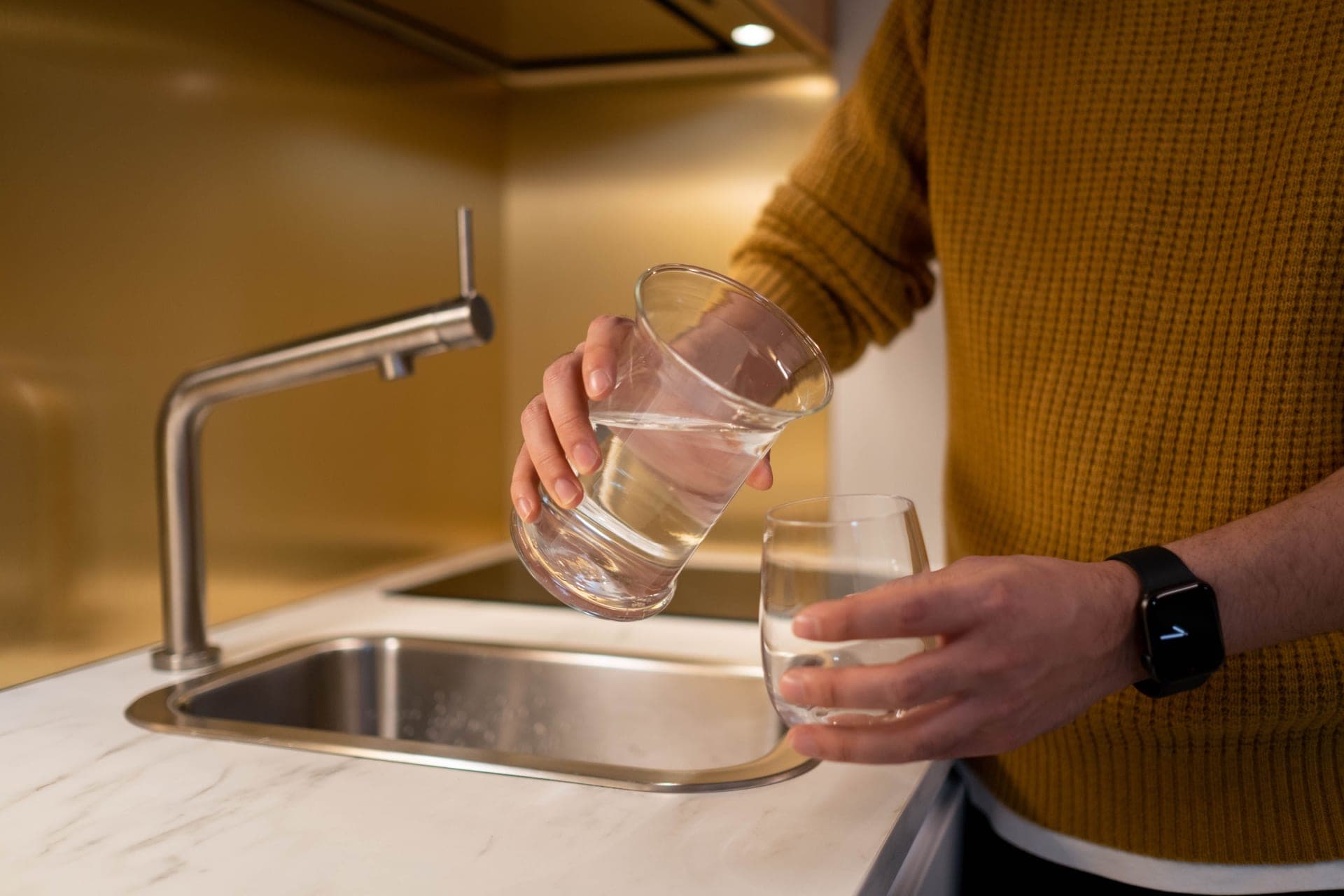
A sediment prefilter removes sand, silt, rust and scale before they reach anything expensive. The two formats are a flushable spin-down screen, which has no consumable at all, and a cartridge filter, which goes finer. On a well you usually want both, staged coarse to fine.
Quick picks
Tap any row to jump to the full write-up. The button goes straight to the retailer.
| # | Product | Best for | Price |
|---|---|---|---|
| 1 | 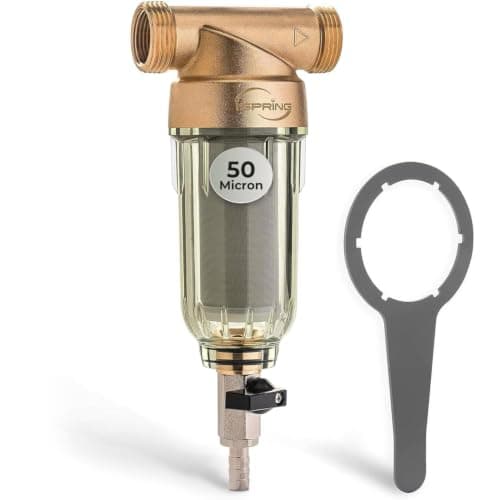 iSpring WSP-50 Spin-Down Sediment Prefilter50-micron stainless screen in a clear housing, flushed with a valve rather than replaced. iSpring WSP-50 Spin-Down Sediment Prefilter50-micron stainless screen in a clear housing, flushed with a valve rather than replaced. | Best overall | $50.97 - View on Amazon $59.99 — 15% off #ad Price as of October 6, 2026. We may earn a commission. Disclosure. |
| 2 | 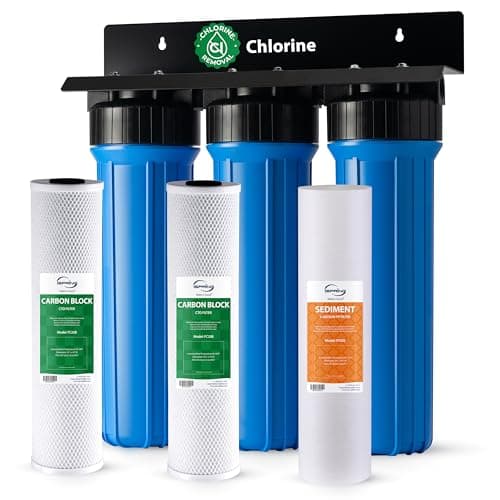 iSpring WGB32B 3-Stage Whole-House FilterThree 20-inch stages, so sediment and carbon live in the same housing bank. iSpring WGB32B 3-Stage Whole-House FilterThree 20-inch stages, so sediment and carbon live in the same housing bank. | Best cartridge system | $359.10 - View on Amazon $516.99 — 31% off #ad Price as of October 6, 2026. We may earn a commission. Disclosure. |
| 3 | 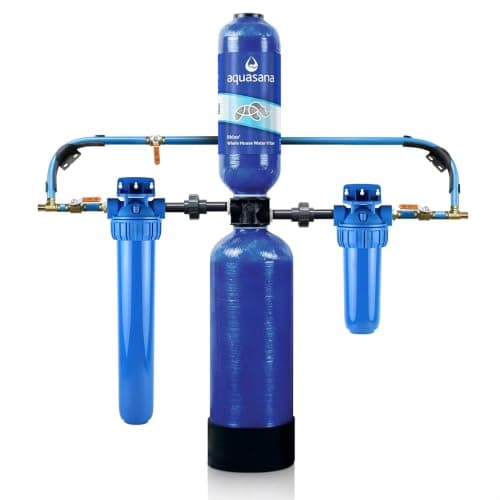 Aquasana Rhino EQ-1000 Whole-House FilterShips with a 20-inch pre-filter and a post-filter as part of the standard system. Aquasana Rhino EQ-1000 Whole-House FilterShips with a 20-inch pre-filter and a post-filter as part of the standard system. | Best with it built in | $939.55 - View on Amazon $1,123.00 — 16% off #ad Price as of October 6, 2026. We may earn a commission. Disclosure. |
| 4 | Sno photoSpringWell CF1 Whole-House Carbon FilterFour-stage design with 5-micron sediment filtration ahead of the carbon bed. | Best integrated on city water | Sold direct by SpringWell Water. No affiliate link, so nothing to click and nothing for us to earn. The maker's page is in the sources below. Disclosure. |
What sediment is, and what it costs you
Sediment is anything solid the water is carrying: sand and silt from a well, rust flakes from an aging main or your own galvanized pipe, scale shed from a water heater, or fines stirred up after a main break. None of it is a health contaminant in the usual sense. It is a mechanical problem, and mechanical problems are expensive in a different way.
- It blinds every filter downstream. A carbon block loaded with silt has not exhausted its carbon — it has simply clogged, months before its rated capacity.
- It shortens membranes. Reverse osmosis pre-filters exist to stop exactly this, and on dirty feed water they are the consumable that dominates the running cost.
- It eats valves and appliances. Grit lodges in cartridge valves, toilet fill valves, faucet aerators and softener control heads.
- It is the cheapest thing to fix. Which is the entire argument for this page.
Spin-down or cartridge
| Spin-down screen | Cartridge filter | |
|---|---|---|
| How it works | Stainless mesh in a clear housing; water spins, solids drop out | Pleated or spun media traps particles through its depth |
| Typical rating | 50 micron and coarser | 1 to 20 micron |
| Consumable | None — you flush it | A cartridge, on a schedule |
| Maintenance | Open a valve; seconds | Shut off water, open housing, swap, refill |
| Best at | Sand, grit, rust flakes, protecting everything after it | Fine silt and turbidity that a screen passes |
| Where it belongs | First, right after the pressure tank or meter | After the spin-down, before carbon or softening |
The two are complements rather than alternatives. A spin-down screen catches the coarse material that would otherwise destroy a cartridge in a fortnight; the cartridge then does the fine work with a workload it can survive. On a clean municipal supply a single cartridge stage is usually enough. On a well carrying visible grit, running a cartridge without a screen in front of it is how people end up changing filters monthly.
Micron ratings, and staging them properly
A micron rating is the particle size a filter is designed to catch. Lower is finer, and finer is not automatically better — a 1-micron cartridge on gritty water clogs almost immediately and costs you pressure everywhere in the house.
| Rating | Catches | Use it as |
|---|---|---|
| 100-50 micron | Sand, grit, rust flakes, scale chips | The first stage on a well, flushable |
| 20-25 micron | Coarse silt | A second stage on very dirty water |
| 5 micron | Fine silt, turbidity, most visible cloudiness | The standard stage before carbon or RO |
| 1 micron | Very fine particulate, some cysts | Only where the water is already clean, or the target needs it |
Stage them coarse to fine, in that order. Each stage removes the load that would have shortened the next one, and the total cost of ownership falls even though there are more components. Reversing the order — fine first — is a common and expensive mistake.
For reference on what the fine end is for: a conventional municipal plant is required to hold turbidity at or below 0.3 NTU in 95% of samples, so city water arriving at your meter is already clear. If yours is not, the cloudy water page is the faster diagnosis.
Where it goes in the line
Order matters as much as specification. On a private well:
- Pressure tank
- Spin-down screen — coarse, flushable
- Any oxidizing or iron system
- Cartridge sediment stage — 5 micron
- Softener, if hardness requires it
- Carbon, whole-house
- Under-sink reverse osmosis at the drinking tap
On municipal water, drop steps one and three, and the sequence is simply sediment, then softening if needed, then carbon. The principle is unchanging: physical removal before chemical treatment, cheap consumables before expensive ones.
Two plumbing details people learn the hard way. Fit a bypass so the house can have water while you service the filter, and fit shutoff valves on both sides of the housing. Neither is expensive at installation and both are miserable to retrofit.
Knowing when to service it
Sediment filters do not announce themselves. The signals are a gradual pressure drop, a visibly loaded screen, or a change in how long the shower takes to run hot.
A clear housing is worth paying for on the first stage precisely because it turns maintenance into something you can see. Flush a spin-down whenever the housing looks loaded — weekly on a dirty well, monthly or less on clean water. Cartridges are best judged on a pressure gauge before and after the housing: a growing differential is the honest replacement signal, and it beats any calendar.
The failure mode to avoid is the forgotten cartridge. A loaded sediment filter left in place for a year is a pressure restriction and a stagnant surface, which is why the skip-block above exists: this is a component to fit deliberately and service, not to fit and forget.
Systems with sediment stages built in
Several whole-house systems include the sediment stage rather than expecting you to fit one. Aquasana's Rhino ships with a 20-inch pre-filter and a post-filter as part of the standard package. SpringWell's CF1 describes 5-micron sediment filtration as one of its four stages ahead of the carbon bed. The iSpring WGB32B is three 20-inch cartridge stages in one bank, which is the same idea in cartridge form at a much lower purchase price.
If you are choosing between those, the sediment stage is rarely the deciding factor — the whole-house roundup compares them on the things that do decide it, and the Aquasana versus SpringWell comparison takes the two tank systems head to head.
The cost-per-gallon math
This is the one component on the site whose value is measured in what it saves rather than what it does.
A flushable spin-down screen has no consumable: you buy it once and clean the mesh. Every cartridge downstream of it then runs closer to its rated capacity instead of clogging early, and on a gritty well that difference can be a factor of several.
Work it out with your own numbers. Count what you currently spend a year on carbon cartridges and RO pre-filters, then estimate how much of that is being consumed by particulate rather than by the contaminant the filter was bought for. On clean municipal water the answer is often none, and you should not fit one. On a well it is frequently most of it.
We show the arithmetic rather than a verdict so you can redo it with the price you actually pay. Filter prices move; the rated capacities above do not.
The picks in full
Best overall
iSpring WSP-50 Spin-Down Sediment Prefilter
iSpring
The only filter on this site with no consumable at all: a stainless mesh in a clear housing that you flush with a valve instead of replacing. On a well it protects every cartridge and membrane downstream, which is the entire argument for it.
Certification status
No NSF/ANSI performance certification, and none is applicable — this is a mechanical screen for suspended solids rather than a contaminant-reduction device. iSpring specifies a 316L food-grade stainless steel screen and a lead-free brass head. Treat it as plumbing hardware, not as treatment.
Published specifications
| Filtration | 50 micron stainless steel mesh screen |
|---|---|
| Screen material | 316L food-grade stainless steel |
| Head material | Lead-free brass |
| Ports | 1" MNPT and 3/4" FNPT on both ends |
| Housing | Transparent, so the load is visible without opening it |
| Consumable | None — the screen is flushed and reused |
| Maintenance | Open the flush valve; frequency depends on sediment load |
What we like
- No cartridge to buy, ever — you flush the screen and reuse it
- The clear housing makes maintenance something you can see rather than schedule blindly
- Protects softeners, carbon tanks, cartridges and RO membranes downstream, which is where the money is
What we do not
- 50 micron is coarse: it catches grit and rust flakes, not fine silt or turbidity
- It is a prefilter, not a treatment — it reduces no contaminant of any kind
- Needs a spot in the line with room underneath for the flush valve and a drain or bucket
- Requires actual maintenance; a neglected screen becomes a pressure restriction
Skip it if
Anyone on clean municipal water with no downstream equipment to protect. There is nothing for it to catch, and an unserviced housing is worse than no housing.
$59.99 — 15% off
#ad Price as of October 6, 2026. We may earn a commission. Disclosure.
Where these specifications came from
Best cartridge system
iSpring WGB32B 3-Stage Whole-House Filter
iSpring
A cartridge system rather than a tank system. It costs a fraction of a tank install and asks for a filter change roughly once a year in exchange.
Certification status
Uses standard 20 x 4.5 inch cartridges. Certification travels with the cartridge fitted rather than the housing — check the specific cartridge's listing for any health claim you intend to rely on.
Published specifications
| Cartridge size | 20" x 4.5", 3 stages |
|---|---|
| Peak flow | 15 gpm |
| Rated capacity | 100,000 gallons — typically about a year for a family of four |
| Working pressure | 25-80 psi |
| Operating temperature | 40-100 degrees F |
| Ports | 1" NPT |
What we like
- Far cheaper up front than any tank-based point-of-entry system
- Standard 20 x 4.5 inch cartridges, available from many manufacturers
- You can change the media mix by changing cartridges as your water changes
What we do not
- Annual cartridge changes, and they are heavy and messy
- Certification depends on the cartridge you fit, not the housing
- Cartridge capacity is a fraction of a tank system's million gallons
Skip it if
Anyone who wants to install a system and forget it. A tank system is the right answer if an annual cartridge change is not realistically going to happen.
$516.99 — 31% off
#ad Price as of October 6, 2026. We may earn a commission. Disclosure.
Where these specifications came from
Best with it built in
Aquasana Rhino EQ-1000 Whole-House Filter
Aquasana
A million-gallon point-of-entry filter for chlorinated municipal supply. It fixes the shower and the laundry as well as the kitchen tap, and it does not pretend to be a health-contaminant system.
Certification status
Certified by NSF International to NSF/ANSI 42, with the tank certified to NSF/ANSI 61 for material safety. NSF/ANSI 42 is an aesthetic-effects standard — taste, odor and chlorine — not a health-effects claim.
Published specifications
| Rated capacity | 1,000,000 gallons / up to 10 years |
|---|---|
| Rated flow | 7.0 gpm |
| Max operating pressure | 100 psi |
| Operating temperature | 40-90 degrees F |
| Dimensions | 46" L x 9" W x 44" H, 44.1 lb |
| Certified standards | NSF/ANSI 42; tank to NSF/ANSI 61 |
| Published chlorine reduction | Greater than 97% |
What we like
- Ten years or a million gallons before the main media is due — effectively no maintenance routine
- Treats every tap, so showers and laundry benefit, not just drinking water
- NSF/ANSI 61 material certification on the tank
What we do not
- NSF/ANSI 42 only — this is a chlorine and aesthetics system, not a lead or PFAS system
- Needs a main-line install, usually a plumber, and space where the water enters
- Does nothing for hardness
Skip it if
Anyone buying it to solve lead, PFAS or hard water. It is certified for aesthetic effects. Pair it with an under-sink system for drinking-water health contaminants, and a softener for hardness.
$1,123.00 — 16% off
#ad Price as of October 6, 2026. We may earn a commission. Disclosure.
Where these specifications came from
Best integrated on city water
SpringWell CF1 Whole-House Carbon Filter
SpringWell
Catalytic carbon and KDF rather than plain carbon, which is the meaningful difference on chloraminated supply. Sold direct rather than through Amazon, and we earn nothing when you buy it.
Certification status
SpringWell publishes its own media specifications rather than a system-level NSF certification listing for the CF1. Treat the contaminant list as manufacturer claim, not certified performance, and weigh it accordingly.
Published specifications
| Sizing | CF1 covers 1-3 bathrooms |
|---|---|
| Rated capacity | 1,000,000 gallons / about 10 years of media life |
| Service flow | 9 gpm |
| Tank | 9" diameter x 48" (52" with the head) |
| Connection size | 1" |
| Operating pressure | 25-80 psi |
| Media | 4-stage catalytic carbon and KDF |
| Warranty | Lifetime on tanks and valves |
What we like
- Catalytic carbon handles chloramine, which standard activated carbon struggles with
- Lifetime warranty on tanks and valves
- Works down to 25 psi, lower than most point-of-entry systems
What we do not
- No system-level NSF certification listing published — the contaminant list is manufacturer claim
- Direct-sale only; not reliably available on Amazon
- We earn no commission on this link, which is worth knowing when you read the recommendation
Skip it if
Well water. The CF1 is a city-water filter — a well with iron or sulfur needs an oxidizing system, not a carbon tank, and putting one in front of untreated well water fouls the media.
Sold direct by SpringWell Water. No affiliate link, so nothing to click and nothing for us to earn. The maker's page is in the sources below. Disclosure.
Where these specifications came from
Questions people actually ask
What micron sediment filter do I need?
Stage it: 50 micron and coarser as a flushable first screen on a well, 5 micron as the standard stage before carbon or reverse osmosis, and 1 micron only where the water is already clean or a specific target requires it. Fitting a fine cartridge first on gritty water clogs it almost immediately.
Is a spin-down filter better than a cartridge?
They do different jobs. A spin-down screen catches coarse material and has no consumable — you flush it with a valve. A cartridge goes far finer but has to be replaced. On a well you generally want the screen first and a cartridge behind it.
Where should a whole house sediment filter be installed?
As the first treatment stage after the pressure tank on a well, or after the meter and main shutoff on municipal water, and always before softening, carbon or reverse osmosis. Fit shutoff valves either side and a bypass, so servicing it does not mean turning off the house.
How often do you change a sediment filter?
By pressure differential rather than by calendar. A flushable screen gets flushed whenever the housing looks loaded — weekly on a dirty well, rarely on clean water. Cartridges are replaced when the pressure drop across the housing grows noticeably, which on a well can be months earlier than the box suggests.
Does a sediment filter remove chlorine or lead?
No. It is a mechanical filter for suspended solids. Chlorine and lead are jobs for carbon and for certified NSF/ANSI 53 media, which is why sediment filtration is a prefilter stage rather than a treatment on its own.