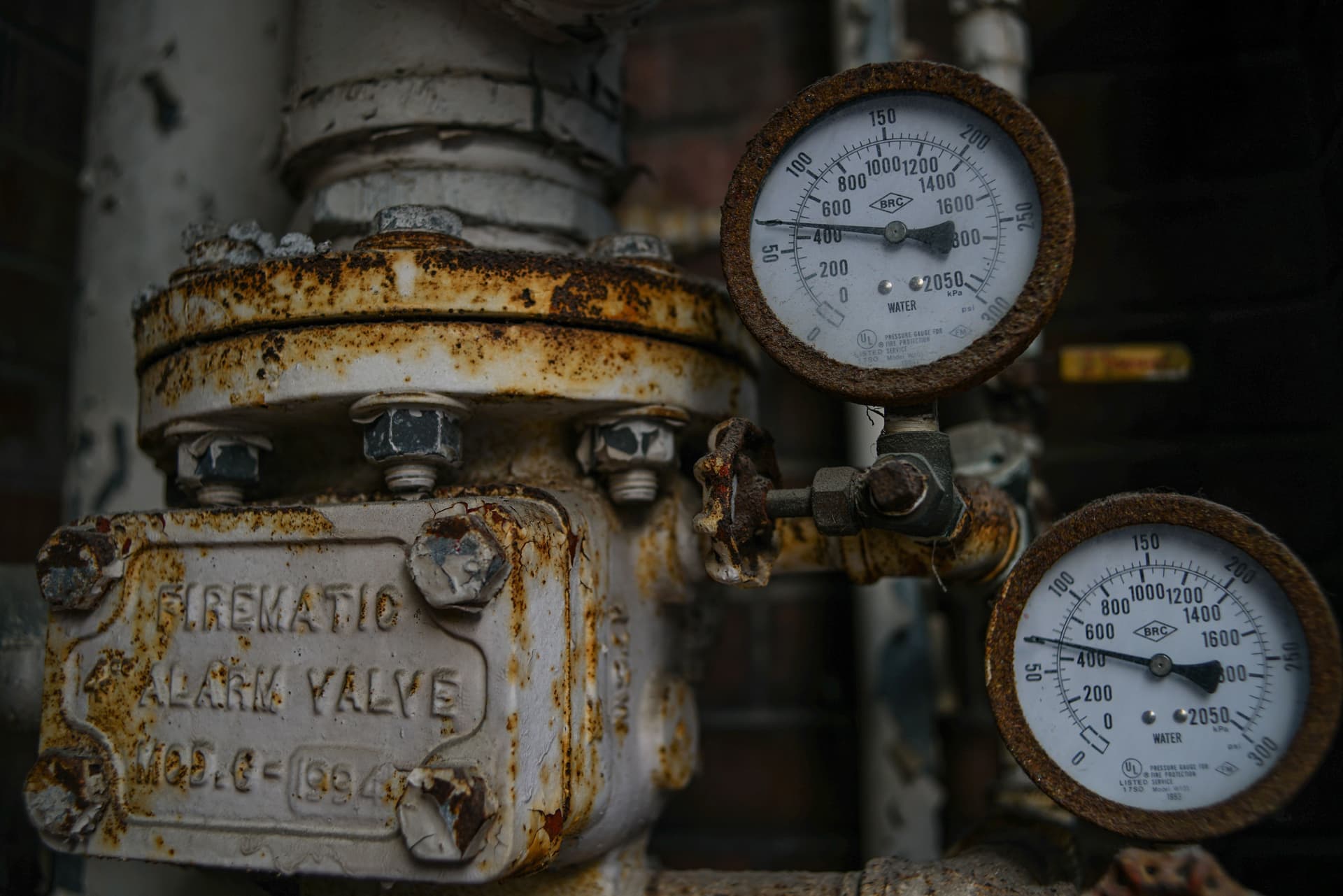
A metallic or blood-like taste is almost always iron, copper or manganese. Orange staining points at iron; blue-green staining points at copper leaching from your own pipes, usually because the water is acidic. The stain tells you which, and the fixes are completely different.
Quick picks
Tap any row to jump to the full write-up. The button goes straight to the retailer.
| # | Product | Best for | Price |
|---|---|---|---|
| 1 | Sno photoSpringWell WS1 Well Water Iron Filter (Air Injection)Air injection to 7 ppm iron plus 1 ppm manganese, with automatic backwash. | Best for well iron | Sold direct by SpringWell Water. No affiliate link, so nothing to click and nothing for us to earn. The maker's page is in the sources below. Disclosure. |
| 2 | 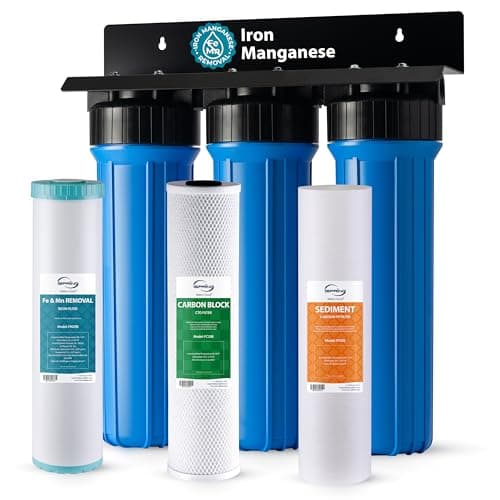 iSpring WGB32BM 3-Stage Iron & Manganese Whole-House FilterCartridge system with published iron and manganese ceilings you can test against. iSpring WGB32BM 3-Stage Iron & Manganese Whole-House FilterCartridge system with published iron and manganese ceilings you can test against. | Best under 3 ppm iron | $459.00 - View on Amazon $535.99 — 14% off #ad Price as of October 17, 2026. We may earn a commission. Disclosure. |
| 3 | 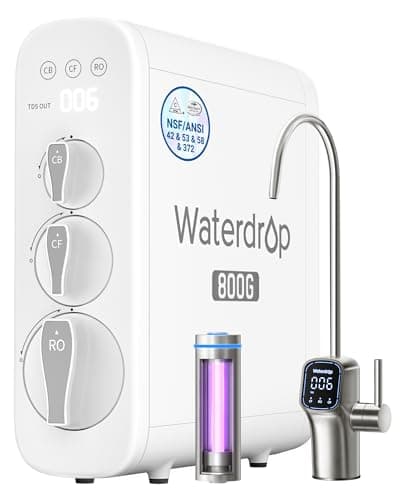 Waterdrop G3P800 Tankless Reverse Osmosis SystemReverse osmosis at one tap, when the metallic taste is all you want gone. Waterdrop G3P800 Tankless Reverse Osmosis SystemReverse osmosis at one tap, when the metallic taste is all you want gone. | Best for the drinking tap only | $759.00 - View on Amazon $999.00 — 24% off #ad Price as of October 17, 2026. We may earn a commission. Disclosure. |
Read the stain, not just the taste
Three metals produce a metallic taste and they leave different fingerprints. The staining in your fixtures is a better diagnostic than the taste, because taste perception varies wildly between people.
| Metal | Stain color | Where it comes from | What removes it |
|---|---|---|---|
| Iron | Orange, rust, reddish-brown | Groundwater, or corroding steel pipe | Point-of-entry oxidation and filtration |
| Manganese | Black, dark gray | Groundwater, frequently alongside iron | The same oxidizing systems, within their manganese limit |
| Copper | Blue-green, especially in tubs and around drains | Your own copper pipes, leaching because the water is acidic | Fix the pH first. A neutralizing filter, not an iron filter. |
The copper case is the one people misdiagnose. Blue-green staining means the water is dissolving your plumbing, which is a symptom of low pH. Installing an iron filter changes nothing, because the metal is not arriving in the supply — it is being picked up on the way to your tap. Test the pH. Below about 6.5 and the water is corrosive; a neutralizing filter is the fix, and it goes ahead of everything else.
The same mechanism has a more serious version. Acidic water leaches whatever your plumbing is made of, and in a house with older solder that can include lead. If you have blue-green staining and any chance of lead-bearing plumbing, test for lead as well as pH.
Clear water that turns orange in the glass
This is a genuinely useful observation. Iron comes in two forms:
- Ferrous ("clear water") iron is dissolved. The water looks clean from the tap and turns orange over the next few minutes as it oxidizes in air. If you have watched a glass go cloudy on the counter, that is ferrous iron.
- Ferric ("red water") iron is already an oxidized particle. The water is visibly discolored the moment it leaves the tap.
Ferrous iron needs oxidizing before it can be filtered. Ferric iron is already a particle and can be caught by filtration alone. Systems are rated for one or both, and buying the wrong one is a common and expensive mistake. Note that softeners can handle a limited amount of clear water iron as a side effect of ion exchange, but ferric iron fouls the resin.
Is iron in water bad for you?
The EPA classifies iron as a secondary contaminant — regulated for aesthetic reasons rather than health. The staining and the taste are the problem, not toxicity. Manganese is a different case: it has a health advisory level as well as a staining threshold, and the health threshold is low, so black staining is worth taking more seriously than orange.
Sizing the fix
Every iron system publishes a ppm ceiling and it is a hard limit rather than a suggestion. The air-injection route reaches 7 ppm iron; cartridge systems typically cap at 3 ppm, and one of them caps at 3 ppm combined across iron, manganese and sulfur — which means 2 ppm iron plus 2 ppm manganese is already over. Add your lab numbers together before deciding, not separately.
The picks in full
Best for well iron
SpringWell WS1 Well Water Iron Filter (Air Injection)
SpringWell
Air injection oxidation rather than chemical dosing: it draws in air, oxidizes iron and sulfide into particles, and backwashes them out. The published limits are unusually specific, which makes them easy to check against your own water test.
Certification status
SpringWell publishes performance limits by contaminant rather than a system NSF certification listing. Match those limits against your own lab test before buying — this is a system you size from data, not from a category.
Published specifications
| Iron | Up to 7 ppm |
|---|---|
| Hydrogen sulfide | Up to 8 ppm |
| Manganese | Up to 1 ppm |
| Service flow | 12 gpm |
| Process | Air injection oxidation, chemical-free |
| Regeneration | Automatic backwash |
| Warranty | Lifetime |
What we like
- Handles iron, sulfur and manganese in one system, which is the actual well-water problem set
- No chemical dosing and no chlorine tank to refill
- Published ppm limits you can check against a lab report before you buy
What we do not
- Needs a drain for backwash, which constrains where it can go
- Not sold through Amazon, so we earn nothing on this recommendation
- Does nothing for bacteria — that is a UV job
Skip it if
Anyone who has not tested their well. Buying an iron filter without a lab result is how people end up with a system rated for 7 ppm sitting on 12 ppm water, and it fails within months.
Sold direct by SpringWell Water. No affiliate link, so nothing to click and nothing for us to earn. The maker's page is in the sources below. Disclosure.
Where these specifications came from
Best under 3 ppm iron
iSpring WGB32BM 3-Stage Iron & Manganese Whole-House Filter
iSpring
A cartridge answer to a problem usually solved with a tank. It works inside its published limits and fails outside them, so the lab result decides whether this is the right purchase or wasted money.
Certification status
Published performance figures rather than a system certification listing. The stated limits are the buying criteria.
Published specifications
| Iron | Max 3.0 ppm, reduced to 0.01 ppm |
|---|---|
| Manganese | Max 1.0 ppm, reduced to 0.01 ppm |
| Rated capacity | 100,000 gallons; 50,000 gallons at 3.0 ppm iron |
| Peak flow | 15 gpm |
| Working pressure | 25-80 psi |
| pH range | 6-11 |
| Cartridge size | 20" x 4.5", 3 stages |
What we like
- Far cheaper than a backwashing iron tank
- No drain connection required — a real advantage in a finished basement
- Explicit iron and manganese ceilings you can test against
What we do not
- Hard 3.0 ppm iron ceiling; above it the cartridges blind off quickly
- Capacity halves at the top of the iron range
- Cartridge changes are heavy, wet work
Skip it if
Wells above 3 ppm iron, and any well whose main complaint is a rotten-egg smell. Hydrogen sulfide needs oxidation, not a cartridge.
$535.99 — 14% off
#ad Price as of October 17, 2026. We may earn a commission. Disclosure.
Where these specifications came from
Best for the drinking tap only
Waterdrop G3P800 Tankless Reverse Osmosis System
Waterdrop
Tankless reverse osmosis that gives back the cupboard a pressure tank would eat, fills a glass without the pause, and sends markedly less water down the drain than a classic tank system.
Certification status
Certified to NSF/ANSI 42 for chlorine reduction, NSF/ANSI 53 and 58 for TDS, fluoride, cadmium, hexavalent chromium and selenium, and NSF/ANSI 372 for lead-free materials.
Published specifications
| Output | 800 GPD |
|---|---|
| Pure-to-drain ratio | 3:1 |
| Format | Tankless — no pressure tank |
| Certified standards | NSF/ANSI 42, 53, 58, 372 |
| Installation | Two holes: smart LED faucet and drain |
| Faucet | Included, with TDS display |
What we like
- No pressure tank, so it fits cabinets a tank system cannot
- 3:1 pure-to-drain is far better than the ratio typical of older reverse osmosis
- 800 GPD means no waiting for a tank to refill
What we do not
- Needs a power outlet under the sink — a real constraint in older kitchens
- Proprietary filter cartridges, so you are tied to Waterdrop's pricing
- Requires drilling for the included faucet unless you have a spare hole
Skip it if
Renters, and anyone with no outlet under the sink. It is a permanent, powered installation — a countertop unit is the answer if you cannot commit to that.
$999.00 — 24% off
#ad Price as of October 17, 2026. We may earn a commission. Disclosure.
Where these specifications came from
Questions people actually ask
Is it safe to drink water that tastes metallic?
Iron is regulated by the EPA as a secondary, aesthetic contaminant, so the taste and the staining are the complaint rather than toxicity. Manganese and copper both carry actual health guidance, and lead — which is tasteless — travels by the same corrosion mechanism as copper. If you have blue-green staining, test rather than assume.
Why is the taste worse in the morning?
Water sitting still in the pipes overnight has hours of contact time to pick up metal from the pipe walls. If a thirty-second flush clears it, the metal is coming from your plumbing rather than the supply, and that changes the fix entirely.
Will a water softener remove iron?
It removes a limited amount of dissolved ferrous iron as a side effect, and manufacturers publish that limit — the Whirlpool WHES40E is rated to 10 ppm clear-water iron, for example. Oxidized ferric iron fouls softener resin instead. Above the published limit, iron gets removed before the softener, not by it.
Can reverse osmosis fix a metallic taste?
At the drinking tap, yes — RO removes dissolved metals effectively. It does nothing for staining in your tubs, showers and laundry, because it treats one tap. If the staining is the complaint, you need point-of-entry treatment; if only the drinking taste bothers you, RO is enough.