
The HMF3SdgFeC is a three-stage cartridge system rated to 3 ppm combined across iron, manganese and sulfur, at 15 gpm and under 1 psi pressure drop. It needs no drain connection, which is why it exists in basements where a backwashing tank cannot go.
Quick picks
Tap any row to jump to the full write-up. The button goes straight to the retailer.
| # | Product | Best for | Price |
|---|---|---|---|
| 1 | 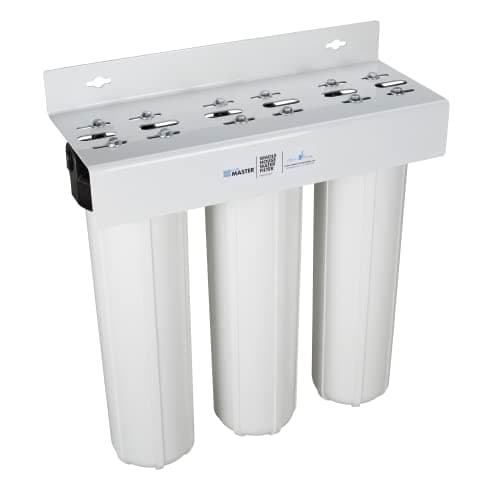 Home Master HMF3SdgFeC 3-Stage Well Water Filter3 ppm combined, 15 gpm, under 1 psi drop, works down to 20 psi feed. Home Master HMF3SdgFeC 3-Stage Well Water Filter3 ppm combined, 15 gpm, under 1 psi drop, works down to 20 psi feed. | The system reviewed here | $503.85 - View on Amazon #ad Price as of October 17, 2026. We may earn a commission. Disclosure. |
| 2 | Sno photoSpringWell WS1 Well Water Iron Filter (Air Injection)Air injection to 7 ppm iron and 8 ppm sulfide, with a drain requirement. | If you are above 3 ppm | Sold direct by SpringWell Water. No affiliate link, so nothing to click and nothing for us to earn. The maker's page is in the sources below. Disclosure. |
| 3 | 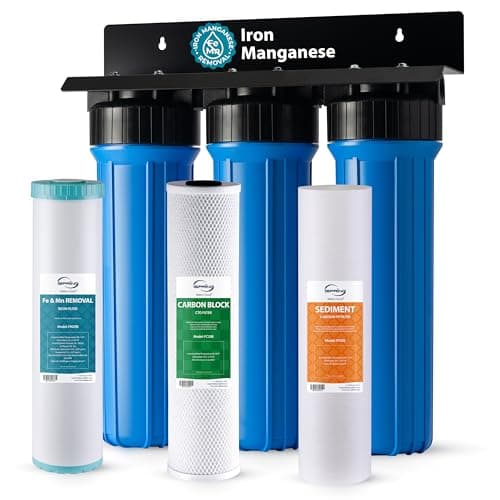 iSpring WGB32BM 3-Stage Iron & Manganese Whole-House FilterSeparate 3.0 ppm iron and 1.0 ppm manganese ceilings rather than a combined one. iSpring WGB32BM 3-Stage Iron & Manganese Whole-House FilterSeparate 3.0 ppm iron and 1.0 ppm manganese ceilings rather than a combined one. | If iron is the only problem | $459.00 - View on Amazon $535.99 — 14% off #ad Price as of October 17, 2026. We may earn a commission. Disclosure. |
The combined limit, first, because it decides everything
The HMF3SdgFeC is rated to 3 ppm combined across iron, manganese and sulfur. Not 3 ppm each. Combined.
A well testing 2 ppm iron and 2 ppm manganese is at 4 ppm combined and outside the specification, even though each individual number looks comfortable. This is the most common misreading in the well-water category, and it is why we lead with it.
Add your lab numbers together first. If the total is over 3, you are looking at air injection instead.
What it does unusually well
Pressure. Cartridge systems have a deserved reputation for killing well water pressure. This one uses radial-flow media — water moves through the bed sideways rather than end to end, presenting far more surface area to the flow — and publishes a pressure drop under 1 psi on the iron stage.
It also works down to 20 psi feed pressure, lower than most competitors. On an older well with a marginal pressure tank, that is the difference between a system that works and one that makes the shower unusable.
The sediment stage. Stage one is a four-layer graded depth filter at 25, 10, 5 and 1 micron. Graded layers catch large particles in the outer layer and progressively finer ones deeper in, so the cartridge loads evenly instead of blinding at the surface. Wells deliver real grit, and this is the stage that keeps the rest of the system alive.
Specifications
| Specification | Published figure |
|---|---|
| Iron + manganese + sulfur | Up to 3 ppm COMBINED |
| Max filtered flow | 15 gpm |
| Feed pressure | 20-90 psi |
| Feed temperature | 40-100 degrees F |
| Rated capacity | 100,000 gallons |
| Stage 1 | 4-layer sediment: 25 / 10 / 5 / 1 micron |
| Stage 2 | Radial-flow iron reduction, under 1 psi pressure drop |
| Stage 3 | Radial-flow granular activated coconut-shell carbon |
No drain, which is the reason to choose it
Backwashing systems must send their flush water somewhere. In a finished basement with no nearby drain, plumbing one is a real project — and that single constraint is what pushes many well owners toward cartridges.
This system needs no drain, no power and no salt. It hangs on a wall and filters. What it asks instead is that you change three cartridges roughly annually, and they are heavy and wet when you do.
The honest ceiling
At the top of its range this system is working hard, and capacity reflects that. Cartridge-based iron reduction always trades capacity against concentration — the media loads faster on harder work. If your combined figure is at 2.8 ppm, expect the lower end of the rated life and budget for more frequent changes.
If it is at 1.2 ppm, this is a comfortable, cheap and quiet system that will do exactly what it says for a decade.
The cost-per-gallon math
Three cartridges, roughly annually, for as long as you own the house.
Price a full set locally and multiply by ten. Add the purchase price. Then compare against an air-injection system's purchase price plus essentially nothing — no consumables at all.
On a well at 1 ppm combined, this system is cheaper on that ten-year view and simpler to install. On a well at 3 ppm combined, the changes come faster, the totals converge, and the air-injection system starts to look like the better purchase — with the drain requirement as the deciding practical question.
We show the arithmetic rather than a verdict so you can redo it with the price you actually pay. Filter prices move; the rated capacities above do not.
The picks in full
The system reviewed here
Home Master HMF3SdgFeC 3-Stage Well Water Filter
Home Master
Radial-flow media in oversized housings, built specifically to avoid the pressure loss that makes most cartridge systems miserable on a well. The published limit is combined, not per contaminant, which is the detail people miss.
Certification status
Published performance figures rather than a system certification listing. The 3 ppm ceiling is combined across iron, manganese and sulfur.
Published specifications
| Iron + manganese + sulfur | Up to 3 ppm COMBINED |
|---|---|
| Max filtered flow | 15 gpm |
| Feed pressure | 20-90 psi |
| Feed temperature | 40-100 degrees F |
| Rated capacity | 100,000 gallons |
| Stage 1 | 4-layer sediment, 25 / 10 / 5 / 1 micron |
| Stage 2 | Radial-flow iron reduction, under 1 psi pressure drop |
| Stage 3 | Radial-flow coconut-shell granular carbon |
What we like
- Radial flow keeps pressure drop under 1 psi — the usual complaint about cartridge systems, addressed
- Graded 4-layer sediment stage handles the grit a well actually delivers
- Works down to 20 psi feed pressure, lower than most competitors
What we do not
- 3 ppm is a COMBINED ceiling, so 2 ppm iron plus 2 ppm manganese is already over it
- No bacteria treatment
- Cartridge changes on a well are messier than on city water
Skip it if
Wells whose combined iron, manganese and sulfur exceeds 3 ppm. Add your lab numbers together before you decide, not separately.
#ad Price as of October 17, 2026. We may earn a commission. Disclosure.
Where these specifications came from
If you are above 3 ppm
SpringWell WS1 Well Water Iron Filter (Air Injection)
SpringWell
Air injection oxidation rather than chemical dosing: it draws in air, oxidizes iron and sulfide into particles, and backwashes them out. The published limits are unusually specific, which makes them easy to check against your own water test.
Certification status
SpringWell publishes performance limits by contaminant rather than a system NSF certification listing. Match those limits against your own lab test before buying — this is a system you size from data, not from a category.
Published specifications
| Iron | Up to 7 ppm |
|---|---|
| Hydrogen sulfide | Up to 8 ppm |
| Manganese | Up to 1 ppm |
| Service flow | 12 gpm |
| Process | Air injection oxidation, chemical-free |
| Regeneration | Automatic backwash |
| Warranty | Lifetime |
What we like
- Handles iron, sulfur and manganese in one system, which is the actual well-water problem set
- No chemical dosing and no chlorine tank to refill
- Published ppm limits you can check against a lab report before you buy
What we do not
- Needs a drain for backwash, which constrains where it can go
- Not sold through Amazon, so we earn nothing on this recommendation
- Does nothing for bacteria — that is a UV job
Skip it if
Anyone who has not tested their well. Buying an iron filter without a lab result is how people end up with a system rated for 7 ppm sitting on 12 ppm water, and it fails within months.
Sold direct by SpringWell Water. No affiliate link, so nothing to click and nothing for us to earn. The maker's page is in the sources below. Disclosure.
Where these specifications came from
If iron is the only problem
iSpring WGB32BM 3-Stage Iron & Manganese Whole-House Filter
iSpring
A cartridge answer to a problem usually solved with a tank. It works inside its published limits and fails outside them, so the lab result decides whether this is the right purchase or wasted money.
Certification status
Published performance figures rather than a system certification listing. The stated limits are the buying criteria.
Published specifications
| Iron | Max 3.0 ppm, reduced to 0.01 ppm |
|---|---|
| Manganese | Max 1.0 ppm, reduced to 0.01 ppm |
| Rated capacity | 100,000 gallons; 50,000 gallons at 3.0 ppm iron |
| Peak flow | 15 gpm |
| Working pressure | 25-80 psi |
| pH range | 6-11 |
| Cartridge size | 20" x 4.5", 3 stages |
What we like
- Far cheaper than a backwashing iron tank
- No drain connection required — a real advantage in a finished basement
- Explicit iron and manganese ceilings you can test against
What we do not
- Hard 3.0 ppm iron ceiling; above it the cartridges blind off quickly
- Capacity halves at the top of the iron range
- Cartridge changes are heavy, wet work
Skip it if
Wells above 3 ppm iron, and any well whose main complaint is a rotten-egg smell. Hydrogen sulfide needs oxidation, not a cartridge.
$535.99 — 14% off
#ad Price as of October 17, 2026. We may earn a commission. Disclosure.
Where these specifications came from
Questions people actually ask
Is the 3 ppm limit per contaminant or combined?
Combined, across iron, manganese and sulfur together. This is the specification people most often misread. Add your lab numbers before deciding — 2 ppm iron plus 2 ppm manganese is already over the ceiling.
Will it reduce my water pressure?
Very little, by design. The radial-flow media publishes under 1 psi pressure drop on the iron stage, and the system works down to 20 psi feed pressure. That is the main technical advantage of this design over conventional axial-flow cartridges.
Does it need a drain or electricity?
Neither. It is passive cartridge filtration — no backwash, no valve, no power. That is exactly why it exists: for basements where plumbing a backwash drain is impractical.
How often do the cartridges need changing?
About annually for a family of four, and sooner as the combined concentration approaches the 3 ppm ceiling. Falling water pressure is the practical signal, and by the time you notice it the cartridges are well loaded.