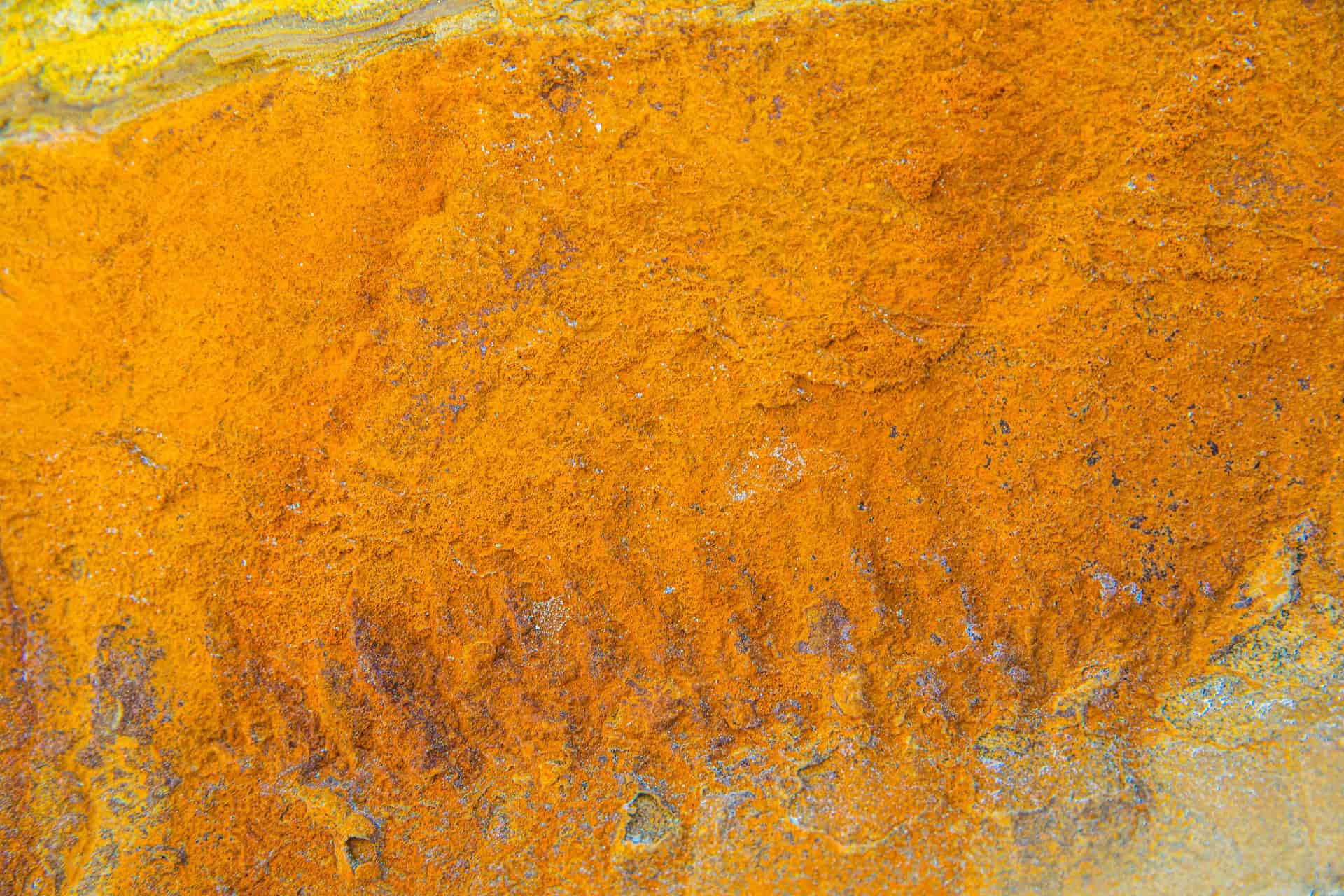
Well iron comes in two forms needing different treatment, and iron bacteria is a third problem that looks similar and responds to neither. pH decides whether oxidation works at all, which is why an iron filter on acidic water underperforms in ways that look like a defect.
Quick picks
Tap any row to jump to the full write-up. The button goes straight to the retailer.
| # | Product | Best for | Price |
|---|---|---|---|
| 1 | Sno photoSpringWell WS1 Well Water Iron Filter (Air Injection)Handles ferrous iron, sulfide and manganese together by oxidation. | Best overall | Sold direct by SpringWell Water. No affiliate link, so nothing to click and nothing for us to earn. The maker's page is in the sources below. Disclosure. |
| 2 | 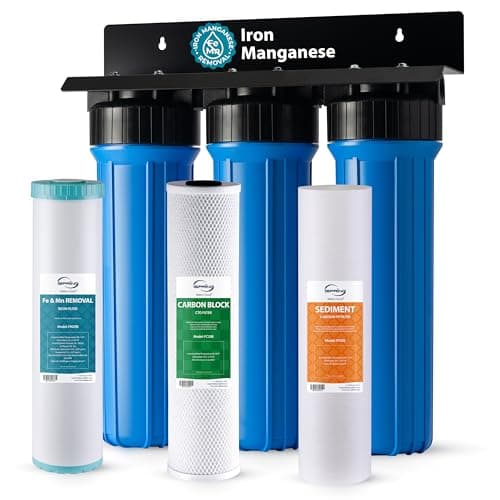 iSpring WGB32BM 3-Stage Iron & Manganese Whole-House FilterCartridge filtration with separate 3.0 ppm iron and 1.0 ppm manganese ceilings. iSpring WGB32BM 3-Stage Iron & Manganese Whole-House FilterCartridge filtration with separate 3.0 ppm iron and 1.0 ppm manganese ceilings. | Best for ferric iron | $459.00 - View on Amazon $535.99 — 14% off #ad Price as of October 17, 2026. We may earn a commission. Disclosure. |
| 3 | 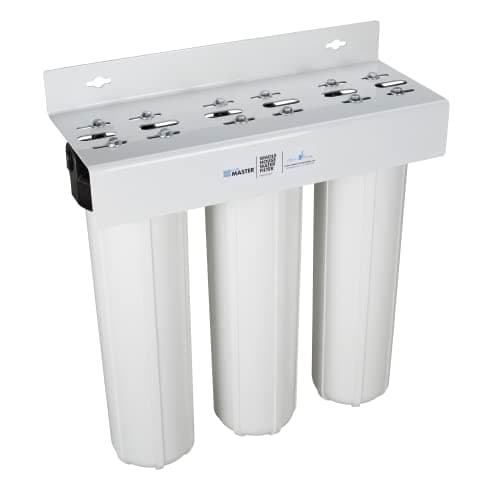 Home Master HMF3SdgFeC 3-Stage Well Water FilterRadial flow, under 1 psi drop, works down to 20 psi feed pressure. Home Master HMF3SdgFeC 3-Stage Well Water FilterRadial flow, under 1 psi drop, works down to 20 psi feed pressure. | Best when pressure matters | $503.85 - View on Amazon #ad Price as of October 17, 2026. We may earn a commission. Disclosure. |
Three problems, one orange stain
Well owners describe the same symptom and have different problems underneath it. Sorting them out costs nothing and determines what to buy.
| What you observe | What it is | What treats it |
|---|---|---|
| Clear from the tap, orange after five minutes | Ferrous (clear water) iron, dissolved | Oxidation, then filtration |
| Orange the moment it leaves the tap | Ferric (red water) iron, already a particle | Filtration alone can catch it |
| Reddish-brown slime, rainbow sheen on standing water | Iron bacteria | Shock chlorination. Filters do not remove it. |
| Black staining rather than orange | Manganese | The same oxidizing systems, within their manganese limit |
| Rotten-egg smell on both hot and cold | Hydrogen sulfide in the supply | Oxidation at the point of entry |
| Rotten-egg smell on hot only | Water-heater anode rod reacting with sulfate | Replace the magnesium rod with aluminum-zinc |
Iron bacteria: the one filters cannot fix
Iron bacteria metabolize iron and produce a gelatinous reddish-brown mass that clogs pipes, pumps, pressure tanks and filters. They are not a health hazard and they are a serious nuisance, and no iron filter removes them — they are organisms, not a dissolved contaminant.
Shock chlorination of the well is the treatment: a strong chlorine solution introduced into the well, circulated through the entire plumbing system, left to work, then flushed out. Recolonization is common, so this may need repeating.
The reason it matters here is that installing an expensive iron filter on a well with iron bacteria produces a fouled filter and no improvement. Look for the slime before you spend.
pH decides whether treatment works
Oxidation chemistry is pH-dependent. Below roughly 6.8, iron oxidizes slowly and incompletely, and an air-injection system installed on acidic water underperforms in a way that looks exactly like a defective product.
If your pH is below 6.8, a neutralizing filter goes first. Low pH is also worth treating in its own right, because acidic water dissolves copper and, in older plumbing, lead. Blue-green staining is the visible sign.
The sequence
- Sediment — grit
- Neutralizer — if pH is below about 6.8
- Oxidation and filtration — iron, manganese, sulfide
- Softener — hardness, after iron removal because iron fouls resin
- UV — bacteria, last, because it needs clear water
Choosing a system from your numbers
Once the diagnosis is done, the purchase is arithmetic. Air injection reaches 7 ppm iron and 8 ppm sulfide; cartridge systems cap around 3 ppm, and one caps at 3 ppm combined across all three contaminants. Full comparison in the well systems roundup.
The cost-per-gallon math
The expensive mistake here is not a wrong brand, it is a wrong diagnosis.
An iron filter installed on a well with iron bacteria delivers nothing and fouls. A treatment system on acidic water underperforms and gets blamed. A whole-house system bought for a rotten-egg smell that turns out to be a water-heater anode rod is a four-figure purchase replacing a part costing a few tens of dollars.
All three are prevented by diagnostics that cost nothing but attention: the glass test, the hot-versus-cold smell test, a look in the toilet cistern, and a pH reading. Do those before you price anything.
We show the arithmetic rather than a verdict so you can redo it with the price you actually pay. Filter prices move; the rated capacities above do not.
The picks in full
Best overall
SpringWell WS1 Well Water Iron Filter (Air Injection)
SpringWell
Air injection oxidation rather than chemical dosing: it draws in air, oxidizes iron and sulfide into particles, and backwashes them out. The published limits are unusually specific, which makes them easy to check against your own water test.
Certification status
SpringWell publishes performance limits by contaminant rather than a system NSF certification listing. Match those limits against your own lab test before buying — this is a system you size from data, not from a category.
Published specifications
| Iron | Up to 7 ppm |
|---|---|
| Hydrogen sulfide | Up to 8 ppm |
| Manganese | Up to 1 ppm |
| Service flow | 12 gpm |
| Process | Air injection oxidation, chemical-free |
| Regeneration | Automatic backwash |
| Warranty | Lifetime |
What we like
- Handles iron, sulfur and manganese in one system, which is the actual well-water problem set
- No chemical dosing and no chlorine tank to refill
- Published ppm limits you can check against a lab report before you buy
What we do not
- Needs a drain for backwash, which constrains where it can go
- Not sold through Amazon, so we earn nothing on this recommendation
- Does nothing for bacteria — that is a UV job
Skip it if
Anyone who has not tested their well. Buying an iron filter without a lab result is how people end up with a system rated for 7 ppm sitting on 12 ppm water, and it fails within months.
Sold direct by SpringWell Water. No affiliate link, so nothing to click and nothing for us to earn. The maker's page is in the sources below. Disclosure.
Where these specifications came from
Best for ferric iron
iSpring WGB32BM 3-Stage Iron & Manganese Whole-House Filter
iSpring
A cartridge answer to a problem usually solved with a tank. It works inside its published limits and fails outside them, so the lab result decides whether this is the right purchase or wasted money.
Certification status
Published performance figures rather than a system certification listing. The stated limits are the buying criteria.
Published specifications
| Iron | Max 3.0 ppm, reduced to 0.01 ppm |
|---|---|
| Manganese | Max 1.0 ppm, reduced to 0.01 ppm |
| Rated capacity | 100,000 gallons; 50,000 gallons at 3.0 ppm iron |
| Peak flow | 15 gpm |
| Working pressure | 25-80 psi |
| pH range | 6-11 |
| Cartridge size | 20" x 4.5", 3 stages |
What we like
- Far cheaper than a backwashing iron tank
- No drain connection required — a real advantage in a finished basement
- Explicit iron and manganese ceilings you can test against
What we do not
- Hard 3.0 ppm iron ceiling; above it the cartridges blind off quickly
- Capacity halves at the top of the iron range
- Cartridge changes are heavy, wet work
Skip it if
Wells above 3 ppm iron, and any well whose main complaint is a rotten-egg smell. Hydrogen sulfide needs oxidation, not a cartridge.
$535.99 — 14% off
#ad Price as of October 17, 2026. We may earn a commission. Disclosure.
Where these specifications came from
Best when pressure matters
Home Master HMF3SdgFeC 3-Stage Well Water Filter
Home Master
Radial-flow media in oversized housings, built specifically to avoid the pressure loss that makes most cartridge systems miserable on a well. The published limit is combined, not per contaminant, which is the detail people miss.
Certification status
Published performance figures rather than a system certification listing. The 3 ppm ceiling is combined across iron, manganese and sulfur.
Published specifications
| Iron + manganese + sulfur | Up to 3 ppm COMBINED |
|---|---|
| Max filtered flow | 15 gpm |
| Feed pressure | 20-90 psi |
| Feed temperature | 40-100 degrees F |
| Rated capacity | 100,000 gallons |
| Stage 1 | 4-layer sediment, 25 / 10 / 5 / 1 micron |
| Stage 2 | Radial-flow iron reduction, under 1 psi pressure drop |
| Stage 3 | Radial-flow coconut-shell granular carbon |
What we like
- Radial flow keeps pressure drop under 1 psi — the usual complaint about cartridge systems, addressed
- Graded 4-layer sediment stage handles the grit a well actually delivers
- Works down to 20 psi feed pressure, lower than most competitors
What we do not
- 3 ppm is a COMBINED ceiling, so 2 ppm iron plus 2 ppm manganese is already over it
- No bacteria treatment
- Cartridge changes on a well are messier than on city water
Skip it if
Wells whose combined iron, manganese and sulfur exceeds 3 ppm. Add your lab numbers together before you decide, not separately.
#ad Price as of October 17, 2026. We may earn a commission. Disclosure.
Where these specifications came from
Questions people actually ask
What is the difference between ferrous and ferric iron?
Ferrous iron is dissolved and invisible until it meets air, at which point it oxidizes and turns the water orange. Ferric iron is already an oxidized particle and discolors the water immediately. Ferrous needs oxidizing before it can be filtered; ferric can be caught by filtration alone.
Will a water softener remove iron from my well?
A limited amount of dissolved ferrous iron, as a side effect of ion exchange, up to a published limit. Ferric iron fouls the resin instead. Above that limit, iron gets removed before the softener rather than by it.
How do I know if I have iron bacteria?
Look for a reddish-brown slime in the toilet cistern or the pressure tank, and a rainbow sheen on standing water. It is a distinctly different appearance from clean orange staining, and it responds to shock chlorination rather than filtration.
Why does my iron filter not seem to be working?
Three usual causes: your iron is above the system's published ceiling, your pH is below about 6.8 so oxidation is incomplete, or you have iron bacteria rather than dissolved iron. All three are diagnosable before you buy, which is the argument for testing first.