
That rotten-egg smell is hydrogen sulfide. Run the hot and cold taps separately before spending anything: hot-only means your water heater's anode rod is reacting, which is a cheap part. Cold or both means the gas is in your supply, and only oxidation removes it.
Quick picks
Tap any row to jump to the full write-up. The button goes straight to the retailer.
| # | Product | Best for | Price |
|---|---|---|---|
| 1 | Sno photoSpringWell WS1 Well Water Iron Filter (Air Injection)Rated to 8 ppm hydrogen sulfide by air injection, with no chemical dosing. | Highest sulfide ceiling | Sold direct by SpringWell Water. No affiliate link, so nothing to click and nothing for us to earn. The maker's page is in the sources below. Disclosure. |
| 2 | 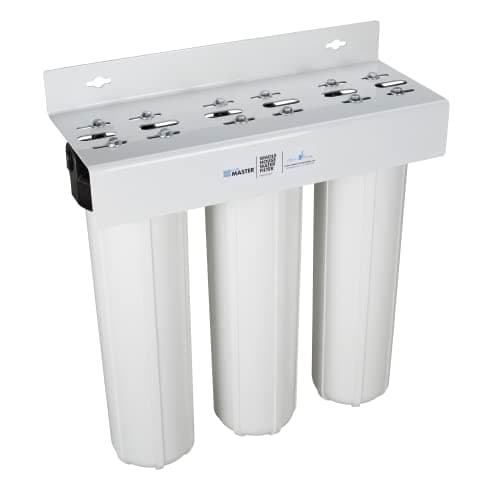 Home Master HMF3SdgFeC 3-Stage Well Water FilterCartridge system for mild cases, with under 1 psi of pressure drop. Home Master HMF3SdgFeC 3-Stage Well Water FilterCartridge system for mild cases, with under 1 psi of pressure drop. | Best under 3 ppm combined | $503.85 - View on Amazon #ad Price as of October 17, 2026. We may earn a commission. Disclosure. |
What it is
Hydrogen sulfide, a dissolved gas. Your nose is extraordinarily sensitive to it — detectable well below any level that matters for health — which is why the smell can be overwhelming while the concentration is genuinely low. It is a nuisance contaminant, not an emergency, though it is corrosive to plumbing and it does tarnish silverware and darken copper over time.
It arrives from one of three places, and they need different fixes:
- The aquifer. Sulfate-reducing bacteria living in groundwater produce it naturally. Common on wells, essentially absent on chlorinated municipal supply.
- Your water heater. The magnesium sacrificial anode rod reacts with sulfate in the water and generates sulfide inside the tank. This is why the smell can be hot-side only.
- Bacterial growth in the well or the plumbing itself, often after a period of low use.
The diagnostic that decides everything
| What you smell | What it means | What to do |
|---|---|---|
| Hot water only | Water-heater anode rod reacting with sulfate | Replace the magnesium rod with aluminum-zinc. Tens of dollars. |
| Cold and hot both | Hydrogen sulfide in the supply itself | Test, then a point-of-entry oxidizing system |
| Cold only | Sulfide in the supply; the heater is stripping it | Same as above — treat at the point of entry |
| One fixture only | Bacterial growth in that fixture, its line, or the drain | Clean the aerator and the drain first — the smell is often the drain, not the water |
| Only after the house sat empty | Stagnation and bacterial growth in the plumbing | Flush thoroughly; if it returns, shock chlorinate the well |
Why a pitcher will not help
This comes up constantly, so plainly: no pitcher filter removes hydrogen sulfide. Activated carbon adsorbs a small amount and saturates almost immediately at any meaningful concentration. Beyond that, the smell is at its worst in the shower, where a pitcher is irrelevant by definition. If your complaint is a rotten-egg smell, the pitcher tier is not your answer and you should not spend money there.
What does work is oxidation — converting the dissolved gas into a solid particle that can then be filtered out:
- Air injection oxidation. The system draws in an air pocket, the water passes through it, sulfide oxidizes, and the media bed catches the particles and backwashes them to drain. No chemicals, no refilling anything. This is the mainstream answer for wells.
- Chemical injection — chlorine or peroxide dosed ahead of a contact tank and a filter. More capable at very high concentrations, more to maintain.
- Manganese greensand, which requires periodic potassium permanganate regeneration.
Test before you size
Sulfide concentration is the number that sizes the system, and it degrades in transit, so it needs either a field test or a lab kit with the correct preservative. A system rated to 8 ppm is an excellent purchase at 4 ppm and a disappointment at 15. Iron and manganese almost always travel with sulfide on a well, so test for all three at once — how to test a well properly.
The picks in full
Highest sulfide ceiling
SpringWell WS1 Well Water Iron Filter (Air Injection)
SpringWell
Air injection oxidation rather than chemical dosing: it draws in air, oxidizes iron and sulfide into particles, and backwashes them out. The published limits are unusually specific, which makes them easy to check against your own water test.
Certification status
SpringWell publishes performance limits by contaminant rather than a system NSF certification listing. Match those limits against your own lab test before buying — this is a system you size from data, not from a category.
Published specifications
| Iron | Up to 7 ppm |
|---|---|
| Hydrogen sulfide | Up to 8 ppm |
| Manganese | Up to 1 ppm |
| Service flow | 12 gpm |
| Process | Air injection oxidation, chemical-free |
| Regeneration | Automatic backwash |
| Warranty | Lifetime |
What we like
- Handles iron, sulfur and manganese in one system, which is the actual well-water problem set
- No chemical dosing and no chlorine tank to refill
- Published ppm limits you can check against a lab report before you buy
What we do not
- Needs a drain for backwash, which constrains where it can go
- Not sold through Amazon, so we earn nothing on this recommendation
- Does nothing for bacteria — that is a UV job
Skip it if
Anyone who has not tested their well. Buying an iron filter without a lab result is how people end up with a system rated for 7 ppm sitting on 12 ppm water, and it fails within months.
Sold direct by SpringWell Water. No affiliate link, so nothing to click and nothing for us to earn. The maker's page is in the sources below. Disclosure.
Where these specifications came from
Best under 3 ppm combined
Home Master HMF3SdgFeC 3-Stage Well Water Filter
Home Master
Radial-flow media in oversized housings, built specifically to avoid the pressure loss that makes most cartridge systems miserable on a well. The published limit is combined, not per contaminant, which is the detail people miss.
Certification status
Published performance figures rather than a system certification listing. The 3 ppm ceiling is combined across iron, manganese and sulfur.
Published specifications
| Iron + manganese + sulfur | Up to 3 ppm COMBINED |
|---|---|
| Max filtered flow | 15 gpm |
| Feed pressure | 20-90 psi |
| Feed temperature | 40-100 degrees F |
| Rated capacity | 100,000 gallons |
| Stage 1 | 4-layer sediment, 25 / 10 / 5 / 1 micron |
| Stage 2 | Radial-flow iron reduction, under 1 psi pressure drop |
| Stage 3 | Radial-flow coconut-shell granular carbon |
What we like
- Radial flow keeps pressure drop under 1 psi — the usual complaint about cartridge systems, addressed
- Graded 4-layer sediment stage handles the grit a well actually delivers
- Works down to 20 psi feed pressure, lower than most competitors
What we do not
- 3 ppm is a COMBINED ceiling, so 2 ppm iron plus 2 ppm manganese is already over it
- No bacteria treatment
- Cartridge changes on a well are messier than on city water
Skip it if
Wells whose combined iron, manganese and sulfur exceeds 3 ppm. Add your lab numbers together before you decide, not separately.
#ad Price as of October 17, 2026. We may earn a commission. Disclosure.
Where these specifications came from
Questions people actually ask
Is sulfur water safe to drink?
At the concentrations where you can smell it, hydrogen sulfide is generally a nuisance rather than a health hazard — your nose detects it far below any level of concern. It is corrosive to plumbing and it tarnishes metal. The bigger concern is what else is in an untreated well alongside it, which is why testing matters more than the smell itself.
Why does the smell only happen when the water first comes on?
Gas accumulates in the pipe or the heater while the water sits still, then arrives all at once when you open the tap. If thirty seconds of running clears it, the sulfide is being generated in stagnant water in your own system rather than arriving continuously from the source.
Will a water softener remove the sulfur smell?
No. Ion exchange targets calcium and magnesium; it does not remove a dissolved gas. Worse, sulfide fouls softener resin, so treatment goes before the softener in the sequence, never after it.
Can I just shock chlorinate the well and be done?
Shock chlorination kills the sulfate-reducing bacteria and usually clears the smell for a while. If the bacteria recolonize, which they often do, the smell returns in weeks to months. It is a legitimate first step and a poor permanent solution.