Uranium in well water is a dissolved metal from bedrock, so carbon filters and boiling do nothing for it. EPA names ion exchange, reverse osmosis, lime softening and coagulation/filtration as best available technology, and point-of-use reverse osmosis is the household answer. The limit is 30 micrograms per liter.
Quick picks
Tap any row to jump to the full write-up. The button goes straight to the retailer.
| # | Product | Best for | Price |
|---|---|---|---|
| 1 | 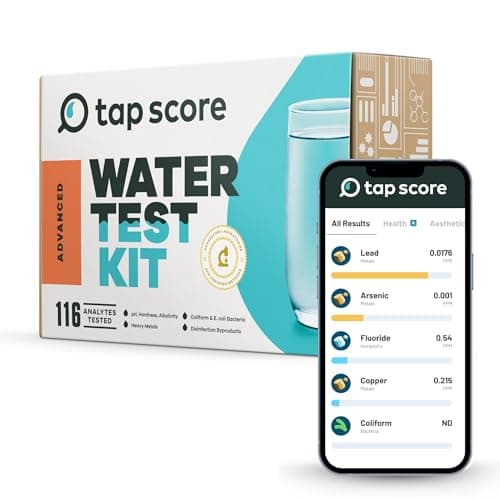 Tap Score Advanced Water Test (SimpleLab)Uranium has no taste, color or smell. A laboratory number is the only way to know it is there. Tap Score Advanced Water Test (SimpleLab)Uranium has no taste, color or smell. A laboratory number is the only way to know it is there. | Buy this first | $215.20 - View on Amazon $269.00 — 20% off #ad Price as of October 6, 2026. We may earn a commission. Disclosure. |
| 2 | 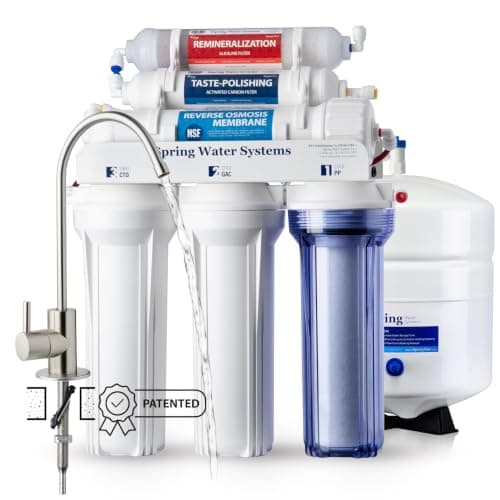 iSpring RCC7AK 6-Stage Reverse Osmosis SystemNSF/ANSI 58 certified reverse osmosis with the WQA Gold Seal and 97.2% certified TDS removal. iSpring RCC7AK 6-Stage Reverse Osmosis SystemNSF/ANSI 58 certified reverse osmosis with the WQA Gold Seal and 97.2% certified TDS removal. | Best overall | $198.75 - View on Amazon $234.99 — 15% off #ad Price as of October 6, 2026. We may earn a commission. Disclosure. |
| 3 | 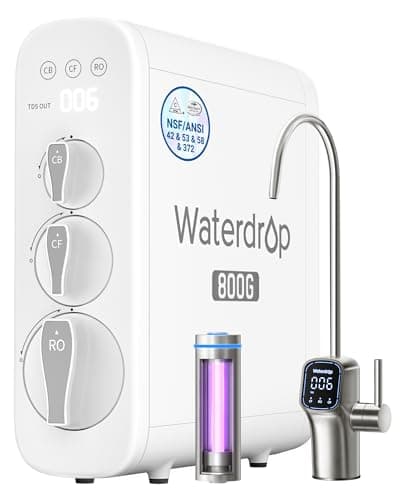 Waterdrop G3P800 Tankless Reverse Osmosis System800 GPD tankless RO certified to NSF/ANSI 42, 53, 58 and 372, at a published 3:1 pure-to-drain ratio. Waterdrop G3P800 Tankless Reverse Osmosis System800 GPD tankless RO certified to NSF/ANSI 42, 53, 58 and 372, at a published 3:1 pure-to-drain ratio. | Best for a busy household | $699.00 - View on Amazon $999.00 — 30% off #ad Price as of October 6, 2026. We may earn a commission. Disclosure. |
| 4 | 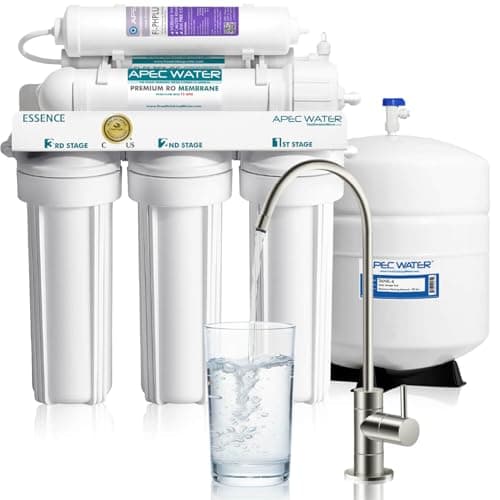 APEC ROES-PH75 Essence 6-Stage Alkaline RO SystemTank system on standard 10-inch cartridges, WQA Gold Seal, and nothing to plug in. APEC ROES-PH75 Essence 6-Stage Alkaline RO SystemTank system on standard 10-inch cartridges, WQA Gold Seal, and nothing to plug in. | Best no-power option | $189.99 - View on Amazon $294.99 — 36% off #ad Price as of October 6, 2026. We may earn a commission. Disclosure. |
| 5 | 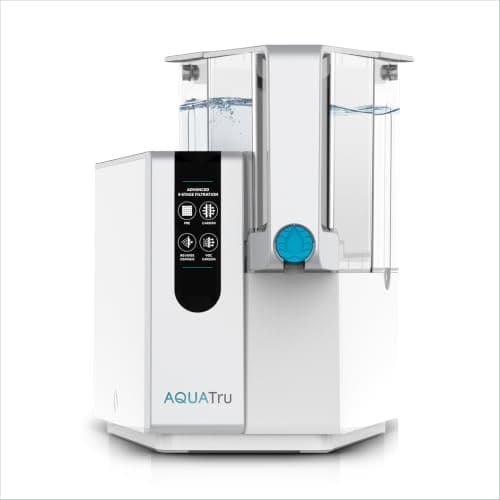 AquaTru Classic Countertop Reverse Osmosis PurifierCountertop reverse osmosis certified by IAPMO to NSF/ANSI 53, 58, 401 and P473. No drain line. AquaTru Classic Countertop Reverse Osmosis PurifierCountertop reverse osmosis certified by IAPMO to NSF/ANSI 53, 58, 401 and P473. No drain line. | Best without plumbing | $403.75 - View on Amazon $475.00 — 15% off #ad Price as of October 6, 2026. We may earn a commission. Disclosure. |
Uranium is a chemistry problem before it is a radiation problem
Most people meet the word uranium and think about radioactivity. For drinking water that instinct points at the wrong hazard and, more usefully, at the wrong filter. Uranium in a well is a dissolved metal that leached out of the rock the well is drilled into. EPA describes the source in its contaminant tables as erosion of earth materials — no spill, no industry, no upstream polluter to complain about. The granite under the house is the polluter.
That single fact decides the whole page. A dissolved ion cannot be strained out, and carbon has nothing to hold it with. Everything that works against uranium works by rejecting it at a membrane or swapping it onto a resin, which is why the shelf of pitchers and faucet mounts that solves a chlorine complaint is simply not in this conversation.
Uranium is also worth separating from the rest of the radionuclide family, because EPA's own rule separates it. The limit for gross alpha particle activity is 15 picocuries per liter including radium-226 but excluding radon and uranium, with combined radium-226 and radium-228 capped separately at 5 picocuries per liter. Uranium gets its own number, in different units, for a different reason.
The number, and where it comes from
The federal limit is specific and easy to check a laboratory report against: the maximum contaminant level for uranium is 30 µg/L — 30 micrograms per liter, which a lab may print as 30 parts per billion. Community water systems have had to comply with it since December 8, 2003.
Private wells sit outside that rule entirely. Nobody tests yours, nobody reports it, and nobody will tell you when it changes. On a well, 30 µg/L is not a protection you are covered by — it is a benchmark you have to go and measure yourself.
The criteria, in the order that decides it
- Test, because there is no symptom to notice. Uranium at twice the limit looks and tastes exactly like uranium at zero. No staining, no metallic edge, no smell. Every other page on this site starts from something you noticed; this one cannot.
- Match the technology to EPA's list, not to the marketing. The rule names four best available technologies for uranium, and only two of them exist as things a household can buy. Anything outside that list is a claim you are being asked to take on trust.
- Treat where you drink. Uranium matters by ingestion. A point-of-use unit under the kitchen sink covers drinking and cooking for a fraction of the cost of treating every toilet and shower in the house.
- Accept that no product is certified for this. See the next section. It changes what a certification can honestly tell you, and it is the most important thing on this page.
- Retest the treated water. A membrane that performs beautifully in a laboratory challenge test may do less on your pressure, your pH and your water. The only proof that applies to your house is a second laboratory result, drawn from the faucet you actually drink from.
The certification problem, stated honestly
Here is the uncomfortable part, and we would rather print it than paper over it: not one of the systems on this page is certified for uranium reduction. Read their certifications and you can see it.
| System | What it is actually certified for | Uranium named? |
|---|---|---|
| iSpring RCC7AK | NSF/ANSI 58 for TDS reduction, WQA Gold Seal, 97.2% TDS removal | No |
| Waterdrop G3P800 | NSF/ANSI 42, 53, 58 and 372 — chlorine, TDS, fluoride, cadmium, hexavalent chromium, selenium | No |
| APEC ROES-PH75 | WQA Gold Seal | No |
| AquaTru Classic | IAPMO to NSF/ANSI 53, 58, 401 and P473 | No |
That is not a scandal, and it is not a reason to buy nothing. Uranium reduction is simply not a common optional claim in consumer certification programs the way lead, fluoride and cyst reduction are. A system can be rigorously certified and still carry no uranium line in its listing, because nobody submitted it for that test.
What it does mean is that the case for reverse osmosis here rests on two things that are not a product certification: EPA naming it a best available technology for uranium, and the physics of rejecting a dissolved ion at a membrane. That is a reasonable basis. It is also a weaker kind of evidence than "certified to NSF/ANSI 53 for lead," and you deserve to know which one you are leaning on. Anyone selling you a "uranium-certified" home filter should be asked to name the certifier, the standard and the listing number.
What each technology actually does
| Technology | Status and performance | The catch |
|---|---|---|
| Reverse osmosis (point of use) | EPA best available technology; 90-99% of uranium per UGA Extension | Sends water to drain; output of roughly 5 to 20 gallons a day |
| Anion exchange | EPA best available technology; ion exchange removes approximately 90% of radionuclides | Concentrates uranium on the resin, then flushes it to household wastewater on backwash |
| Lime softening | EPA best available technology | A municipal chemical process, not a home water softener |
| Coagulation/filtration | EPA best available technology; up to 90% of uranium at pH 10 | Plant-scale chemistry with no household equivalent |
| Activated carbon | No mechanism for a dissolved ion | Removes nothing relevant here |
| Boiling | Counterproductive | Uranium is not volatile; the water leaves and the uranium concentrates |
Two of the four technologies EPA names are plant-scale and do not exist as something you can buy and install. That narrows the household decision to reverse osmosis and anion exchange, and for most houses it narrows further than that.
Anion exchange deserves a specific warning. Ohio State's extension material describes the mechanism plainly: the resin exchanges uranium for chloride, and periodically a backwash flushes the uranium and other wastes away from the resin into household wastewater. A bed quietly accumulating uranium between regenerations is not a fit-and-forget appliance, and where it discharges matters. On a septic system that is a conversation to have with a licensed installer before you buy, not after.
How well reverse osmosis actually performs
The figure worth anchoring to comes from University of Georgia Extension, which puts point-of-use reverse osmosis at 90%-99% of uranium removed, with a practical output of 5 to 20 gallons of drinkable water per day.
Read the whole range rather than the top of it. The spread between 90% and 99% is the difference between a well at 60 µg/L landing just under the limit and landing near 6 µg/L. Both are improvements; only a test tells you which one you got. Membrane rejection falls with low feed pressure and rises with a well-maintained membrane, which is why the retest matters more here than on a page about taste.
The output figure is the other thing to plan around. Five to twenty gallons a day is plenty for drinking and cooking and nowhere near enough to run a house, which is the practical argument for point of use over point of entry on a contaminant that matters by ingestion.
The health question, and an honest disagreement
Our sources do not fully agree here, and we would rather show you the disagreement than quietly pick the scarier or the calmer one.
University of Georgia Extension is explicit that the concern is the kidney rather than cancer: drinking water above 30 ppb may increase the risk of kidney malfunction, and exposure to uranium in drinking water has not been shown to increase the risk of developing cancer.
EPA's standard consumer language, reproduced in Ohio State's contaminant tables, is more cautious: some people who drink water containing uranium in excess of the MCL over many years may have an increased risk of getting cancer.
Both are real published positions from credible bodies, and we are not going to pretend the gap is not there. The practical consequence happens to be identical either way, which is the useful part: the limit is 30 µg/L, the exposure that matters is years of drinking it, and the fix is inexpensive relative to the question. You do not have to resolve a toxicology debate to decide to put a reverse osmosis unit under the sink.
Who should actually test for this
Uranium is geological, so the risk map follows bedrock rather than land use. This is a drilled-well, hard-rock story, not a farming one.
University of Georgia Extension found elevated uranium in wells deeper than 100 feet in granitic bedrock, and notes that levels of uranium above 30 ppb have not been found in shallow wells or surface water. Depth and rock type are the screening questions to start from.
The scale is not trivial in the regions where it does show up. USGS mapping in New Hampshire found 7% of the groundwater samples in the study were at elevated levels of uranium, and 76% of the state has a 50% or more probability for detectable concentrations — in a state where approximately 40% of residents rely on private wells. In Connecticut, USGS built its uranium probability map from more than 2,000 private wells in bedrock aquifers.
Two wells on the same road can differ widely, because the fracture each one draws from is different. A neighbor's clean result is not your result. The well testing guide covers how to get a panel that reports uranium rather than a strip test that cannot see it, and it belongs on the same panel as arsenic — both are invisible, both are geological, and both are found by someone who went looking.
Municipal customers are in a different position. Uranium is regulated and reported for public systems, so your annual water quality report carries the measured value and your utility is required to stay under the limit.
Where this fits in a well treatment train
Uranium treatment sits at the end of the line, not the start. Sediment, iron and manganese come out first because they foul whatever is downstream of them, and a membrane fed raw well water does not last. The order of operations for a well runs through that sequence, and the iron and sulfur guide covers the stage most well households need before anything else.
If your panel came back with more than one problem — and on a well it usually does — the sequence is sediment and oxidation first, then the point-of-use membrane that handles uranium alongside nitrate and arsenic. One membrane covering several of these at once is the strongest practical argument for reverse osmosis over a single-purpose resin.
The cost-per-gallon math
The economics here are unusually clear, because the alternative to treating is buying water forever.
A point-of-use reverse osmosis system is a one-time purchase plus cartridges on a published schedule, and it treats the water you drink and cook with for years. Bottled water for a household is bought every week, never stops, and never ends up cheaper.
Budget for three things rather than one: the system, its replacement cartridges at the manufacturer's interval, and a second laboratory test after installation to confirm it is working on your water. The third is the one people skip, and it is the only one that proves the first two were worth buying.
We do not print product prices in this text. The buy buttons carry the live figure and the date it was checked, which is the only price worth quoting.
We show the arithmetic rather than a verdict so you can redo it with the price you actually pay. Filter prices move; the rated capacities above do not.
The picks in full
Buy this first
Tap Score Advanced Water Test (SimpleLab)
SimpleLab
Mail-in testing through certified laboratories, with a report that names contaminants, gives concentrations, and compares them against health guidelines. This is the number every system on this site is sized from.
Certification status
Samples are analyzed by laboratories in the SimpleLab network certified to ISO/IEC 17025, and Tap Score is recognized by the Water Quality Association.
Published specifications
| Method | Mail-in sample, certified laboratory analysis |
|---|---|
| Lab accreditation | ISO/IEC 17025 certified network laboratories |
| Panels available | City water, well water, and contaminant-specific tests |
| What you get | Concentrations plus health-guideline comparison |
What we like
- Certified-laboratory analysis, not a color-matching strip
- The report explains what each result means rather than dumping numbers
- Contaminant-specific panels exist when you only need one answer
What we do not
- Costs meaningfully more than a strip kit
- Turnaround is days, not minutes
- You have to actually collect the sample correctly, which is where home tests usually go wrong
Skip it if
Somebody whose entire complaint is a chlorine taste. That diagnosis is free — you can smell it — and a certified carbon filter costs less than the test.
$269.00 — 20% off
#ad Price as of October 6, 2026. We may earn a commission. Disclosure.
Where these specifications came from
Best overall
iSpring RCC7AK 6-Stage Reverse Osmosis System
iSpring
The value pick of the reverse-osmosis tier: a WQA Gold Seal system with an alkaline stage, usually at the lowest price of anything here that carries a real certification.
Certification status
Certified against NSF/ANSI 58 for TDS reduction and carries the WQA Gold Seal, with 97.2% TDS removal certified.
Published specifications
| Output | 75 GPD |
|---|---|
| Stages | 6, including alkaline remineralization |
| Certified TDS reduction | 97.2% |
| Feed pressure | 45-70 psi |
| Feed temperature | 40-100 degrees F |
| Assembled size | 15.5" deep x 19.5" high, 25 lb |
| Certification | NSF/ANSI 58, WQA Gold Seal |
What we like
- Certified performance at the lowest price in the tier
- Push-fit tubing makes a first-time install genuinely manageable
- Alkaline stage included rather than sold as an upgrade
What we do not
- Narrow 45-70 psi feed window — low-pressure homes may need a booster pump
- Tank plus housing needs real cabinet depth
- Conventional reverse-osmosis drain ratio
Skip it if
Homes with feed pressure below 45 psi that will not add a booster pump, and anyone who wants a tankless footprint.
$234.99 — 15% off
#ad Price as of October 6, 2026. We may earn a commission. Disclosure.
Where these specifications came from
Best for a busy household
Waterdrop G3P800 Tankless Reverse Osmosis System
Waterdrop
Tankless reverse osmosis that gives back the cupboard a pressure tank would eat, fills a glass without the pause, and sends markedly less water down the drain than a classic tank system.
Certification status
Certified to NSF/ANSI 42 for chlorine reduction, NSF/ANSI 53 and 58 for TDS, fluoride, cadmium, hexavalent chromium and selenium, and NSF/ANSI 372 for lead-free materials.
Published specifications
| Output | 800 GPD |
|---|---|
| Pure-to-drain ratio | 3:1 |
| Format | Tankless — no pressure tank |
| Certified standards | NSF/ANSI 42, 53, 58, 372 |
| Installation | Two holes: smart LED faucet and drain |
| Faucet | Included, with TDS display |
What we like
- No pressure tank, so it fits cabinets a tank system cannot
- 3:1 pure-to-drain is far better than the ratio typical of older reverse osmosis
- 800 GPD means no waiting for a tank to refill
What we do not
- Needs a power outlet under the sink — a real constraint in older kitchens
- Proprietary filter cartridges, so you are tied to Waterdrop's pricing
- Requires drilling for the included faucet unless you have a spare hole
Skip it if
Renters, and anyone with no outlet under the sink. It is a permanent, powered installation — a countertop unit is the answer if you cannot commit to that.
$999.00 — 30% off
#ad Price as of October 6, 2026. We may earn a commission. Disclosure.
Where these specifications came from
Best no-power option
APEC ROES-PH75 Essence 6-Stage Alkaline RO System
APEC Water Systems
A conventional tank system that uses ordinary 10-inch cartridges rather than proprietary pods, which keeps the ten-year running cost sane. The sixth stage puts minerals back for people who dislike RO's flat taste.
Certification status
WQA Gold Seal certified.
Published specifications
| Output | 75 GPD at 60 psi and 77 degrees F |
|---|---|
| Tank capacity | 4 gallons |
| Stages | 6, including a calcite remineralization stage |
| Feed pressure | 40-85 psi |
| Max feed TDS | 2,000 ppm |
| System dimensions | 15.5" L x 5.25" W x 17.5" H, plus a separate tank |
| Certification | WQA Gold Seal |
What we like
- Standard-size cartridges, so replacements are cheap and sourceable from many brands
- Calcite stage restores minerals and lifts the pH of reverse-osmosis water
- No electricity required
What we do not
- The 4-gallon tank plus housing takes most of an under-sink cabinet
- Slower than tankless systems, and it pauses while the tank refills
- Conventional wastewater ratio, well short of the G3P800's 3:1
Skip it if
Small cabinets. Measure before you buy — the tank alone is roughly 11 x 11 x 15 inches, and people discover this after delivery.
$294.99 — 36% off
#ad Price as of October 6, 2026. We may earn a commission. Disclosure.
Where these specifications came from
Best without plumbing
AquaTru Classic Countertop Reverse Osmosis Purifier
AquaTru
Reverse osmosis performance with no plumbing, no drilling and no landlord conversation. You pay for that with counter space, a wait, and two tanks you fill and empty by hand.
Certification status
Certified by IAPMO to NSF/ANSI 53, 58, 401 and P473, covering lead, reverse-osmosis performance, emerging compounds and the PFOA/PFOS protocol.
Published specifications
| Filtration | 4-stage countertop reverse osmosis |
|---|---|
| Clean water tank | 0.75 gallons |
| Tap water tank | 1 gallon |
| Installation | None — no plumbing connection |
| Certified standards | NSF/ANSI 53, 58, 401, P473 (IAPMO) |
What we like
- Real reverse osmosis with a P473 PFOA/PFOS certification and zero installation
- The strongest answer available to a renter with a lead or PFAS problem
- No drilling, no drain saddle, no landlord permission needed
What we do not
- Takes up substantial counter space
- You refill and empty tanks by hand — it is not on-demand
- Highest purchase price in the no-plumbing tier by a wide margin
Skip it if
Anyone who can plumb in an under-sink system. A permanent under-sink RO is cheaper per gallon, on-demand, and out of sight. Buy this when you genuinely cannot install.
$475.00 — 15% off
#ad Price as of October 6, 2026. We may earn a commission. Disclosure.
Where these specifications came from
Questions people actually ask
What filter removes uranium from water?
Reverse osmosis is the household answer. EPA's rule names ion exchange, reverse osmosis, lime softening and coagulation/filtration as best available technologies for uranium, and of those only reverse osmosis and anion exchange exist as consumer products. Carbon filters, sediment filters and pitchers remove none of it.
Does reverse osmosis remove uranium?
Yes. University of Georgia Extension puts point-of-use reverse osmosis at 90% to 99% removal of uranium, producing roughly 5 to 20 gallons of drinkable water per day. The spread is wide enough that a retest of the treated water is the only way to know where your own system landed.
What is a safe level of uranium in drinking water?
EPA's maximum contaminant level is 30 micrograms per liter, which a laboratory may report as 30 parts per billion. Community water systems have had to comply since December 8, 2003. Private wells are not covered by that rule, so on a well the limit is a benchmark you have to measure against yourself.
Does boiling water remove uranium?
No, it makes it worse. Uranium is a non-volatile dissolved metal, so boiling drives off water as steam and leaves the uranium behind at a higher concentration. Boiling is the right response to bacteria and the wrong response to uranium.
Will my water softener remove uranium?
Do not count on it. EPA's technology list names lime softening, which is a municipal chemical process, not the salt-based cation-exchange softener installed for hard water. If uranium is your concern, treat it with a point-of-use reverse osmosis system and verify the result with a laboratory test.
Is any home water filter certified for uranium reduction?
None of the systems on this page carries a uranium-specific certification, and we would rather say so plainly. Their certifications cover TDS reduction and contaminants such as lead, fluoride and chromium. The case for reverse osmosis against uranium rests on EPA naming it a best available technology and on membrane physics, not on a certification listing that names uranium.
Sources
- 40 CFR § 141.66 — Maximum contaminant levels for radionuclides
- University of Georgia Extension — Uranium in Your Water (C858-14)
- Ohio State University Extension — uranium in drinking water and treatment methods
- USGS — New maps show probability of radon and uranium in New Hampshire's groundwater
- USGS — Uranium in private wells in Connecticut
- NSF — Certified Products and Systems
- Tap Score — laboratory certifications