Yes. In the NC State and Duke study of household filters, under-sink reverse osmosis and two-stage systems removed PFAS down to the laboratory reporting limit, while carbon pitchers, faucet mounts and fridge filters removed only part of it. The certification to look for is under NSF/ANSI 53 or P473, not 58.
Quick picks
Tap any row to jump to the full write-up. The button goes straight to the retailer.
| # | Product | Best for | Price |
|---|---|---|---|
| 1 | 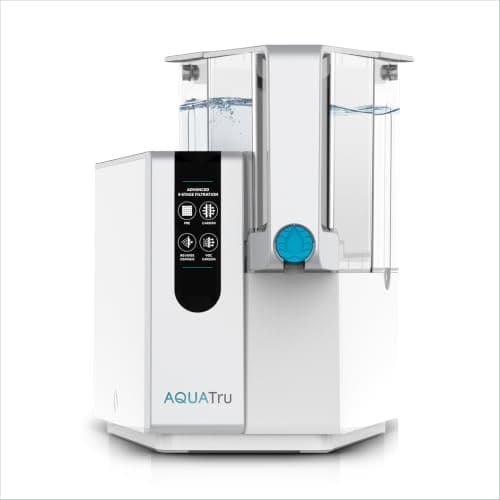 AquaTru Classic Countertop Reverse Osmosis PurifierIAPMO certified to NSF/ANSI 53, 58, 401 and P473 — P473 is the PFOA and PFOS protocol. AquaTru Classic Countertop Reverse Osmosis PurifierIAPMO certified to NSF/ANSI 53, 58, 401 and P473 — P473 is the PFOA and PFOS protocol. | Certified, no plumbing | $403.75 - View on Amazon $475.00 — 15% off #ad Price as of October 7, 2026. We may earn a commission. Disclosure. |
| 2 | 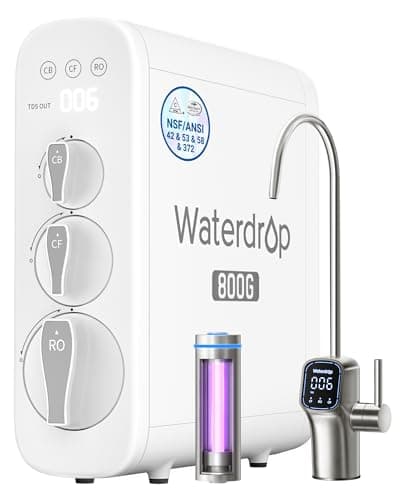 Waterdrop G3P800 Tankless Reverse Osmosis SystemCertified by IAPMO R&T to NSF/ANSI 42, 53 and 58, and to 372 for materials. Waterdrop G3P800 Tankless Reverse Osmosis SystemCertified by IAPMO R&T to NSF/ANSI 42, 53 and 58, and to 372 for materials. | Tankless under the sink | $699.00 - View on Amazon $999.00 — 30% off #ad Price as of October 7, 2026. We may earn a commission. Disclosure. |
| 3 | 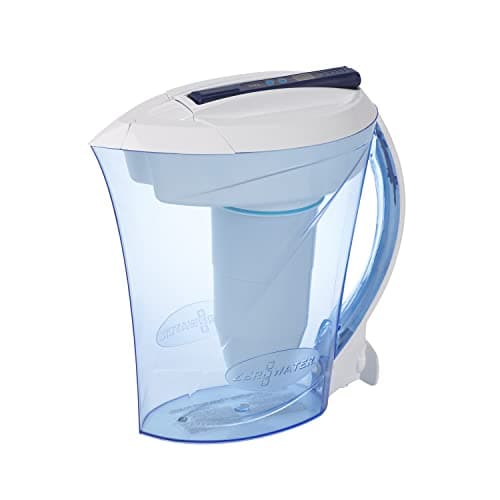 ZeroWater 10-Cup Ready-Pour PitcherThe pitcher route: IAPMO certified against NSF/ANSI 53 for PFOA and PFOS at 99%. ZeroWater 10-Cup Ready-Pour PitcherThe pitcher route: IAPMO certified against NSF/ANSI 53 for PFOA and PFOS at 99%. | If a system is not possible | $28.99 - View on Amazon $59.98 — 52% off #ad Price as of October 7, 2026. We may earn a commission. Disclosure. |
What the independent research found
The most useful study of household filters and PFAS was run by researchers at NC State and Duke, who sampled filtered water in real homes rather than in a laboratory rig. NC State's summary of the work states it plainly: under-sink reverse osmosis and two-stage filters effectively removed PFAS to the reporting limit of analytical methods, whereas activated carbon filters used in pitchers, refrigerators and faucets resulted in partial PFAS removal.
"To the reporting limit" is as strong a result as this kind of testing produces: it means the laboratory could not find PFAS in the treated water, not that the number was merely lower. Partial removal, by contrast, is what most people are actually buying when they put a carbon pitcher on the counter for PFAS.
Why the certification is confusing
Here is the part that catches people out. Reverse osmosis systems are certified under NSF/ANSI 58 — but in NSF's own database, the PFOA reduction claim does not exist under 58 at all. It sits under NSF/ANSI 53, the health-effects standard, and under the separate P473 protocol written specifically for PFOA and PFOS.
| Search in NSF's listing database | Distinct system models returned |
|---|---|
| NSF/ANSI 53 with a PFOA Reduction claim | 50 |
| NSF/ANSI 58 with a PFOA Reduction claim | 0 |
| NSF/ANSI 58 with a Fluoride Reduction claim | 129 |
So a reverse osmosis system can be honestly NSF/ANSI 58 certified and carry no PFAS claim whatsoever. The physics says the membrane rejects PFAS; the paperwork says nobody paid to test this particular model for it. Those are different statements, and only one of them is a guarantee.
What to look for instead
- P473. A protocol written for PFOA and PFOS specifically. If a product holds it, that is the cleanest evidence available to a consumer.
- NSF/ANSI 53 with PFOA and PFOS named. The health-effects standard, with the two compounds listed by name in the claim list rather than implied.
- A named certifying body. NSF, IAPMO R&T or WQA. "Tested to NSF standards" is a sentence a manufacturer writes about itself.
- Nothing about "forever chemicals" in the headline. That phrase appears on plenty of products with no PFAS claim at all.
Reverse osmosis is not the only certified route
It is the strongest one, and it is not the cheapest. A certified pitcher cartridge reaches a PFOA and PFOS claim for a fraction of the purchase price, with a much shorter filter life and a much higher cost per gallon. The PFAS roundup compares both routes with the certification status of each product, and the PFAS explainer covers what the 2024 federal rule actually requires of your utility and when.
One warning worth repeating: whole-house filtration is the wrong tier for this. A tank system treats every gallon in the house, including the ones you flush, and the certified PFAS claims live at the point of use. We went through that in detail here.
The cost-per-gallon math
An under-sink reverse osmosis system is a purchase plus cartridges plus a membrane every two to three years. A certified pitcher is a much smaller purchase and a cartridge every few weeks.
For a single person drinking a gallon a day, the pitcher usually stays cheaper for a year or two. For a household of three or more, the system wins on cost per gallon within months — and it also removes the failure mode that matters most, which is a filter nobody remembers to change.
We show the arithmetic rather than a verdict so you can redo it with the price you actually pay. Filter prices move; the rated capacities above do not.
The picks in full
Certified, no plumbing
AquaTru Classic Countertop Reverse Osmosis Purifier
AquaTru
Reverse osmosis performance with no plumbing, no drilling and no landlord conversation. You pay for that with counter space, a wait, and two tanks you fill and empty by hand.
Certification status
Certified by IAPMO to NSF/ANSI 53, 58, 401 and P473, covering lead, reverse-osmosis performance, emerging compounds and the PFOA/PFOS protocol.
Published specifications
| Filtration | 4-stage countertop reverse osmosis |
|---|---|
| Clean water tank | 0.75 gallons |
| Tap water tank | 1 gallon |
| Installation | None — no plumbing connection |
| Certified standards | NSF/ANSI 53, 58, 401, P473 (IAPMO) |
What we like
- Real reverse osmosis with a P473 PFOA/PFOS certification and zero installation
- The strongest answer available to a renter with a lead or PFAS problem
- No drilling, no drain saddle, no landlord permission needed
What we do not
- Takes up substantial counter space
- You refill and empty tanks by hand — it is not on-demand
- Highest purchase price in the no-plumbing tier by a wide margin
Skip it if
Anyone who can plumb in an under-sink system. A permanent under-sink RO is cheaper per gallon, on-demand, and out of sight. Buy this when you genuinely cannot install.
$475.00 — 15% off
#ad Price as of October 7, 2026. We may earn a commission. Disclosure.
Where these specifications came from
Tankless under the sink
Waterdrop G3P800 Tankless Reverse Osmosis System
Waterdrop
Tankless reverse osmosis that gives back the cupboard a pressure tank would eat, fills a glass without the pause, and sends markedly less water down the drain than a classic tank system.
Certification status
Certified to NSF/ANSI 42 for chlorine reduction, NSF/ANSI 53 and 58 for TDS, fluoride, cadmium, hexavalent chromium and selenium, and NSF/ANSI 372 for lead-free materials.
Published specifications
| Output | 800 GPD |
|---|---|
| Pure-to-drain ratio | 3:1 |
| Format | Tankless — no pressure tank |
| Certified standards | NSF/ANSI 42, 53, 58, 372 |
| Installation | Two holes: smart LED faucet and drain |
| Faucet | Included, with TDS display |
What we like
- No pressure tank, so it fits cabinets a tank system cannot
- 3:1 pure-to-drain is far better than the ratio typical of older reverse osmosis
- 800 GPD means no waiting for a tank to refill
What we do not
- Needs a power outlet under the sink — a real constraint in older kitchens
- Proprietary filter cartridges, so you are tied to Waterdrop's pricing
- Requires drilling for the included faucet unless you have a spare hole
Skip it if
Renters, and anyone with no outlet under the sink. It is a permanent, powered installation — a countertop unit is the answer if you cannot commit to that.
$999.00 — 30% off
#ad Price as of October 7, 2026. We may earn a commission. Disclosure.
Where these specifications came from
If a system is not possible
ZeroWater 10-Cup Ready-Pour Pitcher
ZeroWater
The only mainstream pitcher that hands you a TDS meter and invites you to check its work. It buys you a PFOA/PFOS certification the Brita Elite does not have, and it costs you filter life.
Certification status
The 5-stage filter is system-certified by IAPMO against NSF/ANSI 42 for chlorine taste and odor and NSF/ANSI 53 for lead, hexavalent chromium, mercury and PFOA/PFOS.
Published specifications
| Filtration | 5-stage, including ion-exchange resin |
|---|---|
| Rated filter life | About 15-20 gallons, varying with source TDS |
| Certified standards | NSF/ANSI 42 and 53 (IAPMO) |
| PFOA / PFOS | Certified under NSF/ANSI 53 |
| Published reduction — PFOA/PFOS | 99% |
| Published reduction — lead | 95% |
| Published reduction — chromium 6 | 99% |
| Included | Handheld TDS meter |
What we like
- Carries a PFOA/PFOS certification, which the Brita Elite does not
- The bundled TDS meter turns 'is it still working' from a guess into a reading
- Ion exchange drives total dissolved solids far lower than carbon alone
What we do not
- Filter life is the shortest of any pitcher here, and it collapses further on hard or high-TDS water
- Cost per gallon is the highest in the pitcher tier as a result
- Some owners find the taste flat or faintly sour at very low TDS — a real preference issue, not a defect
Skip it if
Anyone on hard, high-TDS water who will not tolerate changing a filter every few weeks. On 400+ ppm supply the running cost is genuinely painful and an under-sink system is cheaper inside a year.
$59.98 — 52% off
#ad Price as of October 7, 2026. We may earn a commission. Disclosure.
Where these specifications came from
Questions people actually ask
Does reverse osmosis remove PFAS?
Yes. In the NC State and Duke study of filters in real homes, under-sink reverse osmosis and two-stage systems removed PFAS to the laboratory's reporting limit, while carbon pitchers, faucet mounts and refrigerator filters achieved only partial removal. The caveat is certification: check that the specific model carries a PFOA and PFOS claim.
Is an NSF 58 certified system certified for PFAS?
Not necessarily, and usually not. In NSF's own database the PFOA reduction claim appears under NSF/ANSI 53 and the P473 protocol, not under 58. A system can be legitimately 58-certified for total dissolved solids and carry no PFAS claim at all.
What is NSF P473?
A protocol written specifically for the reduction of PFOA and PFOS at concentrations relevant to drinking water advisories. A product certified to P473 has been tested against those two compounds by name, which is the most specific evidence available to a consumer buying for PFAS.
Do carbon filters remove PFAS?
Partially, and inconsistently. The NC State and Duke work found partial removal from carbon pitchers, faucet mounts and refrigerator filters, with performance depending on the compound. Some carbon products do hold a certified PFOA and PFOS claim — the point is that carbon as a category does not, so the claim has to be on the specific product.
Should I test for PFAS before buying?
Check your utility's published monitoring results first, since many have now reported under the 2024 federal rule. A certified laboratory test is the next step if nothing is published and you have a reason to suspect exposure, such as a nearby industrial site or firefighting foam use.