Every iSpring product in NSF's database is certified to NSF/ANSI 58, and only the RCC7 and RO500 reverse osmosis families appear. No iSpring product is NSF-listed under 42, 53 or 401, the tankless RO800G is not listed at all, and the same RCC7AK carries different claims depending on which plant built it.
Quick picks
Tap any row to jump to the full write-up. The button goes straight to the retailer.
| # | Product | Best for | Price |
|---|---|---|---|
| 1 | 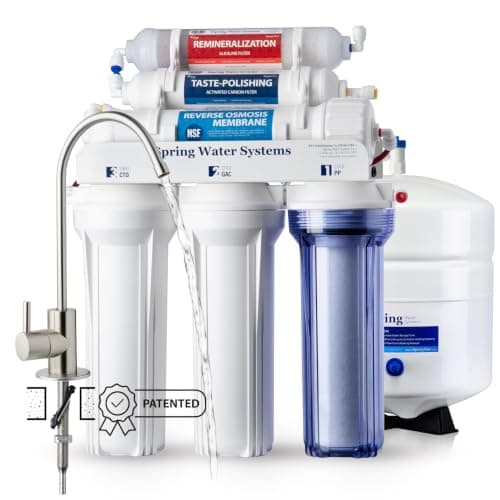 iSpring RCC7AK 6-Stage Reverse Osmosis SystemIn NSF's database under NSF/ANSI 58, and the only iSpring family there alongside the RO500. iSpring RCC7AK 6-Stage Reverse Osmosis SystemIn NSF's database under NSF/ANSI 58, and the only iSpring family there alongside the RO500. | The one NSF lists | $234.99 - View on Amazon #ad Price as of October 9, 2026. We may earn a commission. Disclosure. |
| 2 | 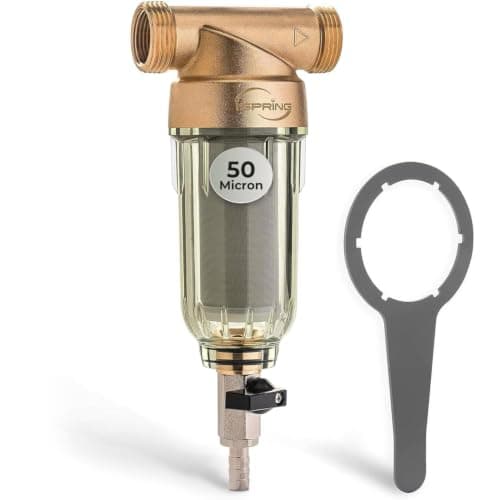 iSpring WSP-50 Spin-Down Sediment PrefilterA flushable 50-micron screen ahead of everything. No certification applies and none is needed. iSpring WSP-50 Spin-Down Sediment PrefilterA flushable 50-micron screen ahead of everything. No certification applies and none is needed. | Buy this first on a well | $56.89 - View on Amazon $59.99 — 5% off #ad Price as of October 9, 2026. We may earn a commission. Disclosure. |
| 3 | 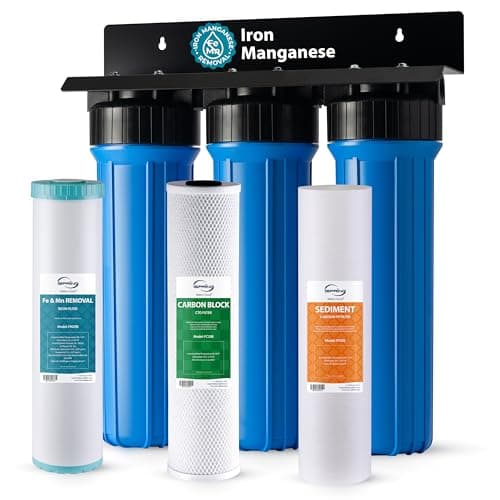 iSpring WGB32BM 3-Stage Iron & Manganese Whole-House FilterPublished ceilings of 3.0 ppm iron and 1.0 ppm manganese. Buy it against your lab numbers. iSpring WGB32BM 3-Stage Iron & Manganese Whole-House FilterPublished ceilings of 3.0 ppm iron and 1.0 ppm manganese. Buy it against your lab numbers. | For well iron and manganese | $473.68 - View on Amazon $535.99 — 12% off #ad Price as of October 9, 2026. We may earn a commission. Disclosure. |
| 4 | 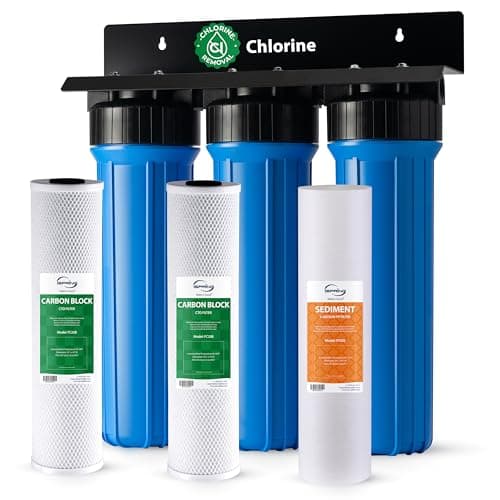 iSpring WGB32B 3-Stage Whole-House FilterStandard 20 x 4.5 inch cartridges, so the certification travels with the cartridge you fit. iSpring WGB32B 3-Stage Whole-House FilterStandard 20 x 4.5 inch cartridges, so the certification travels with the cartridge you fit. | Cheapest route to whole-house | $420.00 - View on Amazon $516.99 — 19% off #ad Price as of October 9, 2026. We may earn a commission. Disclosure. |
| 5 | 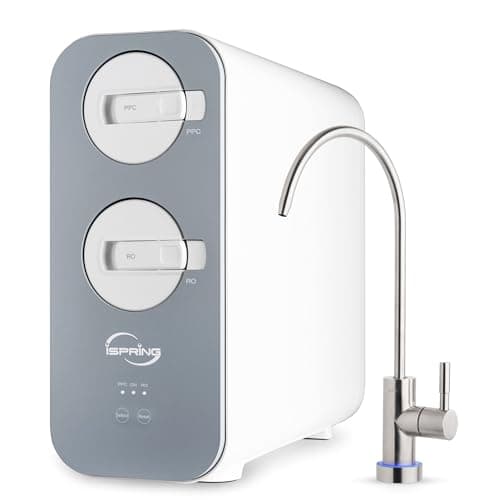 iSpring RO800G Tankless Reverse Osmosis System800 GPD and genuinely fast. Not in NSF's database, while the listing claims PFAS and lead. iSpring RO800G Tankless Reverse Osmosis System800 GPD and genuinely fast. Not in NSF's database, while the listing claims PFAS and lead. | Most output, least evidence | $417.33 - View on Amazon $490.99 — 15% off #ad Price as of October 9, 2026. We may earn a commission. Disclosure. |
What NSF actually lists for iSpring
iSpring is one of the largest water filter brands on Amazon and one of the hardest to pin down, because it sells across four tiers at once — under-sink reverse osmosis, tankless reverse osmosis, whole-house cartridge systems and well-water cartridge systems — and the evidence behind each tier is completely different.
So we searched NSF's own certified drinking water treatment unit database under the company name on the verification date above. The result is narrower and more specific than the word "NSF Certified" on a retail listing suggests.
| What we searched for | What NSF's database returned |
|---|---|
| Company name iSpring Water Systems LLC | 14 listings, every one under NSF/ANSI 58 |
| Model families listed | RCC7 series and RO500 series only |
| NSF/ANSI 42 (taste and odor) | Does not appear for any iSpring product |
| NSF/ANSI 53 (health contaminants) | Does not appear for any iSpring product |
| NSF/ANSI 401 (emerging compounds) | Does not appear for any iSpring product |
| NSF/ANSI/CAN 372 (lead-free materials) | Appears for the Nanjing-built RCC7 variants |
| RO800G (the 800 GPD tankless) | Not listed |
| WGB32B and WGB32BM (whole house) | Not listed |
Read that table the right way round. It is not a finding that iSpring is uncertified — its reverse osmosis systems are genuinely listed with NSF, which is more than a great many Amazon filter brands can say. It is a finding that iSpring's certification is all reverse osmosis, under one standard, across two families. The rest of the catalog is sold on published specifications rather than on a listing.
The same model, two different certified claim lists
Here is the part we have not seen written down anywhere, and it is the reason this page exists. The RCC7AK appears in NSF's database more than once, built at more than one facility, and the certified claims are not the same.
| RCC7AK as listed | Certified claims | Also carries |
|---|---|---|
| Built at the Taichung City, Taiwan facility | TDS reduction | — |
| Built at the Nanjing, China facility | Asbestos, barium, cadmium, chromium (trivalent), copper, fluoride, lead, selenium, TDS | NSF/ANSI/CAN 372 |
| RO500 series, built at the Fujian, China facility | TDS reduction | — |
The box says RCC7AK either way. The price is the same either way. And on the strength of the listing alone, one of them is certified for lead and fluoride and the other is certified for dissolved solids.
We are not going to over-read this. Reverse osmosis rejects lead and fluoride as a matter of membrane physics regardless of which plant assembled the housing, so a Taichung-built RCC7AK is not somehow worse at it. What differs is the evidence — which claims were submitted and tested at which facility — and evidence is the only thing a certification ever gave you. If you are buying specifically because you need a certified lead or fluoride reduction on paper, that distinction is the whole purchase.
It is also why the specification box further down this page states the RCC7AK's certification conservatively, as NSF/ANSI 58 with the TDS figure. That is the claim that holds for every RCC7AK in the database rather than for some of them, and a floor you can rely on beats a ceiling you might not get.
The one that is not in the database at all
The RO800G is iSpring's flagship tankless system: 800 gallons per day, up to a 2.5:1 pure-to-drain ratio, about 0.6 gallons a minute at the faucet. On output and water efficiency it beats the RCC7AK comfortably, and it is the model the brand leads with.
It does not appear in NSF's database. Its retail listings name PFAS, chloramine, lead, fluoride and TDS reduction in the product title itself. Those two sentences sit awkwardly together, and the awkwardness is the point: the RCC7AK's own retail title carries the words "NSF Certified" and the RO800G's does not, while the contaminant lists on the two listings look much the same.
That is not an accusation of dishonesty. A manufacturer is allowed to state what its own testing shows, and an uncertified membrane is not a non-functioning membrane. But a claim with a listing behind it and a claim without one are different kinds of statement, and the price difference between these two systems is not an evidence difference in the direction you would expect. If you can name the contaminant you are buying for, buy the model whose certification names it too. If you want flow and efficiency and you are treating water that is already safe, the RO800G is a reasonable buy on its specifications.
Why the whole-house systems are a different question
Neither the WGB32B nor the WGB32BM is in NSF's database, and for these two that is far less damning than it sounds. Both are housings that take standard 20 by 4.5 inch cartridges, and on a system like that the certification travels with the cartridge you fit rather than with the steel and plastic around it. Fit a certified carbon block and you have a certified carbon block; fit a generic one and you do not.
The practical consequence is that the housing is a commodity and the cartridge is the decision. That is genuinely an advantage: standard sizes mean you are never locked into one brand's proprietary consumable, which is the trap in most of this category. It also means a whole-house iSpring is a platform rather than a treatment claim, and you should read what the standards actually cover before deciding which cartridge goes in it.
The WGB32BM is the exception worth treating as a real product rather than a platform, because its iron and manganese stages come with published ceilings: 3.0 ppm iron and 1.0 ppm manganese, both stated as reduced to 0.01 ppm, with rated capacity halving at the top of the iron range. Those numbers are the buying criteria. Install it on a well testing above them and it blinds off, which is why the iron and sulfur guide puts a lab panel ahead of the purchase.
How to read an iSpring model number
iSpring's naming is more logical than most, once you know the parts.
| Fragment | What it means |
|---|---|
| RCC7 | The tank-based under-sink reverse osmosis platform |
| AK | Alkaline remineralization stage added after the membrane |
| UV | An ultraviolet lamp stage added — a disinfection claim, not a filtration one |
| RO500 / RO800G | Tankless, pumped reverse osmosis. The number is gallons per day |
| G | On the RO-series, the higher-flow generation |
| WGB32B | Whole-house, 3 stages, 20 x 4.5 inch cartridges |
| BM | The iron and manganese cartridge set, for wells |
| WSP | Spin-down sediment prefilter. The number is the micron rating |
| BN / ORB / BLK | Faucet finish only — brushed nickel, oil-rubbed bronze, black |
The finish codes matter more than they should, because they are why the database returns fourteen listings for what is really two systems. RCC7AK-BN and RCC7AK-BLK are the same machine with a different tap. Do not read a long listing count as a wide certification.
Where iSpring is genuinely the right answer
Three situations, and they are all about price per unit of evidence.
- The cheapest certified under-sink reverse osmosis. The RCC7AK is routinely the lowest-priced system in the mid-range bracket that is actually in NSF's database under 58. If what you want is certified RO and you do not care about tankless convenience, it is hard to argue with.
- Protecting equipment on a well. The WSP-50 spin-down is the cheapest component on this whole site and one of the most useful — a transparent housing with a 316L stainless screen and a flush valve, upstream of everything expensive. No certification applies to it because it is a mechanical screen, not a treatment device. That is the honest category, not a gap.
- Moderate well iron and manganese without a backwashing tank. The WGB32BM, bought against lab numbers that sit inside its published ceilings. The order of operations for a well puts it where it belongs: after sediment, before the membrane.
Where it is not
If your concern is a specific contaminant at the drinking tap and you want the strongest paperwork available, iSpring is not the brand with the widest claim list. Waterdrop's reverse osmosis systems are certified by IAPMO R&T across NSF/ANSI 42, 53 and 58 with fluoride among the named claims, and AquaTru's countertop unit adds 401 and the PFOA/PFOS protocol. We compare the two reverse osmosis routes directly on Waterdrop versus iSpring, and the two tank systems on iSpring versus APEC.
One more honest limit worth naming: the Nanjing RCC7AK's certified chromium claim is for chromium (trivalent), not hexavalent. Chromium-6 is the one people read about and worry about, and it is a different claim. The chromium-6 page covers which systems address it and what the certification language actually says.
The cost-per-gallon math
The arithmetic that matters on an iSpring is the cartridge schedule, not the sticker.
A tank system like the RCC7AK runs on commodity 10-inch cartridges plus a membrane on a longer interval, and the whole-house housings take standard 20 by 4.5 inch cartridges. Standard sizes mean competitive refill pricing for the life of the system, which over several years is worth more than a modest difference in purchase price. That is the real advantage of this brand and it rarely appears in a review.
The tankless models invert it: lower water waste and a faster faucet, proprietary filter cartridges, and a pump that needs an outlet under the sink. Price the consumables on the manufacturer's published interval before you choose a format.
We do not print product prices in this text. The buy buttons carry the live figure and the date it was checked, which is the only price worth quoting.
We show the arithmetic rather than a verdict so you can redo it with the price you actually pay. Filter prices move; the rated capacities above do not.
The picks in full
The one NSF lists
iSpring RCC7AK 6-Stage Reverse Osmosis System
iSpring
The value pick of the reverse-osmosis tier: a WQA Gold Seal system with an alkaline stage, usually at the lowest price of anything here that carries a real certification.
Certification status
Certified against NSF/ANSI 58 for TDS reduction and carries the WQA Gold Seal, with 97.2% TDS removal certified.
Published specifications
| Output | 75 GPD |
|---|---|
| Stages | 6, including alkaline remineralization |
| Certified TDS reduction | 97.2% |
| Feed pressure | 45-70 psi |
| Feed temperature | 40-100 degrees F |
| Assembled size | 15.5" deep x 19.5" high, 25 lb |
| Certification | NSF/ANSI 58, WQA Gold Seal |
What we like
- Certified performance at the lowest price in the tier
- Push-fit tubing makes a first-time install genuinely manageable
- Alkaline stage included rather than sold as an upgrade
What we do not
- Narrow 45-70 psi feed window — low-pressure homes may need a booster pump
- Tank plus housing needs real cabinet depth
- Conventional reverse-osmosis drain ratio
Skip it if
Homes with feed pressure below 45 psi that will not add a booster pump, and anyone who wants a tankless footprint.
#ad Price as of October 9, 2026. We may earn a commission. Disclosure.
Where these specifications came from
Buy this first on a well
iSpring WSP-50 Spin-Down Sediment Prefilter
iSpring
The only filter on this site with no consumable at all: a stainless mesh in a clear housing that you flush with a valve instead of replacing. On a well it protects every cartridge and membrane downstream, which is the entire argument for it.
Certification status
No NSF/ANSI performance certification, and none is applicable — this is a mechanical screen for suspended solids rather than a contaminant-reduction device. iSpring specifies a 316L food-grade stainless steel screen and a lead-free brass head. Treat it as plumbing hardware, not as treatment.
Published specifications
| Filtration | 50 micron stainless steel mesh screen |
|---|---|
| Screen material | 316L food-grade stainless steel |
| Head material | Lead-free brass |
| Ports | 1" MNPT and 3/4" FNPT on both ends |
| Housing | Transparent, so the load is visible without opening it |
| Consumable | None — the screen is flushed and reused |
| Maintenance | Open the flush valve; frequency depends on sediment load |
What we like
- No cartridge to buy, ever — you flush the screen and reuse it
- The clear housing makes maintenance something you can see rather than schedule blindly
- Protects softeners, carbon tanks, cartridges and RO membranes downstream, which is where the money is
What we do not
- 50 micron is coarse: it catches grit and rust flakes, not fine silt or turbidity
- It is a prefilter, not a treatment — it reduces no contaminant of any kind
- Needs a spot in the line with room underneath for the flush valve and a drain or bucket
- Requires actual maintenance; a neglected screen becomes a pressure restriction
Skip it if
Anyone on clean municipal water with no downstream equipment to protect. There is nothing for it to catch, and an unserviced housing is worse than no housing.
$59.99 — 5% off
#ad Price as of October 9, 2026. We may earn a commission. Disclosure.
Where these specifications came from
For well iron and manganese
iSpring WGB32BM 3-Stage Iron & Manganese Whole-House Filter
iSpring
A cartridge answer to a problem usually solved with a tank. It works inside its published limits and fails outside them, so the lab result decides whether this is the right purchase or wasted money.
Certification status
Published performance figures rather than a system certification listing. The stated limits are the buying criteria.
Published specifications
| Iron | Max 3.0 ppm, reduced to 0.01 ppm |
|---|---|
| Manganese | Max 1.0 ppm, reduced to 0.01 ppm |
| Rated capacity | 100,000 gallons; 50,000 gallons at 3.0 ppm iron |
| Peak flow | 15 gpm |
| Working pressure | 25-80 psi |
| pH range | 6-11 |
| Cartridge size | 20" x 4.5", 3 stages |
What we like
- Far cheaper than a backwashing iron tank
- No drain connection required — a real advantage in a finished basement
- Explicit iron and manganese ceilings you can test against
What we do not
- Hard 3.0 ppm iron ceiling; above it the cartridges blind off quickly
- Capacity halves at the top of the iron range
- Cartridge changes are heavy, wet work
Skip it if
Wells above 3 ppm iron, and any well whose main complaint is a rotten-egg smell. Hydrogen sulfide needs oxidation, not a cartridge.
$535.99 — 12% off
#ad Price as of October 9, 2026. We may earn a commission. Disclosure.
Where these specifications came from
Cheapest route to whole-house
iSpring WGB32B 3-Stage Whole-House Filter
iSpring
A cartridge system rather than a tank system. It costs a fraction of a tank install and asks for a filter change roughly once a year in exchange.
Certification status
Uses standard 20 x 4.5 inch cartridges. Certification travels with the cartridge fitted rather than the housing — check the specific cartridge's listing for any health claim you intend to rely on.
Published specifications
| Cartridge size | 20" x 4.5", 3 stages |
|---|---|
| Peak flow | 15 gpm |
| Rated capacity | 100,000 gallons — typically about a year for a family of four |
| Working pressure | 25-80 psi |
| Operating temperature | 40-100 degrees F |
| Ports | 1" NPT |
What we like
- Far cheaper up front than any tank-based point-of-entry system
- Standard 20 x 4.5 inch cartridges, available from many manufacturers
- You can change the media mix by changing cartridges as your water changes
What we do not
- Annual cartridge changes, and they are heavy and messy
- Certification depends on the cartridge you fit, not the housing
- Cartridge capacity is a fraction of a tank system's million gallons
Skip it if
Anyone who wants to install a system and forget it. A tank system is the right answer if an annual cartridge change is not realistically going to happen.
$516.99 — 19% off
#ad Price as of October 9, 2026. We may earn a commission. Disclosure.
Where these specifications came from
Most output, least evidence
iSpring RO800G Tankless Reverse Osmosis System
iSpring
The cheapest way into 800 GPD tankless reverse osmosis, and the reason it is cheaper is visible in the paperwork: iSpring certifies its RCC7AK and does not publish a certification for this model.
Certification status
We could find no NSF/ANSI certification published for the RO800G, which is notable because iSpring publishes one for its own RCC7AK (NSF/ANSI 58). The listing claims TDS and PFAS reduction; without a certification listing those are manufacturer claims, not verified performance.
Published specifications
| Output | 800 GPD |
|---|---|
| Pure-to-drain ratio | Up to 2.5:1 |
| Format | Tankless — needs a power outlet under the sink |
| Flow | Up to 0.6 gpm |
| Stages | 3-stage, including PP and carbon block composite |
| Certification | None published for this model |
What we like
- Tankless output at a meaningfully lower price than the certified alternatives
- 2.5:1 published pure-to-drain is far better than conventional tank systems
- Filter-life reminders and automatic pre-flush, so maintenance is not guesswork
What we do not
- No published NSF/ANSI certification, in a category where the direct competitor has three
- The PFAS and TDS claims have no listing behind them
- Needs an outlet under the sink, which older kitchens frequently do not have
- Proprietary cartridges, so iSpring sets the running cost
Skip it if
Anyone buying reverse osmosis for a specific contaminant they can name. If the reason is fluoride, nitrate or arsenic, buy the system whose certification names it.
$490.99 — 15% off
#ad Price as of October 9, 2026. We may earn a commission. Disclosure.
Where these specifications came from
Questions people actually ask
Is iSpring NSF certified?
Partly, and specifically. On the verification date above, NSF's database listed 14 iSpring systems, every one under NSF/ANSI 58 — the reverse osmosis standard — covering the RCC7 and RO500 families. No iSpring product appeared under NSF/ANSI 42, 53 or 401, and the tankless RO800G and the whole-house WGB32B and WGB32BM were not listed at all.
Which iSpring system is certified for lead?
The RCC7AK, but it depends on the facility that built it. NSF lists the Nanjing-built RCC7AK with certified claims for lead, fluoride, copper, barium, cadmium, trivalent chromium, selenium, asbestos and TDS, while the Taichung-built listing of the same model carries TDS reduction only. Reverse osmosis rejects lead either way; the certified claim is what differs.
Is the iSpring RO800G certified?
Not in NSF's database, as of the verification date on this page. Its retail listings name PFAS, chloramine, lead, fluoride and TDS reduction, so those are manufacturer claims rather than certified ones. The RCC7AK and the RO500 series are the iSpring systems with NSF listings behind them.
Is iSpring a good brand?
For certified under-sink reverse osmosis at the low end of the price range, yes — and the use of standard cartridge sizes keeps refill costs competitive for the life of the system. It is the wrong brand if you want a certified pitcher or faucet mount, which it does not make, or a health claim certified under NSF/ANSI 53 or 401, which no iSpring product carried when we searched.
Why does iSpring have 14 NSF listings for two systems?
Faucet finishes and options. RCC7AK, RCC7AK-BN, RCC7AK-BLK and the UV variants are listed separately, as are the RO500 finishes. A long listing count is not a wide certification — it is the same two platforms counted several times.
Is iSpring or Waterdrop better for reverse osmosis?
Waterdrop has the wider certified claim list: its G3P800 is certified by IAPMO R&T to NSF/ANSI 42, 53 and 58 plus 372, with fluoride named. iSpring's certification is under 58, and the fuller claim list applies only to the Nanjing-built RCC7AK. iSpring usually wins on purchase price and on cartridge commodity pricing.