
Fill a glass and watch it. If the cloudiness clears from the bottom upward within a couple of minutes, it is dissolved air escaping and there is nothing wrong with your water. If it clears from the top down, settles into a layer, or never clears at all, you have particles, and that is worth acting on.
Quick picks
Tap any row to jump to the full write-up. The button goes straight to the retailer.
| # | Product | Best for | Price |
|---|---|---|---|
| 1 | 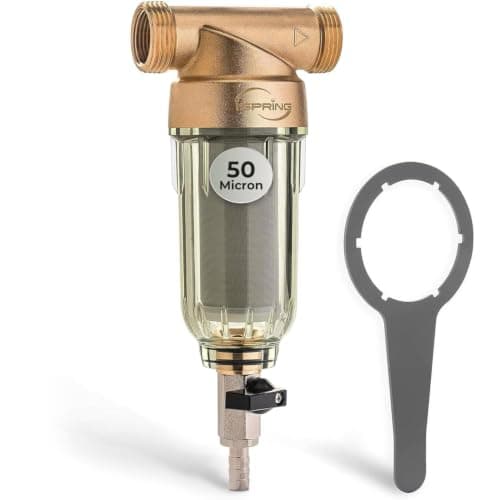 iSpring WSP-50 Spin-Down Sediment PrefilterA flushable 50-micron spin-down at the point of entry, so sand and rust never reach the house. iSpring WSP-50 Spin-Down Sediment PrefilterA flushable 50-micron spin-down at the point of entry, so sand and rust never reach the house. | Best first line for grit | $50.97 - View on Amazon $59.99 — 15% off #ad Price as of October 6, 2026. We may earn a commission. Disclosure. |
| 2 | 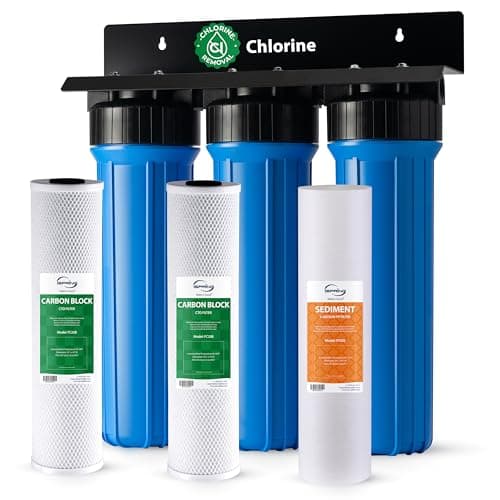 iSpring WGB32B 3-Stage Whole-House FilterThree 20-inch cartridges, sediment plus carbon, for whole-house treatment at cartridge prices. iSpring WGB32B 3-Stage Whole-House FilterThree 20-inch cartridges, sediment plus carbon, for whole-house treatment at cartridge prices. | Best if you want carbon too | $359.10 - View on Amazon $516.99 — 31% off #ad Price as of October 6, 2026. We may earn a commission. Disclosure. |
| 3 | 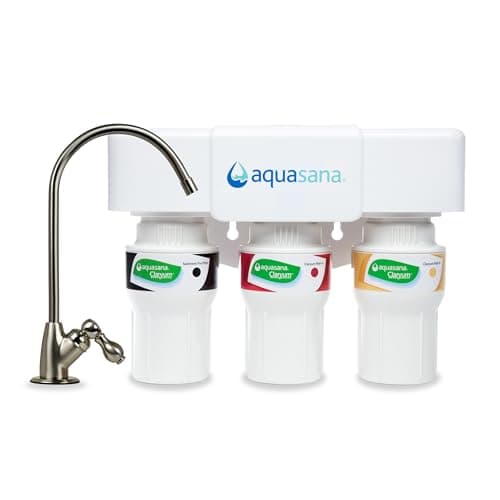 Aquasana Claryum 3-Stage Under-Sink Filter (AQ-5300)Certified carbon block under the sink you drink from, with sub-micron filtration and full flow. Aquasana Claryum 3-Stage Under-Sink Filter (AQ-5300)Certified carbon block under the sink you drink from, with sub-micron filtration and full flow. | Best for one tap | $154.99 - View on Amazon $349.99 — 56% off #ad Price as of October 6, 2026. We may earn a commission. Disclosure. |
Do the test before you do anything else
Fill a clear glass from the cold tap and set it on the counter. Then watch which way the cloud goes.
| What you see | What it is | What to do |
|---|---|---|
| Clears from the bottom upward in 1-2 minutes | Dissolved air | Nothing. This is not a water quality problem |
| Clears slowly from the top down, leaves a layer | Sediment or rust particles | Filter it, and find out where it enters |
| Stays cloudy, white, does not clear | Fine particles, or gas on a private well | Test. On a well, rule out methane first |
| Cloudy only from the hot tap | Water heater — scale, sediment or a failing anode | Flush the heater. Filtration is the wrong tool |
| Cloudy at one tap only | That tap's aerator or a short run of old pipe | Clean the aerator before anything else |
Air rises because bubbles are less dense than water, so an air cloud disappears from the bottom of the glass upward. Particles are denser than water, so they fall, and the glass clears from the top down. Two minutes of watching separates the harmless case from the real one, and the harmless case is the common one.
Why dissolved air happens, and why winter makes it worse
Water in a pressurized main holds more dissolved gas than water at room pressure can. When you open the tap the pressure drops and that gas comes out of solution as a cloud of very fine bubbles, which then rise and vanish. Cold water holds more dissolved gas than warm water, so the effect is strongest in winter and after any work on the mains that has let air into the system.
Nothing you can buy improves this, because there is nothing in the water to remove. A pitcher will not help, an under-sink filter will not help, and a whole-house system will not help. If a salesperson tells you otherwise, that is the moment to end the conversation.
When it is actually particles
Cloudiness that settles is turbidity — suspended solids, usually sand, silt, rust or scale. On a municipal supply this normally arrives after a main break, a hydrant flush or work on the street, and it should clear within a day. If it persists, call the utility before you buy hardware, because it is their pipe until it reaches your property line.
The regulatory context is worth knowing, because it tells you how tightly this is controlled at the plant. Under EPA's surface water treatment rules a conventional filtration plant must keep turbidity at or below 0.3 NTU in at least 95% of monthly samples, and never above 1 NTU. Water leaving a compliant plant is not visibly cloudy. If yours is, the particles almost always joined it after that point — in the distribution main, in your service line, or in your own plumbing.
Which is why the fix is placed by where the particles enter. Grit arriving from a well or a distribution main belongs at the point of entry, before it reaches every fixture in the house. Particles shedding from your own aging galvanized pipe are better handled at the tap you drink from.
Private wells: rule out gas before anything else
On a private well, persistent milky water deserves a specific check that municipal customers never need. Minnesota's Department of Health describes methane-bearing well water as water that may appear clear with bubbles, milky, frothy, or have a bluish tint, often with a sputtering or spitting faucet and a gurgling noise from the well.
The health risk is not from drinking it. MDH states that studies have not linked ingestion of methane-bearing water to short or long-term health effects. The risk is that methane released indoors can accumulate: concentrations in air between 5 and 14 percent can ignite, and because methane rises and displaces oxygen it is a confined-space hazard in a well house or a basement. That is a testing-and-ventilation problem, not a filter problem, and it is the one form of cloudy water that warrants a phone call rather than a purchase.
If the well is not gassy but the water carries grit, that is ordinary sediment and the well water tier handles it. Sediment is also the first thing any well system removes, because everything downstream of it fails faster when it does not.
What about white residue rather than cloudy water?
Different problem, and people mix them up constantly. Water that looks fine in the glass but leaves white crust on the kettle element, spots on glassware and film on the shower screen is hard water — dissolved calcium and magnesium, invisible until it dries. The limescale page covers that case, and the answer there is a softener or a conditioner, not a sediment filter.
Total dissolved solids can also make water look slightly opaque at high concentrations. EPA's secondary standard for TDS is 500 mg/L, with hardness, deposits, colored water, staining and salty taste listed as the noticeable effects. A TDS meter costs very little and tells you in seconds whether that is the direction to investigate.
Matching the fix to where the particles come from
| Where it enters | Right tier | Why |
|---|---|---|
| A well, or the incoming main | Spin-down or cartridge prefilter at the point of entry | Protects every fixture, appliance and downstream filter in the house |
| Your own old galvanized plumbing | Under-sink filter at the drinking tap | You cannot filter what is shed downstream of the filter |
| The water heater only | Flush the heater | No filter fixes sediment that is generated inside the tank |
| A single aerator | Unscrew and rinse the aerator | Free, and it is the answer more often than people expect |
A spin-down prefilter is the cheapest useful thing in this category: a stainless mesh in a clear housing that you flush with a valve rather than replace. The sediment prefilter guide covers micron ratings and where in the line it goes.
The cost-per-gallon math
The economics here are unusual, because the correct answer is often free.
Air costs nothing to fix. An aerator rinse costs nothing. A water heater flush costs nothing but an hour. Those three cover most cloudy-water complaints before any product is involved.
When you do need hardware, a flushable spin-down screen is the only filter on this site with no consumable at all — you clean the mesh instead of buying a cartridge. Every cartridge-based sediment filter downstream of it then lasts substantially longer, which is the actual argument for fitting one.
We show the arithmetic rather than a verdict so you can redo it with the price you actually pay. Filter prices move; the rated capacities above do not.
The picks in full
Best first line for grit
iSpring WSP-50 Spin-Down Sediment Prefilter
iSpring
The only filter on this site with no consumable at all: a stainless mesh in a clear housing that you flush with a valve instead of replacing. On a well it protects every cartridge and membrane downstream, which is the entire argument for it.
Certification status
No NSF/ANSI performance certification, and none is applicable — this is a mechanical screen for suspended solids rather than a contaminant-reduction device. iSpring specifies a 316L food-grade stainless steel screen and a lead-free brass head. Treat it as plumbing hardware, not as treatment.
Published specifications
| Filtration | 50 micron stainless steel mesh screen |
|---|---|
| Screen material | 316L food-grade stainless steel |
| Head material | Lead-free brass |
| Ports | 1" MNPT and 3/4" FNPT on both ends |
| Housing | Transparent, so the load is visible without opening it |
| Consumable | None — the screen is flushed and reused |
| Maintenance | Open the flush valve; frequency depends on sediment load |
What we like
- No cartridge to buy, ever — you flush the screen and reuse it
- The clear housing makes maintenance something you can see rather than schedule blindly
- Protects softeners, carbon tanks, cartridges and RO membranes downstream, which is where the money is
What we do not
- 50 micron is coarse: it catches grit and rust flakes, not fine silt or turbidity
- It is a prefilter, not a treatment — it reduces no contaminant of any kind
- Needs a spot in the line with room underneath for the flush valve and a drain or bucket
- Requires actual maintenance; a neglected screen becomes a pressure restriction
Skip it if
Anyone on clean municipal water with no downstream equipment to protect. There is nothing for it to catch, and an unserviced housing is worse than no housing.
$59.99 — 15% off
#ad Price as of October 6, 2026. We may earn a commission. Disclosure.
Where these specifications came from
Best if you want carbon too
iSpring WGB32B 3-Stage Whole-House Filter
iSpring
A cartridge system rather than a tank system. It costs a fraction of a tank install and asks for a filter change roughly once a year in exchange.
Certification status
Uses standard 20 x 4.5 inch cartridges. Certification travels with the cartridge fitted rather than the housing — check the specific cartridge's listing for any health claim you intend to rely on.
Published specifications
| Cartridge size | 20" x 4.5", 3 stages |
|---|---|
| Peak flow | 15 gpm |
| Rated capacity | 100,000 gallons — typically about a year for a family of four |
| Working pressure | 25-80 psi |
| Operating temperature | 40-100 degrees F |
| Ports | 1" NPT |
What we like
- Far cheaper up front than any tank-based point-of-entry system
- Standard 20 x 4.5 inch cartridges, available from many manufacturers
- You can change the media mix by changing cartridges as your water changes
What we do not
- Annual cartridge changes, and they are heavy and messy
- Certification depends on the cartridge you fit, not the housing
- Cartridge capacity is a fraction of a tank system's million gallons
Skip it if
Anyone who wants to install a system and forget it. A tank system is the right answer if an annual cartridge change is not realistically going to happen.
$516.99 — 31% off
#ad Price as of October 6, 2026. We may earn a commission. Disclosure.
Where these specifications came from
Best for one tap
Aquasana Claryum 3-Stage Under-Sink Filter (AQ-5300)
Aquasana
Carbon-block filtration rather than reverse osmosis: it keeps the minerals, wastes nothing, and fits where a reverse-osmosis system will not. It also cannot do what RO does for fluoride or nitrate.
Certification status
WQA tested and certified to NSF/ANSI 42, 53 — which includes the P473 protocol for PFOA and PFOS — and 401, for the reduction of 78 contaminants. Aquasana publishes 99.6% for lead and microplastics, 99.7% for PFOA and PFOS, 99.99% for cysts and 97% for chlorine across the Claryum 3-Stage line.
Published specifications
| Filter life | 600 gallons / up to 6 months |
|---|---|
| Certified standards | NSF/ANSI 42, 53 (includes P473), 401 (WQA) |
| Flow rate | 0.5 gpm |
| Wastewater | None |
| Format | 3-stage carbon block with a dedicated faucet |
| Contaminants claimed | 78 |
| Lead / PFOA and PFOS | 99.6% / 99.7% |
What we like
- No drain line, no wastewater, no tank — much easier to install than reverse osmosis
- NSF/ANSI 401 certification covers pharmaceutical-class trace compounds
- Full flow rate, unlike reverse osmosis, so filling a pot is not a project
What we do not
- Not reverse osmosis: no meaningful fluoride, nitrate or TDS reduction
- 600-gallon filter life is short next to an inline system's tens of thousands
- Proprietary cartridges
Skip it if
Anyone whose problem is fluoride, nitrate or total dissolved solids. Carbon block does not remove those; you need reverse osmosis for that job.
$349.99 — 56% off
#ad Price as of October 6, 2026. We may earn a commission. Disclosure.
Questions people actually ask
Is cloudy tap water safe to drink?
If it clears from the bottom upward within a couple of minutes, yes — that is dissolved air and it is harmless. If it does not clear, or it settles into a layer, the water contains particles and you should find out what they are before deciding. On a private well, milky water with a sputtering tap should be tested for methane before anything else.
Why is my water cloudy only in winter?
Cold water holds more dissolved gas than warm water. In winter the incoming supply is colder, so more gas is dissolved in it, and more comes out of solution as bubbles when the pressure drops at your tap. It is seasonal, it is normal, and it needs no treatment.
Will a water filter fix cloudy water?
Only if the cloudiness is particles. A sediment filter removes suspended solids, and a certified carbon block removes fine particulates at the tap. Neither does anything about dissolved air, because there is nothing there to remove.
My water is cloudy only from the hot tap. What does that mean?
Almost always the water heater — accumulated scale and sediment in the tank, or a deteriorating anode rod. Flush the tank first. Filtering the cold supply cannot fix something generated inside the heater, and drinking hot tap water is a bad idea regardless.
How cloudy is too cloudy?
There is no consumer threshold, but the regulatory one is informative: a conventional municipal filtration plant must hold turbidity at or below 0.3 NTU in 95% of samples and never above 1 NTU. Water that is visibly cloudy is far above that, so if it is not air, something has been added between the plant and your glass.