Yes. ZeroWater states its 5-stage filter was independently tested by an EPA-certified laboratory for fluoride reduction at 99%. That is test data rather than a certified claim: its IAPMO certification covers PFOA/PFOS, lead, chlorine, chromium and mercury, and fluoride is not on that list.
Quick picks
Tap any row to jump to the full write-up. The button goes straight to the retailer.
| # | Product | Best for | Price |
|---|---|---|---|
| 1 | 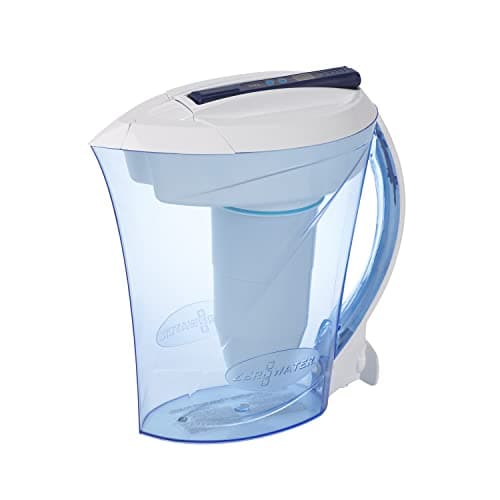 ZeroWater 10-Cup Ready-Pour PitcherIon exchange to near-zero TDS, with 99% fluoride reduction published from independent lab testing. ZeroWater 10-Cup Ready-Pour PitcherIon exchange to near-zero TDS, with 99% fluoride reduction published from independent lab testing. | The pitcher in question | $28.99 - View on Amazon $59.98 — 52% off #ad Price as of October 6, 2026. We may earn a commission. Disclosure. |
| 2 | 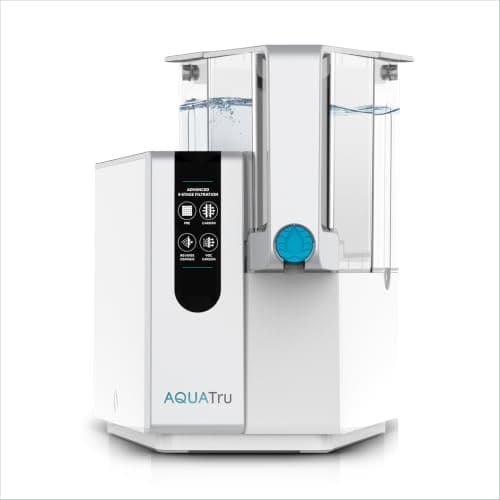 AquaTru Classic Countertop Reverse Osmosis PurifierCountertop RO certified by IAPMO across 84 contaminants, fluoride named among them. AquaTru Classic Countertop Reverse Osmosis PurifierCountertop RO certified by IAPMO across 84 contaminants, fluoride named among them. | If you want it certified | $403.75 - View on Amazon $475.00 — 15% off #ad Price as of October 6, 2026. We may earn a commission. Disclosure. |
| 3 | 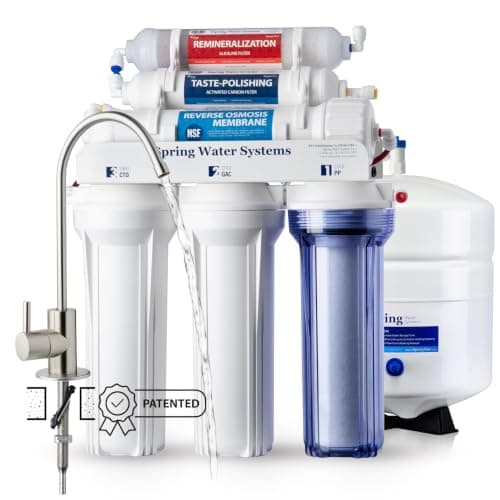 iSpring RCC7AK 6-Stage Reverse Osmosis SystemNSF/ANSI 58 certified under-sink RO with 97.4% fluoride published by the manufacturer. iSpring RCC7AK 6-Stage Reverse Osmosis SystemNSF/ANSI 58 certified under-sink RO with 97.4% fluoride published by the manufacturer. | Cheapest per gallon | $198.75 - View on Amazon $234.99 — 15% off #ad Price as of October 6, 2026. We may earn a commission. Disclosure. |
The short answer
Yes — and the sentence to read carefully is ZeroWater's own. Its FAQ states that the 5-stage filters have been independently tested by an EPA certified lab for the reduction of fluoride with an overall reduction percentage of 99%.
That is a real, specific, useful claim. It is also not a certification, and ZeroWater does not present it as one. The company's certified claims are listed separately: the 5 Stage Ion Exchange Filter is IAPMO certified to reduce PFOA/PFOS, lead, chlorine, chromium and mercury. Fluoride is not on that list.
Why the difference matters
A certification is a listing body standing behind a claim, with ongoing surveillance and a public listing you can search by model number. A laboratory test is a snapshot: a real measurement of real filters under stated conditions, commissioned by the manufacturer.
Neither is dishonest. They are different weights of evidence, and this site keeps them apart everywhere — what the standards actually cover explains why the distinction exists at all. If you need paperwork for a landlord, a lender or your own standard of proof, a certified fluoride claim is available and it lives in reverse osmosis. If you want the number, ZeroWater has published one.
Why the number is plausible
ZeroWater does not filter like Brita or PUR. The 5-stage cartridge finishes with ion exchange resin, which strips dissolved ions rather than adsorbing organic compounds onto carbon. Fluoride is a small charged ion — precisely the kind of thing carbon cannot hold and ion exchange can.
That is also why ZeroWater reaches metals that pitcher carbon does not, and why its own FAQ says the filter removes 99.6% of TDS and does not discriminate between bad chemicals and good minerals. The mechanism does not choose. Everything dissolved comes out, including the calcium and magnesium that give water its taste, which is why some people find the result flat.
The catch is capacity, not capability
Here is the practical problem, and it is the reason this page does not simply say "buy it".
Ion exchange resin has a fixed capacity. It exhausts in proportion to the total dissolved load in your water, not in proportion to the one contaminant you care about. On soft municipal water a cartridge might last a few weeks. On hard or high-TDS water — which is exactly the groundwater most likely to carry naturally high fluoride — the same cartridge can be finished in days.
ZeroWater's own instruction is to test the output with the supplied meter and replace the filter when the meter reads 006 or higher. That is a genuinely good design: the pitcher tells you when it stops working, which almost nothing else in this category does. It also means an exhausted filter is not a maybe. Past 006, the fluoride reduction goes with the rest of it.
How long pitcher filters last runs the arithmetic across the tier, and ZeroWater, honestly covers the taste complaints that come with near-zero TDS water.
The honest comparison
| ZeroWater 5-stage | Certified reverse osmosis | |
|---|---|---|
| Fluoride evidence | 99%, independent lab testing | Certified claim under NSF/ANSI 58 |
| Certifying body for fluoride | None | NSF, IAPMO R&T or WQA, depending on the system |
| Purchase cost | Low | Higher, sometimes much higher |
| Filter life | About 15-20 gallons, less on high TDS | Cartridges in months, membrane in years |
| Cost per gallon | Highest in the category | Lowest once installed |
| Installation | None | Plumbed, or countertop with no plumbing |
| Tells you when it is spent | Yes, the meter | No, you follow a schedule |
So should you buy it for fluoride?
Buy it if you are renting, or short of space, or want to spend very little to start, and your water is not especially hard. The meter makes it the most honest pitcher in the category, and 99% in independent testing is a better number than any carbon pitcher can claim.
Buy reverse osmosis instead if fluoride is a long-term concern, if your household drinks a lot, or if you want the claim to be certified rather than tested. The reverse osmosis answer covers the optional-claim trap to check for, and the fluoride roundup is the full shortlist.
The cost-per-gallon math
A household drinking two gallons a day uses about 730 gallons a year. At roughly 15 to 20 gallons per cartridge, that is something like forty ZeroWater filters in a year on average water — and more on hard water.
An under-sink reverse osmosis system covers the same year on two or three cartridge changes and a membrane every couple of years. The pitcher wins on the first purchase and loses badly over twelve months, which is the trade to make deliberately rather than by accident.
We show the arithmetic rather than a verdict so you can redo it with the price you actually pay. Filter prices move; the rated capacities above do not.
The picks in full
The pitcher in question
ZeroWater 10-Cup Ready-Pour Pitcher
ZeroWater
The only mainstream pitcher that hands you a TDS meter and invites you to check its work. It buys you a PFOA/PFOS certification the Brita Elite does not have, and it costs you filter life.
Certification status
The 5-stage filter is system-certified by IAPMO against NSF/ANSI 42 for chlorine taste and odor and NSF/ANSI 53 for lead, hexavalent chromium, mercury and PFOA/PFOS.
Published specifications
| Filtration | 5-stage, including ion-exchange resin |
|---|---|
| Rated filter life | About 15-20 gallons, varying with source TDS |
| Certified standards | NSF/ANSI 42 and 53 (IAPMO) |
| PFOA / PFOS | Certified under NSF/ANSI 53 |
| Published reduction — PFOA/PFOS | 99% |
| Published reduction — lead | 95% |
| Published reduction — chromium 6 | 99% |
| Included | Handheld TDS meter |
What we like
- Carries a PFOA/PFOS certification, which the Brita Elite does not
- The bundled TDS meter turns 'is it still working' from a guess into a reading
- Ion exchange drives total dissolved solids far lower than carbon alone
What we do not
- Filter life is the shortest of any pitcher here, and it collapses further on hard or high-TDS water
- Cost per gallon is the highest in the pitcher tier as a result
- Some owners find the taste flat or faintly sour at very low TDS — a real preference issue, not a defect
Skip it if
Anyone on hard, high-TDS water who will not tolerate changing a filter every few weeks. On 400+ ppm supply the running cost is genuinely painful and an under-sink system is cheaper inside a year.
$59.98 — 52% off
#ad Price as of October 6, 2026. We may earn a commission. Disclosure.
Where these specifications came from
If you want it certified
AquaTru Classic Countertop Reverse Osmosis Purifier
AquaTru
Reverse osmosis performance with no plumbing, no drilling and no landlord conversation. You pay for that with counter space, a wait, and two tanks you fill and empty by hand.
Certification status
Certified by IAPMO to NSF/ANSI 53, 58, 401 and P473, covering lead, reverse-osmosis performance, emerging compounds and the PFOA/PFOS protocol.
Published specifications
| Filtration | 4-stage countertop reverse osmosis |
|---|---|
| Clean water tank | 0.75 gallons |
| Tap water tank | 1 gallon |
| Installation | None — no plumbing connection |
| Certified standards | NSF/ANSI 53, 58, 401, P473 (IAPMO) |
What we like
- Real reverse osmosis with a P473 PFOA/PFOS certification and zero installation
- The strongest answer available to a renter with a lead or PFAS problem
- No drilling, no drain saddle, no landlord permission needed
What we do not
- Takes up substantial counter space
- You refill and empty tanks by hand — it is not on-demand
- Highest purchase price in the no-plumbing tier by a wide margin
Skip it if
Anyone who can plumb in an under-sink system. A permanent under-sink RO is cheaper per gallon, on-demand, and out of sight. Buy this when you genuinely cannot install.
$475.00 — 15% off
#ad Price as of October 6, 2026. We may earn a commission. Disclosure.
Where these specifications came from
Cheapest per gallon
iSpring RCC7AK 6-Stage Reverse Osmosis System
iSpring
The value pick of the reverse-osmosis tier: a WQA Gold Seal system with an alkaline stage, usually at the lowest price of anything here that carries a real certification.
Certification status
Certified against NSF/ANSI 58 for TDS reduction and carries the WQA Gold Seal, with 97.2% TDS removal certified.
Published specifications
| Output | 75 GPD |
|---|---|
| Stages | 6, including alkaline remineralization |
| Certified TDS reduction | 97.2% |
| Feed pressure | 45-70 psi |
| Feed temperature | 40-100 degrees F |
| Assembled size | 15.5" deep x 19.5" high, 25 lb |
| Certification | NSF/ANSI 58, WQA Gold Seal |
What we like
- Certified performance at the lowest price in the tier
- Push-fit tubing makes a first-time install genuinely manageable
- Alkaline stage included rather than sold as an upgrade
What we do not
- Narrow 45-70 psi feed window — low-pressure homes may need a booster pump
- Tank plus housing needs real cabinet depth
- Conventional reverse-osmosis drain ratio
Skip it if
Homes with feed pressure below 45 psi that will not add a booster pump, and anyone who wants a tankless footprint.
$234.99 — 15% off
#ad Price as of October 6, 2026. We may earn a commission. Disclosure.
Where these specifications came from
Questions people actually ask
Does ZeroWater remove fluoride?
Yes. ZeroWater states its 5-stage filter was independently tested by an EPA-certified laboratory for fluoride reduction at 99%. That is laboratory test data rather than a certified claim — its IAPMO certification covers PFOA/PFOS, lead, chlorine, chromium and mercury, and fluoride is not among them.
Is ZeroWater certified for fluoride?
No. The certification ZeroWater publishes is an IAPMO certification covering PFOA/PFOS, lead, chlorine, chromium and mercury. The fluoride figure comes from independent laboratory testing the company commissioned, which is a different kind of evidence and worth reading as such.
How long does a ZeroWater filter last on fluoridated water?
It depends on total dissolved solids, not on fluoride. Ion exchange resin exhausts in proportion to everything dissolved in the water, so a cartridge lasting weeks on soft water can be finished in days on hard or high-TDS water. The supplied meter is the answer: replace at a reading of 006.
Is ZeroWater or reverse osmosis better for fluoride?
Reverse osmosis, if you can install it. The claim is certified rather than tested, the cost per gallon is far lower, and there is no cartridge to change every few weeks. ZeroWater is the better answer for renters, small spaces and small budgets.
Do Brita or PUR pitchers remove fluoride?
No. Neither brand claims fluoride on any pitcher filter, and carbon adsorption does not hold it. The pitcher-tier options that address fluoride all use composite or ion exchange media rather than carbon alone.